Ikigai
A Japanese concept locating your reason for being at the overlap of passion, skill, world need, and pay.
 Find this on the mind-map
Introduction
The word comes from Japan: iki, meaning life, and gai, meaning worth. Put them together and you get 生き甲斐 — Ikigai, roughly "a reason for being." It traces back to Okinawa, a region famous for how long its residents live, and researchers noticed the two things traveled together: an unusually strong, clear sense of purpose showed up again and again in the people who lived the longest. The four-circle version most people know today is a later, Western take on that idea, and it's the one worth learning, because it turns something as fuzzy as "purpose" into something you can actually pin down.
How It Works
Ikigai sits at the point where four circles overlap.
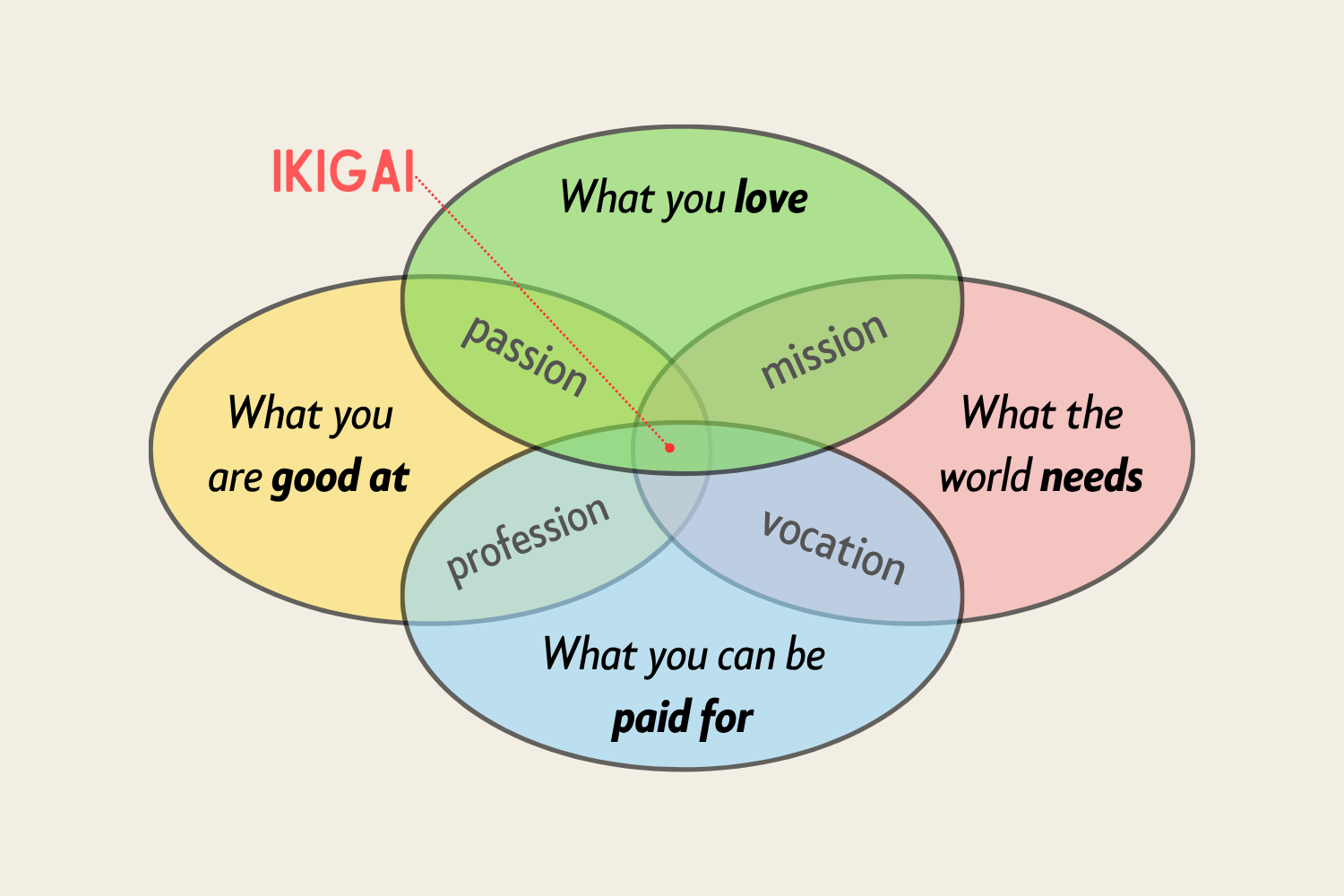
The four circles are:
- What you love — the stuff that genuinely lights you up: music, research, being outdoors, helping people.
- What you're good at — your real strengths, including the ones other people spot in you before you spot them yourself.
- What the world needs — a gap you're positioned to close, whether that's in your industry, your company, or society more broadly.
- What you can get paid for — the practical piece. Without it, the rest is a hobby, not a living.
Any two of these circles overlapping on their own feels almost right, and each pairing is missing something specific:
| Overlap | Produces | What's missing |
|---|---|---|
| Love + good at | Passion | Not necessarily needed or paid for |
| Love + world needs | Mission | Not sustainable |
| Good at + paid for | Profession | Can feel hollow |
| World needs + paid for | Vocation | Not deeply engaging |
Only when all four circles overlap do you get Ikigai: work that means something to you, that you're actually skilled at, that someone needs, and that keeps the lights on.
Why It Matters for Leaders
Watch for this in yourself: you're performing fine, hitting your numbers, doing everything a good leader is supposed to do — and your real passion lives somewhere the job never touches. That gap matters more the higher you sit, because your energy sets the tone for everyone underneath you. A team can tell the difference between a leader who believes the mission and one who's reciting it, and borrowed purpose doesn't survive a hard quarter.
What makes this framework useful is that it's diagnostic, not motivational. When someone on your team feels stuck, the four circles tell you where to look. A strong performer who's bored is probably sitting in profession without love — skilled and paid, but not moved by the work. Someone doing meaningful work while quietly burning out is likely in mission without a paid path. That's a much more useful answer than telling them to "find their passion."
It also changes how you build roles, not just how you coach people. When you can put someone where their strengths, their interests, and what the team actually needs overlap, engagement and output both move, because the work stops feeling like an assignment. Google built its famous 20%-time policy on exactly this logic — let people spend part of their week on what they care about — and it's how Gmail and Google News got made: real market needs, met by people who wanted to build them anyway.
You see the same pattern in the founders people point to. Yvon Chouinard built Patagonia out of a love of climbing and the outdoors, and still funnels profit into environmental causes. Howard Schultz built Starbucks around the idea of a "third place" between home and work. Muhammad Yunus took an economics background and a determination to fight poverty and built microcredit at Grameen Bank. Bill Gates found his purpose first in technology, then later redirected it toward global health. None of them were coasting on inspiration alone — all four circles were doing their job at once.
What to do next
Skills related to Ikigai

Frameworks related to Ikigai

BHAG
A Big Hairy Audacious Goal: a 10-to-30-year target so bold it looks impossible — your organization's North Star.

The Golden Circle
Simon Sinek's three-ring model: most leaders talk What, How, Why — inspiring ones flip it, because belief precedes product.

The Hedgehog Concept
Jim Collins' test for finding what your team should be built around — where passion, potential, and results overlap.