BHAG
A Big Hairy Audacious Goal: a 10-to-30-year target so bold it looks impossible — your organization's North Star.
 Find this on the mind-map
Introduction
Jim Collins and Jerry Porras coined the term in their 1994 book Built to Last, after studying what separated companies that thrived for decades from ones that just had a good run. The pattern they found: the best ones set a Big Hairy Audacious Goal — a target bold enough to look nearly impossible the day it's set, and big enough to still be pulling the organization forward twenty years later.
How It Works
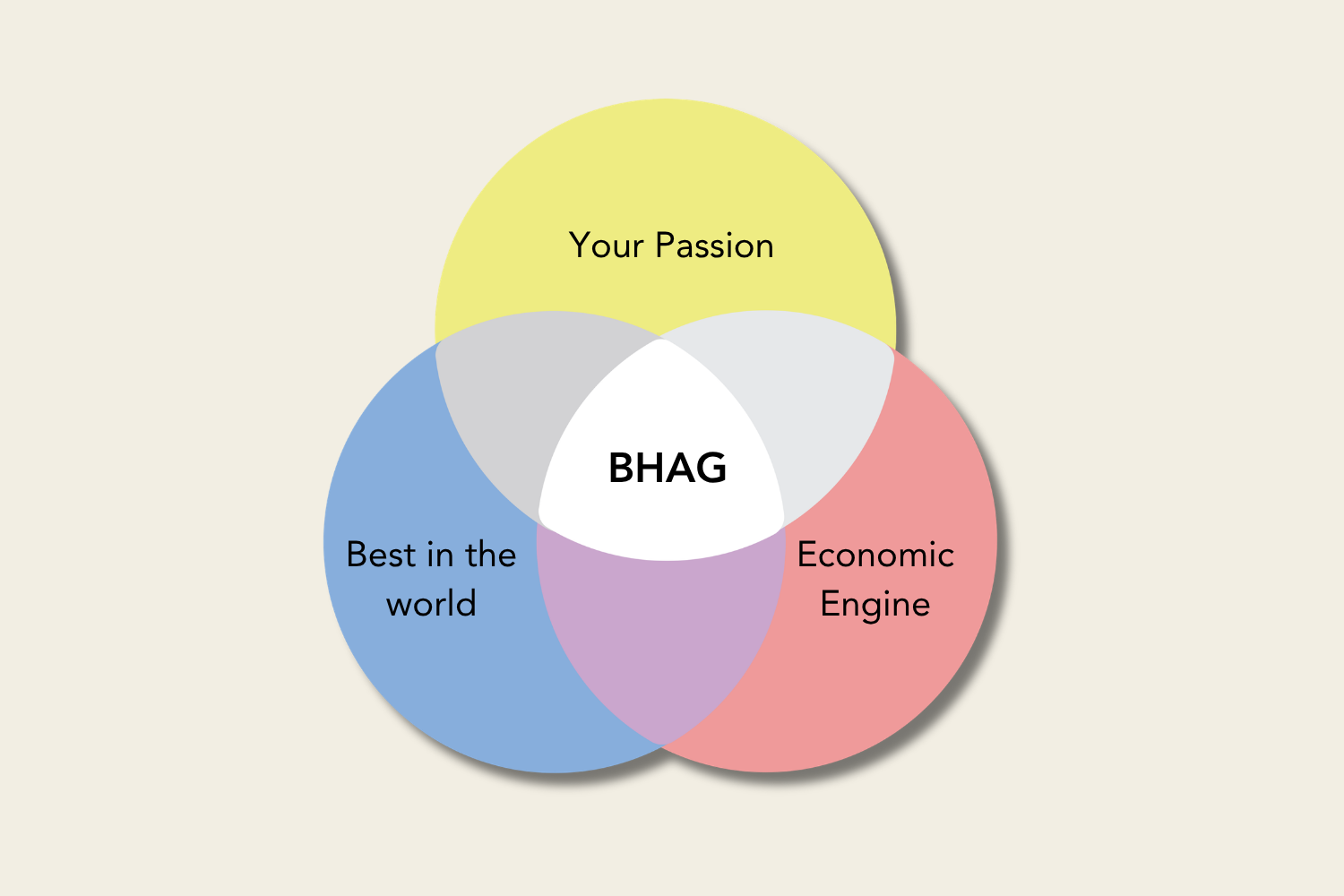
A real BHAG isn't just a stretch goal — it has to sit at the intersection of three things, the same three that define Collins's The Hedgehog Concept:
- What you're deeply passionate about
- What you can be the best in the world at
- What drives your economic engine
Those three conditions do the filtering for you. A goal that excites everyone but sits outside what you're actually good at is a fantasy. A goal that's economically sound but nobody cares about is just a budget line. You want a BHAG big enough to stretch you past your comfort zone, audacious enough to inspire people, and bold enough to make them act instead of just nod along.
Some named BHAGs that shaped their organizations:
| Organisation | BHAG |
|---|---|
| SpaceX | Enable human exploration and settlement of Mars |
| Organize the world's information and make it universally accessible and useful | |
| Microsoft (early) | Put a computer on every desk and in every home |
| Meta | Make the world more open and connected |
| Boeing (1950) | Become the dominant player in commercial aircraft and bring the world into the jet age |
| Patagonia | We're in business to save our home planet |
| United States (1961) | Land a man on the moon before the end of the decade |
And it's not just a feel-good idea — there's data behind it. A Harvard Business Review survey found teams with clear, bold objectives are 37% more likely to outperform teams working off vague or moderate goals. Gallup found employees involved in setting bold goals are 3.6 times more engaged at work.
Why It Matters for Leaders
Here's the trap: you can have a great year — deliver ahead of schedule, rack up wins — and still not be able to answer "what's the boldest goal we set this year?" A strong track record of comfortable goals is still a track record of playing it safe.
Safe goals produce safe work. When a target is reachable with what you're already doing, nobody has a reason to invent anything new, so small, safe improvements become the ceiling. The moon landing worked as a goal precisely because NASA couldn't hit it by doing more of what it already knew how to do — it forced problems nobody had solved yet.
A BHAG also works as a decision filter, and that's where most of its everyday value actually sits. When Amazon set out to be the most customer-focused company on earth, every debate could be routed through one question: does this improve the customer's experience? A goal that can't filter a decision is really just a slogan hanging on the wall.
It also does something for commitment. When a BHAG grows out of real purpose instead of getting handed down as a target, people experience it as a mission they're choosing to join, not a number assigned to them. Ask any SpaceX engineer what they're working toward — they'll give you the same one-sentence answer, because it's repeated constantly and it's real.
Getting it wrong is expensive too. A vague BHAG confuses your team, an uncommunicated one disengages them, and an under-resourced one teaches everyone that "bold goals" are just theatre. That's why you need a bridge from the BHAG to your near-term work — OKR Model or SMART Goals — and why it works best once you've already named your real purpose with something like The Golden Circle.
What to do next
Skills related to BHAG

Frameworks related to BHAG

Ikigai
A Japanese concept locating your reason for being at the overlap of passion, skill, world need, and pay.

The Golden Circle
Simon Sinek's three-ring model: most leaders talk What, How, Why — inspiring ones flip it, because belief precedes product.

The Hedgehog Concept
Jim Collins' test for finding what your team should be built around — where passion, potential, and results overlap.
