Built to Last
Collins and Porras' earlier, lesser-known study of visionary companies: the research that came before Good to Great, built around a single hard question: what actually survives past the founder, the product, and the current strategy?
 Find this on the mind-map
Introduction
Before Good to Great, Collins (with Jerry Porras) studied a different question: not which companies became briefly excellent, but which ones stayed genuinely great across decades and multiple generations of leadership. Their answer has little to do with any single product, founder, or brilliant strategy. It's about what the organization is built to preserve, and what it's built to keep changing.
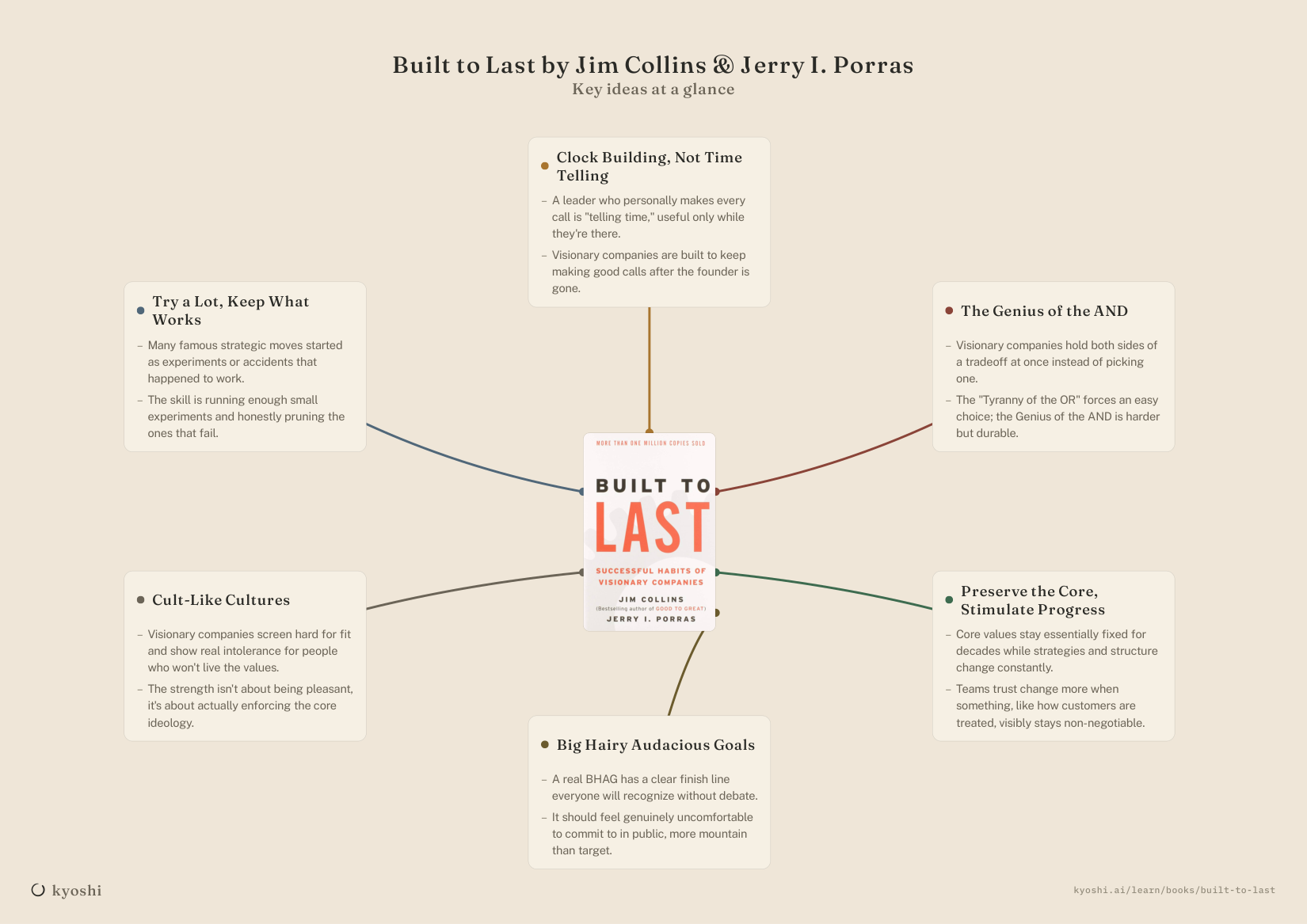
Clock Building, Not Time Telling
A great leader who personally makes every important call is "telling time." That's useful while they're there, and worthless the moment they leave. A great leader who builds an organization, culture, and set of mechanisms that keep making good calls after they're gone is "building a clock." Visionary companies are built by clock builders, even ones with a single iconic founder, because that founder deliberately built the organization to outlast their own involvement.
The Genius of the AND
Most leaders frame tradeoffs as an either/or: stability or change, values or profit, long-term vision or short-term results. Collins and Porras call this the "Tyranny of the OR." Visionary companies instead pursue the "Genius of the AND": holding both sides at once, refusing to resolve the tension by sacrificing one for the other, even when it's harder and slower than picking a side.
Preserve the Core, Stimulate Progress
A core ideology, meaning core values and a sense of purpose, stays essentially fixed over decades, while everything else (strategies, products, practices, org structure) is expected to change constantly. Manager A treats a reorg as a chance to also rewrite "how we treat customers" without saying so, because it's inconvenient this year. Manager B treats the reorg as entirely up for grabs while treating "how we treat customers" as completely non-negotiable. Manager B's team trusts the change more precisely because something stayed fixed.
Big Hairy Audacious Goals (BHAGs)
A clear, compelling, long-term goal so bold it creates its own momentum, closer to a mountain to climb than a target to hit. Collins and Porras coined the term in this book. A real BHAG has a clear finish line (you'll know unambiguously whether you got there) and enough audacity that it's genuinely uncomfortable to commit to publicly.
Cult-Like Cultures
Visionary companies have cultures strong enough to feel almost cult-like to outsiders: tight indoctrination, strong screening of who fits, real intolerance for people who won't live the core ideology. This isn't about being a nice place to work. It's about being a place where the core values are enforced, not just displayed on a wall.
Try a Lot of Stuff, Keep What Works
Many of the "brilliant strategic moves" visionary companies are famous for, in hindsight, actually started as experiments, side projects, or accidents that worked: evolutionary variation and selection, not a master plan executed perfectly. The organizational skill isn't predicting the right strategy in advance. It's running enough small experiments and being honest enough to prune the ones that don't work.
Putting It Together
Clock Building and the Genius of the AND are the mindset. Preserve the Core / Stimulate Progress and BHAGs are what that mindset produces in practice: a fixed identity paired with an ambitious, changing strategy. Cult-Like Cultures and evolutionary experimentation are the mechanisms that make the first two actually durable instead of aspirational.
Why It Matters for Leaders
Most managers treat "stability" and "ambition" as a dial, more of one means less of the other. This book's real argument is that the best organizations don't dial between them. They hold both at full strength at the same time, which is a much harder discipline than compromise and why most teams give up on one side without admitting it.
Here's where it actually bites: during a reorg, a pivot, or a rough quarter, everything gets put up for negotiation at once, including the things that should never move. The pressure of a bad quarter makes "cut corners on how we treat people" and "cut the product roadmap in half" feel like the same kind of decision. They're not. One is strategy, which should change constantly. The other is identity, which should barely move at all. A leader who can't tell the two apart ends up either rigid everywhere (refusing good changes because "we've always done it this way") or unprincipled everywhere (treating every value as negotiable under enough pressure).
The BHAG piece matters just as much day to day, and it's usually misapplied. A goal that's inspiring on a slide but has no clear finish line isn't a BHAG, it's a slogan, and teams can tell the difference. The useful test before you commit to any big goal: will everyone in the room know, without an argument, whether you hit it or not. If the answer requires a debate, the goal isn't doing its job yet.
Dana, a VP at a mid-size company going through a cost-cutting year, kept getting asked to "find savings anywhere." She drew a hard line around two things that weren't up for discussion, the team's promise to never ship a known bug to a customer and its practice of giving engineers real input on what they build, and put everything else on the table, including things she personally liked. Costs came down. The two things she protected are the reason the team stayed intact through the year instead of scattering the moment things got better.
What to do next
Reinforce your understanding of Built to Last
Books related to Built to Last

Good Strategy Bad Strategy
Richard Rumelt's blunt case that most of what gets called "strategy" in a typical planning meeting is actually a wish list dressed up in strategic language, plus a concrete test for telling the two apart.

Good to Great
Jim Collins' research into why some companies go from average to sustained market dominance, and others don't. Read less as a book about companies and more as a book about the kind of leader you have to become before a company (or a team) can get great.

Start With Why
Simon Sinek's argument that people don't buy what you do, they buy why you do it, and that most organizations have never actually answered the question, even the ones that think they have.

Sun Tzu and The Art of Business
Mark McNeilly's translation of Sun Tzu's 2,500-year-old military strategy into six concrete business principles, built around a point most business books skip: the best wins are the ones nobody had to fight for.

The Art of War
The original 2,500-year-old military treatise, read the way most modern leaders actually use it. Not as a manual for fighting better, but as a manual for needing to fight less.

The Infinite Game
Simon Sinek's case that most leaders are playing the wrong game entirely: treating an endless competition as something you can win, when the only real goal is staying in it, strong enough to keep playing.

The Innovator's Dilemma
Clayton Christensen's answer to a puzzle that looks impossible: well-run companies, doing everything their best customers ask for, still lose to products that look worse on every spec sheet, right up until the moment they don't. The book every leader cites and few actually apply to their own team.

Walmart
A retail-industry case study of how Walmart built, and is now fighting to defend, the position it spent sixty years earning. Less a biography of Sam Walton and more a hard look at what scale economics can and can't protect you from in the age of Amazon.

Your Next Five Moves
Patrick Bet-David's chess-inspired framework for strategic leadership, built around five "moves" every founder or executive has to master in order, from knowing yourself to running power plays against bigger competitors, instead of just reacting to whatever just happened.
Skills related to Built to Last

Frameworks referenced from this book

Frameworks related to Built to Last
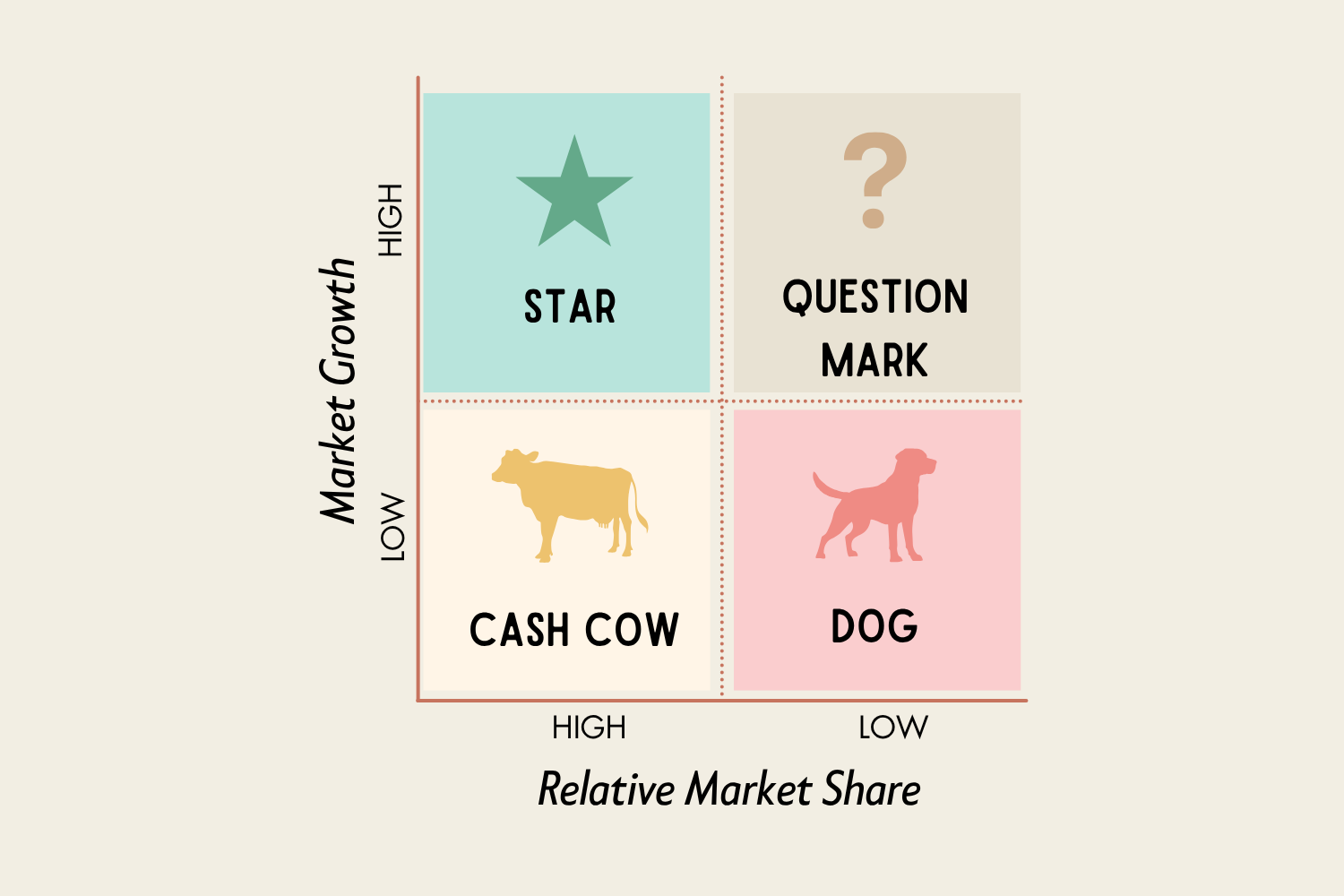
BCG Matrix
A 2x2 that sorts products or units by market growth and share — telling you what to fund, milk, or kill.

McKinsey's Three Horizons Model
Split your team's effort across three time frames — defend the core, grow what's emerging, seed future bets — without mortgaging tomorrow.

Porter's Five Forces
Porter's answer to why some industries are brutal for profit — five forces shaping any market, telling you where to compete.
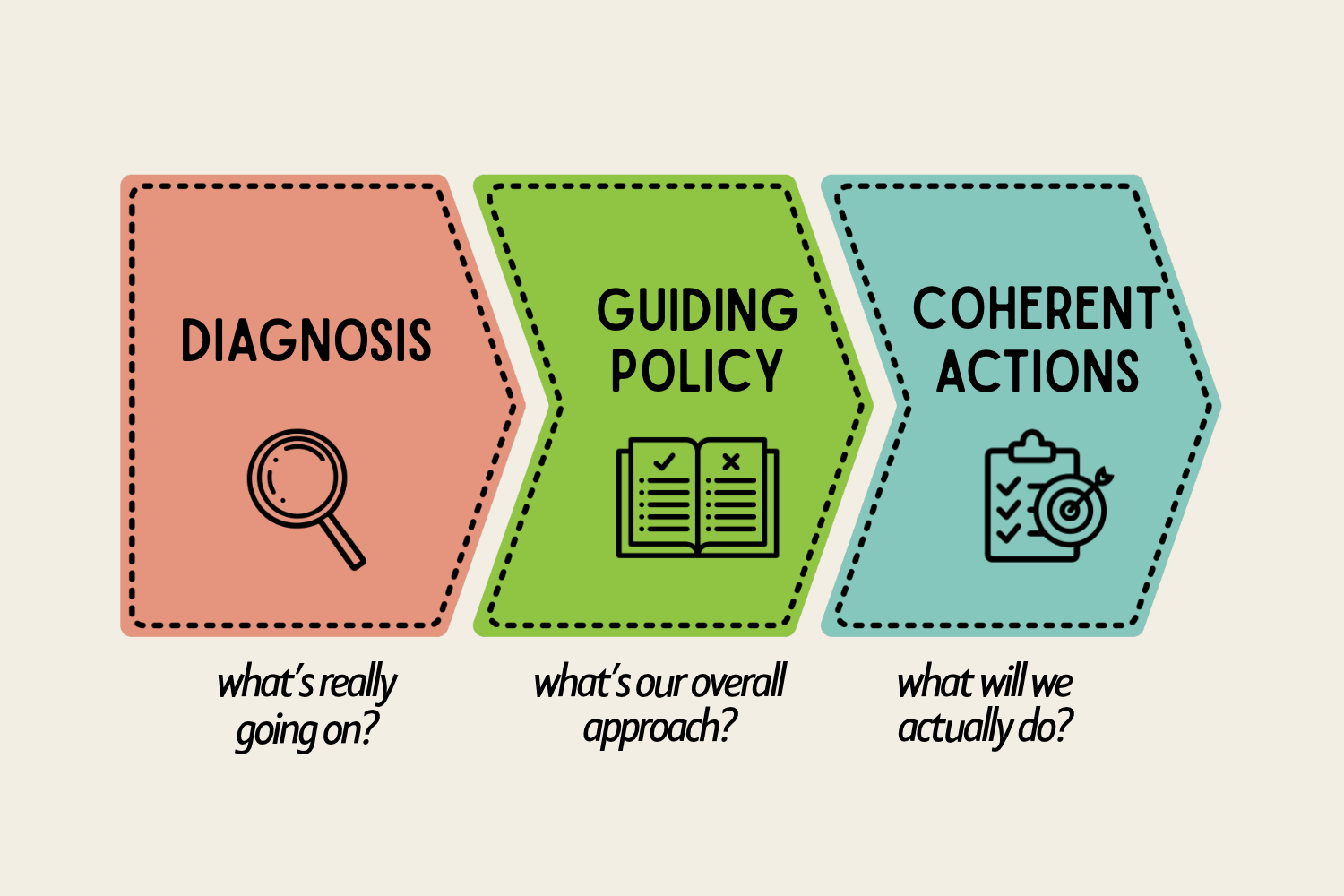
Rumelt's Kernel
Richard Rumelt's test for telling a real strategy from a list of goals — a diagnosis, a guiding policy, and coherent actions. Miss any one of the three and what you have is a wish, not a strategy.

The Innovator's Dilemma
Clayton Christensen's explanation for why great companies fail doing everything right — serving your best customers blinds you to cheap newcomers.