BCG Matrix
A 2x2 that sorts products or units by market growth and share — telling you what to fund, milk, or kill.
 Find this on the mind-map
Introduction
Bruce Henderson built this at the Boston Consulting Group in 1970 to answer a question every leader eventually has to face: where should the next dollar go? The matrix sorts a product or business unit by its market growth and its market share, which gives you a simple way to decide what to grow, what to maintain, and what to phase out.
How It Works
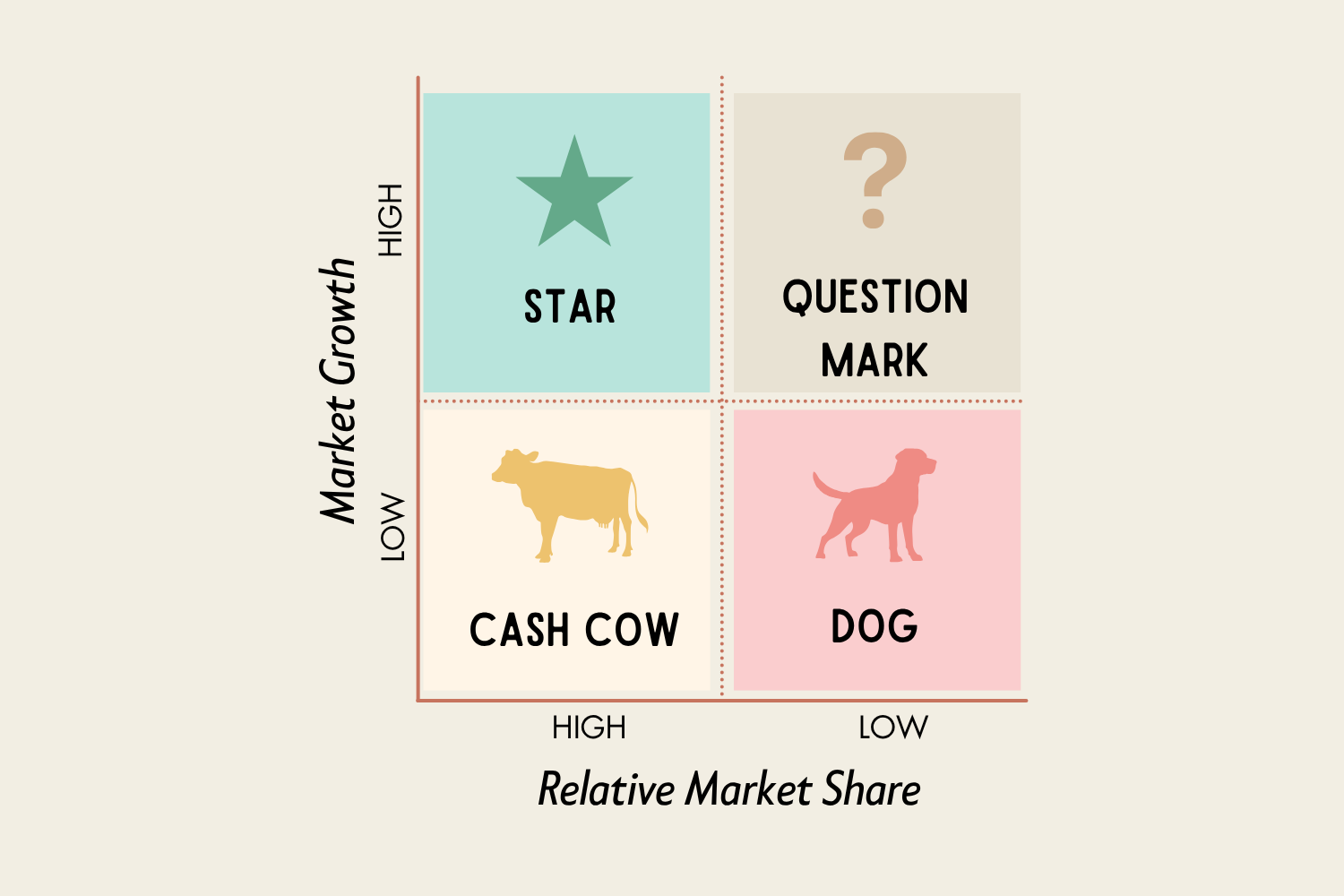
Two axes carry the whole model. The vertical axis is market growth rate — a rough stand-in for how much cash a unit is going to burn through. The horizontal axis is relative market share — your share compared with the largest competitor — a rough stand-in for how much cash it brings in.
| High relative share | Low relative share | |
|---|---|---|
| High market growth | Star: leads a growing market. Generates cash and burns through it at about the same rate. Fund it — it becomes tomorrow's Cash Cow. | Question Mark: in a growing market, but behind. Consumes cash without returning much. Make a deliberate call — back it hard enough to actually lead, or stop. |
| Low market growth | Cash Cow: leads a mature market. Throws off cash with little reinvestment needed. Harvest it and put the cash to work elsewhere. | Dog: behind, in a flat market. Ties up capital and management attention for little return. Usually a candidate for exit. |
The intended cash flow runs in a loop: Cash Cows fund Question Marks, the Question Marks that win become Stars, and Stars mature into the next generation of Cash Cows as their markets slow down. A portfolio with no Question Marks has no future. One with no Cash Cows can't pay for one.
Keep in mind this is a portfolio tool, not a product-quality tool. A Dog can be a genuinely well-built product with happy customers and still be the wrong place for your company's next dollar.
Why It Matters for Leaders
Most resource allocation happens out of habit. Budgets get set from last year's budget, and whichever team is loudest or longest-serving keeps its funding. This matrix forces every unit into an explicit category, which makes the funding conversation about actual position instead of about who argued best in the room.
The Question Mark box is where you'll lose the most money — by half-funding several bets at once instead of committing. A Question Mark backed at 60% of what it needs to reach market leadership just becomes a Dog with extra steps. The discipline this matrix forces on you is to concentrate, not to spread thin.
The Dog box is where you'll lose the most time. Legacy products get kept around for emotional reasons — someone built it, a big customer still uses it, killing it feels like admitting failure. The real cost is rarely the direct spend. It's the engineering attention and roadmap space that a Star actually needed.
At team level, the same logic applies to a service portfolio, an internal platform, or a set of ongoing initiatives. The question's the same one: which of these is growing, which of these do you actually lead in, and what does that tell you about where your next hire should go.
What to do next
Test your knowledge of BCG Matrix
Apply BCG Matrix to a real situation
Skills related to BCG Matrix

Frameworks related to BCG Matrix

McKinsey's Three Horizons Model
Split your team's effort across three time frames — defend the core, grow what's emerging, seed future bets — without mortgaging tomorrow.

Porter's Five Forces
Porter's answer to why some industries are brutal for profit — five forces shaping any market, telling you where to compete.
Rumelt's Kernel
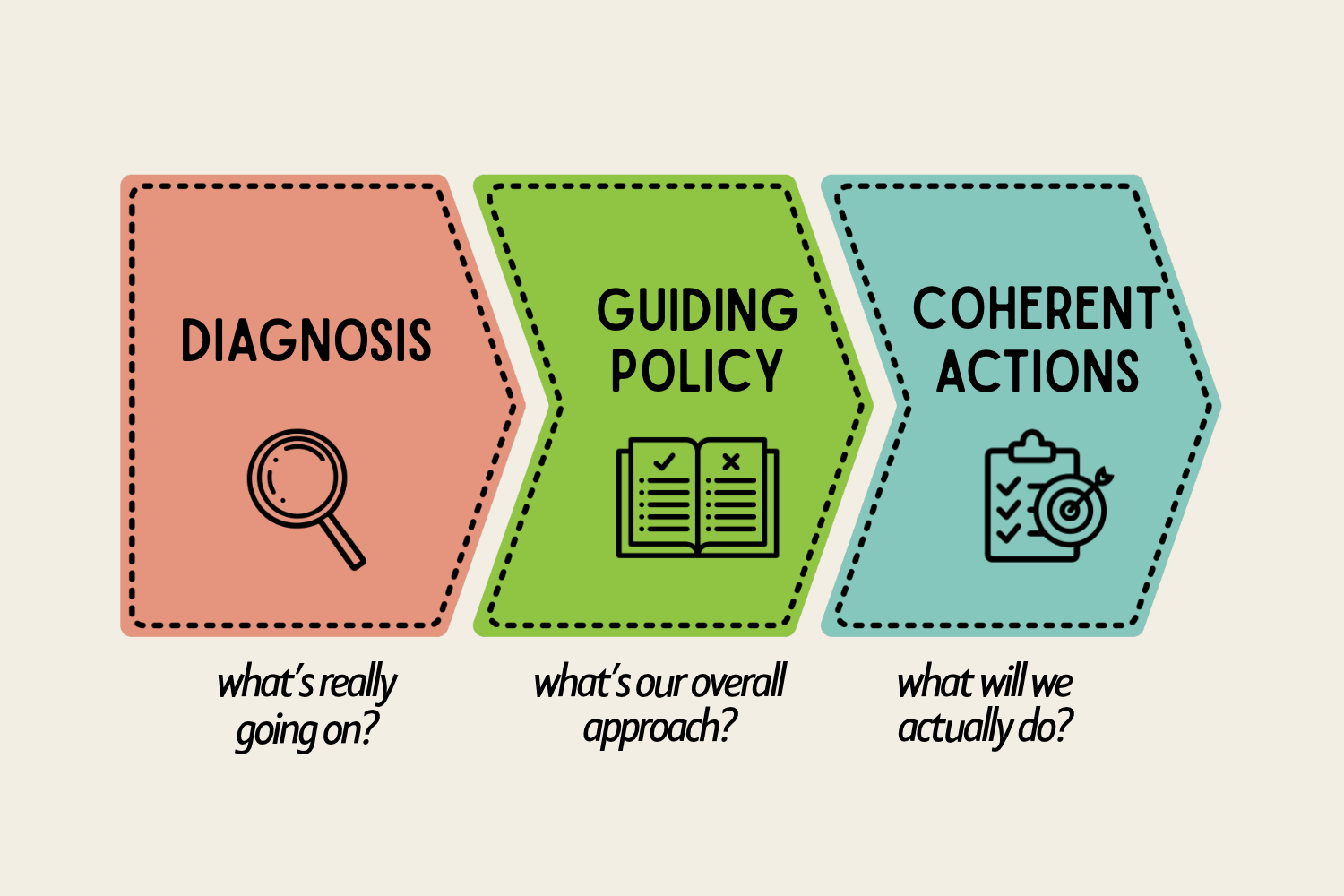
Richard Rumelt's test for telling a real strategy from a list of goals — a diagnosis, a guiding policy, and coherent actions. Miss any one of the three and what you have is a wish, not a strategy.

The Innovator's Dilemma
Clayton Christensen's explanation for why great companies fail doing everything right — serving your best customers blinds you to cheap newcomers.
Books related to BCG Matrix

Built to Last
Collins and Porras' earlier, lesser-known study of visionary companies: the research that came before Good to Great, built around a single hard question: what actually survives past the founder, the product, and the current strategy?

Good Strategy Bad Strategy
Richard Rumelt's blunt case that most of what gets called "strategy" in a typical planning meeting is actually a wish list dressed up in strategic language, plus a concrete test for telling the two apart.

Good to Great
Jim Collins' research into why some companies go from average to sustained market dominance, and others don't. Read less as a book about companies and more as a book about the kind of leader you have to become before a company (or a team) can get great.

Start With Why
Simon Sinek's argument that people don't buy what you do, they buy why you do it, and that most organizations have never actually answered the question, even the ones that think they have.

Sun Tzu and The Art of Business
Mark McNeilly's translation of Sun Tzu's 2,500-year-old military strategy into six concrete business principles, built around a point most business books skip: the best wins are the ones nobody had to fight for.

The Art of War
The original 2,500-year-old military treatise, read the way most modern leaders actually use it. Not as a manual for fighting better, but as a manual for needing to fight less.

The Infinite Game
Simon Sinek's case that most leaders are playing the wrong game entirely: treating an endless competition as something you can win, when the only real goal is staying in it, strong enough to keep playing.

The Innovator's Dilemma
Clayton Christensen's answer to a puzzle that looks impossible: well-run companies, doing everything their best customers ask for, still lose to products that look worse on every spec sheet, right up until the moment they don't. The book every leader cites and few actually apply to their own team.

Walmart
A retail-industry case study of how Walmart built, and is now fighting to defend, the position it spent sixty years earning. Less a biography of Sam Walton and more a hard look at what scale economics can and can't protect you from in the age of Amazon.

Your Next Five Moves
Patrick Bet-David's chess-inspired framework for strategic leadership, built around five "moves" every founder or executive has to master in order, from knowing yourself to running power plays against bigger competitors, instead of just reacting to whatever just happened.