Your Next Five Moves
Patrick Bet-David's chess-inspired framework for strategic leadership, built around five "moves" every founder or executive has to master in order, from knowing yourself to running power plays against bigger competitors, instead of just reacting to whatever just happened.
 Find this on the mind-map
Introduction
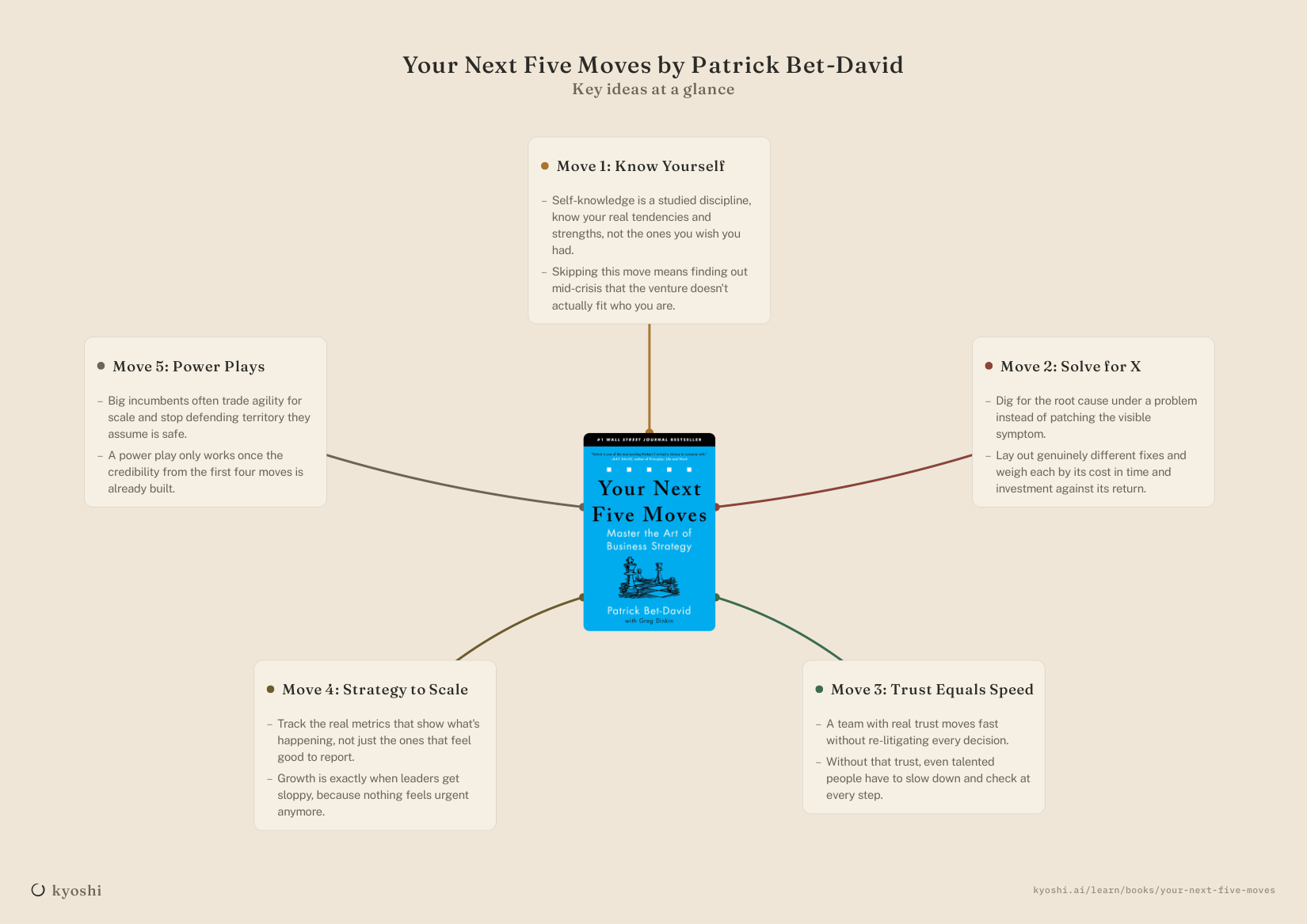
Your Next Five Moves opens with a comparison Bet-David comes back to throughout the book: the difference between an amateur chess player and a grandmaster isn't that the grandmaster is reacting faster, it's that the grandmaster is already several moves into a sequence most people haven't started thinking about yet. He organizes the book around five "Moves," each one a master-level skill in its own right: Master Knowing Yourself, Master the Ability to Reason, Master Building the Right Team, Master Strategy to Scale, and Master Power Plays. The moves build on each other in order. You can't scale a team you haven't built, and you can't play power plays credibly until the first four moves are solid underneath you.
Move 1: Master Knowing Yourself
Before any of the later moves matter, Bet-David asks the question he opens the book with: who do you actually want to be, and are your current decisions pointed at that person or at someone else's definition of success? He treats self-knowledge as a studied discipline, not a mood. Know your own tendencies, your actual strengths versus the ones you wish you had, and whether you're built to be an entrepreneur who creates ventures or an intrapreneur who drives results inside someone else's. A founder who skips this move tends to find out the hard way, usually mid-crisis, that the venture they built doesn't actually fit who they are.
Move 2: Master the Ability to Reason (Solve for X)
The book's sharpest tool here is a method Bet-David calls "Solve for X": when a problem shows up, resist the instinct to patch the visible symptom and instead dig for the root cause underneath it, lay out a few genuinely different ways to address that root cause, and weigh each one by what it costs in investment and time against what it actually returns. Picture a manager watching a team's output slide for a month without anyone quite noticing why. The amateur move is a pep talk about hustle. The Solve-for-X move is asking what actually changed underneath the output, a process, a person, an incentive, and fixing that, even if it's less satisfying than a rousing speech.
Move 3: Master Building the Right Team (Trust = Speed)
Bet-David's case for team-building rests on a simple equation: trust equals speed. A team that trusts each other and operates from a shared, principles-based culture can move fast without re-litigating every decision, because everyone already knows how the group reasons. A team without that trust has to slow down and check at every step, no matter how talented its individual members are. Building that team isn't a soft HR exercise in his telling. It's the mechanism that lets an organization execute at the pace its strategy actually requires.
Move 4: Master Strategy to Scale
Scaling, in this book, means two things working together: finding momentum and building the systems to see clearly while you're in it. Bet-David borrows the "Moneyball" idea: track the real metrics that tell you what's actually happening in the business, not just the ones that feel good to report, so that growth doesn't outrun your visibility into it without anyone catching it in time. He pairs this with a warning he frames in chess terms: a grandmaster never lets his guard down, and neither should a leader whose company is finally working. Growth is exactly when leaders get sloppy, because it's the first time in a while that nothing feels urgent.
Move 5: Master Power Plays
The final move is about leverage against bigger, better-resourced opponents, what Bet-David calls beating Goliath, since large incumbents often trade their agility for scale and stop defending territory they assume is safe. He pairs this with lessons drawn from how skilled negotiators and influence operators, the "study mobsters" lens, read leverage, build options before a negotiation instead of during it, and stay battle-tested rather than complacent once they've won a round. None of it works, in his framing, without the credibility built in the first four moves. A power play from a leader who hasn't done the earlier work reads as desperation, not strategy.
Putting It Together
The five moves aren't independent chapters so much as a sequence: knowing yourself gives you a stable base to reason from, reasoning well (Solve for X) gets the right problems solved instead of the visible ones, a high-trust team lets you execute at speed, scaling systems keep you honest about what's actually happening as you grow, and power plays let you compete for ground that would otherwise go to whoever's biggest. Skip an earlier move and the later ones get shakier. A brilliant power play built on a team that doesn't trust each other usually doesn't survive contact with reality.
Why It Matters for Leaders
The move most managers skip in this sequence isn't the flashy one, it's the first one. Power plays and scaling tactics are the parts people want to copy from a book like this, but a leader who hasn't actually done the work of knowing their own tendencies, strengths, and blind spots tends to make those later moves from the wrong instincts, and the whole sequence gets shaky underneath them.
The most useful habit here is Solve for X, applied honestly rather than as a slogan. When a team's numbers slip, the real discipline isn't finding a fix fast, it's resisting the fix that's merely fast. A process change, a personnel change, an incentive change: these are different root causes with different solutions, and guessing wrong because a pep talk felt more satisfying than an investigation costs more time than the investigation would have.
The trust-equals-speed idea also reframes a decision a lot of leaders get backwards under pressure. When a team is moving slowly, the instinct is often to add a process, another approval, another check-in. If the actual problem is that people don't trust each other's judgment yet, more process just formalizes the slowness. Building the trust directly, through smaller shared wins and clearer accountability, fixes the speed problem that the process was only ever papering over.
Picture a founder, Marcus, whose company just closed its best quarter yet. The easy move is to relax, since the numbers finally justify it. The move this book argues for is the opposite: treat the win as the moment to get more disciplined about tracking the real metrics, not less, because growth is exactly when problems start hiding behind good headline numbers. The leaders who get caught off guard a year later are usually the ones who let their guard down the one quarter it finally looked safe to.
What to do next
Reinforce your understanding of Your Next Five Moves
Books related to Your Next Five Moves

Built to Last
Collins and Porras' earlier, lesser-known study of visionary companies: the research that came before Good to Great, built around a single hard question: what actually survives past the founder, the product, and the current strategy?

Good Strategy Bad Strategy
Richard Rumelt's blunt case that most of what gets called "strategy" in a typical planning meeting is actually a wish list dressed up in strategic language, plus a concrete test for telling the two apart.

Good to Great
Jim Collins' research into why some companies go from average to sustained market dominance, and others don't. Read less as a book about companies and more as a book about the kind of leader you have to become before a company (or a team) can get great.

Start With Why
Simon Sinek's argument that people don't buy what you do, they buy why you do it, and that most organizations have never actually answered the question, even the ones that think they have.

Sun Tzu and The Art of Business
Mark McNeilly's translation of Sun Tzu's 2,500-year-old military strategy into six concrete business principles, built around a point most business books skip: the best wins are the ones nobody had to fight for.

The Art of War
The original 2,500-year-old military treatise, read the way most modern leaders actually use it. Not as a manual for fighting better, but as a manual for needing to fight less.

The Infinite Game
Simon Sinek's case that most leaders are playing the wrong game entirely: treating an endless competition as something you can win, when the only real goal is staying in it, strong enough to keep playing.

The Innovator's Dilemma
Clayton Christensen's answer to a puzzle that looks impossible: well-run companies, doing everything their best customers ask for, still lose to products that look worse on every spec sheet, right up until the moment they don't. The book every leader cites and few actually apply to their own team.

Walmart
A retail-industry case study of how Walmart built, and is now fighting to defend, the position it spent sixty years earning. Less a biography of Sam Walton and more a hard look at what scale economics can and can't protect you from in the age of Amazon.
Skills related to Your Next Five Moves

Frameworks related to Your Next Five Moves
BCG Matrix
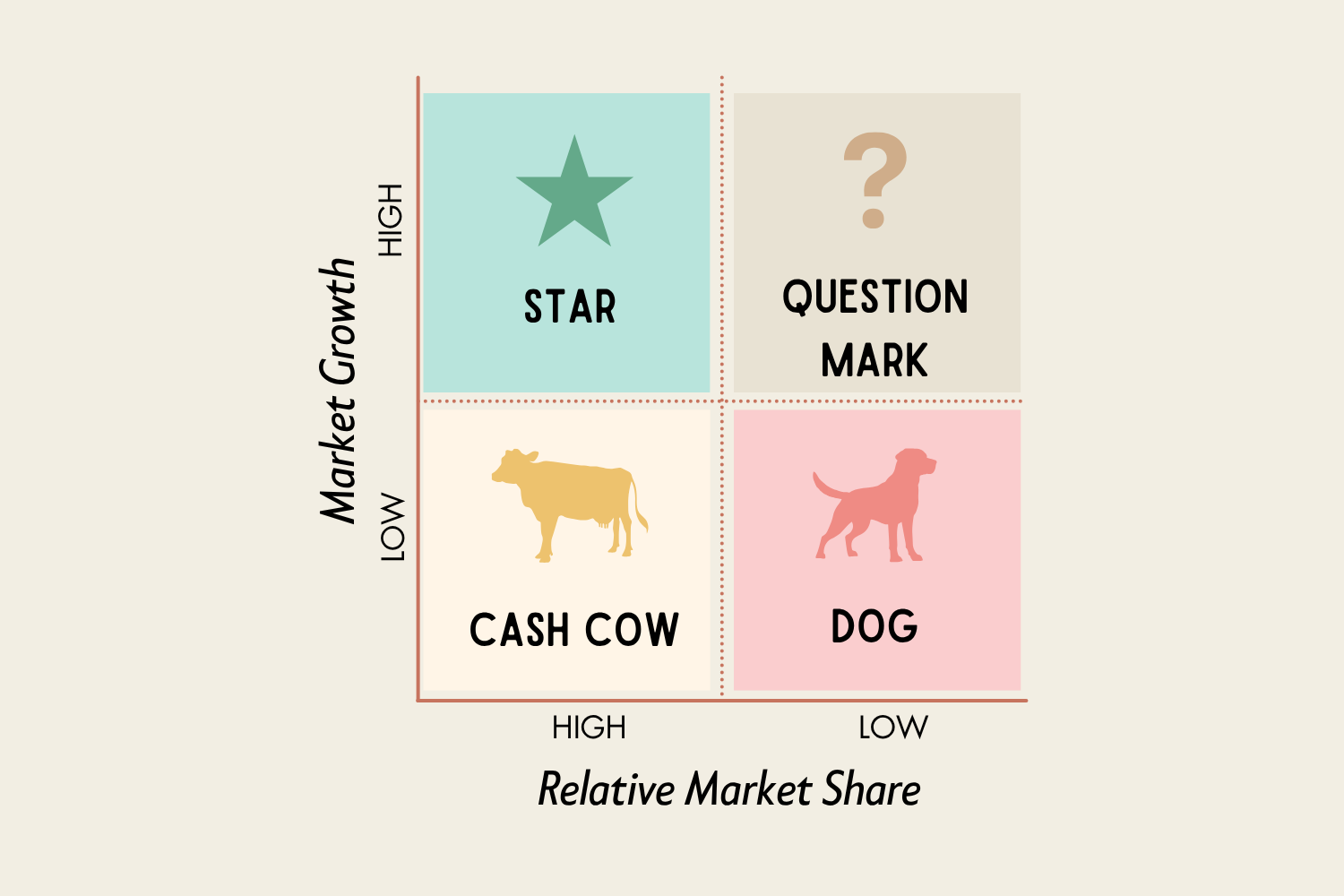
A 2x2 that sorts products or units by market growth and share — telling you what to fund, milk, or kill.

McKinsey's Three Horizons Model
Split your team's effort across three time frames — defend the core, grow what's emerging, seed future bets — without mortgaging tomorrow.

Porter's Five Forces
Porter's answer to why some industries are brutal for profit — five forces shaping any market, telling you where to compete.
Rumelt's Kernel
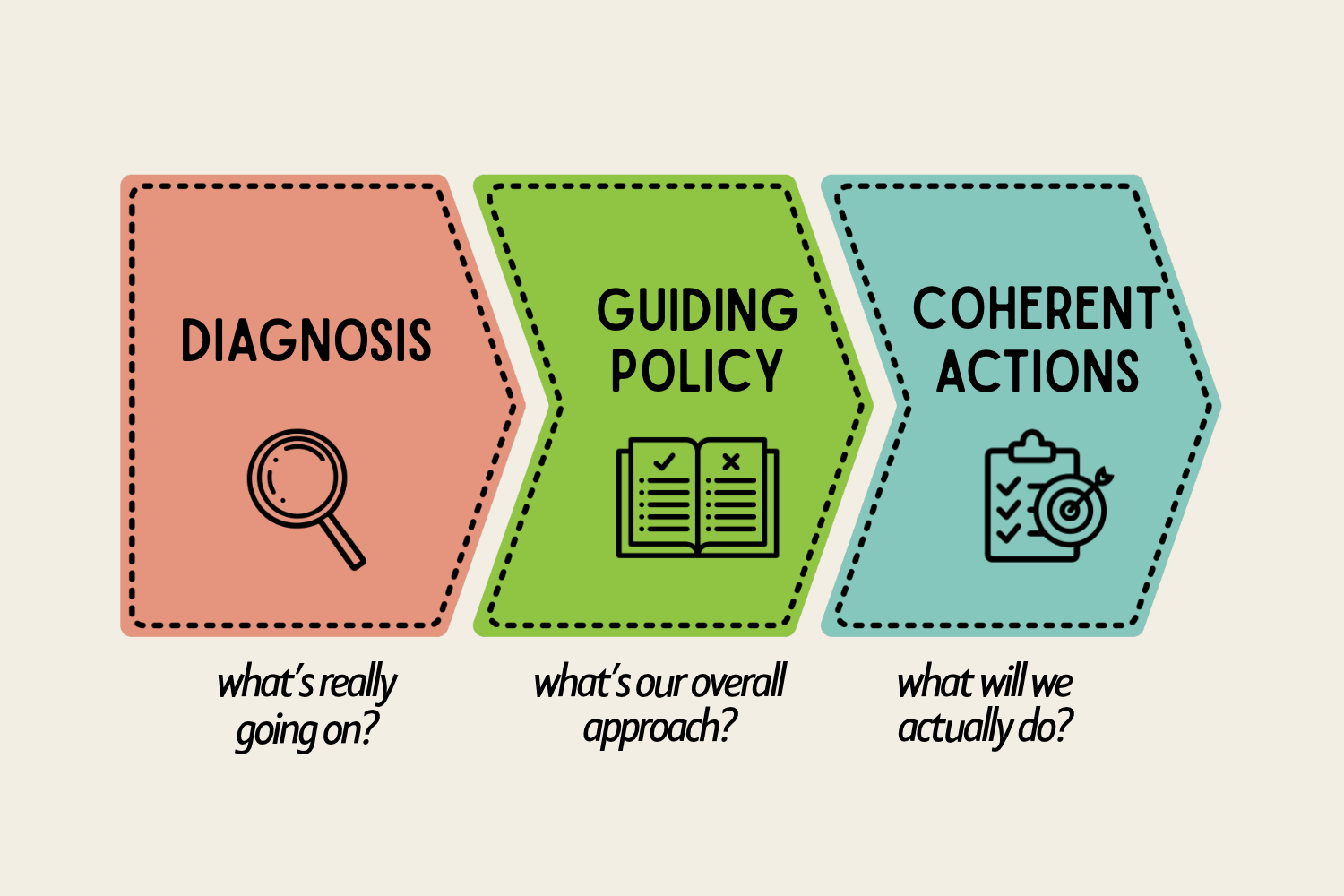
Richard Rumelt's test for telling a real strategy from a list of goals — a diagnosis, a guiding policy, and coherent actions. Miss any one of the three and what you have is a wish, not a strategy.

The Innovator's Dilemma
Clayton Christensen's explanation for why great companies fail doing everything right — serving your best customers blinds you to cheap newcomers.