Good Strategy Bad Strategy
Richard Rumelt's blunt case that most of what gets called "strategy" in a typical planning meeting is actually a wish list dressed up in strategic language, plus a concrete test for telling the two apart.
 Find this on the mind-map
Introduction
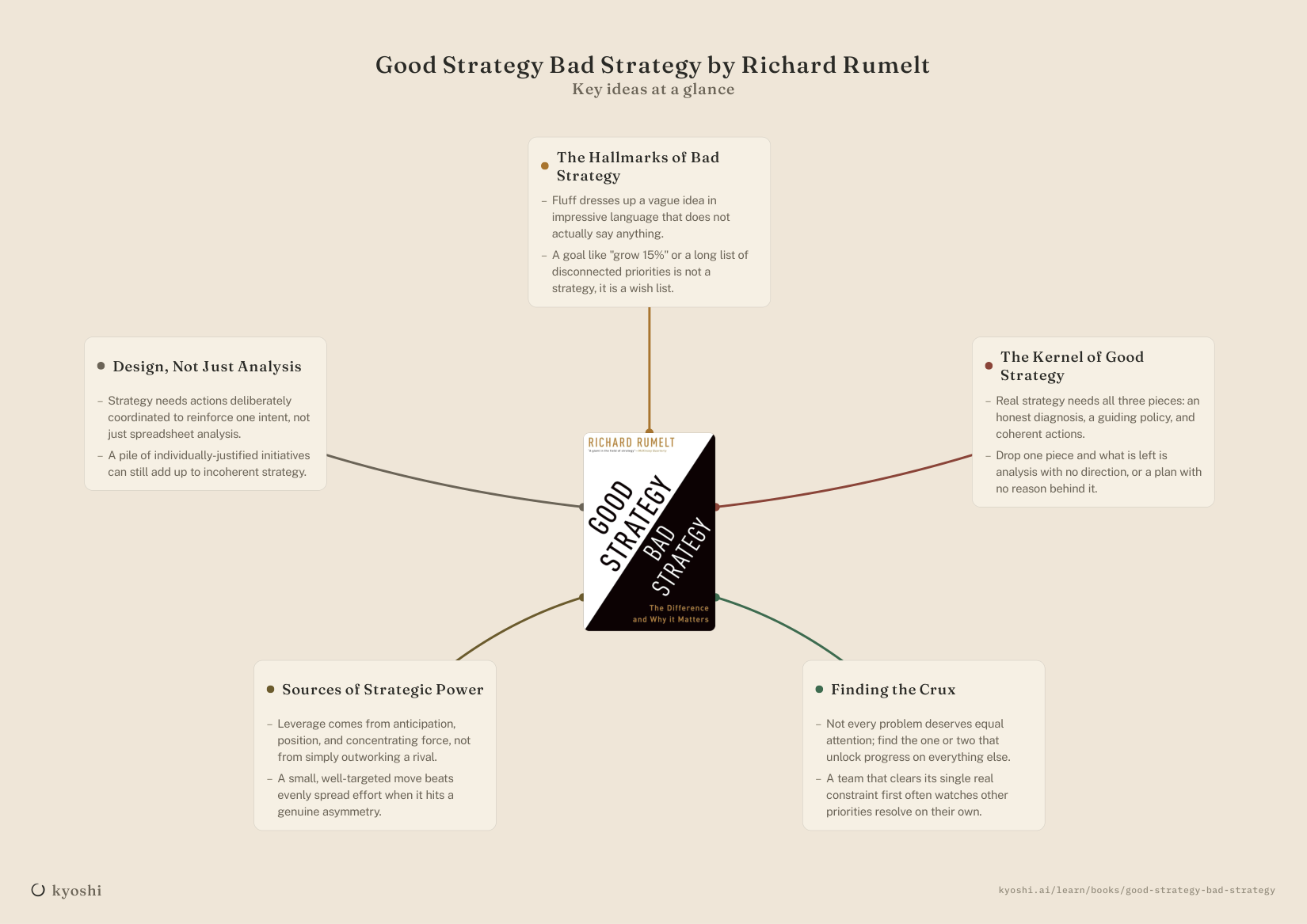
Rumelt's starting claim is almost an insult to how most organizations plan: most strategy documents aren't strategy at all, they're a collection of goals, aspirations, and buzzwords with no actual logic connecting the current situation to the desired outcome. Good strategy, in his framing, is rare specifically because it requires admitting there's a real problem to solve, rather than just declaring a destination.
The Hallmarks of Bad Strategy
Rumelt names specific, recognizable failure patterns: fluff (superficial abstraction dressed in impressive-sounding language that doesn't actually say anything, like "we will leverage our synergies to drive customer-centric innovation"), failure to face the challenge (treating strategy as goal-setting rather than first diagnosing what's actually in the way), mistaking goals for strategy (a growth target of 15% isn't a strategy, it's a wish), and bad strategic objectives (a long list of disconnected priorities that's really just a wish list with bullet points, not a coherent set of choices).
The Kernel of Good Strategy
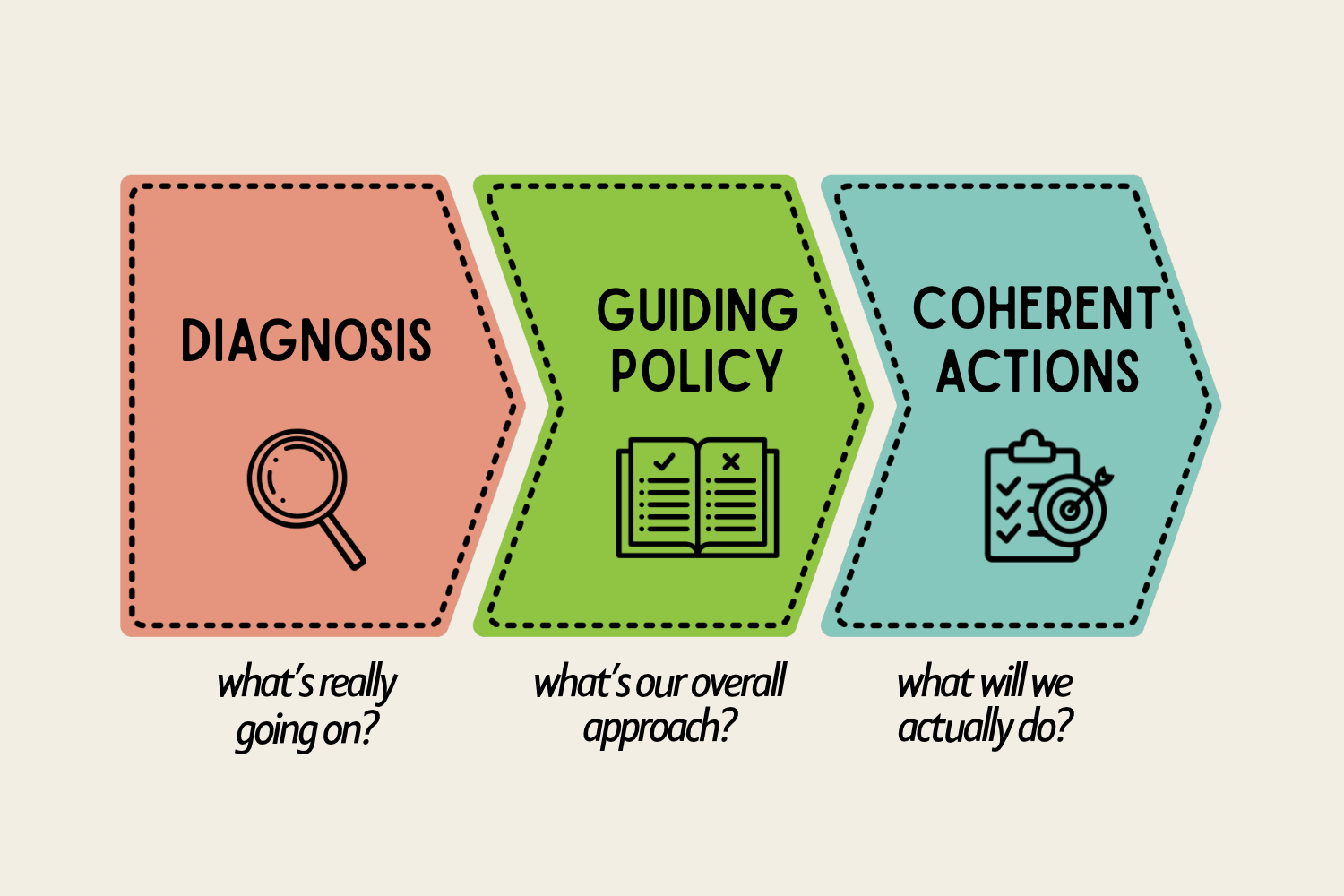
Good strategy has a specific logical structure, regardless of industry: a diagnosis (what's actually the key challenge, stated honestly), a guiding policy (the overall approach for dealing with that specific challenge, not a generic value like "be excellent"), and coherent actions (specific, resourced steps that fit together and actually implement the guiding policy, not a loose bundle of separately-justified initiatives). Strip away any of the three and what's left isn't strategy. It's either analysis with no direction, direction with no plan, or a plan with no reason behind it.
Finding the Crux
Not every problem deserves equal strategic attention; the real skill is identifying the one or two challenges, the crux, whose resolution would unlock the most progress on everything else. Manager A's team has twelve listed priorities for the quarter and makes modest progress on all twelve. Manager B's team identifies the single constraint actually blocking the other eleven and clears that one first. By quarter's end, several of the other eleven resolved themselves.
Sources of Strategic Power (Leverage)
Good strategy exploits asymmetries, a place where a small, well-targeted action produces a disproportionately large effect because of timing, position, or a competitor's blind spot, rather than relying on simply outworking or outspending a rival head-on. Leverage comes from anticipation (seeing a shift before competitors do), a strong position relative to others, and concentrating force on the actual crux instead of spreading effort evenly.
Using Design, Not Just Analysis
Strategy isn't purely an analytical output of spreadsheets and market data. It also requires design thinking, where multiple actions are deliberately coordinated to reinforce each other, the way pieces of a design fit a single coherent intent. A pile of individually-justified initiatives, each defensible on its own data, can still add up to incoherent strategy if they don't reinforce a single guiding policy.
Putting It Together
Avoiding the hallmarks of bad strategy clears the ground. Finding the crux tells you which problem actually deserves the strategy. The Kernel (diagnosis, guiding policy, coherent action) is the structure that turns that problem into something actionable, and leverage plus coordinated design is what makes the resulting actions punch above their resourcing instead of just being another well-intentioned initiative list.
Why It Matters for Leaders
Most "strategy" conversations in a typical team never get past the wish-list stage, and this book gives you a fast way to catch it happening. If a plan is a list of outcomes you want with no honest account of what's actually standing in the way, it's not a strategy yet, no matter how confident it sounds in the room.
The diagnosis step is the one leaders skip most, usually because naming the real obstacle means naming something uncomfortable: a team that's understaffed for what it's been promising, a product bet that hasn't worked, a competitor who's out-executing you without much noise. Rumelt's point is that skipping this step doesn't make the plan safer, it just moves the risk from the plan to the execution, where it's harder to fix.
The crux idea changes how you run a planning meeting. Instead of asking "what are our priorities this quarter," ask "which one problem, if we solved it, would make the other ten easier." That question routinely kills half the list, and the half that survives is usually the half that actually mattered.
Picture a product lead, Marcus, walking into his quarterly planning review with a list of eleven initiatives, each backed by real data and a reasonable owner. His VP asks him a single question: if you could only do one of these, which one makes the other ten less urgent? Marcus goes quiet for a minute, then admits the real answer is a data pipeline nobody's prioritized because it's not customer-facing. Nine of the eleven initiatives are downstream of that one broken pipeline. He hadn't written a strategy. He'd written a wish list with a due date.
What to do next
Reinforce your understanding of Good Strategy Bad Strategy
Books related to Good Strategy Bad Strategy

Built to Last
Collins and Porras' earlier, lesser-known study of visionary companies: the research that came before Good to Great, built around a single hard question: what actually survives past the founder, the product, and the current strategy?

Good to Great
Jim Collins' research into why some companies go from average to sustained market dominance, and others don't. Read less as a book about companies and more as a book about the kind of leader you have to become before a company (or a team) can get great.

Start With Why
Simon Sinek's argument that people don't buy what you do, they buy why you do it, and that most organizations have never actually answered the question, even the ones that think they have.

Sun Tzu and The Art of Business
Mark McNeilly's translation of Sun Tzu's 2,500-year-old military strategy into six concrete business principles, built around a point most business books skip: the best wins are the ones nobody had to fight for.

The Art of War
The original 2,500-year-old military treatise, read the way most modern leaders actually use it. Not as a manual for fighting better, but as a manual for needing to fight less.

The Infinite Game
Simon Sinek's case that most leaders are playing the wrong game entirely: treating an endless competition as something you can win, when the only real goal is staying in it, strong enough to keep playing.

The Innovator's Dilemma
Clayton Christensen's answer to a puzzle that looks impossible: well-run companies, doing everything their best customers ask for, still lose to products that look worse on every spec sheet, right up until the moment they don't. The book every leader cites and few actually apply to their own team.

Walmart
A retail-industry case study of how Walmart built, and is now fighting to defend, the position it spent sixty years earning. Less a biography of Sam Walton and more a hard look at what scale economics can and can't protect you from in the age of Amazon.

Your Next Five Moves
Patrick Bet-David's chess-inspired framework for strategic leadership, built around five "moves" every founder or executive has to master in order, from knowing yourself to running power plays against bigger competitors, instead of just reacting to whatever just happened.
Skills related to Good Strategy Bad Strategy

Frameworks referenced from this book
Frameworks related to Good Strategy Bad Strategy
BCG Matrix
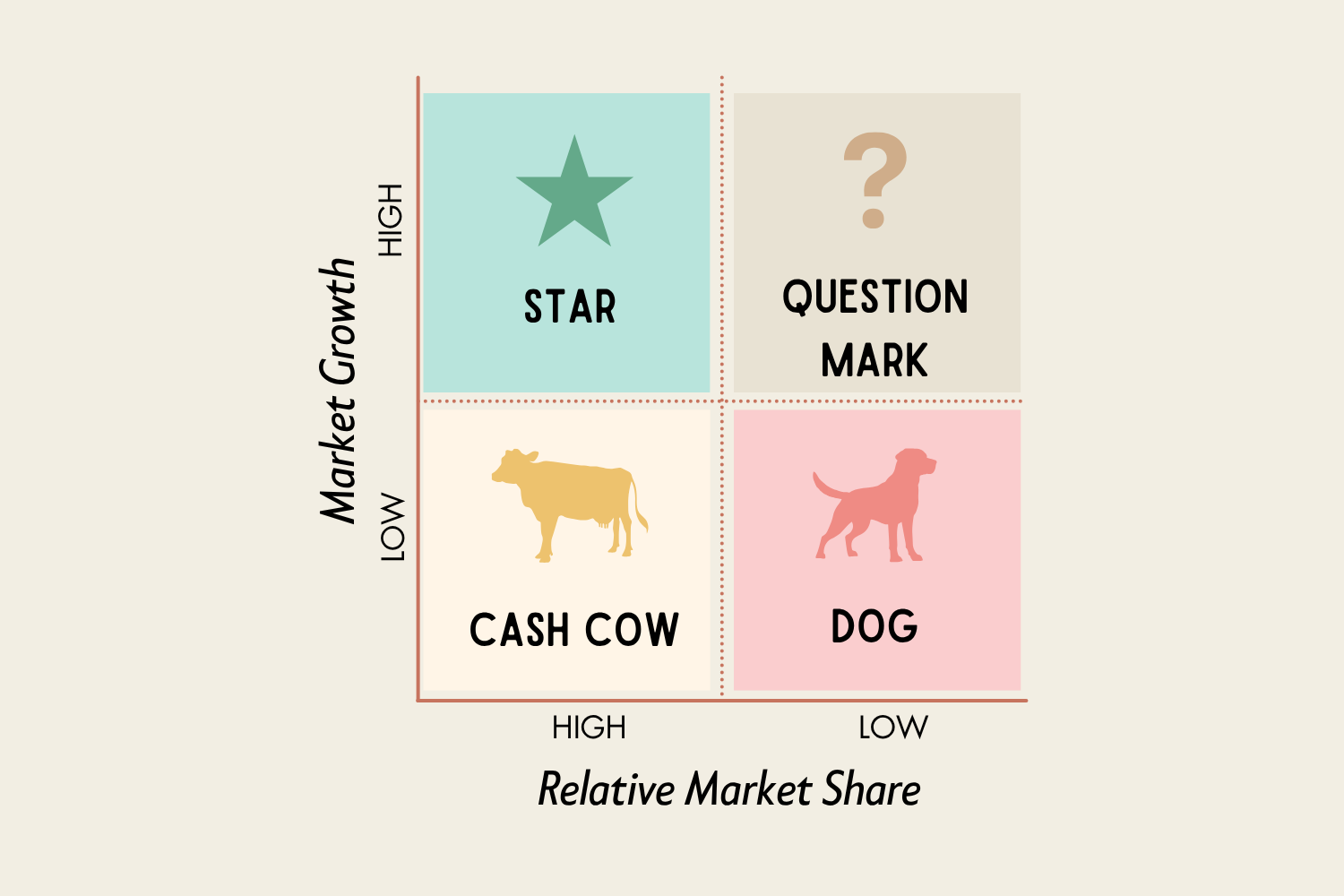
A 2x2 that sorts products or units by market growth and share — telling you what to fund, milk, or kill.

McKinsey's Three Horizons Model
Split your team's effort across three time frames — defend the core, grow what's emerging, seed future bets — without mortgaging tomorrow.

Porter's Five Forces
Porter's answer to why some industries are brutal for profit — five forces shaping any market, telling you where to compete.
Rumelt's Kernel
Richard Rumelt's test for telling a real strategy from a list of goals — a diagnosis, a guiding policy, and coherent actions. Miss any one of the three and what you have is a wish, not a strategy.

The Innovator's Dilemma
Clayton Christensen's explanation for why great companies fail doing everything right — serving your best customers blinds you to cheap newcomers.