The Innovator's Dilemma
Clayton Christensen's answer to a puzzle that looks impossible: well-run companies, doing everything their best customers ask for, still lose to products that look worse on every spec sheet, right up until the moment they don't. The book every leader cites and few actually apply to their own team.
 Find this on the mind-map
Introduction
Why do good companies, run by smart people doing everything textbook management tells them to do, keep losing to products that are worse? Clayton Christensen's answer is the uncomfortable core of this book: it's not bad management that kills market leaders. It's good management, pointed at the wrong market. The companies that disrupt them aren't smarter. They're just competing in a market the leader correctly decided wasn't worth competing in, yet.
Sustaining Innovation vs. Disruptive Innovation
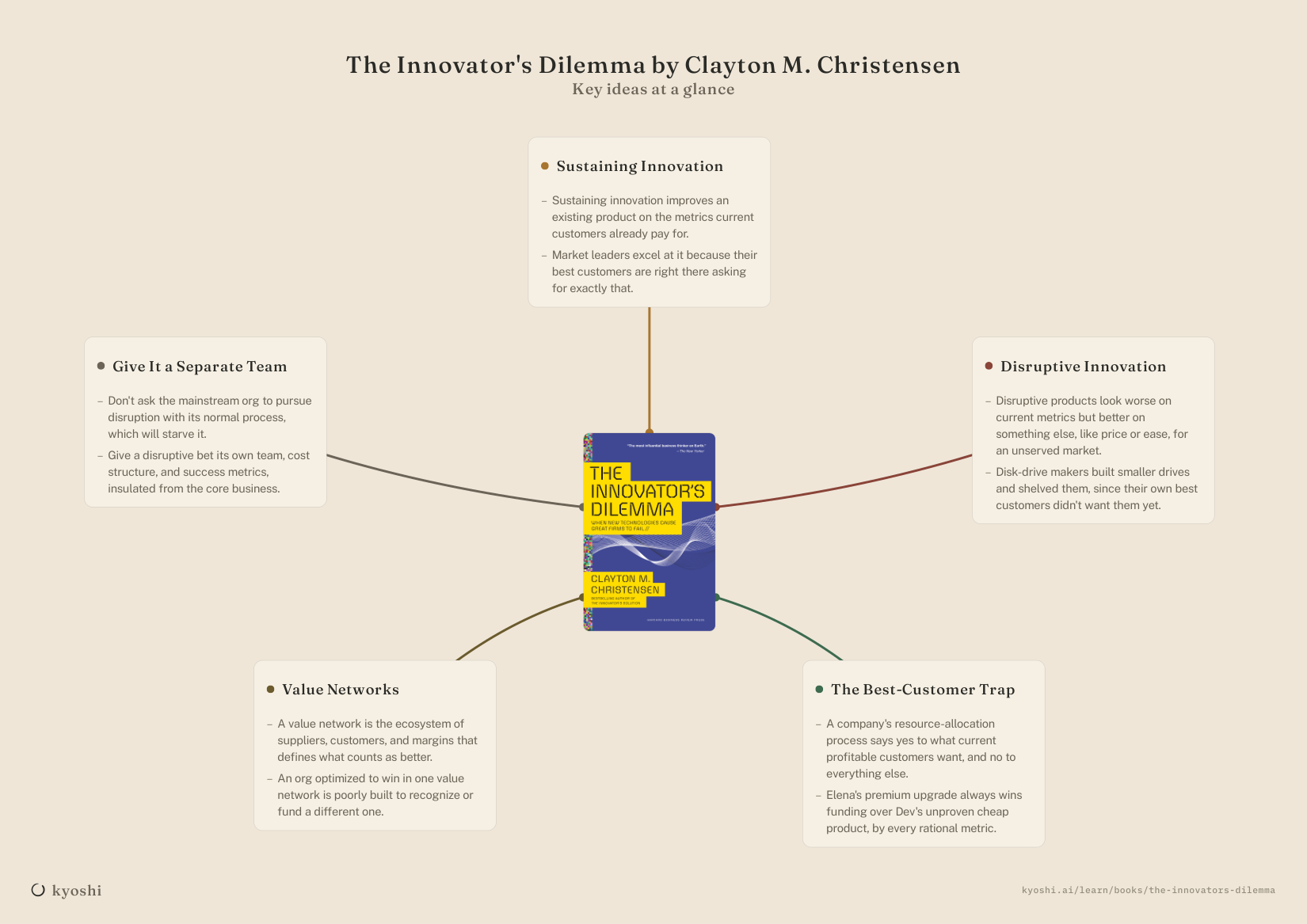
Most innovation is sustaining: it makes an existing product better along the dimensions existing customers already pay for, things like speed, capacity, and features. Market leaders are great at sustaining innovation, because their best customers are right there asking for it. Disruptive innovation looks different from the inside: it's worse on the metrics the current market cares about, but better on something else entirely, cheaper, simpler, more convenient, or more accessible, for customers the current market doesn't serve or doesn't value yet. The disk-drive makers Christensen studied didn't miss the smaller drive sizes that went on to disrupt them because they couldn't build them. They built them, shelved them, and let someone else ship them, because their own best customers didn't want them yet.
Why Listening to Your Best Customers Can Sink You
This is the actual dilemma. A company's resource-allocation process, the unglamorous, mostly invisible system of who gets funded, which projects get staffed, and which get killed, is built to say yes to whatever its most profitable current customers are asking for, and no to everything else. That's not a flaw. It's what good management looks like. The problem is that a genuinely disruptive opportunity, by definition, looks small, low-margin, and unwanted by your best customers right up until it isn't. A team pitching it inside a healthy company is pitching against every rational reason to fund something else instead.
Picture two product leads at the same company. Elena runs the premium line and spends her year squeezing another 15% of performance out of it for customers who are paying well and asking for exactly that. Dev is pitching a stripped-down, cheaper version aimed at a market the company doesn't currently serve. Elena's case writes itself: clear customers, clear revenue, clear margin. Dev's case is a bet on a market that barely exists yet. Every quarterly review, Elena's project wins the resources, and that's the correct call by every metric the company tracks. It's also exactly how the company gets blindsided five years later.
Value Networks: Why the Same Team Can't Chase Both
Christensen's term for this is a value network: the ecosystem of suppliers, customers, margin structures, and cost expectations a company is embedded in. A value network isn't just a market; it's a set of assumptions about what counts as "better" that gets baked into how a company measures everything, from engineering priorities to sales incentives. A disruptive opportunity usually requires a different value network with a different definition of better, and an organization optimized to win in one value network is, by the same optimization, poorly built to recognize or fund a different one. This is why the failure isn't stupidity. It's structural.
The Case for a Separate Team
Christensen's practical answer isn't "try harder to listen to new markets." It's: don't ask your mainstream organization to pursue a disruptive opportunity using its normal processes, because those processes will correctly and systematically starve it. Give the disruptive bet its own small team, its own cost structure, and its own metrics for what success looks like at this size, insulated from having to compete, quarter over quarter, against the company's actual profitable business for the same resources.
Putting It Together
The dilemma isn't a competence problem, it's a measurement problem. Sustaining work wins every head-to-head resource fight because it's the only kind of work your current metrics are built to see. The fix isn't better discipline on the existing scorecard. It's having the humility to fund something that looks like a bad bet on that scorecard, in a structure where it's allowed to be judged by a different one.
Why It Matters for Leaders
Most leaders don't lose to disruption because they ignore it. They lose because they ran the numbers correctly and the numbers said no. That's the part of this book that should actually worry you: the decision that sinks you isn't a mistake, it's a well-run process doing exactly what it was built to do.
So the practical move isn't "pay more attention." It's building a second track that your normal process isn't allowed to touch. If a new idea has to clear the same bar as your core business this quarter, on the same spreadsheet, with the same people deciding, it will lose, every time, for reasons that are individually correct. The question to ask isn't "is this a good idea." It's "what scorecard is this failing, and is that the right scorecard for something this size and this early."
Picture a VP of Engineering who sees a junior team pitch an internal tool that automates a chunk of what her senior engineers bill hours for. The margins on it look terrible next to the team's real project work, and the use case only fits a handful of smaller clients right now. She could kill it in the same meeting where she approves three solid feature requests for her biggest account, and by every number in the room that would be the right call. Instead, she funds it as a small, separate experiment with its own goal: not revenue this year, just proof that ten clients will actually use it. Eighteen months later, that tool is cheaper and faster than what three competitors are still selling as a premium service.
The skill this book is actually teaching isn't prediction. Nobody can reliably tell which rough, unprofitable idea is the one that matures. The skill is building a structure where a handful of those ideas get to survive long enough to find out, without having to win a fight against your best, most profitable work first.
What to do next
Reinforce your understanding of The Innovator's Dilemma
Books related to The Innovator's Dilemma

Built to Last
Collins and Porras' earlier, lesser-known study of visionary companies: the research that came before Good to Great, built around a single hard question: what actually survives past the founder, the product, and the current strategy?

Creativity, Inc.
Pixar co-founder Ed Catmull's record of building a studio where brilliant, well-intentioned people still nearly wrecked their own creative process, and the specific habits that protected it instead. Less a book about animation than a book about managing anything fragile and unfinished.

Good Strategy Bad Strategy
Richard Rumelt's blunt case that most of what gets called "strategy" in a typical planning meeting is actually a wish list dressed up in strategic language, plus a concrete test for telling the two apart.

Good to Great
Jim Collins' research into why some companies go from average to sustained market dominance, and others don't. Read less as a book about companies and more as a book about the kind of leader you have to become before a company (or a team) can get great.

Loonshots
Physicist-turned-biotech-CEO Safi Bahcall borrows a concept from phase transitions in physics (the same sudden shift that turns water to ice) to explain why the same smart people, in the same company, kill their best "crazy" ideas as they grow, and what structure, not willpower, it takes to stop that from happening.

Originals
Adam Grant's case that originality isn't a fearless personality trait, it's a set of specific, learnable moves that scared, doubtful people use to get a novel idea past the resistance everyone meets when they try something new.

Range
David Epstein's case against the cult of early specialization, using Roger Federer's meandering path through half a dozen sports against Tiger Woods' single-minded golf-only childhood to show why breadth, not a head start, wins in most of the problems that actually matter.

Six Thinking Hats
Edward de Bono's fix for the meeting where everyone argues past each other because they're all doing a different kind of thinking at the same time, a simple discipline for making a group think one way, together, on purpose, instead of six ways at once.

Start With Why
Simon Sinek's argument that people don't buy what you do, they buy why you do it, and that most organizations have never actually answered the question, even the ones that think they have.

Sun Tzu and The Art of Business
Mark McNeilly's translation of Sun Tzu's 2,500-year-old military strategy into six concrete business principles, built around a point most business books skip: the best wins are the ones nobody had to fight for.

The Art of War
The original 2,500-year-old military treatise, read the way most modern leaders actually use it. Not as a manual for fighting better, but as a manual for needing to fight less.

The Infinite Game
Simon Sinek's case that most leaders are playing the wrong game entirely: treating an endless competition as something you can win, when the only real goal is staying in it, strong enough to keep playing.

Walmart
A retail-industry case study of how Walmart built, and is now fighting to defend, the position it spent sixty years earning. Less a biography of Sam Walton and more a hard look at what scale economics can and can't protect you from in the age of Amazon.

Your Next Five Moves
Patrick Bet-David's chess-inspired framework for strategic leadership, built around five "moves" every founder or executive has to master in order, from knowing yourself to running power plays against bigger competitors, instead of just reacting to whatever just happened.
Skills related to The Innovator's Dilemma

Business Strategy
Making the focused calls about where to compete, what to prioritize, and what to say no to, because a strategy is defined as much by what it rules out as by what it commits to.

Creative Thinking
Finding the approach everyone else misses, by challenging assumptions, widening your options, and testing unfamiliar ideas cheaply before you commit to them.
Frameworks referenced from this book
Frameworks related to The Innovator's Dilemma
BCG Matrix
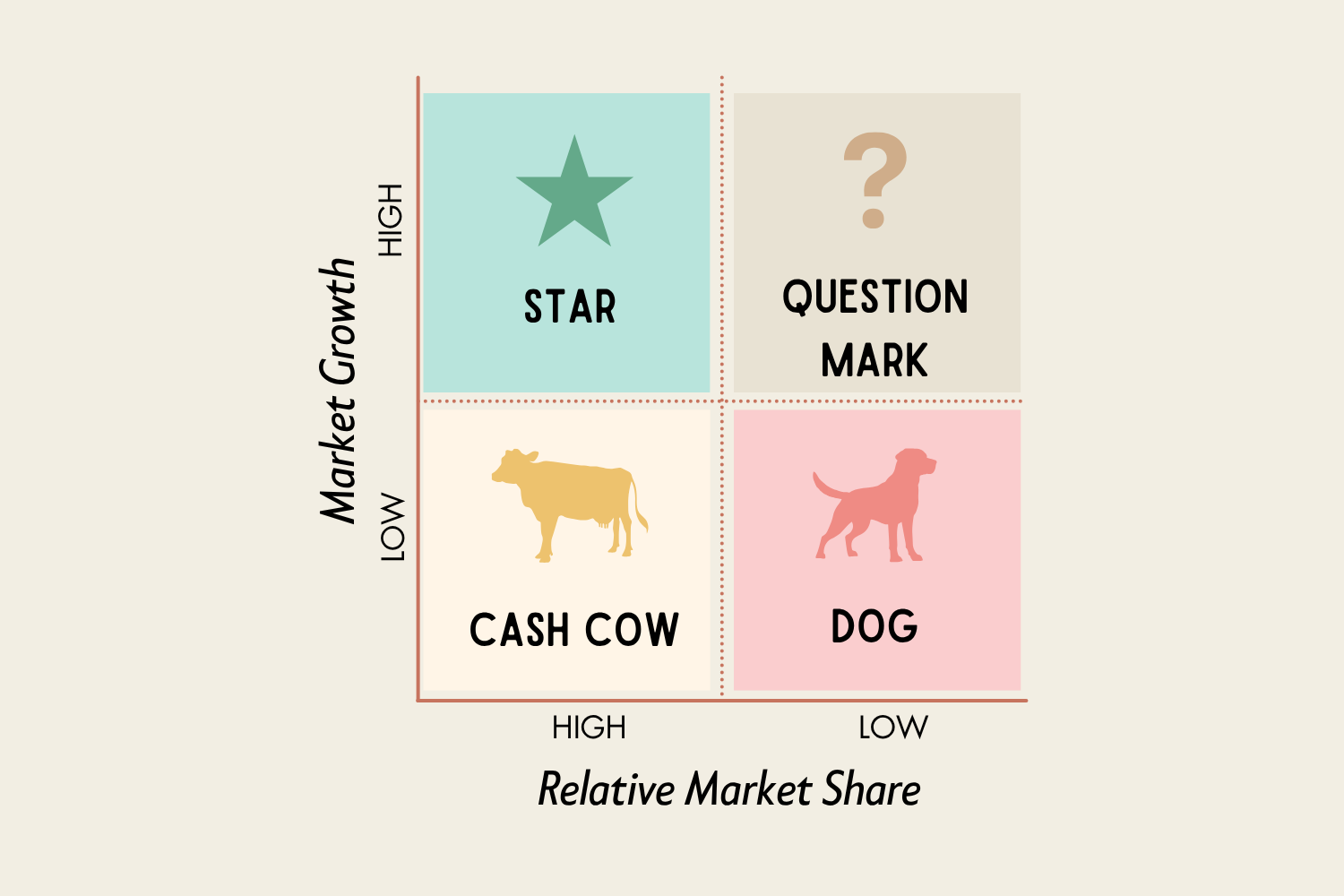
A 2x2 that sorts products or units by market growth and share — telling you what to fund, milk, or kill.

Design Thinking
A human-centered process — empathize, define, ideate, prototype, test — for understanding the people living a problem before you design anything.

Lego Serious Play
A guided exercise building LEGO models as metaphors for a problem, then explaining them aloud, surfacing what discussions miss.

McKinsey's Three Horizons Model
Split your team's effort across three time frames — defend the core, grow what's emerging, seed future bets — without mortgaging tomorrow.

Porter's Five Forces
Porter's answer to why some industries are brutal for profit — five forces shaping any market, telling you where to compete.
Rumelt's Kernel
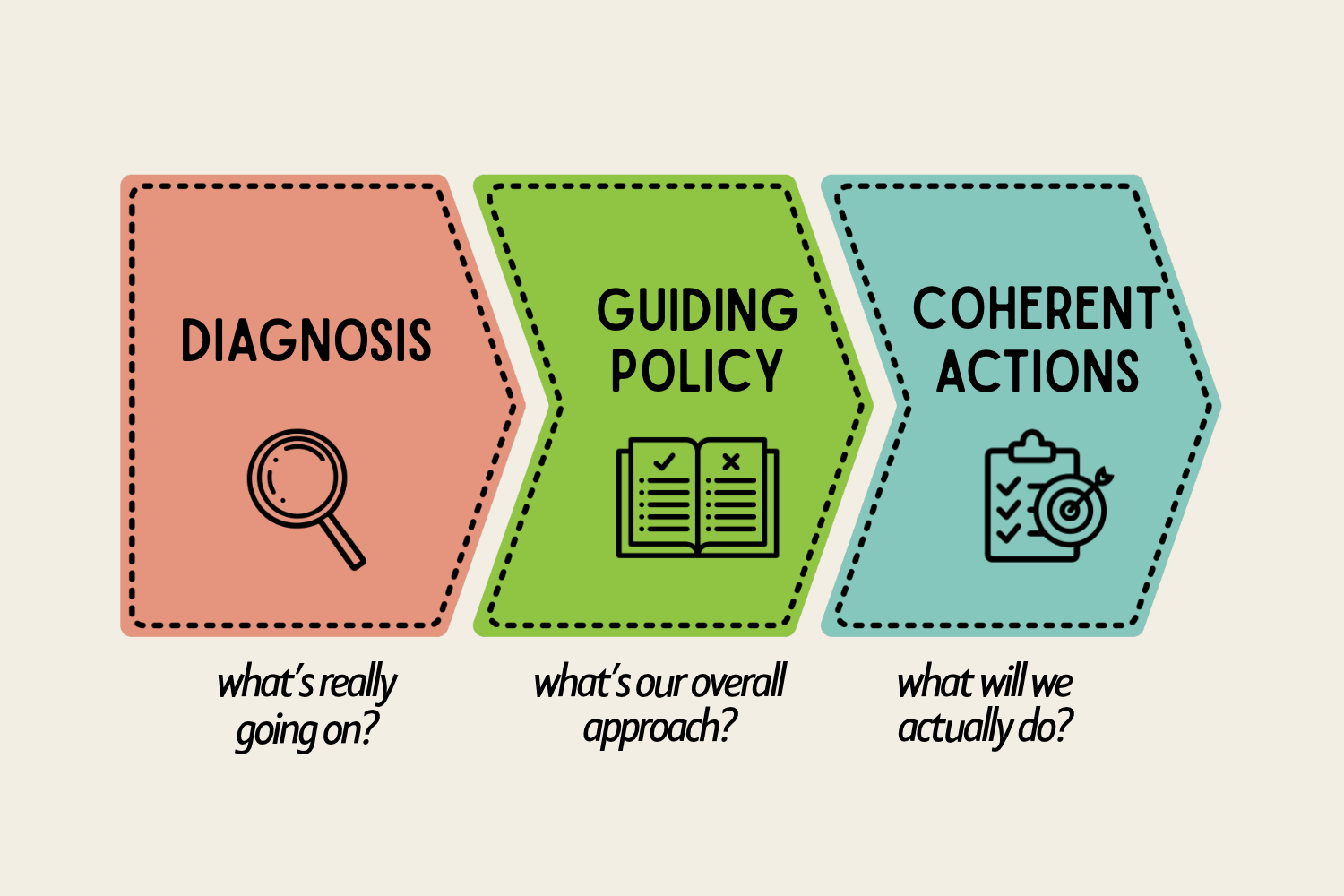
Richard Rumelt's test for telling a real strategy from a list of goals — a diagnosis, a guiding policy, and coherent actions. Miss any one of the three and what you have is a wish, not a strategy.

SCAMPER Technique
Seven forced questions — Substitute, Combine, Adapt, Modify, Put to another use, Eliminate, Reverse — generating ideas by twisting what exists.

The Innovator's Dilemma
Clayton Christensen's explanation for why great companies fail doing everything right — serving your best customers blinds you to cheap newcomers.

The Six Thinking Hats
Get your whole team thinking in the same mode at once — facts, emotions, risk, benefits, creativity, process — covering every angle.