Walmart
A retail-industry case study of how Walmart built, and is now fighting to defend, the position it spent sixty years earning. Less a biography of Sam Walton and more a hard look at what scale economics can and can't protect you from in the age of Amazon.
 Find this on the mind-map
Introduction
Written by retail analysts Natalie Berg and Bryan Roberts, Roberts spent over a decade covering Walmart directly as an industry analyst, this is a retail-industry case study more than a leadership parable: a close, studiously neutral look at how Walmart became the dominant force in global retail, and the harder, more interesting question of whether the same model that built that dominance can survive a retail world reshaped by e-commerce. The honest core thesis is that scale, once it compounds far enough, becomes nearly impossible for competitors to match on its own terms, until the basis of competition shifts to something scale doesn't automatically win.
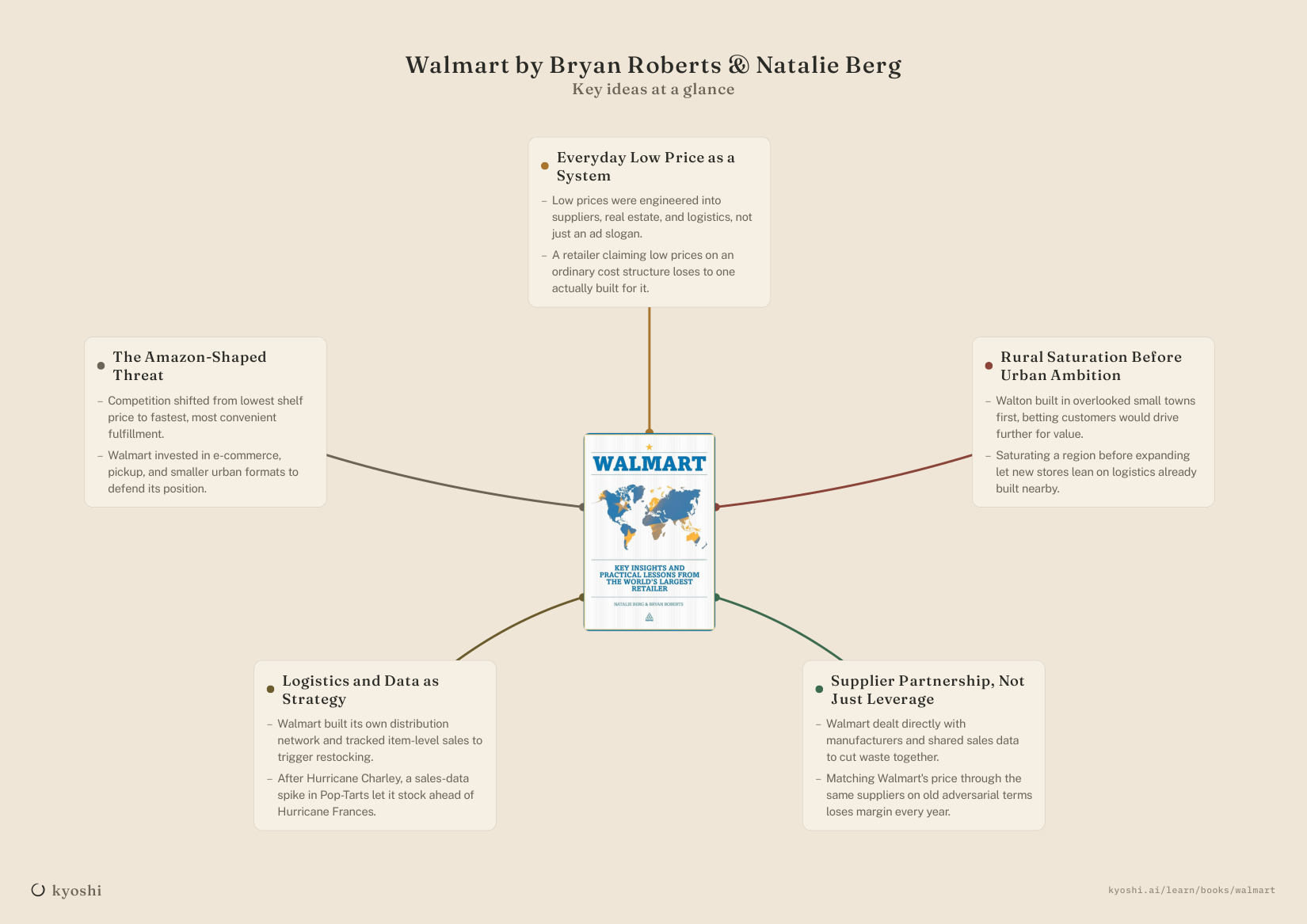
Everyday Low Price as a System, Not a Slogan
Walmart's famous pricing promise wasn't a marketing line bolted onto an existing business. It was the organizing principle the entire company was engineered around, from supplier negotiations to real estate to logistics, down to decisions as granular as stripping unnecessary packaging to cut cost. A retailer that treats "low prices" as an advertising claim while running an ordinary cost structure underneath it will lose to one that actually redesigned the business to make low prices structurally true.
Rural Saturation Before Urban Ambition
Rather than competing head-on in cities where larger chains already had density, Walton built out in small, rural towns competitors overlooked, betting that a broad selection and low prices would draw customers willing to drive further than they would for a city store. That disciplined, overlooked-market-first expansion, saturating a region before pushing into the next, is what let each new store benefit from logistics and brand density already built nearby, long before Walmart was large enough to go toe-to-toe with anyone in a major city.
Supplier Relationships as Partnership, Not Just Leverage
Walmart's purchasing volume gave it negotiating leverage that smaller rivals simply couldn't match. But the book's more specific point is that Walmart also worked to turn adversarial supplier negotiations into genuine operating partnerships, bypassing middlemen to deal directly with manufacturers and share sales data so both sides could cut waste and forecast demand together. A regional retailer, matching Walmart's low-price promise through the same suppliers on the same old adversarial terms, loses margin every year trying to match a price Walmart can sustain and they can't. Matching a competitor's price point without matching their underlying cost structure, or their supplier relationships, is a losing game dressed up as competition.
Logistics and Data as Competitive Advantage
Long before "supply chain" was a boardroom buzzword, Walmart treated logistics investment, building its own distribution network when existing distributors wouldn't serve its remote rural stores, then layering item-level sales tracking on top to trigger automatic restocking, as core strategy rather than a back-office cost center. The often-cited example: after Hurricane Charley hit Florida in 2004, Walmart mined its own sales data and found that strawberry Pop-Tarts sales rose sharply ahead of a storm, which let it stock shelves correctly before Hurricane Frances hit weeks later. It's a small case study in how operational data, treated as a strategic asset rather than exhaust, becomes a real advantage competitors can't just copy by watching from outside.
The Amazon-Shaped Threat
The retail-strategy case the book is really interested in is what happens when the basis of competition shifts from "who has the lowest shelf price" to "who has the most convenient, fastest fulfillment," a dimension where Walmart's physical-store-optimized scale advantage doesn't automatically transfer. The book is candid that Walmart was slow into e-commerce relative to Amazon's head start, and frames the response, investing heavily in online sales, pickup, delivery, and smaller urban formats to reach city customers its big-box rural model never served well, as a case study in a dominant incumbent trying to defend a position by changing what it competes on, not just how hard it competes.
Putting It Together
Everyday Low Price, disciplined rural-first expansion, and genuine supplier partnership explain how Walmart built a decades-long moat that was nearly unbeatable on its own terms. Treating logistics and sales data as strategic assets, not overhead, is how that moat kept compounding. The Amazon-shaped threat is the book's real tension: a moat built for one competitive dimension (price, physical scale, rural reach) doesn't automatically hold when competition moves to a different one (speed, convenience, urban density), a risk that applies to any leader who's built real advantage around today's terms of competition.
Why It Matters for Leaders
The uncomfortable thing this book hands a leader is a mirror: whatever made you dominant was built for a specific set of terms, and those terms aren't fixed. A sales lead whose team wins every deal on price is building real strength, right up until a competitor starts winning on speed or convenience instead, and the old strength doesn't transfer to the new fight automatically.
The practical habit this suggests is naming, specifically, what dimension your current edge actually runs on. Is your team winning on cost, on relationships, on speed, on depth of expertise? Whatever it is, growth in that dimension can mask a competitor building strength in a different one without much notice, until the ground shifts and the advantage you spent years building stops mattering.
It also argues against treating your own data as a byproduct of doing the work. The leaders who come off well in this book are the ones who looked at ordinary operational numbers, sales patterns, support tickets, usage logs, and asked what they were actually saying, instead of waiting for a crisis to force the question. A pattern sitting in your own data is a strategic asset only if someone bothers to look at it before a competitor does.
Picture a regional sales director, Carlos, whose team has beaten every local competitor on price for a decade. A national player enters the market offering a worse price but same-day delivery, and Carlos's first instinct is to cut prices further. The better move, straight out of this book's logic, is to ask what his team would need to build to compete on speed instead, because matching a price cut with a worse cost structure just burns margin on a fight he's already losing.
What to do next
Reinforce your understanding of Walmart
Books related to Walmart

Built to Last
Collins and Porras' earlier, lesser-known study of visionary companies: the research that came before Good to Great, built around a single hard question: what actually survives past the founder, the product, and the current strategy?

Good Strategy Bad Strategy
Richard Rumelt's blunt case that most of what gets called "strategy" in a typical planning meeting is actually a wish list dressed up in strategic language, plus a concrete test for telling the two apart.

Good to Great
Jim Collins' research into why some companies go from average to sustained market dominance, and others don't. Read less as a book about companies and more as a book about the kind of leader you have to become before a company (or a team) can get great.

Start With Why
Simon Sinek's argument that people don't buy what you do, they buy why you do it, and that most organizations have never actually answered the question, even the ones that think they have.

Sun Tzu and The Art of Business
Mark McNeilly's translation of Sun Tzu's 2,500-year-old military strategy into six concrete business principles, built around a point most business books skip: the best wins are the ones nobody had to fight for.

The Art of War
The original 2,500-year-old military treatise, read the way most modern leaders actually use it. Not as a manual for fighting better, but as a manual for needing to fight less.

The Infinite Game
Simon Sinek's case that most leaders are playing the wrong game entirely: treating an endless competition as something you can win, when the only real goal is staying in it, strong enough to keep playing.

The Innovator's Dilemma
Clayton Christensen's answer to a puzzle that looks impossible: well-run companies, doing everything their best customers ask for, still lose to products that look worse on every spec sheet, right up until the moment they don't. The book every leader cites and few actually apply to their own team.

Your Next Five Moves
Patrick Bet-David's chess-inspired framework for strategic leadership, built around five "moves" every founder or executive has to master in order, from knowing yourself to running power plays against bigger competitors, instead of just reacting to whatever just happened.
Skills related to Walmart

Frameworks related to Walmart
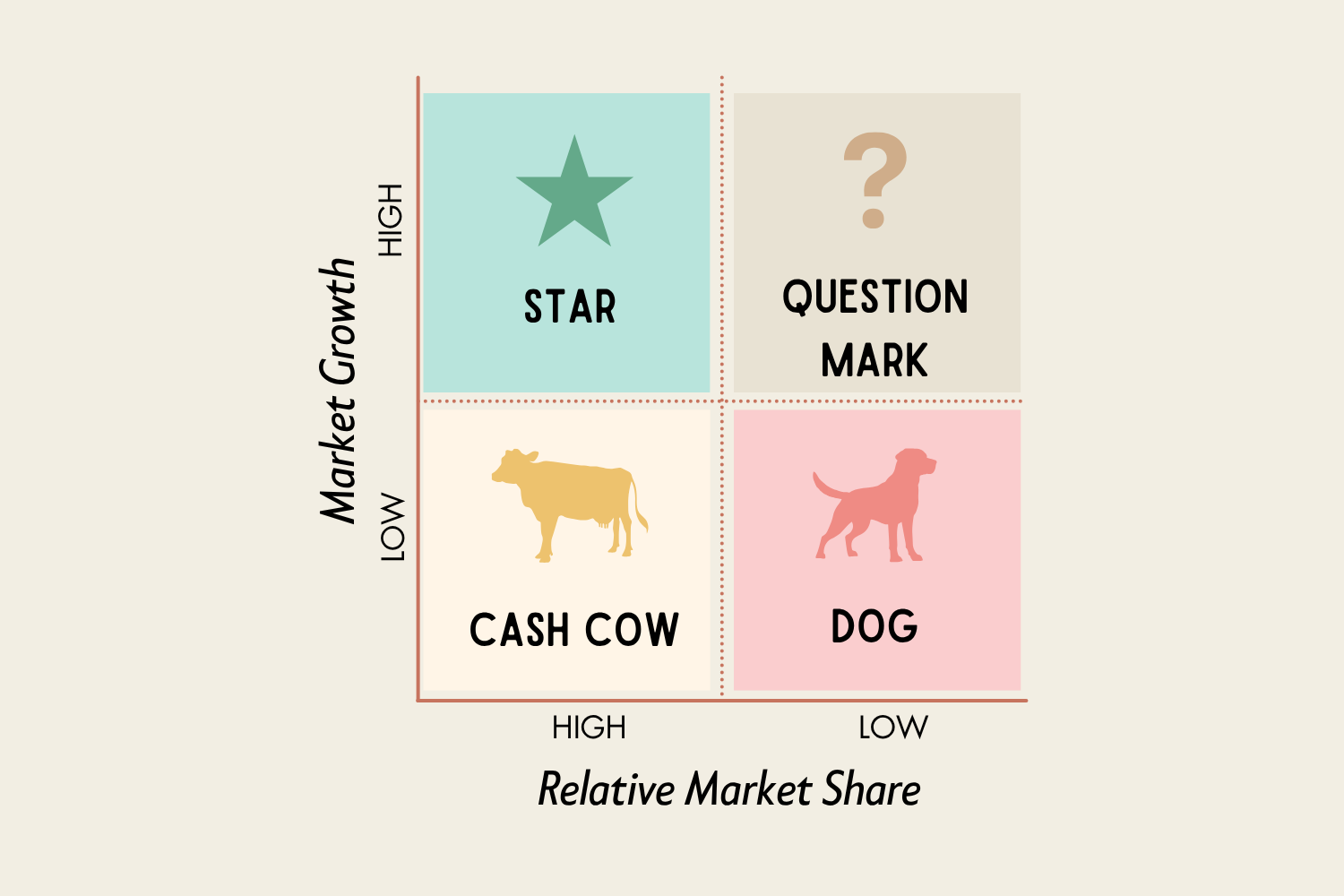
BCG Matrix
A 2x2 that sorts products or units by market growth and share — telling you what to fund, milk, or kill.

McKinsey's Three Horizons Model
Split your team's effort across three time frames — defend the core, grow what's emerging, seed future bets — without mortgaging tomorrow.

Porter's Five Forces
Porter's answer to why some industries are brutal for profit — five forces shaping any market, telling you where to compete.
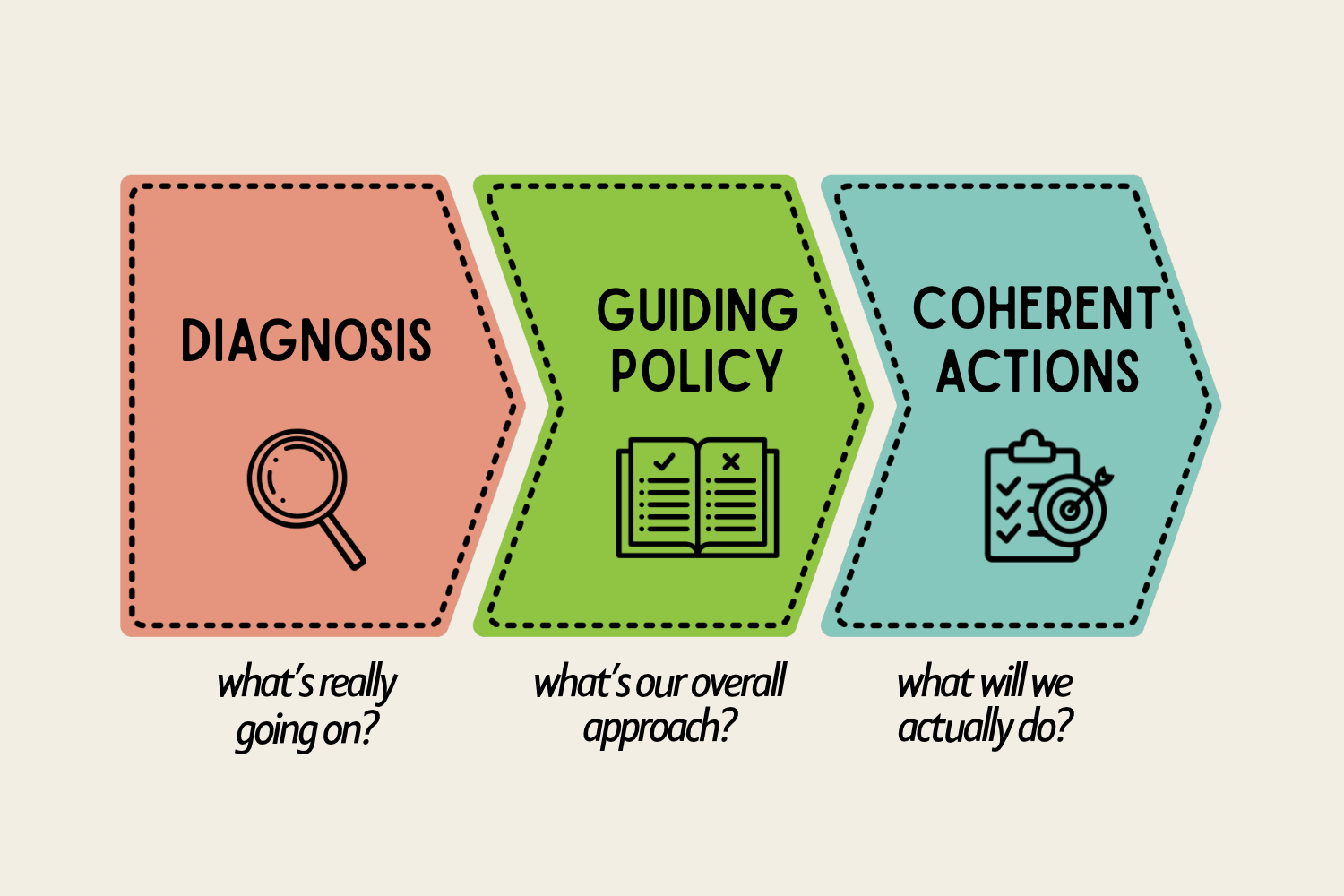
Rumelt's Kernel
Richard Rumelt's test for telling a real strategy from a list of goals — a diagnosis, a guiding policy, and coherent actions. Miss any one of the three and what you have is a wish, not a strategy.

The Innovator's Dilemma
Clayton Christensen's explanation for why great companies fail doing everything right — serving your best customers blinds you to cheap newcomers.