The Leadership OS
The complete system of skills and behaviors that power great leadership.
 Find this on the mind-map
Introduction
Most managers approach leadership backward.
- They try to drive results without really knowing how to lead people.
- They try to lead people without first understanding themselves.
- They get stuck in the daily grind and lose sight of what matters most in the long run.
No wonder leadership can feel so frustrating.
And it’s especially hard when you’re new to the role. One day, you’re great at your job, then suddenly, you’re managing people, resolving conflicts, setting goals, and making decisions that affect more than just your own work.
The problem is that most companies don’t teach you how to lead.
They assume that if you can manage tasks, you can manage people. That if you’re good at getting work done, you’ll figure out leadership on your own.
The Operating System
In reality, leadership behaves less like a random mix of talents or skills, and more like a system.
The Leadership Operating System™ (aka Leadership OS) is a set of interconnected, learnable skills that build on each other. And just like any great system, it only works well when all the parts work together.
Struturally, it is organized into four key layers:
- Layer 1: Leading Self – Know yourself, your strengths, and how you show up as a leader. This is the foundation (or the core) of the system.
- Layer 2: Leading Others – Once you understand yourself, you can lead others, build trust, give feedback, coach, and hold people accountable.
- Layer 3: Leading Results – With the right team in place, you can more effectively focus on vision, execution, and driving real business impact.
- Strategic Leadership – These are the skills that cut across all layers: thinking long-term, solving problems, and making smart decisions.
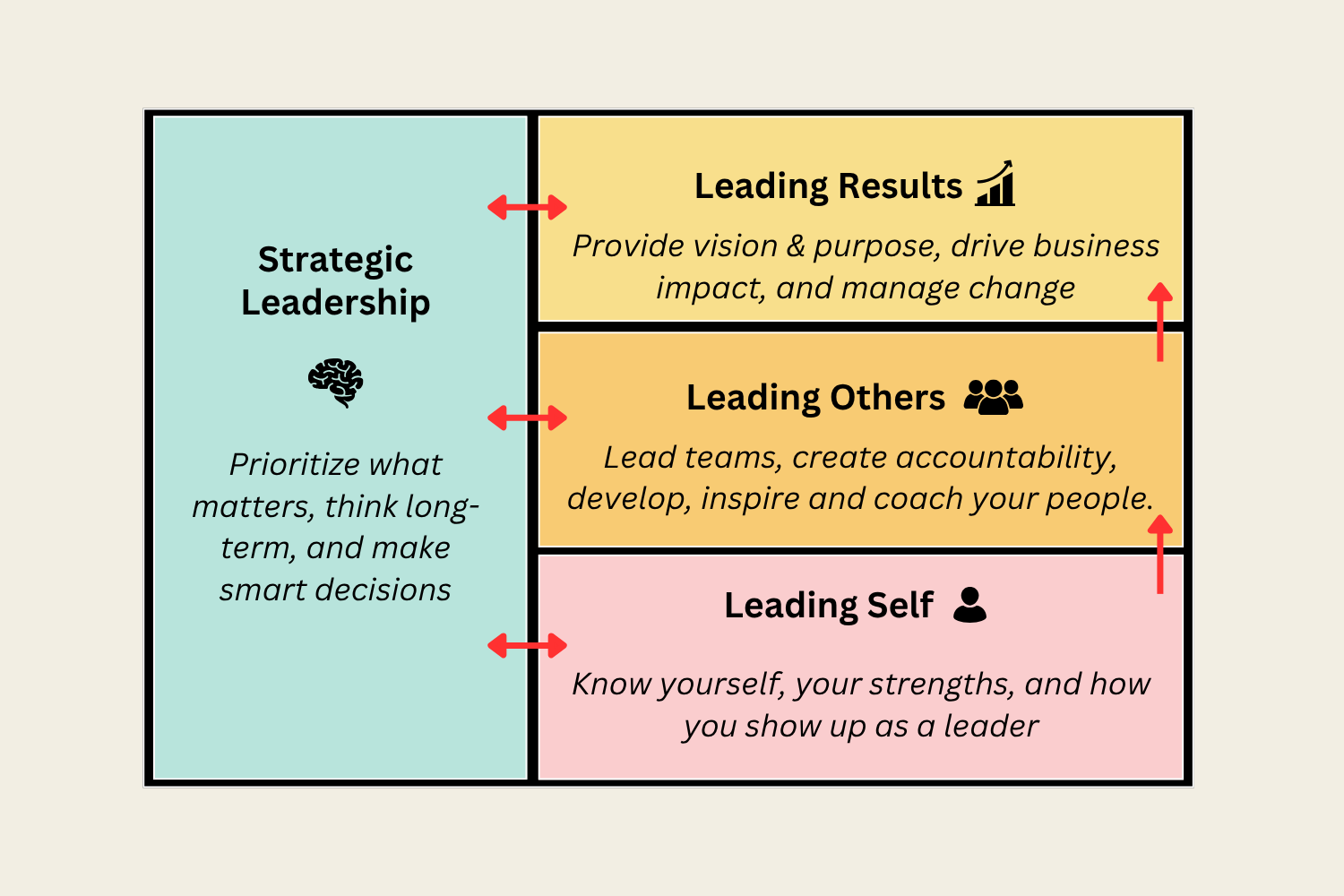
It’s important to remember that these layers aren’t meant to be navigated in sequential order. In fact, they’re all connected, and the skills build upon one another.
The most effective leaders move between them constantly, applying the right skills at the right time.
Layers

Leading Self
Know yourself, your strengths, and how you show up as a leader.

Leading Others
Lead teams, create accountability, develop, inspire and coach your people.

Leading Results
Provide vision & purpose, drive business impact, and manage change.

Strategic Leadership
Prioritize what matters, think long-term, and make smart decisions.