Rumelt's Kernel
Richard Rumelt's test for telling a real strategy from a list of goals — a diagnosis, a guiding policy, and coherent actions. Miss any one of the three and what you have is a wish, not a strategy.
 Find this on the mind-map
Introduction
Richard Rumelt, a strategy professor at UCLA's Anderson School of Management, spent decades advising companies and kept running into the same gap in nearly every planning document he read: a vision statement at the top, a list of targets in the middle, and a roadmap at the end where, somehow, every team's favorite project had made the cut. He laid out the fix in Good Strategy/Bad Strategy — the minimum structure any real strategy has to contain, which he calls the kernel. His core claim is blunt: a strategy is not a statement of ambition, it's a response to a specific challenge, and if you can't name the challenge, what you're holding is a wish, not a strategy.
How It Works
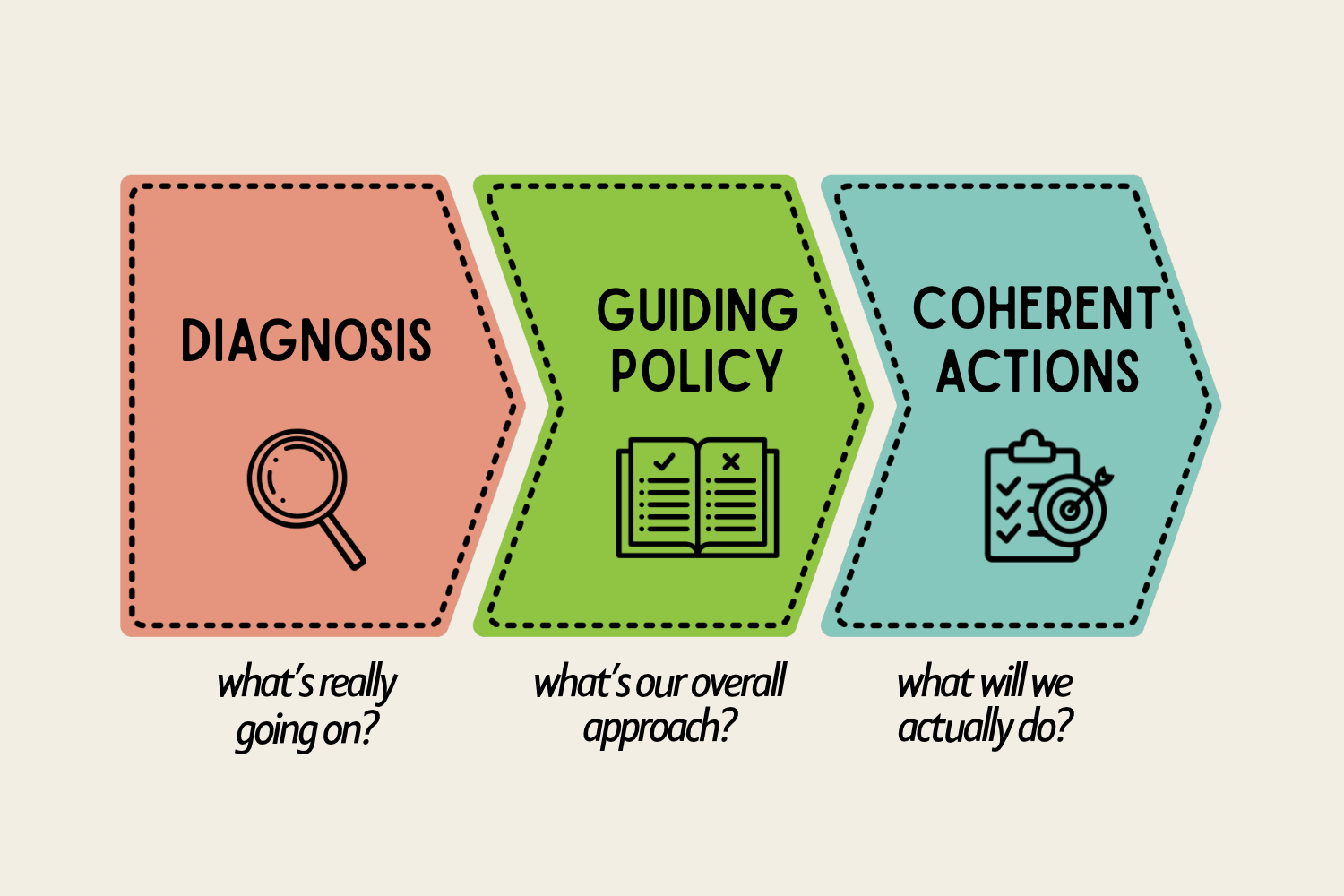
The kernel has three parts. Rumelt is explicit that a strategy can have more than these three things, but if even one of them is missing, it isn't a strategy.
| Part | The question it answers | What it isn't |
|---|---|---|
| Diagnosis | What's the critical challenge, stated honestly? | A restatement of the symptom, or "we need to grow faster" |
| Guiding policy | What's the overall approach to that specific challenge? | A generic value like "be excellent," or anything that doesn't rule something out |
| Coherent actions | What are the specific, resourced steps that carry out the guiding policy? | A list of individually-justified initiatives pulling in different directions |
Take Daniel, a senior engineering manager running a 25-person platform team. His first draft plan read: improve developer experience, cut incidents 50%, migrate to a new CI system, launch a developer portal. Four goals, no strategy.
When Daniel asked "why" and kept digging, he found his senior engineers were burning a third of their week answering escalations from product teams, because the platform tools were unusable without hand-holding. That's a diagnosis — a messy situation reduced to the one piece that actually matters, not just a repeat of the symptom ("we're too slow").
From there came his guiding policy: make product teams self-sufficient before we build anything new. Notice what that sentence rules out. The team won't touch the developer portal or any new services this year, full stop — that's what makes it a policy and not a slogan.
The coherent actions follow directly: freeze new feature work for a quarter, mine six months of support tickets to fix the top five self-serve gaps, rotate a weekly "support shield" engineer, and track weekly escalations as the one health metric. Each action reinforces the others — the freeze buys time for the fixes, the fixes cut the escalations, the shield protects the team while it happens.
Why It Matters for Leaders
Most team plans skip straight to the list of actions, because actions feel like progress. But without a diagnosis first, there's no way to pick a real guiding policy, and without a guiding policy, every action looks equally defensible — which is exactly how a planning meeting ends with twelve priorities and no way to say no to any of them.
Rumelt names specific tells of bad strategy worth checking your own plan against. Fluff: language that sounds impressive and says nothing, like "drive customer-centric innovation across the platform" — ask what your team would actually do differently on Monday. Goals mistaken for strategy: "grow revenue 25%" is a target, not a plan for hitting it. And a laundry list of a dozen vague priorities that nobody could actually act on, dressed up as "strategic objectives."
The fastest test is the one question that makes most planning reviews go quiet: what's the actual problem, and what are you choosing not to do because of it? A leader who can answer that in one sentence has a strategy. A leader who can't, however confident the deck sounds in the room, has a wish list with a due date.
What to do next
Test your knowledge of Rumelt's Kernel
Practice Rumelt's Kernel
Apply Rumelt's Kernel to a real situation
Skills related to Rumelt's Kernel

Frameworks related to Rumelt's Kernel
BCG Matrix
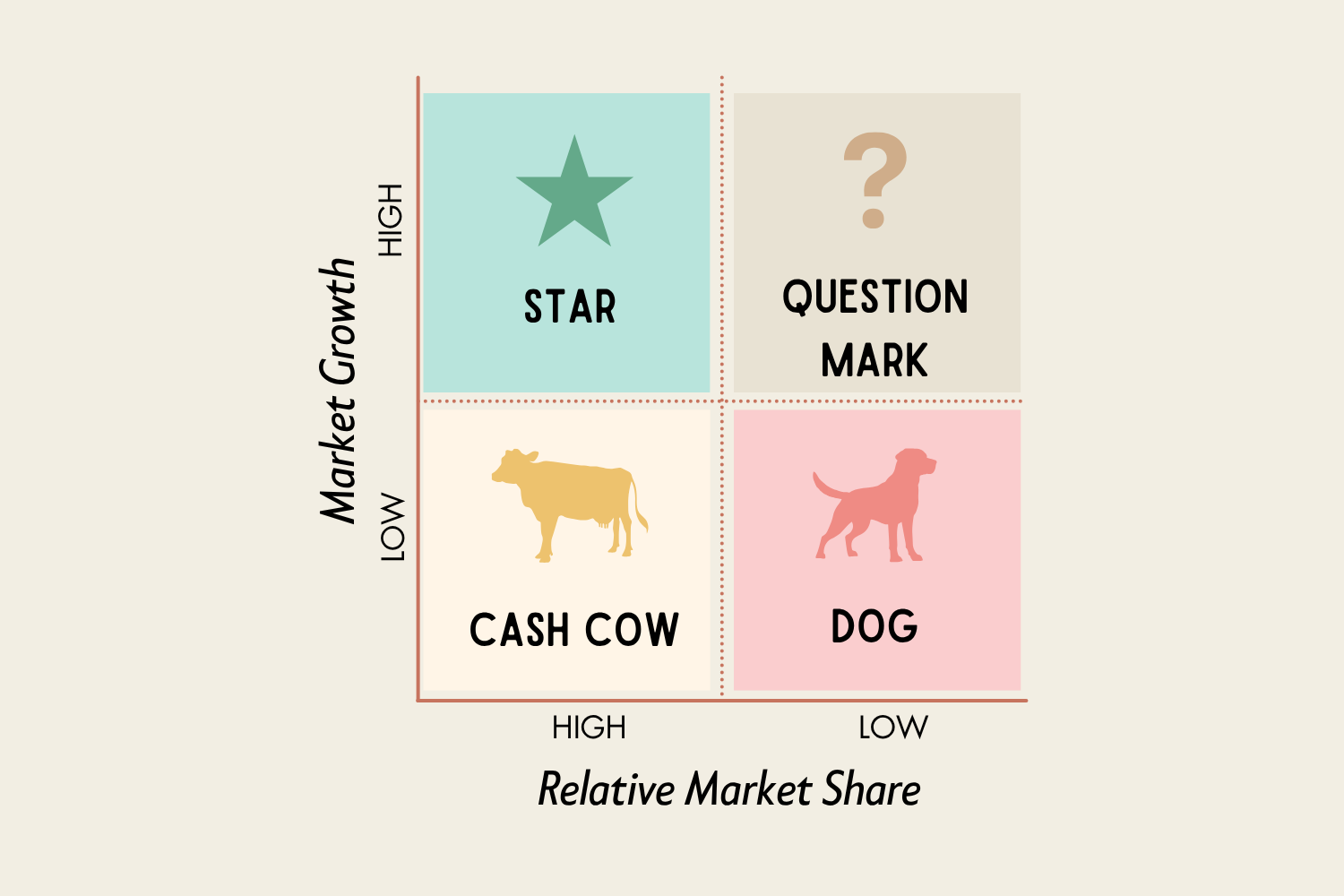
A 2x2 that sorts products or units by market growth and share — telling you what to fund, milk, or kill.

McKinsey's Three Horizons Model
Split your team's effort across three time frames — defend the core, grow what's emerging, seed future bets — without mortgaging tomorrow.

Porter's Five Forces
Porter's answer to why some industries are brutal for profit — five forces shaping any market, telling you where to compete.

The Innovator's Dilemma
Clayton Christensen's explanation for why great companies fail doing everything right — serving your best customers blinds you to cheap newcomers.
Books that reference this framework
Books related to Rumelt's Kernel

Built to Last
Collins and Porras' earlier, lesser-known study of visionary companies: the research that came before Good to Great, built around a single hard question: what actually survives past the founder, the product, and the current strategy?

Good Strategy Bad Strategy
Richard Rumelt's blunt case that most of what gets called "strategy" in a typical planning meeting is actually a wish list dressed up in strategic language, plus a concrete test for telling the two apart.

Good to Great
Jim Collins' research into why some companies go from average to sustained market dominance, and others don't. Read less as a book about companies and more as a book about the kind of leader you have to become before a company (or a team) can get great.

Start With Why
Simon Sinek's argument that people don't buy what you do, they buy why you do it, and that most organizations have never actually answered the question, even the ones that think they have.

Sun Tzu and The Art of Business
Mark McNeilly's translation of Sun Tzu's 2,500-year-old military strategy into six concrete business principles, built around a point most business books skip: the best wins are the ones nobody had to fight for.

The Art of War
The original 2,500-year-old military treatise, read the way most modern leaders actually use it. Not as a manual for fighting better, but as a manual for needing to fight less.

The Infinite Game
Simon Sinek's case that most leaders are playing the wrong game entirely: treating an endless competition as something you can win, when the only real goal is staying in it, strong enough to keep playing.

The Innovator's Dilemma
Clayton Christensen's answer to a puzzle that looks impossible: well-run companies, doing everything their best customers ask for, still lose to products that look worse on every spec sheet, right up until the moment they don't. The book every leader cites and few actually apply to their own team.

Walmart
A retail-industry case study of how Walmart built, and is now fighting to defend, the position it spent sixty years earning. Less a biography of Sam Walton and more a hard look at what scale economics can and can't protect you from in the age of Amazon.

Your Next Five Moves
Patrick Bet-David's chess-inspired framework for strategic leadership, built around five "moves" every founder or executive has to master in order, from knowing yourself to running power plays against bigger competitors, instead of just reacting to whatever just happened.