Start With Why
Simon Sinek's argument that people don't buy what you do, they buy why you do it, and that most organizations have never actually answered the question, even the ones that think they have.
 Find this on the mind-map
Introduction
Sinek's core claim is simple to state and hard to practice: most organizations can clearly say what they do and how they do it, but very few can say why. The why is the only one of the three that actually builds lasting loyalty, in customers and in employees. This book predates (and partly fuels) the modern obsession with "purpose," and it's worth reading past the buzzword to the actual mechanism Sinek is describing.
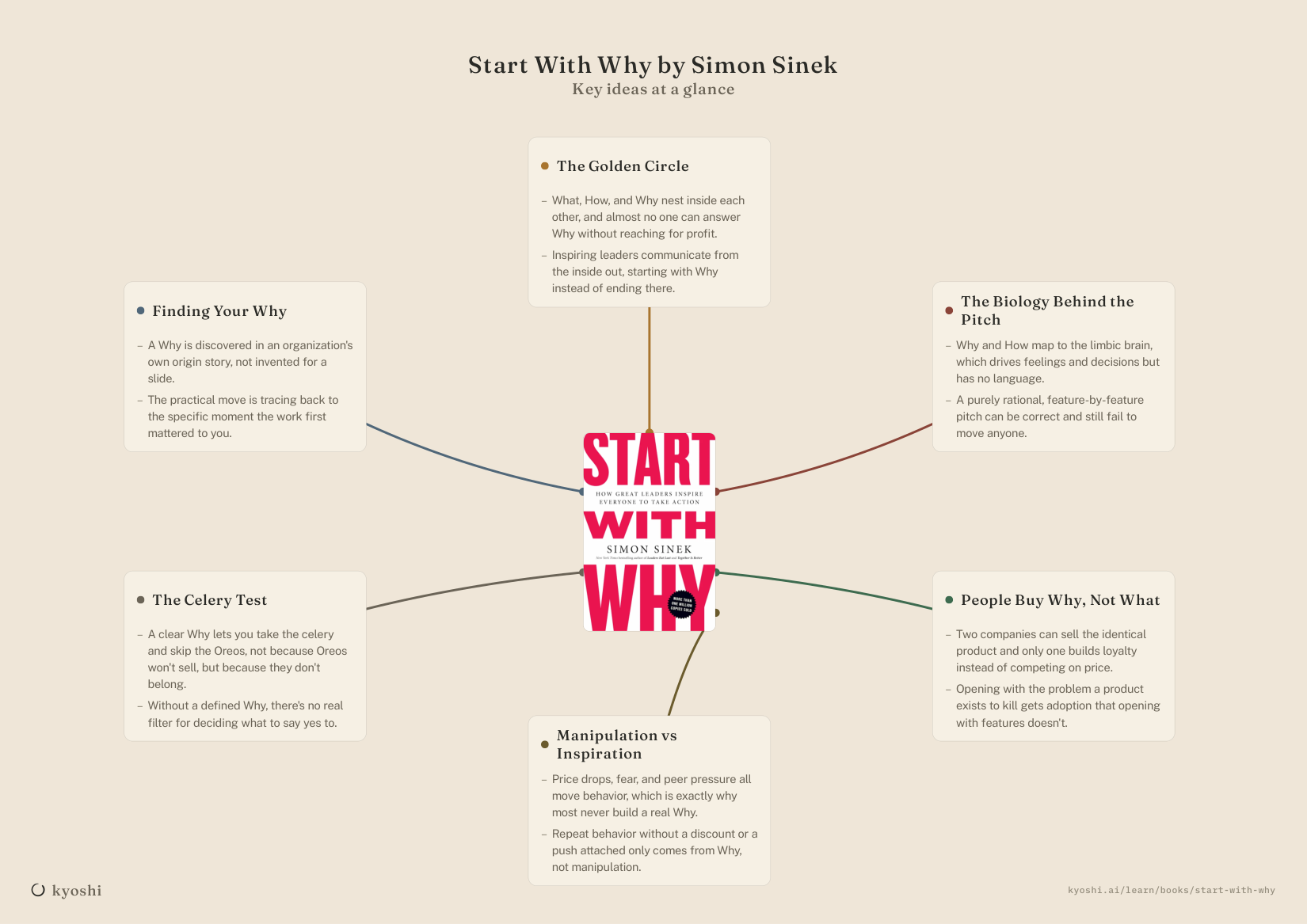
The Golden Circle
Three questions, nested: What you do (every organization can answer this), How you do it (your process, your differentiator, which fewer can answer clearly), and Why you do it (the purpose, cause, or belief behind all of it, which almost none can answer without reaching for "to make a profit," which is a result, not a reason). Most communication runs outside-in: What, then How, then maybe Why. Sinek's claim is that organizations and leaders who inspire run the opposite direction, starting from Why.
The Biology of Decision-Making
Sinek maps the Golden Circle onto brain structure: the outer "What" layer corresponds to the neocortex, responsible for rational, analytical thought and language. The inner "Why" and "How" layers correspond to the limbic brain, responsible for feelings, trust, and decision-making. The limbic brain has no capacity for language. That's why a Why-driven pitch feels compelling without the listener being able to fully articulate why it's compelling, and why a purely rational, feature-by-feature pitch can be "correct" and still fail to move anyone.
People Don't Buy What You Do, They Buy Why You Do It
Two companies can sell the same product at the same price with the same features, and one builds a loyal following while the other wins on price alone until a cheaper competitor shows up. The difference is whether customers feel like they're buying a product or joining a belief. Manager A pitches a new internal tool by walking through every feature. Manager B opens with the specific problem the tool exists to kill and lets the features follow. The second pitch gets adoption; the first gets a shrug and a "looks fine."
Manipulation vs. Inspiration
You can get short-term behavior out of people with manipulation tactics: price drops, promotions, fear, aspirational messaging, peer pressure, novelty. They all work, which is exactly the problem. They work well enough that most organizations never have to develop a real Why, and they produce transactions, not loyalty. The tell is repeat behavior without a discount, a push, or a fear attached. That only comes from Why.
The Celery Test
A simple filter for deciding what to say yes to: if your Why is "we believe in health," and someone pitches adding both celery and Oreos to your lineup because "customers want variety," the Celery Test says take the celery, skip the Oreos. Not because Oreos won't sell, but because they don't belong. Most organizations can't apply a filter like this because they've never actually defined the Why clearly enough for it to filter anything.
Finding Your Why
A Why is discovered, not invented. Sinek argues it's usually sitting in an organization's own origin story, in whatever problem the founder (or the team, or you personally) originally set out to fix, before the mission statement got written by committee. For a leader without a tidy founding story, the practical move is the same: trace back to the specific moment you decided this work mattered, and start from there instead of from a slide.
Putting It Together
What and How are necessary but not sufficient. They explain the product, not the pull. Why is what makes the Golden Circle work in the right direction, lets you apply a real filter (the Celery Test) to decisions, and is the difference between customers and employees you manipulated into a transaction versus ones you actually inspired into loyalty.
Why It Matters for Leaders
Most managers can explain what their team does and how. Almost none can tell you why, in a way that isn't a slogan on a slide. That gap is easy to miss because the team still ships work either way. What it costs you shows up later, in who stays when a competitor offers more money, and who actually cares whether the thing they built works.
Here's the practical use of this model: it tells you what to lead with. When you're pitching a reorg, a new process, or asking someone to take on a hard project, the instinct is to open with the plan, the what. People nod along and then decide, without saying so, that it's not their problem. Open instead with the actual problem you're trying to kill, or the reason the work matters to you, and watch whether people start asking questions instead of just taking notes.
The Celery Test is the other piece worth stealing directly. Most managers say yes to good ideas because they'd probably work, not because they fit. A feature request, a new initiative, a hire who's talented but pulls the team in a different direction: all of these can be individually reasonable and still be the wrong yes. Before approving the next "good idea" that lands on your desk, ask whether it actually serves what your team is for, not just whether it would work.
Watch your own wins, too. If your team hit its number because of a deadline, a bonus, or a fear of missing a target, that's manipulation, and it's not wrong to use it occasionally. But if you're mistaking that result for loyalty, you'll be surprised the day the deadline isn't there and the effort doesn't show up either.
Picture a manager named Daniel rolling out a new internal process. He opens the all-hands with a slide of the rollout timeline and the tooling changes, and the room is polite and unmoved. Two weeks later, adoption is weak. He tries again, this time opening with the actual problem: three customers walked away last quarter because of a mistake this process exists to prevent. He barely gets to the timeline before people start asking how soon they can start.
What to do next
Reinforce your understanding of Start With Why
Books related to Start With Why

Built to Last
Collins and Porras' earlier, lesser-known study of visionary companies: the research that came before Good to Great, built around a single hard question: what actually survives past the founder, the product, and the current strategy?

Good Strategy Bad Strategy
Richard Rumelt's blunt case that most of what gets called "strategy" in a typical planning meeting is actually a wish list dressed up in strategic language, plus a concrete test for telling the two apart.

Good to Great
Jim Collins' research into why some companies go from average to sustained market dominance, and others don't. Read less as a book about companies and more as a book about the kind of leader you have to become before a company (or a team) can get great.

Sun Tzu and The Art of Business
Mark McNeilly's translation of Sun Tzu's 2,500-year-old military strategy into six concrete business principles, built around a point most business books skip: the best wins are the ones nobody had to fight for.

The Art of War
The original 2,500-year-old military treatise, read the way most modern leaders actually use it. Not as a manual for fighting better, but as a manual for needing to fight less.

The Infinite Game
Simon Sinek's case that most leaders are playing the wrong game entirely: treating an endless competition as something you can win, when the only real goal is staying in it, strong enough to keep playing.

The Innovator's Dilemma
Clayton Christensen's answer to a puzzle that looks impossible: well-run companies, doing everything their best customers ask for, still lose to products that look worse on every spec sheet, right up until the moment they don't. The book every leader cites and few actually apply to their own team.

Walmart
A retail-industry case study of how Walmart built, and is now fighting to defend, the position it spent sixty years earning. Less a biography of Sam Walton and more a hard look at what scale economics can and can't protect you from in the age of Amazon.

Your Next Five Moves
Patrick Bet-David's chess-inspired framework for strategic leadership, built around five "moves" every founder or executive has to master in order, from knowing yourself to running power plays against bigger competitors, instead of just reacting to whatever just happened.
Skills related to Start With Why

Frameworks referenced from this book

Frameworks related to Start With Why
BCG Matrix
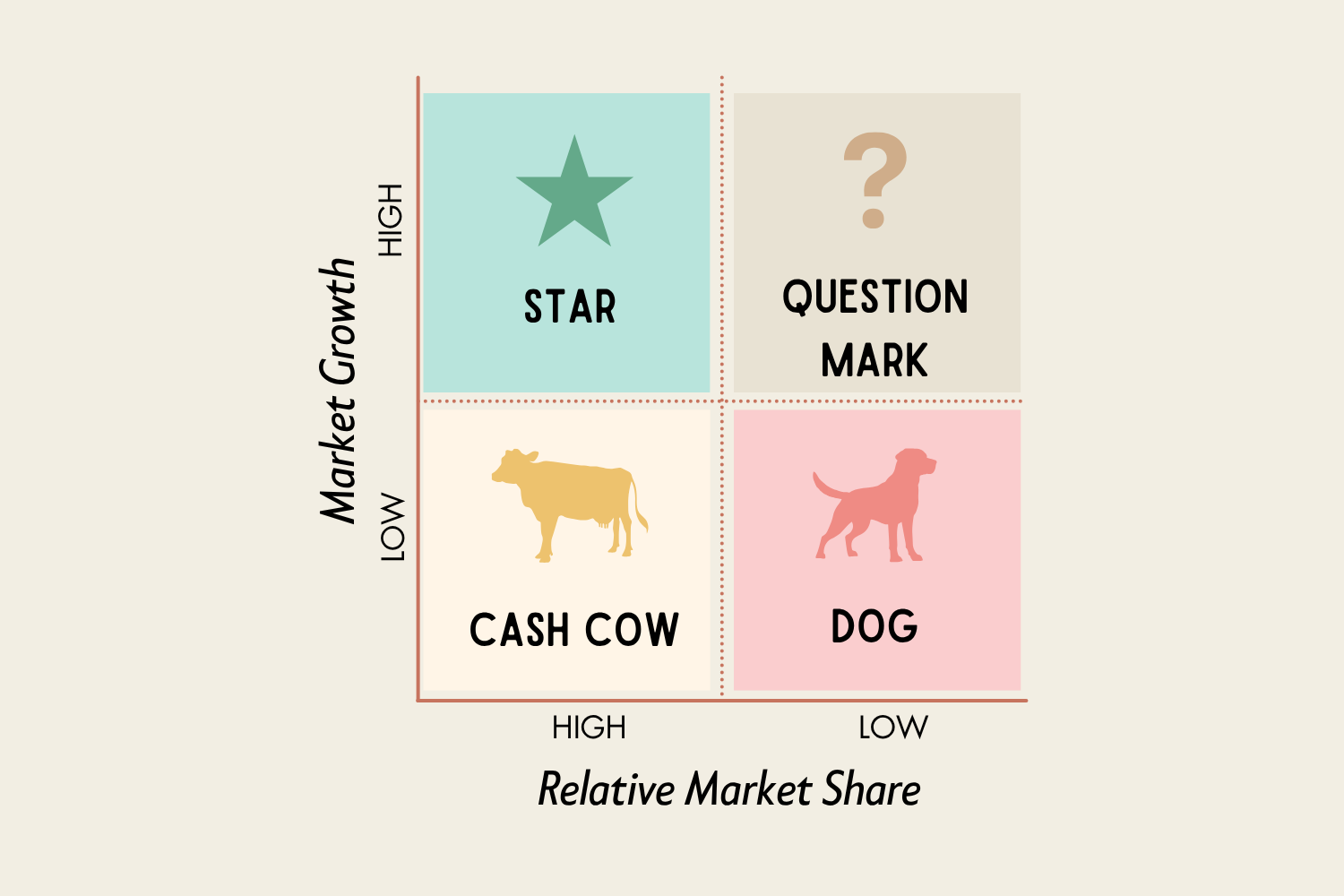
A 2x2 that sorts products or units by market growth and share — telling you what to fund, milk, or kill.

McKinsey's Three Horizons Model
Split your team's effort across three time frames — defend the core, grow what's emerging, seed future bets — without mortgaging tomorrow.

Porter's Five Forces
Porter's answer to why some industries are brutal for profit — five forces shaping any market, telling you where to compete.
Rumelt's Kernel
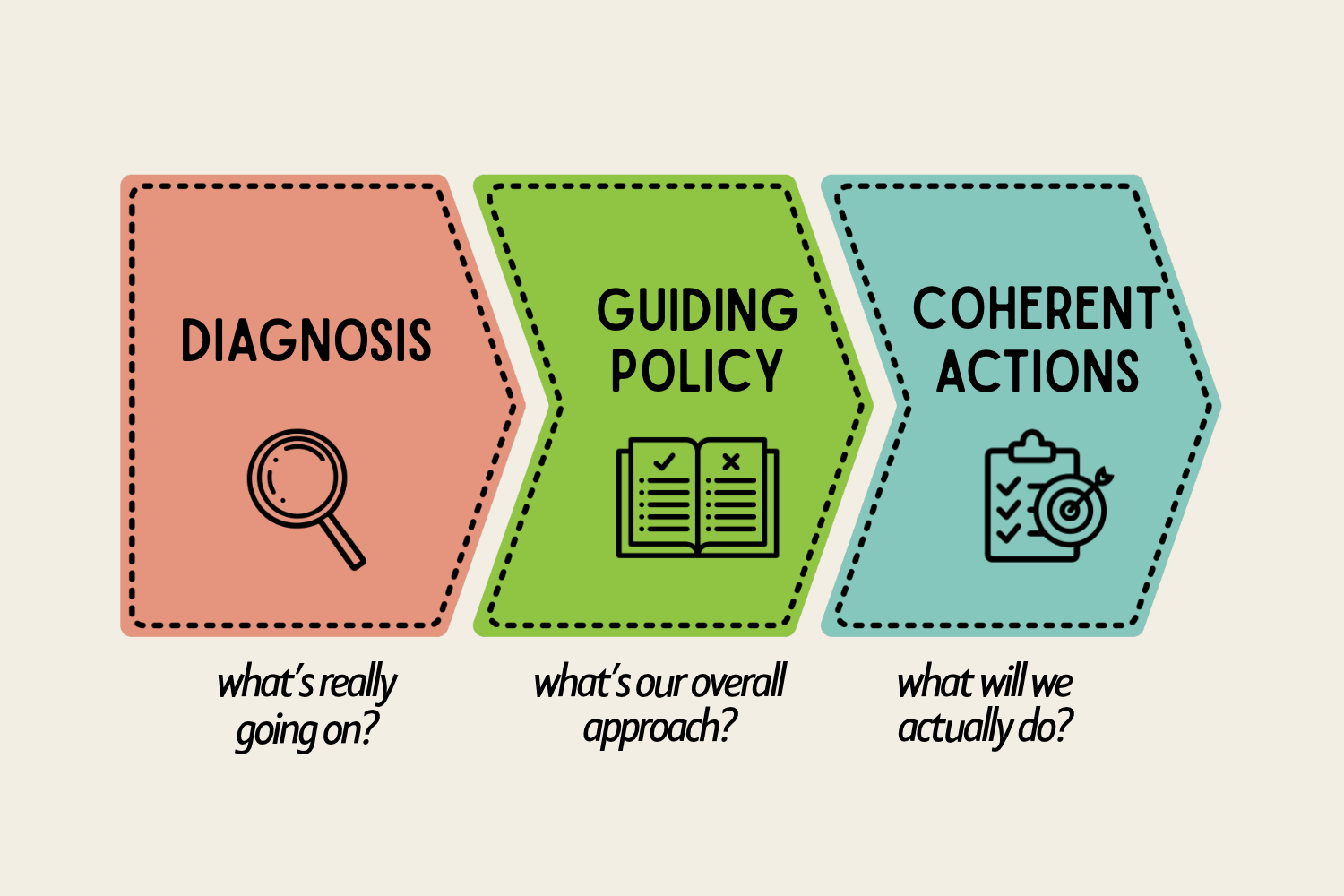
Richard Rumelt's test for telling a real strategy from a list of goals — a diagnosis, a guiding policy, and coherent actions. Miss any one of the three and what you have is a wish, not a strategy.

The Innovator's Dilemma
Clayton Christensen's explanation for why great companies fail doing everything right — serving your best customers blinds you to cheap newcomers.