The Infinite Game
Simon Sinek's case that most leaders are playing the wrong game entirely: treating an endless competition as something you can win, when the only real goal is staying in it, strong enough to keep playing.
 Find this on the mind-map
Introduction
Sinek borrows a distinction from the philosopher James Carse: finite games have fixed players, fixed rules, and an agreed-upon end, like chess or a football season. Infinite games have no fixed end and no fixed players; the rules can change, people can enter and leave anytime, and there's no final whistle. Business, politics, and most careers are infinite games. The trouble is that most leaders still play them like finite ones, chasing quarterly "wins," trying to "beat" a competitor once and for all, and that mismatch is the actual root of most short-term thinking.
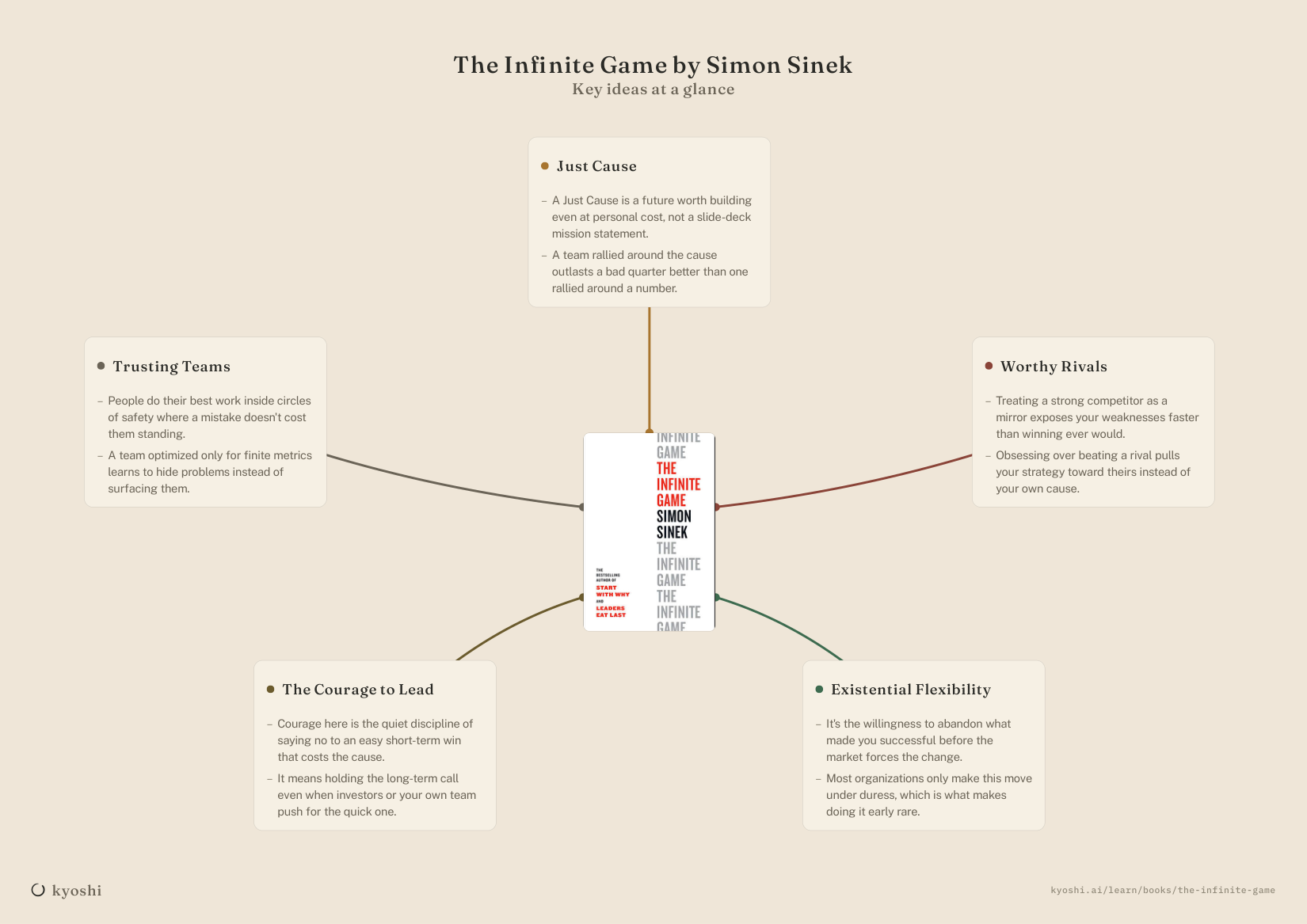
Just Cause
A Just Cause is a specific, future-focused vision of a world that doesn't exist yet, one worth building even at personal cost. It's not a mission statement written for a slide. Contrast a manager who rallies a team around hitting this quarter's number with one who rallies the same team around the reason the number is supposed to serve. The second team tends to outlast the first through a bad quarter, because the cause survives the miss.
Worthy Rivals
A finite-minded leader sees a competitor as an enemy to defeat. An infinite-minded leader treats a strong competitor as a mirror: a Worthy Rival whose strengths expose exactly where you're weak, and whose existence sharpens you faster than winning ever would. Obsessing over beating a rival pulls your strategy toward theirs instead of toward your own cause.
Existential Flexibility
The willingness to make a significant, even painful, shift in strategy or identity if it's what the Just Cause actually requires, abandoning the thing that made you successful, before the market forces you to. Most organizations only make this move under duress, which is exactly what makes it rare and valuable when a leader makes it early.
The Courage to Lead
Playing the infinite game requires the courage to make decisions that serve the long-term cause even when finite-minded voices around you (investors, a board, even your own team) are pushing for the short-term win. Courage here isn't dramatic; it's the quieter discipline of saying no to the easy finite win that would compromise the cause.
Trusting Teams
People do their best work inside circles of safety, where admitting a mistake or asking for help doesn't cost them standing. A team optimized purely for finite performance metrics trains people, without anyone saying so, to hide problems instead of surfacing them, which is slower and more expensive than the metric it was protecting.
Putting It Together
A Just Cause gives the game a direction worth playing for. Worthy Rivals and Existential Flexibility keep you honest about where you actually stand and willing to change course. Courage and Trusting Teams are what let an organization actually act on both, instead of just believing in them on paper.
Why It Matters for Leaders
Most of the pressure a manager feels day to day comes from finite-game thinking dressed up as urgency: beat this quarter, beat that competitor, close this deal before they do. None of that is wrong exactly, but Sinek's point is that treating any of it as the actual goal sets you up to make short-term calls that cost you in a game that never ends.
The useful habit is checking your own language for finite framing before it becomes a decision. "We need to win this deal" is a finite sentence. "We need to be the kind of company this customer trusts for the next ten years" is an infinite one, and it leads to a different negotiation. The words you use to rally a team aren't neutral; they set what the team optimizes for when you're not in the room.
Worthy Rivals is the practice leaders misuse most, because it's tempting to pick a rival who makes you feel good by comparison rather than one who actually exposes a real gap. If your competitive benchmark never makes you uncomfortable, it's not doing its job. The discomfort is the point: it tells you exactly where to improve instead of where to feel superior.
And Trusting Teams is the one that determines, without anyone announcing it, whether any of the rest is real. A leader who talks about the long game while punishing the first person to admit a miss is still playing finite, no matter what the slide deck says.
Picture a manager, Lucas, whose team just lost a deal to a competitor they've been chasing for a year. His first instinct is to call an emergency meeting about "how we beat them next time." Instead, he asks the team what the loss actually revealed about a weakness in their product, not just the rival's strength, and spends the next quarter fixing that gap instead of plotting the next head-to-head win.
What to do next
Reinforce your understanding of The Infinite Game
Books related to The Infinite Game

Built to Last
Collins and Porras' earlier, lesser-known study of visionary companies: the research that came before Good to Great, built around a single hard question: what actually survives past the founder, the product, and the current strategy?

Good Strategy Bad Strategy
Richard Rumelt's blunt case that most of what gets called "strategy" in a typical planning meeting is actually a wish list dressed up in strategic language, plus a concrete test for telling the two apart.

Good to Great
Jim Collins' research into why some companies go from average to sustained market dominance, and others don't. Read less as a book about companies and more as a book about the kind of leader you have to become before a company (or a team) can get great.

Start With Why
Simon Sinek's argument that people don't buy what you do, they buy why you do it, and that most organizations have never actually answered the question, even the ones that think they have.

Sun Tzu and The Art of Business
Mark McNeilly's translation of Sun Tzu's 2,500-year-old military strategy into six concrete business principles, built around a point most business books skip: the best wins are the ones nobody had to fight for.

The Art of War
The original 2,500-year-old military treatise, read the way most modern leaders actually use it. Not as a manual for fighting better, but as a manual for needing to fight less.

The Innovator's Dilemma
Clayton Christensen's answer to a puzzle that looks impossible: well-run companies, doing everything their best customers ask for, still lose to products that look worse on every spec sheet, right up until the moment they don't. The book every leader cites and few actually apply to their own team.

Walmart
A retail-industry case study of how Walmart built, and is now fighting to defend, the position it spent sixty years earning. Less a biography of Sam Walton and more a hard look at what scale economics can and can't protect you from in the age of Amazon.

Your Next Five Moves
Patrick Bet-David's chess-inspired framework for strategic leadership, built around five "moves" every founder or executive has to master in order, from knowing yourself to running power plays against bigger competitors, instead of just reacting to whatever just happened.
Skills related to The Infinite Game

Frameworks related to The Infinite Game
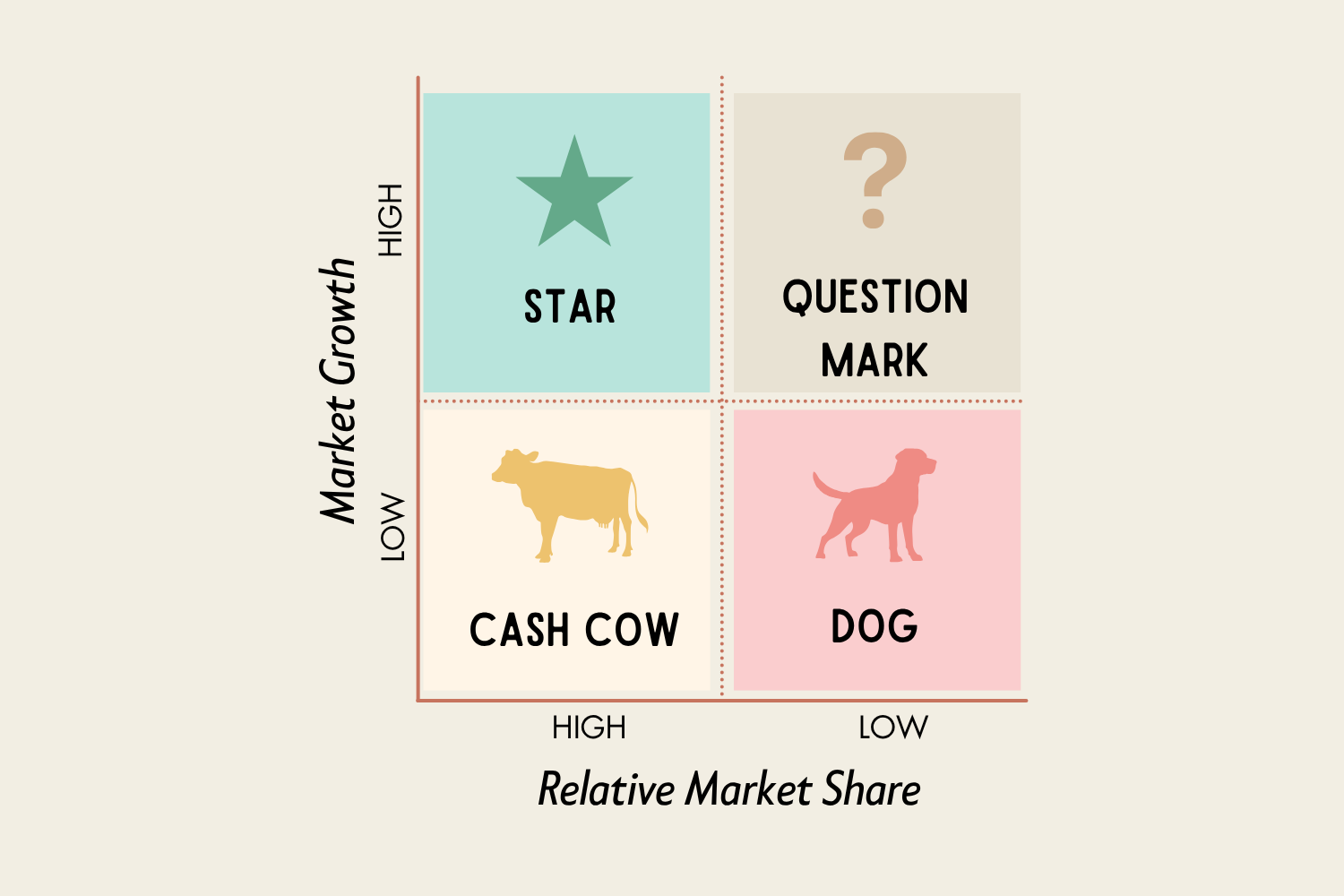
BCG Matrix
A 2x2 that sorts products or units by market growth and share — telling you what to fund, milk, or kill.

McKinsey's Three Horizons Model
Split your team's effort across three time frames — defend the core, grow what's emerging, seed future bets — without mortgaging tomorrow.

Porter's Five Forces
Porter's answer to why some industries are brutal for profit — five forces shaping any market, telling you where to compete.
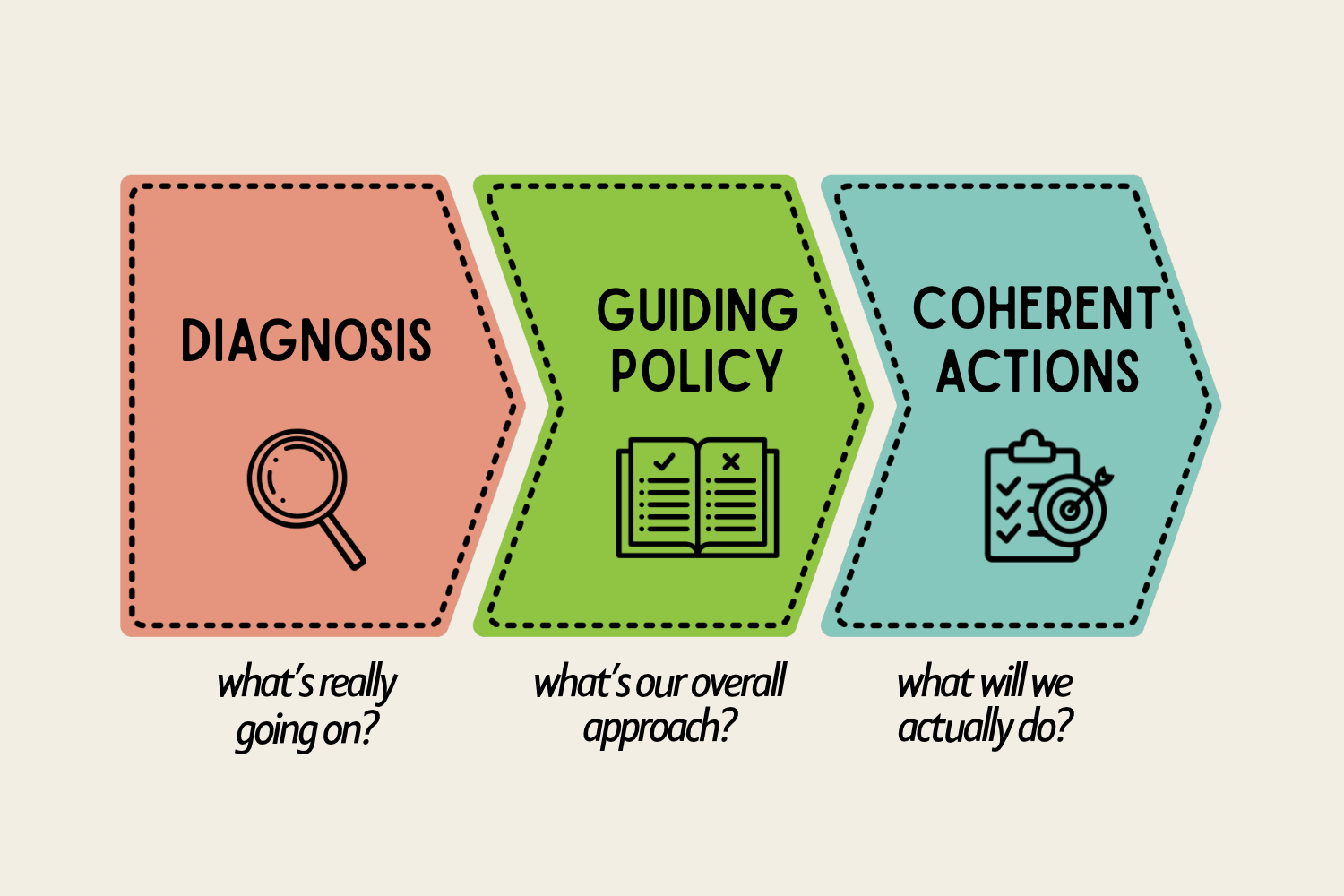
Rumelt's Kernel
Richard Rumelt's test for telling a real strategy from a list of goals — a diagnosis, a guiding policy, and coherent actions. Miss any one of the three and what you have is a wish, not a strategy.

The Innovator's Dilemma
Clayton Christensen's explanation for why great companies fail doing everything right — serving your best customers blinds you to cheap newcomers.