Six Thinking Hats
Edward de Bono's fix for the meeting where everyone argues past each other because they're all doing a different kind of thinking at the same time, a simple discipline for making a group think one way, together, on purpose, instead of six ways at once.
 Find this on the mind-map
Introduction
Most meetings fail at thinking before they fail at anything else. One person is privately worried about risk, another is defending the idea they proposed, a third is trying to be positive for morale, and a fourth is just reciting facts, and because nobody agrees what kind of thinking the room is doing at any given moment, the conversation turns into cross-talk dressed up as debate. Edward de Bono's fix is deceptively simple: stop letting everyone think a different way at the same time. Pick one mode, have everyone think that way together, then switch.
The Hats, and What Each One Actually Does
Six metaphorical hats, each standing for a distinct mode of thinking:
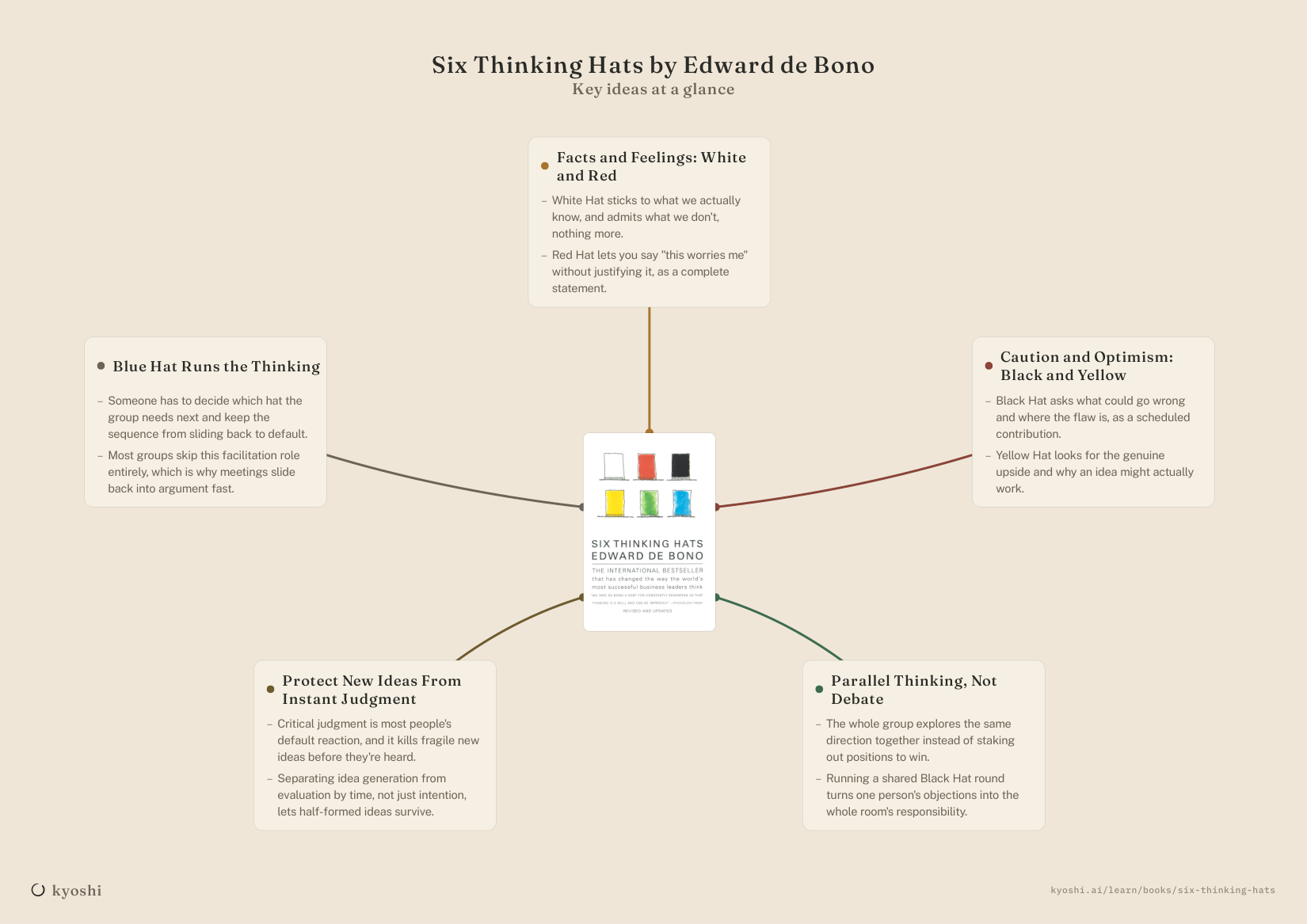
- White: facts and data only. What do we actually know, and what do we not know?
- Red: feelings and intuition, stated without justification. "This worries me" is a complete sentence.
- Black: caution and critical judgment. What could go wrong, what's the risk, where's the flaw?
- Yellow: optimism and value. What's genuinely good about this, and why might it work?
- Green: new ideas and alternatives. What else could we try that we haven't said yet?
- Blue: control of the thinking itself. Where are we in the process, and what hat do we need next?
None of the hats are a personality. Nobody "is" a Black Hat thinker. Everyone wears every hat at different points. That's the entire point.
Parallel Thinking, Not Adversarial Debate
Western meeting culture defaults to adversarial argument: I state a position, you attack it, I defend it, and whoever argues better "wins," regardless of whether the best idea in the room survived the process. De Bono calls his alternative parallel thinking: the whole group explores the same direction at once, under the same hat, instead of staking out opposing positions and fighting. A team doing Yellow Hat together is genuinely looking for the upside together, not having an optimist defend their view against a pessimist's attack. This removes ego from the exercise: nobody has to "win" the Black Hat argument, because everyone is just doing Black Hat thinking for five minutes, then moving on.
Picture a product review where Tom always plays devil's advocate and Priya always plays cheerleader. Over time, the team stops hearing either of them. Tom's risk flags get discounted as "Tom being Tom," and Priya's enthusiasm gets discounted as "Priya being nice." Run the same review with hats: for two minutes, the whole room is Black Hat, Tom included, Priya included. The risks that surface aren't "Tom's objections" anymore. They're the room's objections, surfaced on purpose, with nobody's reputation on the line for raising them.
Why Separating Critical Judgment Helps Creativity Survive
De Bono's sharpest observation is that critical thinking (Black Hat) is the mode most people default to first, reflexively, whenever a new idea is raised, and a fragile new idea raised in a room full of instant critics usually dies before it's even been understood. Separating Green Hat (pure idea generation) from Black Hat (evaluation) by time, not just by intention, protects half-formed ideas long enough to be heard. The discipline isn't "don't criticize." It's "not yet."
Blue Hat: Someone Has to Run the Thinking
The Blue Hat is thinking about the thinking: deciding what hat the group needs next, summarizing where things stand, and keeping the sequence honest when the room drifts back into default mode (usually straight to Black). In practice this is a facilitation role, often the meeting leader's, and it's the hat most groups skip entirely, which is exactly why most meetings slide back into unstructured argument within five minutes.
Putting It Together
The six hats aren't a personality test or a brainstorming gimmick. They're a sequencing tool. Most meetings don't fail from a lack of good ideas or valid concerns; they fail because facts, feelings, risk, optimism, and new ideas all get voiced in the same thirty seconds, each one undermining the others before any of them gets a real hearing. Separate the modes, give each one its turn, and the same room with the same people produces sharper thinking without anyone becoming a better debater.
Why It Matters for Leaders
The real cost of an unstructured meeting isn't that it's unpleasant. It's that it throws away information the room actually has, and nobody notices the loss because the meeting still felt like a real conversation. The engineer who's worried about a dependency says nothing because the room is in "sell the plan" mode. The person with the best new idea never says it, because the room is in "poke holes" mode. Neither is a people problem. It's a sequencing problem, and de Bono's fix is specific enough to actually use.
The thing a manager running the meeting can actually control is naming the mode out loud, before people start talking. Say "we're doing Black Hat for five minutes, risks only" and you've turned a scary thing to say into a scheduled contribution. Say "Green Hat first, no critiquing yet" and the junior person with the weird idea gets thirty seconds of real air before anyone's allowed to shoot it down. The content of the meeting doesn't change. Who gets heard, and when, changes completely.
This also fixes a specific trap that forms over time on any team: the designated skeptic and the designated optimist. Once someone's played the critic three meetings in a row, their objections stop registering as information and start registering as personality, "that's just Raj being negative." Running an actual Black Hat round, with everyone in it, strips the personality label off the concern and puts it back in front of the room as something the whole team is responsible for weighing.
Picture a manager, Dana, running a quarterly planning meeting where the same two people always end up locked in the same argument: one pushing for the ambitious roadmap, one flagging every reason it won't work. Instead of letting them debate, she runs a ten-minute Black Hat round for the whole team, then a ten-minute Yellow Hat round for the whole team, same people, same roadmap. The risks that come out in the Black Hat round aren't "the skeptic's objections" anymore. Three other people raise two of them independently, which is the information Dana actually needed and would have missed if she'd just let the usual two people argue it out.
What to do next
Reinforce your understanding of Six Thinking Hats
Books related to Six Thinking Hats

Creativity, Inc.
Pixar co-founder Ed Catmull's record of building a studio where brilliant, well-intentioned people still nearly wrecked their own creative process, and the specific habits that protected it instead. Less a book about animation than a book about managing anything fragile and unfinished.

Loonshots
Physicist-turned-biotech-CEO Safi Bahcall borrows a concept from phase transitions in physics (the same sudden shift that turns water to ice) to explain why the same smart people, in the same company, kill their best "crazy" ideas as they grow, and what structure, not willpower, it takes to stop that from happening.

Originals
Adam Grant's case that originality isn't a fearless personality trait, it's a set of specific, learnable moves that scared, doubtful people use to get a novel idea past the resistance everyone meets when they try something new.

Range
David Epstein's case against the cult of early specialization, using Roger Federer's meandering path through half a dozen sports against Tiger Woods' single-minded golf-only childhood to show why breadth, not a head start, wins in most of the problems that actually matter.

The Innovator's Dilemma
Clayton Christensen's answer to a puzzle that looks impossible: well-run companies, doing everything their best customers ask for, still lose to products that look worse on every spec sheet, right up until the moment they don't. The book every leader cites and few actually apply to their own team.
Skills related to Six Thinking Hats

Frameworks referenced from this book
Frameworks related to Six Thinking Hats

Design Thinking
A human-centered process — empathize, define, ideate, prototype, test — for understanding the people living a problem before you design anything.

Lego Serious Play
A guided exercise building LEGO models as metaphors for a problem, then explaining them aloud, surfacing what discussions miss.

SCAMPER Technique
Seven forced questions — Substitute, Combine, Adapt, Modify, Put to another use, Eliminate, Reverse — generating ideas by twisting what exists.

The Six Thinking Hats
Get your whole team thinking in the same mode at once — facts, emotions, risk, benefits, creativity, process — covering every angle.