Creativity, Inc.
Pixar co-founder Ed Catmull's record of building a studio where brilliant, well-intentioned people still nearly wrecked their own creative process, and the specific habits that protected it instead. Less a book about animation than a book about managing anything fragile and unfinished.
 Find this on the mind-map
Introduction
Pixar's co-founder didn't write a book about animation technique. He wrote a book about a harder problem: even when you hire genuinely talented, well-meaning people, a creative organization can still slowly strangle its own best work, through habits nobody intended and few people notice happening. Creativity, Inc. is Ed Catmull's record of the specific structures Pixar built to keep that from happening, and the times those structures weren't enough.
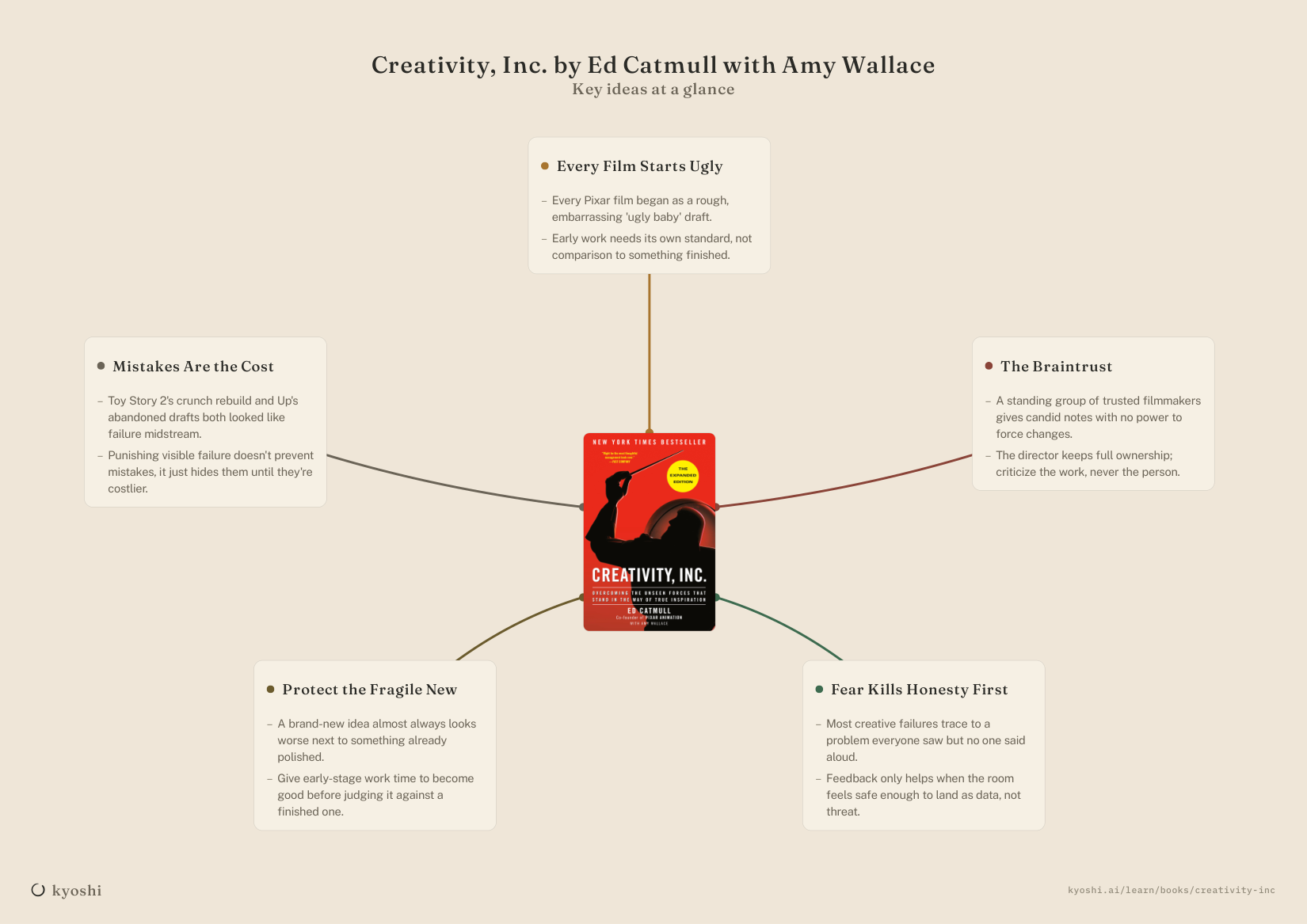
Every Good Film Starts Ugly
Catmull's term is the "ugly baby": every film Pixar has made was, at some early stage, bad. Not promising-but-rough. Bad. The instinct when you see an unfinished, awkward draft is to judge it as if it were the finished thing, which kills ideas that simply hadn't had time to become good yet. Protecting early work means judging it by a different standard than finished work, not lowering the bar, but recognizing which bar actually applies at that stage.
The Braintrust: Candor Without Authority
Pixar's solution for giving honest feedback without killing the director's ownership of the film is the Braintrust, a standing group of trusted, experienced filmmakers who review work in progress and say exactly what isn't working, with no authority to force a change. The director hears everything, then decides what to do with it. This only works because of a specific norm: criticize the work, never the person, and separate the person's worth from the current cut's problems. A Braintrust session that feels like a performance review instead of a peer diagnosis has already failed, no matter how accurate the notes are.
Fear Kills Honesty Before It Kills Ideas
Most creative failures Catmull describes aren't failures of talent. They're failures of candor: a problem everyone saw and nobody said out loud soon enough, because saying it felt risky. Picture two directors getting the same rough cut back from a test screening. Marcus hears "it's not working yet" as an attack and spends the next meeting defending every choice; the same honest notes bounce off him for weeks. Sofia hears the same notes as data about the film, not a verdict on her, and the film improves within days. The difference wasn't the feedback. It was whether the room was safe enough for the feedback to actually land as information instead of threat. Building that safety was management's job, not the feedback-giver's.
Protect the New, Precisely Because It's Fragile
A new idea, in its earliest form, is almost always worse-looking than an established, polished alternative, which means a fair, apples-to-apples comparison will nearly always favor the thing that already exists. Catmull's answer is to deliberately protect early-stage work from being judged by the same standards as finished work, and to give it enough runway to become what it's actually capable of becoming before passing final judgment.
Mistakes Are the Cost of Making Anything New
Pixar's films all went through phases that looked, internally, like failure: Toy Story 2's long crunch rebuild, Up's abandoned early drafts. Catmull's conclusion isn't "avoid mistakes," it's "make it survivable to be wrong early and often, and expensive to find out you were wrong late." A culture that punishes visible failure doesn't get fewer mistakes. It gets the same mistakes, hidden longer, discovered later, at a much higher cost.
Putting It Together
None of this works as a single trick. Ugly babies need the Braintrust's honest notes to become good; honest notes only land in a culture where candor doesn't feel like an attack; and candor only survives if mistakes are treated as the normal cost of making anything new, not as proof someone should have known better. Pull out any one piece and the whole system reverts, without much notice, to polishing ideas that are safe instead of pursuing ones that are actually good.
Why It Matters for Leaders
Most managers think they already run an open, honest team. The actual test isn't whether people speak up. It's whether early, rough work gets judged by the standard it deserves or the standard that's easiest to apply, which is almost always "does this look as good as the thing we already shipped." By that standard, nothing new survives its first week.
The practical move is building your own small Braintrust: two or three people whose only job, when you show them something unfinished, is to tell you what isn't working yet, with zero authority to make you change it. The authority staying with you is what makes the room safe enough for the notes to be useful instead of threatening. If the people you ask only ever tell you what's working, you haven't built a Braintrust. You've built an audience.
The harder discipline is noticing when you're the one about to kill an ugly baby. A new idea pitched next to a polished, finished one will almost always look worse in the room, and that comparison is unfair in a specific, fixable way: one of them has had months to get good and the other hasn't had a week. Catching yourself making that comparison, and naming it out loud before the group does the same, is most of the job.
Picture a product lead, Daniela, reviewing two prototypes in the same meeting: a mature feature her team has polished for a quarter, and a rough new concept a junior designer sketched last week. The room's energy clearly favors the polished one. Daniela's job isn't to pretend they're equally good right now. It's to say, out loud, "this one's had twelve weeks and this one's had five days, let's judge them on that basis" and ask what the rough idea would need to become good, instead of asking why it isn't good yet.
What to do next
Reinforce your understanding of Creativity, Inc.
Books related to Creativity, Inc.

Loonshots
Physicist-turned-biotech-CEO Safi Bahcall borrows a concept from phase transitions in physics (the same sudden shift that turns water to ice) to explain why the same smart people, in the same company, kill their best "crazy" ideas as they grow, and what structure, not willpower, it takes to stop that from happening.

Originals
Adam Grant's case that originality isn't a fearless personality trait, it's a set of specific, learnable moves that scared, doubtful people use to get a novel idea past the resistance everyone meets when they try something new.

Range
David Epstein's case against the cult of early specialization, using Roger Federer's meandering path through half a dozen sports against Tiger Woods' single-minded golf-only childhood to show why breadth, not a head start, wins in most of the problems that actually matter.

Six Thinking Hats
Edward de Bono's fix for the meeting where everyone argues past each other because they're all doing a different kind of thinking at the same time, a simple discipline for making a group think one way, together, on purpose, instead of six ways at once.

The Innovator's Dilemma
Clayton Christensen's answer to a puzzle that looks impossible: well-run companies, doing everything their best customers ask for, still lose to products that look worse on every spec sheet, right up until the moment they don't. The book every leader cites and few actually apply to their own team.
Skills related to Creativity, Inc.

Frameworks related to Creativity, Inc.

Design Thinking
A human-centered process — empathize, define, ideate, prototype, test — for understanding the people living a problem before you design anything.

Lego Serious Play
A guided exercise building LEGO models as metaphors for a problem, then explaining them aloud, surfacing what discussions miss.

SCAMPER Technique
Seven forced questions — Substitute, Combine, Adapt, Modify, Put to another use, Eliminate, Reverse — generating ideas by twisting what exists.

The Six Thinking Hats
Get your whole team thinking in the same mode at once — facts, emotions, risk, benefits, creativity, process — covering every angle.