Loonshots
Physicist-turned-biotech-CEO Safi Bahcall borrows a concept from phase transitions in physics (the same sudden shift that turns water to ice) to explain why the same smart people, in the same company, kill their best "crazy" ideas as they grow, and what structure, not willpower, it takes to stop that from happening.
 Find this on the mind-map
Introduction
A "loonshot," in Safi Bahcall's term, is a widely dismissed idea, usually championed by someone treated as a little unreasonable for believing in it, that goes on to transform an industry: early radar, the vacuum-tube amplifier, a cancer drug nobody wanted to fund. The puzzle Bahcall is actually solving isn't how to come up with loonshots; most organizations have no shortage of weird early ideas. It's why the same organization, staffed with the same smart, well-meaning people, reliably gets worse at nurturing them as it succeeds and grows.
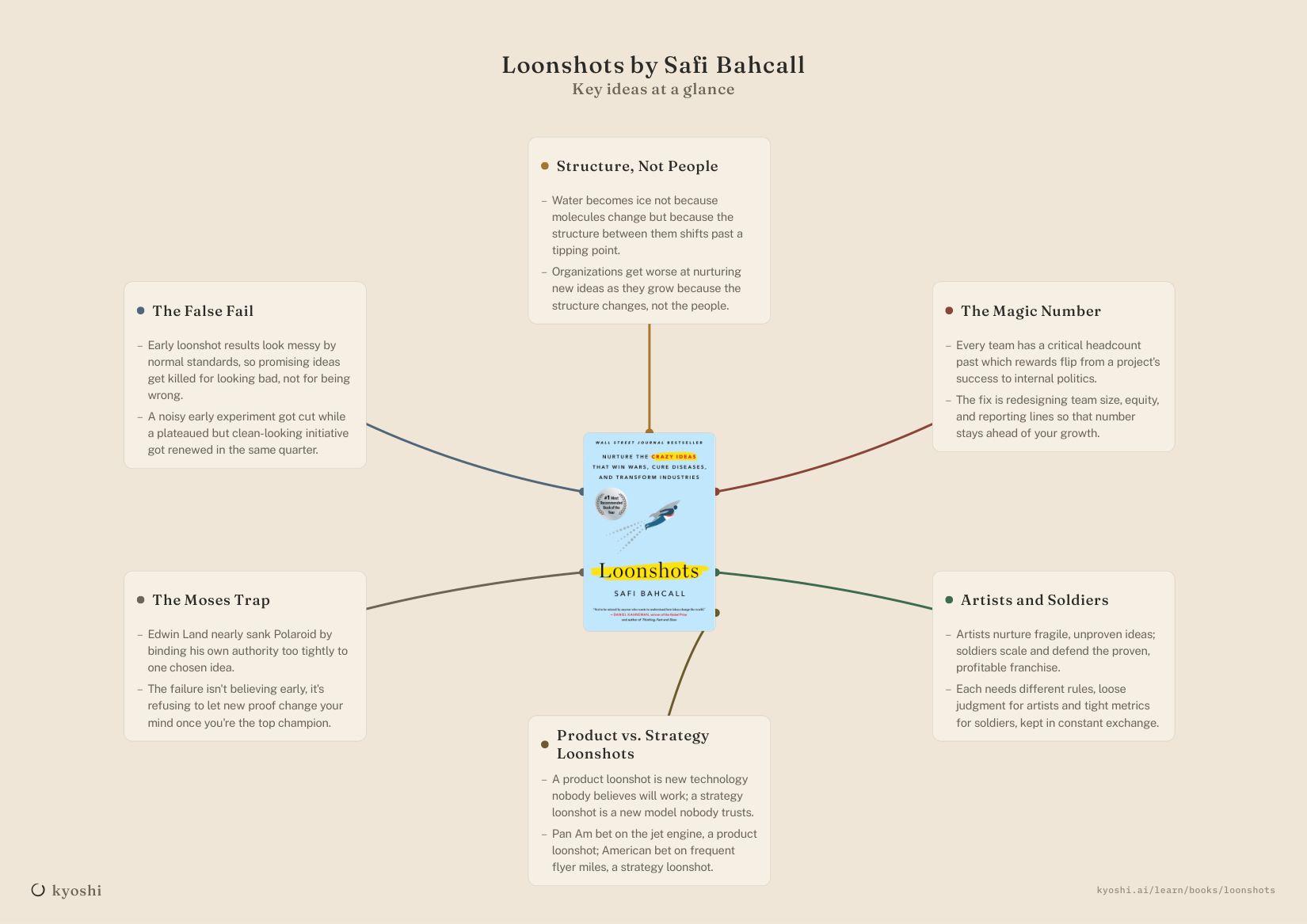
The Phase Transition: It's Structure, Not People
Bahcall's central metaphor comes from physics: water becomes ice not because its molecules change, but because the relationships between them shift past a tipping point: same ingredients, different structure, radically different behavior. He argues organizations go through an equivalent phase transition as they scale. A small, scrappy team naturally protects fragile new ideas; a larger, successful one naturally shifts toward protecting what's already working. The people didn't get worse at creativity. The structure around them, specifically team size, changed what behavior gets rewarded.
The Magic Number: Why Growing Teams Quietly Change the Rules
Bahcall pushes the physics further than metaphor: he argues every team has a "magic number," a critical headcount past which the dominant currency for getting ahead flips from the success of your project to the politics of your rank. Below that number, people are rewarded for making the idea work; above it, they're rewarded for managing up and defending turf, often without anyone deciding that on purpose. The number itself depends on things like how much equity or ownership people feel in the outcome and how wide each manager's span of control is. That's why the fix isn't a slogan about innovation, it's literally redesigning team size, equity, and reporting lines so the magic number stays ahead of you as you grow.
Artists and Soldiers
Every organization needs two different kinds of work happening at once: "artists," who nurture early, fragile, unproven ideas that look bad by any current metric, and "soldiers," who scale and defend the proven, profitable franchise. Artists explore the bizarre, soldiers grow the franchise. Artists need loose controls and creative, qualitative judgment; soldiers need tight controls and quantitative targets. Bahcall's fix isn't picking a side. It's building a "loonshot nursery" that structurally separates the two groups, so each is managed, measured, and promoted by rules suited to its stage, while senior leadership keeps them in constant, respectful exchange, a balance he calls dynamic equilibrium. Separation without that exchange just produces an isolated skunkworks that never ships anything the main business adopts; exchange without separation just lets the franchise group's metrics slowly strangle the artists' early work.
Two Kinds of Loonshots
Bahcall splits loonshots into two types, illustrated through a real rivalry in commercial aviation: Juan Trippe at Pan Am bet on a new product, the jet engine, while Robert Crandall at American Airlines bet on a new strategy, the frequent-flyer program. A product loonshot (P-type) is a new technology nobody believes will work; a strategy loonshot (S-type) is a new business model or approach nobody believes will reach its goal. The distinction matters because the two fail differently: a product loonshot's failure is usually loud and visible, while a strategy loonshot can fail or succeed slowly, out of sight, for years before anyone notices. A team that only hunts for the product kind of breakthrough will walk right past the strategy kind sitting in its own org chart.
The Moses Trap
Bahcall tells the story of Edwin Land, Polaroid's founder, who built the company on a string of genuine loonshots and then nearly sank it by falling into what Bahcall calls the Moses trap: anointing one idea as the chosen loonshot and binding his own authority to it so tightly that disconfirming data couldn't reach him. The failure isn't believing in an idea. Every loonshot champion has to, early on, when the proof is thin. It's refusing to let new proof change your mind once you're the most senior person backing it. Escaping the trap means deliberately separating a leader's standing from any single project's fate, so a team can tell its most powerful champion the data looks bad without that being career-ending news for either of them.
Beware the False Fail
A loonshot's early-stage results are almost always messy and bad-looking by normal evaluation standards. That means organizations systematically kill promising loonshots not because the idea was wrong, but because the experiment was poorly designed to show progress at that stage. Bahcall calls this a false fail. Picture two project leads presenting the same quarter: Aiko's early-stage experimental project shows inconclusive, noisy results and gets cut, while Ben's established initiative shows clean, on-track metrics and gets renewed, even though Ben's project has structurally plateaued and Aiko's was one better-designed experiment away from a real signal. The lesson isn't "never kill anything early." It's that the kill decision has to be separated from whether the result merely looks like failure.
Putting It Together
None of this is a culture problem fixable with inspirational language about embracing failure. It's a structural problem: how big your team is before incentives flip without anyone deciding it, whether your artists and soldiers are evaluated by rules suited to their stage, whether your most senior champion's ego is entangled with a single bet, and whether your early-stage experiments are even designed to tell success apart from a false fail. Get the structure right and ordinary incentives stop working against your best ideas.
Why It Matters for Leaders
The temptation this book argues against is blaming people for killing good ideas, when the actual cause is almost always structural. A team that's grown past its magic number doesn't have worse judgment than it had a year ago. It has different incentives, and people are responding to them exactly as rationally as they did before. The useful move for a leader isn't a speech about embracing crazy ideas. It's looking at your own team's size, reporting lines, and what actually gets someone promoted, and asking whether those are rewarding turf over results without anyone meaning for that to happen.
The second practical habit is separating how you evaluate early, fragile work from how you evaluate the proven, scaling work, on purpose rather than by accident. If the same scorecard and the same meeting cadence apply to a two-person experiment and a team defending a shipped product, the experiment loses every time, because its results look messy by design at that stage. That doesn't mean isolating the early work completely. A team with zero contact with the rest of the business becomes a side project nobody adopts. The job is keeping the two groups separately managed but constantly talking to each other.
The hardest discipline is personal: noticing when your own standing has gotten tied to one bet you've championed loudly. Once that happens, your team has a real incentive to tell you the data looks good even when it doesn't, because telling you otherwise now reads as a threat to you specifically, not just an update on the project. The fix isn't lowering your conviction. It's deliberately building a way for someone to tell you the bad news without it costing either of you anything.
Picture a manager, Dmitri, who pushed hard for a new internal tool two years ago, got it built against real skepticism, and has quoted its early wins in every leadership update since. The team running it now has data showing adoption has flattened, and two other teams have built workarounds instead of using it, without telling anyone. Nobody's flagged this to Dmitri directly, because the tool has become his tool in everyone's mind, and raising the flat numbers feels like telling him he was wrong. Dmitri notices the pattern himself, calls a meeting, and opens with "tell me what the data actually says, and don't soften it for me because I built this." That one sentence is the difference between catching a false fail early and sinking two more years into something that already plateaued.
What to do next
Reinforce your understanding of Loonshots
Books related to Loonshots

Creativity, Inc.
Pixar co-founder Ed Catmull's record of building a studio where brilliant, well-intentioned people still nearly wrecked their own creative process, and the specific habits that protected it instead. Less a book about animation than a book about managing anything fragile and unfinished.

Originals
Adam Grant's case that originality isn't a fearless personality trait, it's a set of specific, learnable moves that scared, doubtful people use to get a novel idea past the resistance everyone meets when they try something new.

Range
David Epstein's case against the cult of early specialization, using Roger Federer's meandering path through half a dozen sports against Tiger Woods' single-minded golf-only childhood to show why breadth, not a head start, wins in most of the problems that actually matter.

Six Thinking Hats
Edward de Bono's fix for the meeting where everyone argues past each other because they're all doing a different kind of thinking at the same time, a simple discipline for making a group think one way, together, on purpose, instead of six ways at once.

The Innovator's Dilemma
Clayton Christensen's answer to a puzzle that looks impossible: well-run companies, doing everything their best customers ask for, still lose to products that look worse on every spec sheet, right up until the moment they don't. The book every leader cites and few actually apply to their own team.
Skills related to Loonshots

Frameworks related to Loonshots

Design Thinking
A human-centered process — empathize, define, ideate, prototype, test — for understanding the people living a problem before you design anything.

Lego Serious Play
A guided exercise building LEGO models as metaphors for a problem, then explaining them aloud, surfacing what discussions miss.

SCAMPER Technique
Seven forced questions — Substitute, Combine, Adapt, Modify, Put to another use, Eliminate, Reverse — generating ideas by twisting what exists.

The Six Thinking Hats
Get your whole team thinking in the same mode at once — facts, emotions, risk, benefits, creativity, process — covering every angle.