Range
David Epstein's case against the cult of early specialization, using Roger Federer's meandering path through half a dozen sports against Tiger Woods' single-minded golf-only childhood to show why breadth, not a head start, wins in most of the problems that actually matter.
 Find this on the mind-map
Introduction
Tiger Woods held a golf club before he could talk and had one sport, one path, one obsessive focus from early childhood. Roger Federer played soccer, basketball, skiing, wrestling, and badminton before focusing on tennis as a teenager, with parents who never pushed him into serious, structured training early on. Both became the best in the world at their sport. David Epstein's argument is that the Tiger story gets told as if it's the rule, and the Federer story as if it's a charming exception, when for most problems people actually face, Federer's path is the one that works better.
Kind Worlds vs. Wicked Worlds
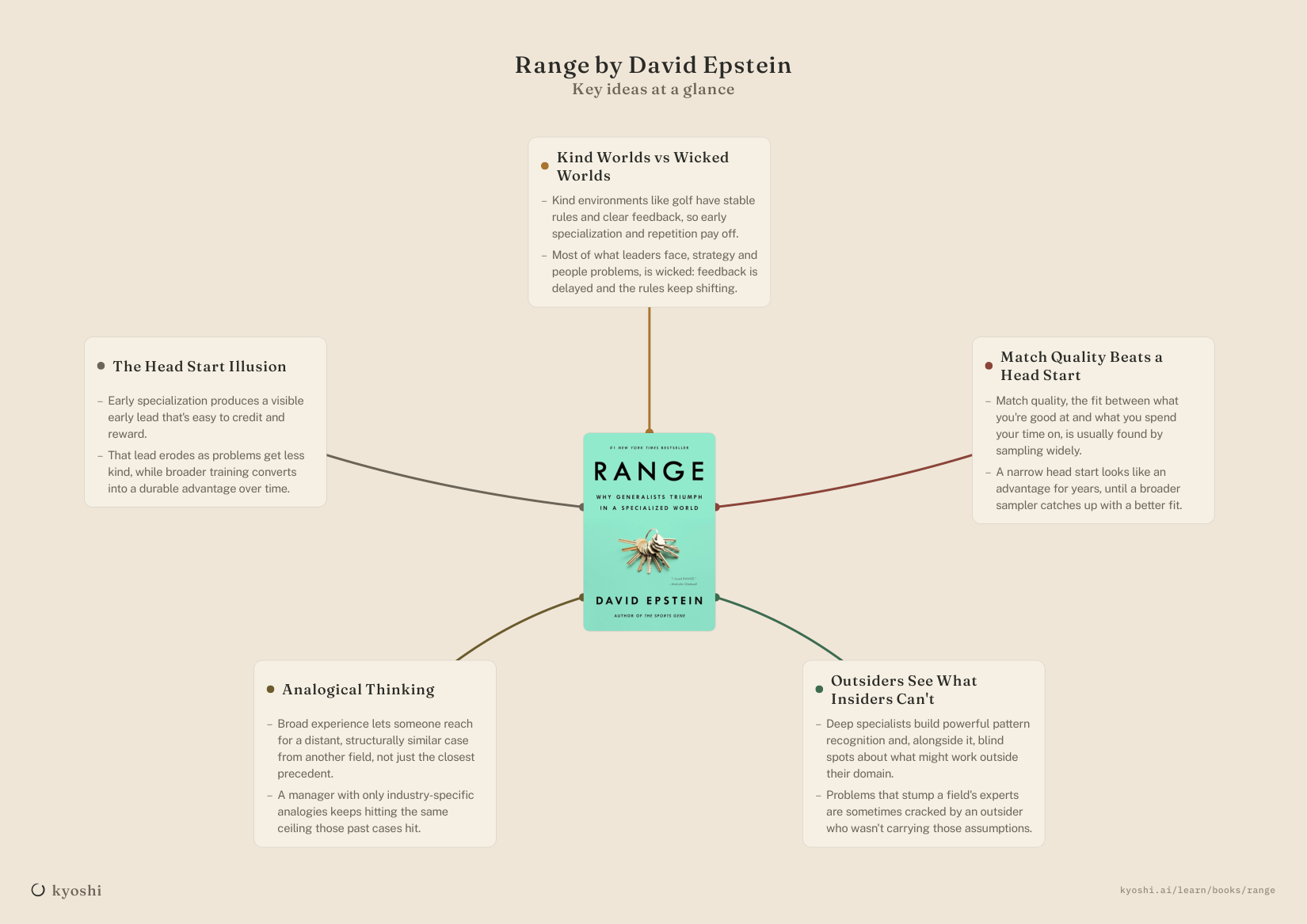
The difference is the kind of problem you're solving. Golf is a "kind" learning environment: the rules are stable, feedback is immediate and clear, and patterns repeat reliably. That means repetition and early specialization pay off enormously, because practice today reliably predicts performance tomorrow. Most of the world leaders actually operate in (business, strategy, people problems) is "wicked": feedback is delayed or misleading, the rules shift, and the same move that worked last time can fail this time. In wicked environments, the deep, narrow pattern-matching that wins in kind ones can actively mislead you, because it's fluent at recognizing patterns that no longer apply.
Match Quality Beats a Head Start
"Match quality" is Epstein's term for the fit between what you're actually good at and interested in, and what you spend your time doing. It's usually discovered by sampling widely, not by committing early and optimizing a single track from the start. A head start in one narrow lane looks like an advantage for years, right up until the person who sampled broadly catches up with a better match and a wider toolkit to draw from, and then keeps gaining.
Outsiders Solve What Insiders Can't See
Deep specialists accumulate powerful pattern recognition inside their domain, and, almost as a side effect, blind spots about which patterns from outside that domain might actually apply. Problems that have stumped a field's deepest experts are sometimes cracked by someone from a completely unrelated background, not despite their lack of specialized training but partly because of it. They weren't carrying the specialist's assumptions about what definitely wouldn't work.
Analogical Thinking: Borrowing From Somewhere Else
A specific skill broad experience builds is reaching for a distant, structurally similar situation from a different domain entirely to solve a problem in front of you, rather than reaching only for the closest, most literal precedent inside your own field. Picture two managers facing a supply bottleneck. Felix only draws analogies from past supply-chain cases he's personally run, and keeps hitting the same ceiling those cases hit. Grace, who spent years in an unrelated operations role before this one, recognizes the shape of the problem from a completely different industry's solution and adapts it. The literal precedent wasn't there for her either. The structural one was.
The Head Start Illusion
Early specialization produces an early lead that's highly visible and easy to credit: the junior employee who already knows the tools, the kid who's already winning tournaments. Epstein's argument is that this early lead erodes as problems get more complex and less kind, while the broader-trained person's slower start converts into a durable advantage once match quality, adaptability, and analogical range start to matter more than raw repetition.
Putting It Together
None of this argues against depth. Federer still had to specialize eventually, and got very deep in tennis. It argues against assuming depth has to start immediately, in a single lane, before you've sampled enough to find the lane where your effort will actually compound.
Why It Matters for Leaders
The trap this book catches managers in is treating an early head start as proof of a good long-term bet. The new hire who already knows the stack, or the analyst who nails the first three quarters doing exactly what worked at their last company, looks like the safer choice. Epstein's point cuts the other way: a head start only compounds in a kind environment, stable rules, fast clear feedback, where repetition keeps paying off. Most of what leaders actually manage, people, strategy, a market that keeps moving, is wicked. A fast starter's fluency can turn into a liability the moment the old patterns stop applying, and they may not notice, because fluency feels like confidence from the inside.
The practical shift is in how you read a resume and how you develop people once they're on the team. A winding path through two unrelated roles isn't a red flag to explain away in an interview. It's often the thing that gives someone a wider set of analogies to reach for when the obvious playbook doesn't work. If you only hire and promote people who did the same job, the same way, at the same kind of company, you're optimizing for a kind-world skill in a wicked-world job.
This also changes what you do when your team is stuck. The instinct is to bring in a deeper specialist, someone who's seen this exact problem before. Sometimes that's the right call. But the more interesting move, especially on something genuinely new, is pulling in someone from an unrelated function and asking them what this reminds them of. They're not carrying the specialist's assumptions about what definitely won't work, which is exactly why they sometimes see the opening nobody else does.
Picture a VP, Tomas, trying to fix a sales team that's missed its number for two straight quarters using the same playbook that worked the previous three years. He keeps bringing in sales specialists to tighten the existing process, and the number keeps missing. On a hunch, he asks an ops manager from a completely different part of the company to sit in on a pipeline review. She's never run a sales team, but she immediately asks why deals are scored the same way regardless of how the buyer actually makes decisions, a question nobody steeped in the existing sales process had thought to ask in two years.
What to do next
Reinforce your understanding of Range
Books related to Range

Creativity, Inc.
Pixar co-founder Ed Catmull's record of building a studio where brilliant, well-intentioned people still nearly wrecked their own creative process, and the specific habits that protected it instead. Less a book about animation than a book about managing anything fragile and unfinished.

Loonshots
Physicist-turned-biotech-CEO Safi Bahcall borrows a concept from phase transitions in physics (the same sudden shift that turns water to ice) to explain why the same smart people, in the same company, kill their best "crazy" ideas as they grow, and what structure, not willpower, it takes to stop that from happening.

Originals
Adam Grant's case that originality isn't a fearless personality trait, it's a set of specific, learnable moves that scared, doubtful people use to get a novel idea past the resistance everyone meets when they try something new.

Six Thinking Hats
Edward de Bono's fix for the meeting where everyone argues past each other because they're all doing a different kind of thinking at the same time, a simple discipline for making a group think one way, together, on purpose, instead of six ways at once.

The Innovator's Dilemma
Clayton Christensen's answer to a puzzle that looks impossible: well-run companies, doing everything their best customers ask for, still lose to products that look worse on every spec sheet, right up until the moment they don't. The book every leader cites and few actually apply to their own team.
Skills related to Range

Frameworks related to Range

Design Thinking
A human-centered process — empathize, define, ideate, prototype, test — for understanding the people living a problem before you design anything.

Lego Serious Play
A guided exercise building LEGO models as metaphors for a problem, then explaining them aloud, surfacing what discussions miss.

SCAMPER Technique
Seven forced questions — Substitute, Combine, Adapt, Modify, Put to another use, Eliminate, Reverse — generating ideas by twisting what exists.

The Six Thinking Hats
Get your whole team thinking in the same mode at once — facts, emotions, risk, benefits, creativity, process — covering every angle.