Originals
Adam Grant's case that originality isn't a fearless personality trait, it's a set of specific, learnable moves that scared, doubtful people use to get a novel idea past the resistance everyone meets when they try something new.
 Find this on the mind-map
Introduction
The popular image of an original thinker is someone fearless, confident, first to the idea, first to market. Adam Grant's research-backed argument is that almost none of that is true. Originals feel just as much doubt and fear as everyone else. They just act despite it, and they usually aren't first. What actually separates people who get novel ideas adopted from people whose good ideas die in a drawer is a handful of specific, learnable habits, not a personality.
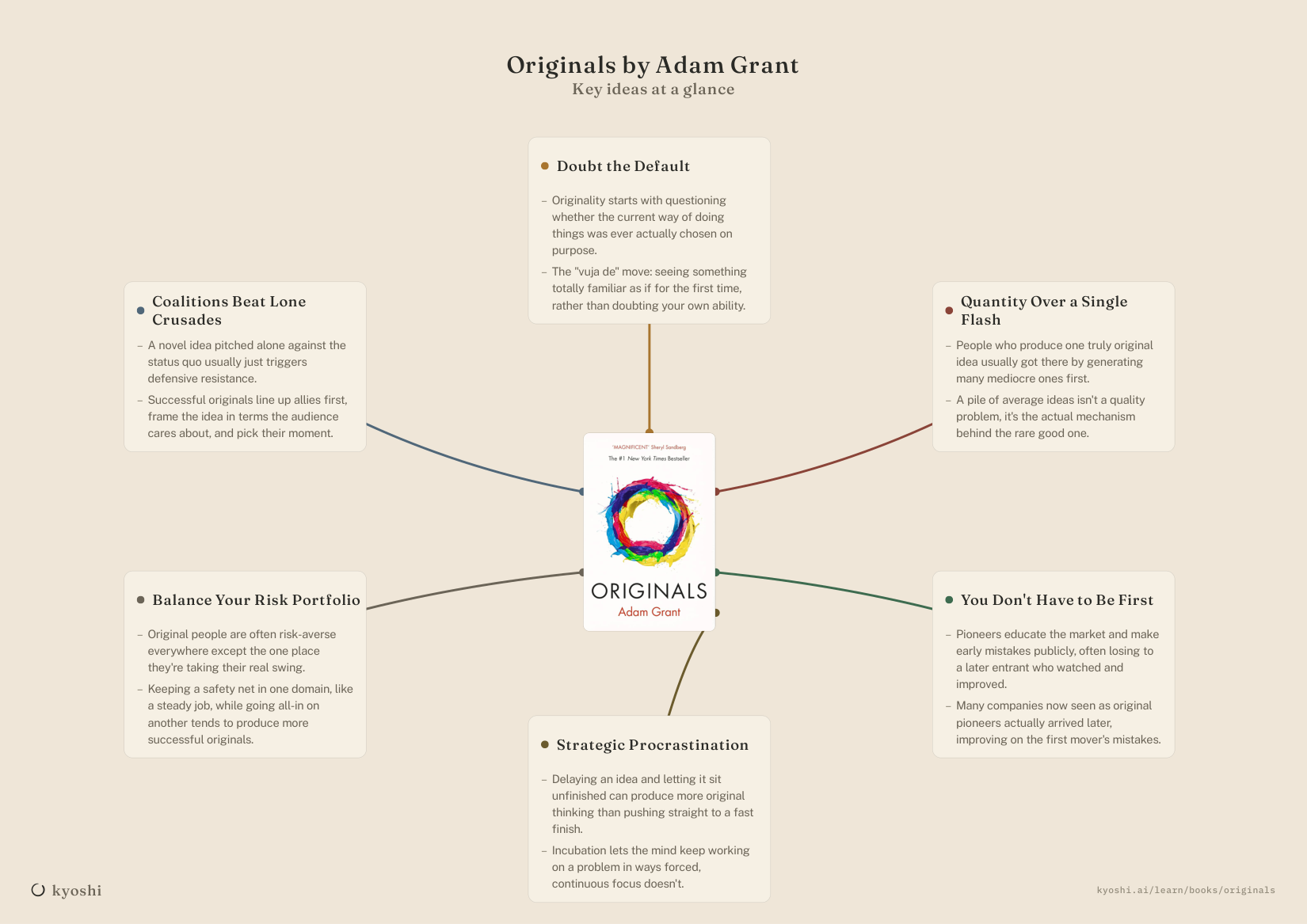
Doubt the Default, Not Yourself
Originality starts with questioning whether the way things currently work is actually the right way, rather than just the familiar way. Grant's term is "vuja de," the inverse of deja vu: looking at something completely familiar as if seeing it for the first time, and noticing it doesn't have to be this way. The useful move isn't doubting your own ability to contribute. It's specifically doubting the inherited assumption that the current default was ever actually chosen on purpose.
Quantity Is a Strategy, Not a Compromise
People who produce one genuinely original idea usually got there by producing many ideas, most of them mediocre, and picking the best, not by having one flash of pure insight. The uncomfortable implication is that judging your own creative output by your best single idea, and feeling discouraged by how many mediocre ones surround it, misreads how originality actually works. Volume isn't a lack of standards. It's the mechanism.
You Don't Have to Be First
Being a pioneer carries real disadvantages that the "first mover wins" story skips over: you educate the market at your own expense, make the early mistakes publicly, and often get overtaken by a later entrant who watched you learn. Many of the products and companies now treated as originality's poster children weren't first. They were better, later, having watched the first mover's market-education and mistakes happen for free.
Strategic Procrastination
Delay isn't automatically a failure of discipline. Grant's argument is that putting an idea down and coming back to it (letting it sit, half-finished, in the back of your mind) can produce more divergent, original thinking than pushing straight through to a fast finish, because incubation lets your mind keep working on the problem in ways that forced, continuous focus doesn't.
Balance Your Risk Portfolio
Original people aren't uniformly bold. They're often strikingly risk-averse everywhere except the one place they're taking their real swing: keeping a safety net in one domain while going all-in on another. Picture two people both convinced they have a genuinely good idea for a side venture. Noah quits his job immediately, burns his savings, and bets everything on the idea succeeding fast. Mei keeps her job, builds the idea on weekends, and only goes all-in once it has independent traction. Grant's data points toward Mei's pattern being the one that actually produces more successful originals, not because caution is admirable, but because having a floor to fall back on changes the decisions you're willing to make along the way.
Coalitions Beat Lone Crusades
A novel idea pitched alone, against an established status quo, usually just generates defensive resistance from everyone invested in the current way of doing things. Originals who actually get ideas adopted tend to line up allies first, without much fanfare, frame the idea in terms the audience already cares about, and pick their moment, not because the idea needs watering down, but because timing and framing determine whether people are able to hear it at all.
Putting It Together
None of this is about having rarer ideas. It's about managing the fear, the framing, and the timing around ordinary ideas well enough that they survive contact with other people's resistance, which turns out to be the harder part.
Why It Matters for Leaders
Most managers wait for conviction before they back a new idea, their own or someone else's. This book's uncomfortable finding is that conviction isn't the signal you think it is. Originals feel just as scared and unsure as anyone. What separates them is that they act anyway, and that they've built habits that work even while the doubt is still there.
The practical shift is in how you respond when someone on your team pitches something half-formed and clearly nervous about it. The instinct is to wait for them to sound confident before taking the idea seriously. A better instinct is to treat the nervousness as normal, not as proof the idea is weak, and ask about the idea on its own terms.
It also changes how you evaluate your own pipeline of ideas. If you're judging your team's creative output by their single best pitch and feeling let down by how many average ones surround it, you're misreading the process. A high volume of mediocre ideas isn't a quality problem, it's usually what generating one genuinely good idea actually looks like from the inside.
Picture a manager, Dinesh, whose most promising analyst pitches a new approach to a reporting process, then immediately hedges: "it's probably not fully thought through yet." Dinesh's old habit is to nod and move on until she comes back with something more polished. His new habit, after this book, is to say "let's hear the rough version," and ask who else on the team has looked at it before she takes it further. That one question, finding an ally before the idea has to survive a room full of people invested in the current way of doing things, is often the difference between an idea that dies in a drawer, unnoticed, and one that actually ships.
What to do next
Reinforce your understanding of Originals
Books related to Originals

Creativity, Inc.
Pixar co-founder Ed Catmull's record of building a studio where brilliant, well-intentioned people still nearly wrecked their own creative process, and the specific habits that protected it instead. Less a book about animation than a book about managing anything fragile and unfinished.

Loonshots
Physicist-turned-biotech-CEO Safi Bahcall borrows a concept from phase transitions in physics (the same sudden shift that turns water to ice) to explain why the same smart people, in the same company, kill their best "crazy" ideas as they grow, and what structure, not willpower, it takes to stop that from happening.

Range
David Epstein's case against the cult of early specialization, using Roger Federer's meandering path through half a dozen sports against Tiger Woods' single-minded golf-only childhood to show why breadth, not a head start, wins in most of the problems that actually matter.

Six Thinking Hats
Edward de Bono's fix for the meeting where everyone argues past each other because they're all doing a different kind of thinking at the same time, a simple discipline for making a group think one way, together, on purpose, instead of six ways at once.

The Innovator's Dilemma
Clayton Christensen's answer to a puzzle that looks impossible: well-run companies, doing everything their best customers ask for, still lose to products that look worse on every spec sheet, right up until the moment they don't. The book every leader cites and few actually apply to their own team.
Skills related to Originals

Frameworks related to Originals

Design Thinking
A human-centered process — empathize, define, ideate, prototype, test — for understanding the people living a problem before you design anything.

Lego Serious Play
A guided exercise building LEGO models as metaphors for a problem, then explaining them aloud, surfacing what discussions miss.

SCAMPER Technique
Seven forced questions — Substitute, Combine, Adapt, Modify, Put to another use, Eliminate, Reverse — generating ideas by twisting what exists.

The Six Thinking Hats
Get your whole team thinking in the same mode at once — facts, emotions, risk, benefits, creativity, process — covering every angle.