Business Model Canvas
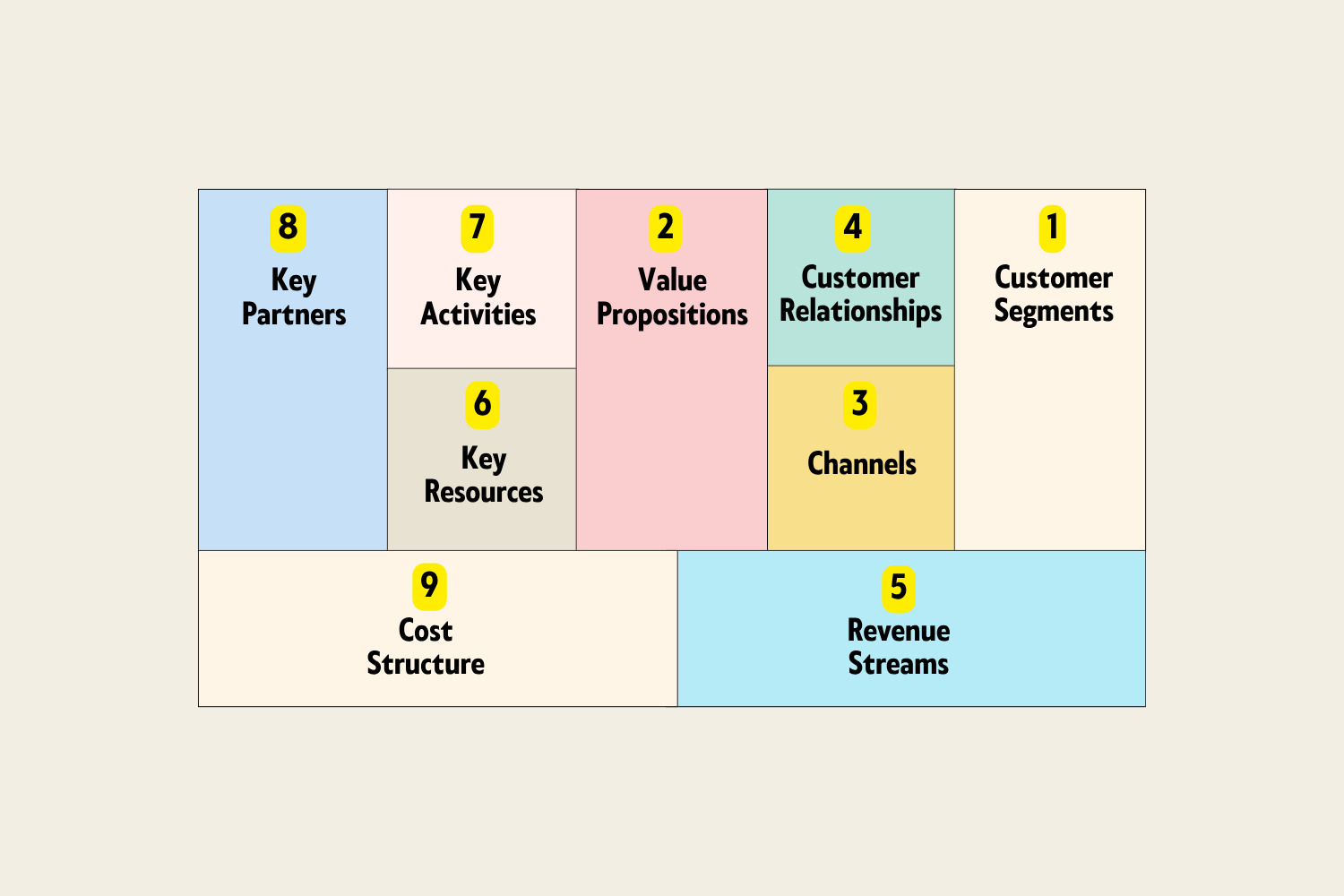
A one-page map of how your business creates, delivers, and captures value, broken into nine blocks you see and debate.
 Find this on the mind-map
Introduction
Alexander Osterwalder built this canvas as part of his doctoral work, then published it with Yves Pigneur in the 2010 book Business Model Generation. It gives you a way to map out how a business creates, delivers, and captures value — whether you're pressure-testing a brand-new idea or trying to understand why an existing team or company works the way it does.
How It Works
Nine blocks, one sheet. On the right sits your market; on the left sits the machine that serves it; along the bottom sits the economics connecting the two.
| Group | Block | The question |
|---|---|---|
| Market | Customer Segments | Who are you creating value for, and who matters most? |
| Market | Value Propositions | What problem are you solving, and why would they choose you? |
| Market | Channels | How do you reach, sell to, and deliver to them? |
| Market | Customer Relationships | What kind of relationship does each segment expect — self-serve, personal, community? |
| Machine | Key Activities | What must you be doing to deliver that value? |
| Machine | Key Resources | Which assets are essential: people, technology, capital, brand? |
| Machine | Key Partners | What don't you do yourself, and who does it with you? |
| Economics | Revenue Streams | How do you get paid, and for what exactly? |
| Economics | Cost Structure | Where does the money go, and which costs are fixed versus variable? |
The reason a single page works is that the blocks limit each other. Put a premium value proposition behind a low-touch channel and it won't hold together; build a partner-heavy model on a thin cost structure and you're usually hiding a dependency nobody has priced yet. Those contradictions stay invisible in a thirty-page plan. On one sheet, they jump out at you.
Osterwalder later added the Value Proposition Canvas, which zooms into the fit between the Value Propositions block and the Customer Segments block — because that's the join where most business models actually break.
Why It Matters for Leaders
Most managers below the executive line understand their own block and nothing else. Your engineering lead knows Key Activities cold; your sales lead knows Channels cold; neither can tell you how the company actually makes money. Decisions made from inside one block end up making that block look good, at the expense of the whole model.
Filling out the canvas turns hidden assumptions into visible ones. Every block is really a belief about your customers, your value, or your economics — and once it's written down, it becomes something you can test instead of something everyone just assumes is settled. That's the connection to Lean Startup, where the canvas becomes your list of guesses to go test.
It also works as a fast way to surface misalignment on a leadership team. Hand everyone a blank canvas, have each person fill one out alone, then compare notes. Whatever disagreements come up — usually about who the real customer is, or what the actual value proposition is — are worth an entire offsite on their own.
The exercise works just as well pointed inward. Run it on your own team: the customer becomes another department, the revenue stream becomes budget or headcount, and you find out fast whether you're funded for the value you're actually delivering.

