First Principles Thinking
Strip a problem to its foundational truths, discard every assumption, and rebuild your solution from the ground up.
 Find this on the mind-map
Introduction
The idea itself is old — Aristotle reasoned this way, and it's been standard practice in physics for centuries. Its modern reputation in business, though, comes almost entirely from Elon Musk.
How It Works
Most of the time, you solve problems by reasoning from analogy: this looks like something that already exists, so you do what was done before. It's fast, it's usually good enough, and it keeps you safely inside the boundaries set by prior solutions. Reasoning from first principles throws out the resemblance entirely and asks what's actually, provably true.
The SpaceX case is the standard illustration, and it's worth knowing in detail. In 2002, Musk found that buying a rocket cost up to $65 million. Instead of accepting that price as a fact of life, he asked what a rocket is actually made of: aerospace-grade aluminum alloys, plus titanium, copper, and carbon fiber. Then he asked what those raw materials cost on the commodity market. The answer came back at around two percent of the typical price of a finished rocket. So he bought the raw materials and built the rockets himself — and within a few years, SpaceX had cut launch costs by close to 10x while still turning a profit. The rest of the industry had been reasoning from existing prices, not from what the materials actually cost.
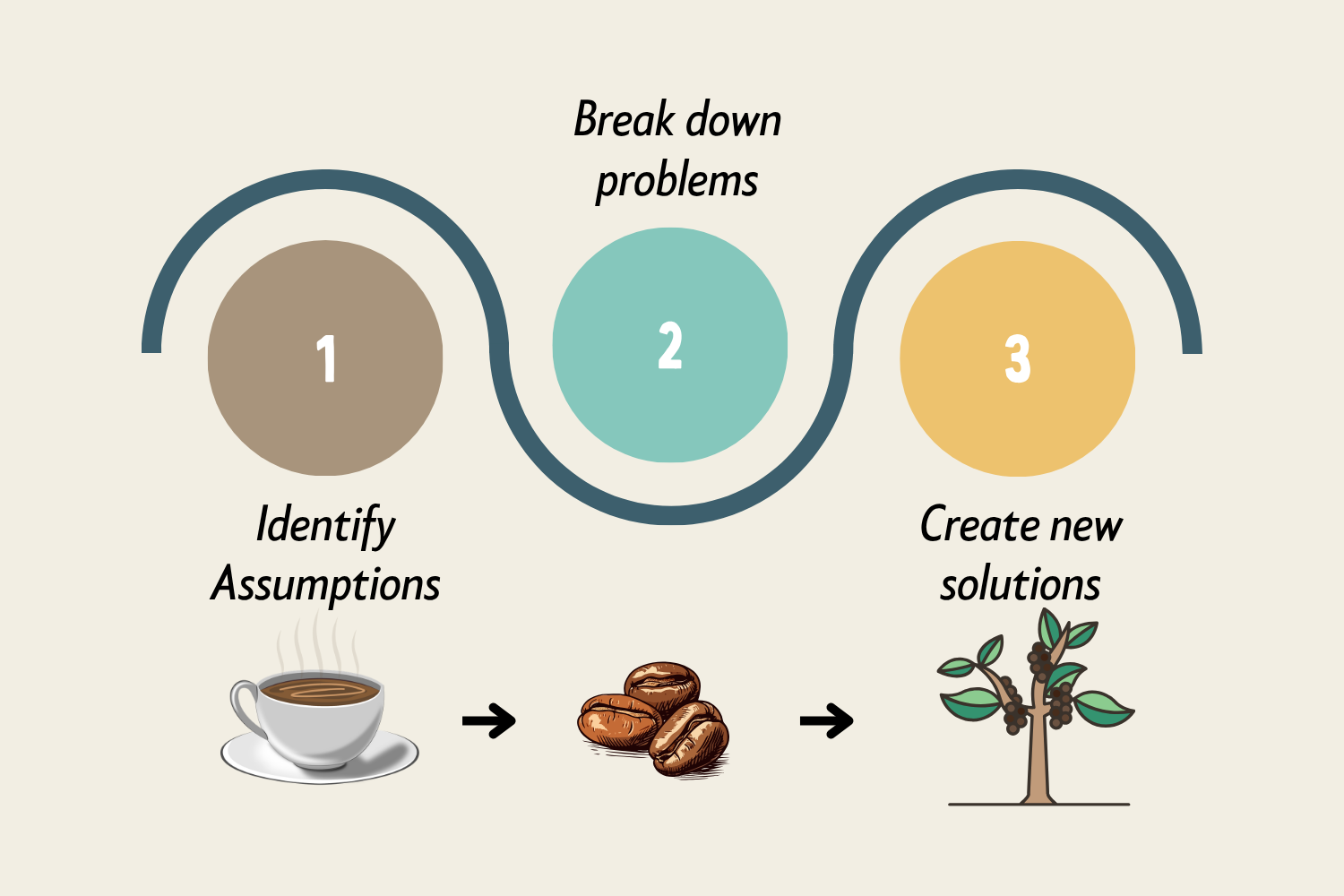
You can run the same process in three moves:
- Identify the problem and strip away your assumptions. Define clearly what you're actually trying to solve, then ask what you're assuming about it. If budgets are being cut, are you assuming certain costs are fixed? Are you assuming more hours automatically produce better results?
- Get down to the foundational truths. Once the assumptions are gone, find what's left that's undeniably true. What is the actual goal here, and what's the simplest version of this problem?
- Rebuild from the ground up. Construct your solution using only those truths. This is where the non-obvious answer usually shows up.
Why It Matters for Leaders
Most management thinking is analogy thinking. A team is missing deadlines, so you add people or push harder, because that's what worked somewhere before. The budget gets cut, so you freeze hiring and cancel tools, because that's the standard move. Analogy is efficient — but it caps the quality of your answer at whatever the previous answer already was.
The cost shows up as effort spent solving the wrong problem. Picture this: a major software feature breaks days before a release to millions of customers, and a team of your strongest engineers spends days chasing the defect inside that feature with nothing to show for it. Someone finally steps back, draws out the whole system architecture, lists every component, and writes down every assumption — and the fault turns out to be in code nobody had touched in years. The feature was never the problem.
Three ordinary situations follow the same shape. Budget constraints: question whether every current cost is actually necessary, then ask what you truly need to accomplish the goal. Team performance: a missed deadline looks like a workload problem on the surface, and stripping the assumptions underneath it often exposes unclear communication or misaligned priorities instead. Operations: instead of adding another process step, question whether every existing one still earns its place — whether every meeting is essential, whether every approval stage adds real value.
The tradeoff is real, so use this deliberately. First principles thinking is slow and effortful, so it doesn't belong on routine decisions. It earns its cost when the conventional approach is failing, when the obvious answer feels artificially constrained, or when the stakes justify rebuilding from scratch.
What to do next
Test your knowledge of First Principles Thinking
Practice First Principles Thinking
Apply First Principles Thinking to a real situation
Skills related to First Principles Thinking

Frameworks related to First Principles Thinking

Inversion Principle
A thinking tool that swaps "how do I succeed?" for "how would this fail?" — surfacing failure modes forward planning misses.

The 5 Whys
Ask "why" repeatedly — about five times — until you move past the symptom and land on the cause you can fix.

The Double Diamond
A four-stage process that separates problem space from solution space — expand then narrow each — so you solve the right problem.