The 5 Whys
Ask "why" repeatedly — about five times — until you move past the symptom and land on the cause you can fix.
 Find this on the mind-map
Introduction
Sakichi Toyoda developed this technique, and it got built straight into the Toyota Production System, where it's still the standard root-cause routine run on the factory floor today.
How It Works
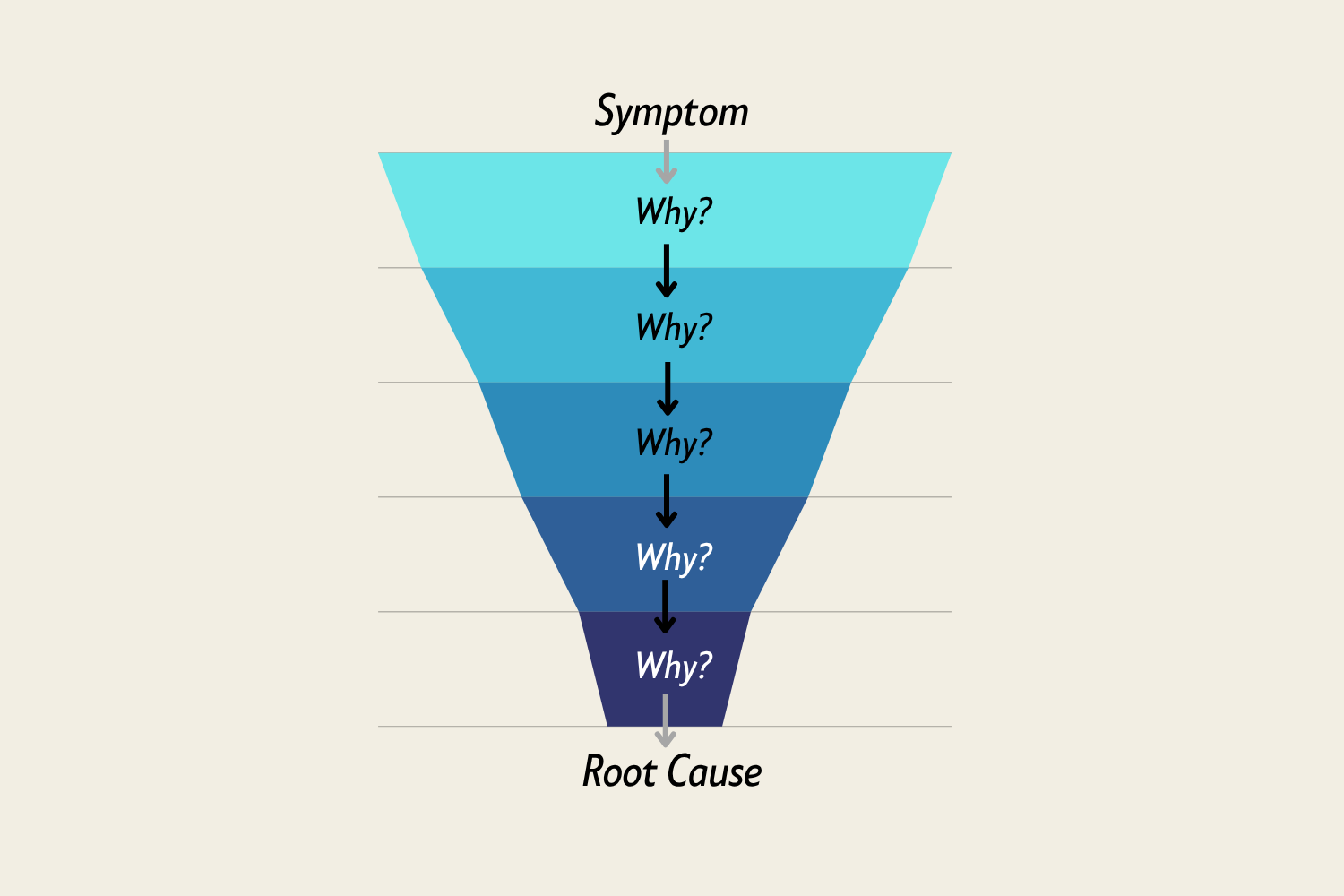
It works like a chain. State the problem, ask why it happened, then ask why about that answer, and keep going until the chain reaches a cause you can permanently remove. Each link is an answer that becomes the next question, so the chain moves from the visible event down through process, then policy, then system design.
Five is a guideline, not a rule. Some problems resolve by the third why; others need seven. You know you're done not by hitting a count, but the moment further questioning stops producing new information and the last answer names something you can actually change.
Here's a worked example from a manufacturing floor:
| Step | Question | Answer |
|---|---|---|
| 1 | Why did the machine stop? | A fuse blew due to an overload. |
| 2 | Why was there an overload? | The bearing was not lubricated. |
| 3 | Why was it not lubricated? | The lubrication pump was not working. |
| 4 | Why was the pump not working? | The pump shaft was worn out. |
| 5 | Why was the shaft worn out? | No maintenance schedule was in place. |
The root cause is the missing maintenance schedule, not the fuse. Replace the fuse and the machine runs again — and you've just guaranteed the same failure comes back.
The same chain works on problems that have nothing to do with machinery. A platform slowdown during a flash sale traces back through unhandled traffic, a misconfigured load balancer, a missed step during an upgrade, and an absent post-upgrade checklist, all the way to a missing standard operating procedure for system upgrades. A three-month spike in resignations traces back through dissatisfaction, unrecognized contribution, skipped performance reviews, and an overloaded manager, all the way to understaffing in the department.
Three things make this technique work. It avoids assumptions, because every "why" forces you to state a reason instead of jumping to a knee-jerk fix. It simplifies complexity, because a huge problem turns into a sequence of small, answerable questions. And it distributes the thinking — run it as a group exercise and it surfaces what different people already know about the same failure.
Why It Matters for Leaders
Most of the fixes you approve are band-aids. They resolve the symptom sitting in front of you, close the ticket, and leave whatever's actually generating the problem untouched — which is exactly why the same kind of problem keeps coming back on the same team, just looking a little different each time.
The real cost is rarely the individual incident. It's the compounding effect: a rushed patch shipped hours before a deadline solves the release and creates a customer-facing defect three days later, and that second failure is worse than the first because it now carries a reputation cost on top. The team looks fast and is actually piling up debt.
Root cause work also changes what a problem is about. A missed deadline stops being a scheduling failure and becomes a planning-template failure. A wave of resignations stops being a compensation problem and becomes a staffing problem. That shift moves the fix from the person to the system — which is the real difference between managing incidents and actually improving how you operate. Research from McKinsey found that teams using root cause analysis techniques resolved a far higher share of their recurring operational problems than teams that didn't.
For you, the practical payoff is having a defensible answer to the question every executive asks after something breaks: what are you doing so this doesn't happen again. A documented 5 Whys chain answers that with a specific change to how things work — not a promise to be more careful next time.
What to do next
Test your knowledge of The 5 Whys
Practice The 5 Whys
Apply The 5 Whys to a real situation
Skills related to The 5 Whys

Frameworks related to The 5 Whys

First Principles Thinking
Strip a problem to its foundational truths, discard every assumption, and rebuild your solution from the ground up.

Inversion Principle
A thinking tool that swaps "how do I succeed?" for "how would this fail?" — surfacing failure modes forward planning misses.

The Double Diamond
A four-stage process that separates problem space from solution space — expand then narrow each — so you solve the right problem.