Radical Candor
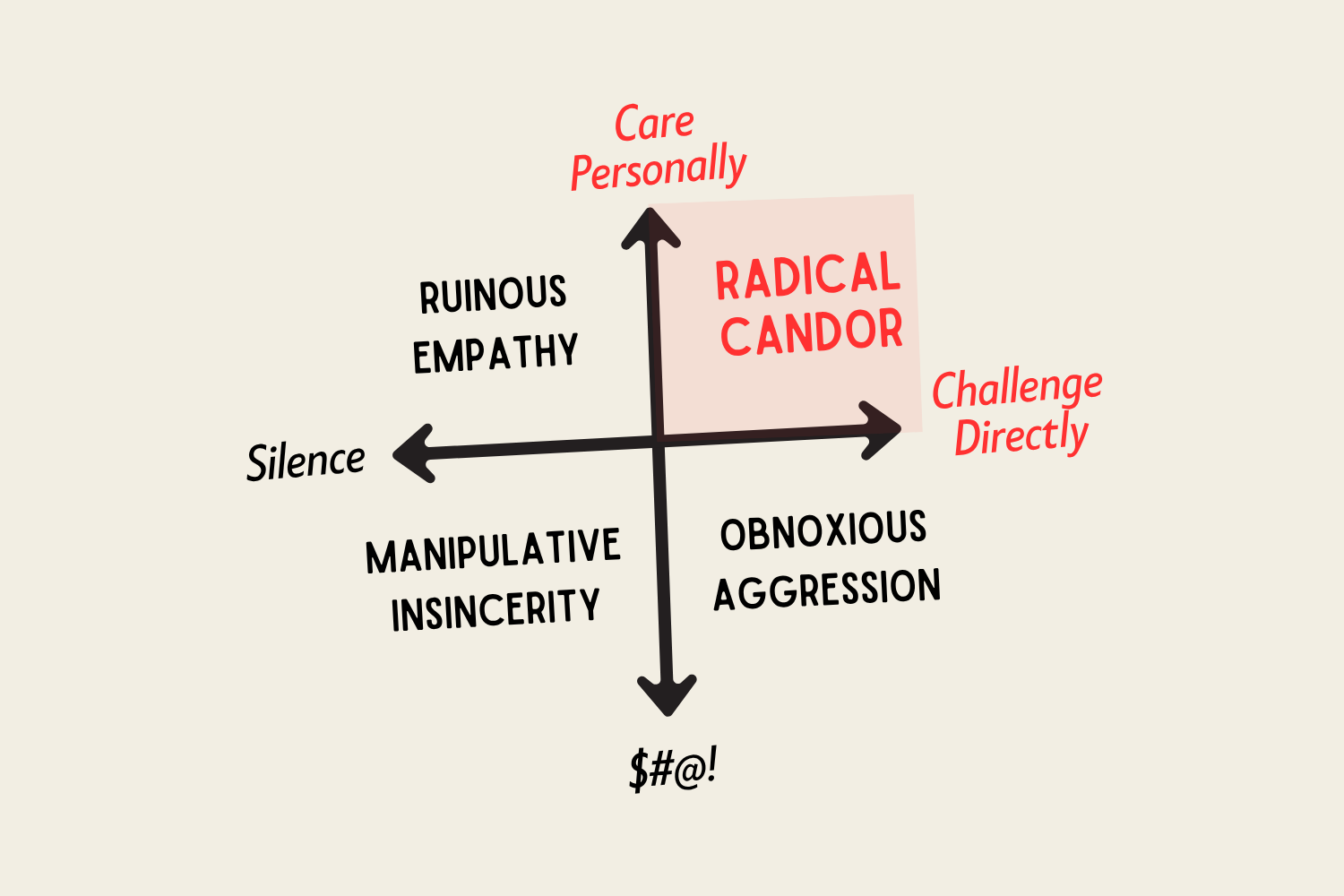
Kim Scott's rule that good feedback means caring personally and challenging directly at once — a 2x2 for what goes wrong.
 Find this on the mind-map
Introduction
Kim Scott spent years as an executive at Google and Apple before writing it all down in Radical Candor: Be a Kick-Ass Boss Without Losing Your Humanity. Her core idea asks you to do two things at once, not in sequence: care about people as actual humans, and tell them the hard truth they need to hear. Most managers are good at exactly one of those, and it's rarely both.
How It Works
Plot care on one axis and challenge on the other, and you get four quadrants.
| Low challenge | High challenge | |
|---|---|---|
| High care | Ruinous Empathy | Radical Candor |
| Low care | Manipulative Insincerity | Obnoxious Aggression |
Obnoxious Aggression is challenge without care. The feedback is honest, but it lands as an attack, and your team shuts down. It buys you compliance, not trust — Gallup found only 10% of employees who experience hostile feedback feel motivated to improve because of it. It sounds like: "This is useless, were you even paying attention?" or "Why do I have to explain this again?"
Manipulative Insincerity is no care and no challenge. You say whatever's convenient instead of what's true — agree in the meeting, vent about it afterward. This one does the most damage of the four, and it shows up most in high-pressure, low-trust environments. A Deloitte study found 70% of employees feel their leaders prioritize self-interest over developing the team. It sounds like: "Yeah, sure, looks good," while thinking the exact opposite — or saying nothing at all and just letting the team fail.
Ruinous Empathy is care without challenge. You want to keep things positive, so you sugarcoat, dodge the hard conversation, and let poor performance slide. This is where most managers actually get stuck — HBR research found 69% of managers are uncomfortable giving direct feedback, especially when they think it might upset the other person, even though most people say straight, honest feedback is exactly what they want. It sounds like: "No worries, it's not a big deal," when it is — or "you're doing fine" while you quietly fix their mistakes behind the scenes.
Radical Candor is care and challenge together. You say what needs saying, and you make it obvious the whole point is the other person's growth. Zenger Folkman found employees whose managers gave frequent, honest feedback were three times more engaged than those who got vague feedback or none at all. It sounds like: "You're great at voicing ideas, and I've noticed you interrupt people in meetings. I want to help you create more space for others."
Why It Matters for Leaders
The default failure isn't cruelty — it's kindness used the wrong way. Picture a manager who notices a strong engineer's work slipping, doesn't want to dent his confidence, and says something soft like "please just double-check your work." He nods, nothing changes, and a month later a misconfigured production resource breaks live workflows. When the direct feedback finally comes, his response is "why didn't you tell me this earlier?" Being nice without being honest was never actually kindness.
Ruinous Empathy costs you in two directions at once. Poor performance goes uncorrected, and your high performers stall out because nobody's telling them what would actually take them further. They tend to leave quietly before they ever complain.
The quadrants also give you a vocabulary you didn't have before. Most people can't describe what's wrong with their own feedback habits, but they can recognize which box their last three conversations landed in. That recognition is what makes this useful in the moment, not just as a theory you nod along to.
Treat this as a mindset you bring to every conversation, not a technique you save for performance reviews. People have to feel your care before they'll trust your challenge, which means you build that relationship long before the hard conversation happens. It runs upward too — disagreeing candidly with your own boss's decision, by describing what your team is actually experiencing on the ground, is the exact same framework pointed in the other direction.
What to do next
Test your knowledge of Radical Candor
Practice Radical Candor
Apply Radical Candor to a real situation
Skills related to Radical Candor

Frameworks related to Radical Candor

Feedback Sandwich
A feedback pattern that wraps criticism between two compliments — widely taught and used, and criticized for burying the message.

SBI Model
Situation, Behavior, Impact — a three-part way to give feedback that stays specific and observable instead of judging someone's character.
