Coaching for Performance
Sir John Whitmore's foundational case for coaching-style management over command-and-control, built on a single idea: performance is limited less by skill than by interference, and a manager's job is to remove the interference, not supply the answer.
 Find this on the mind-map
Introduction
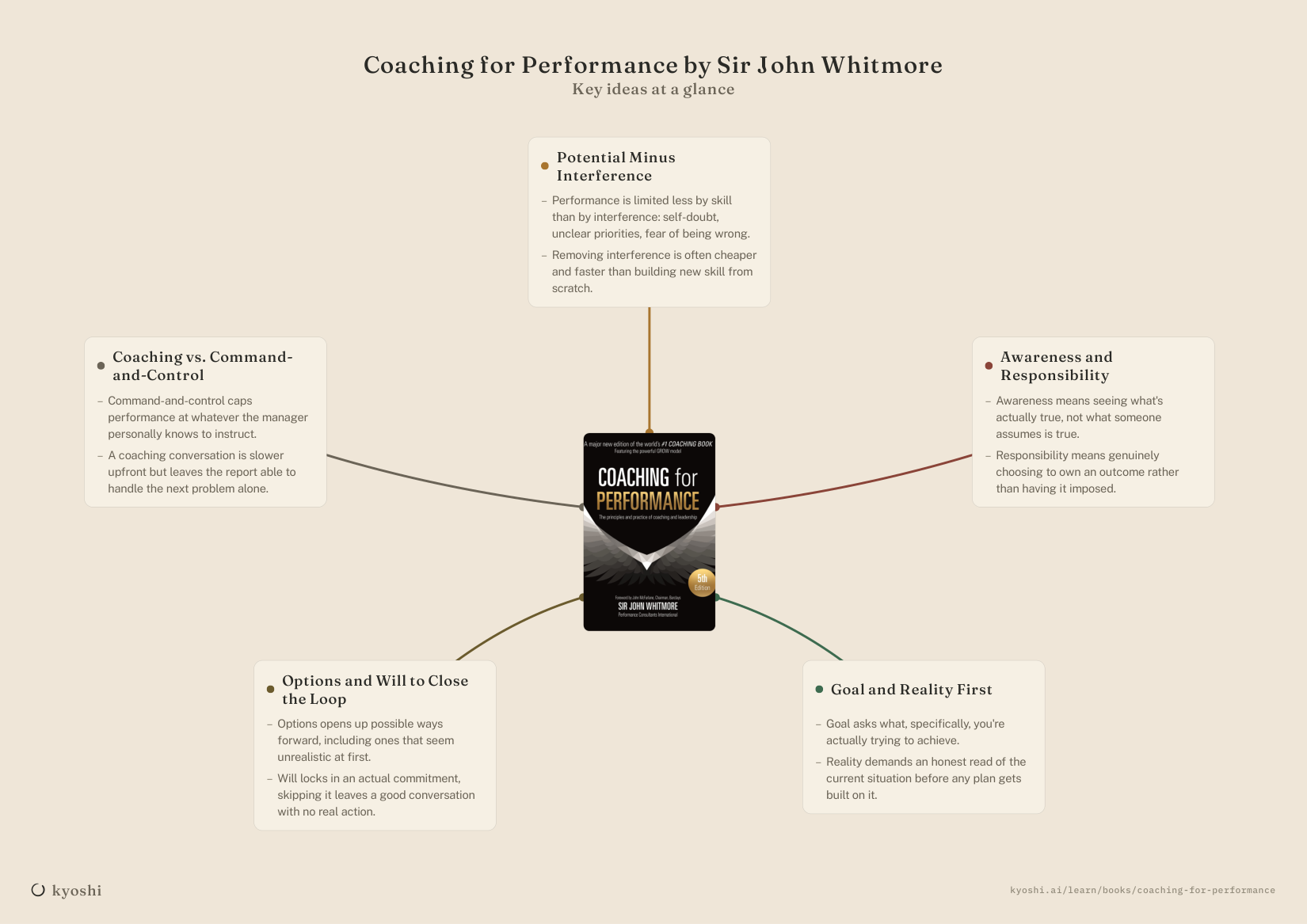
Whitmore's book predates most of the modern coaching literature, and a lot of today's coaching advice still builds on his argument: that performance is a function of potential minus interference, not a direct output of how hard someone tries or how much a manager tells them to do. A manager who only ever gives instructions is managing the "what," while interference (self-doubt, unclear priorities, fear of being wrong) is usually the actual thing limiting someone's output. Coaching is Whitmore's name for the management style built to remove that interference instead of talking over it.
Performance = Potential − Interference
The foundational equation. Most management effort goes into trying to raise potential directly: more training, more instruction, more pressure, while the interference sitting on top of that potential (self-consciousness, fear of failure, confusion about what actually matters) goes untouched. Whitmore's claim is that removing interference is usually the higher-leverage move, because it's often cheaper and faster than building new skill, and it's the reason two equally skilled people can perform very differently under the same manager.
Awareness and Responsibility
Whitmore treats these as the two outcomes every coaching conversation should be building, regardless of topic. Awareness is a clear, accurate view of the current situation: not what someone assumes is true, but what's actually true. Responsibility is choosing, genuinely, to own the outcome rather than having it imposed. Telling someone what to do can change their behavior today; it rarely builds either awareness or responsibility, which is why the change often doesn't last once the telling stops.
The GROW Model
Whitmore's enduring contribution, and still one of the most widely used coaching structures in management: a sequence of four kinds of questions.
- Goal: what, specifically, are we trying to achieve here?
- Reality: what's actually true about the current situation, without the spin?
- Options: what are the possible ways forward, including ones that seem unrealistic at first?
- Will (sometimes "Way Forward"): which option will you commit to, and what exactly will you do?
The order matters. Skipping straight to Options without an honest Reality check produces plans built on a wrong picture of the present; skipping Will means a good conversation produces no actual commitment.
Coaching vs. Command-and-Control
Whitmore is direct that command-and-control isn't just old-fashioned. It actively limits what a manager can get out of a team, because it caps performance at whatever the manager personally knows to instruct. A coaching style asks more of the manager upfront (it's slower in the moment, and requires tolerating someone else's answer being different from what you'd have told them) but removes that ceiling, since the team's thinking is no longer bottlenecked on the manager's own.
Manager A tells a struggling report exactly how to fix a client relationship, step by step. Manager B runs the same situation through GROW: what's the actual goal with this client, what's really going on, what are the options, what will you do. B's conversation takes longer; the report owns the plan at the end of it, and handles the next client problem without needing A at all.
Putting It Together
The equation explains why coaching works (interference is the removable constraint); awareness and responsibility describe what a good coaching conversation should produce regardless of topic; and GROW is the how: a repeatable structure that reliably builds both. None of it requires a special "coaching session" on the calendar. Whitmore's real argument is that this is simply a better default way to have the conversations a manager is already having.
Why It Matters for Leaders
Most managers who want to coach more don't actually have a technique problem. They have a diagnosis problem: when someone underperforms, the default read is "they need to try harder or know more," so the response is more instruction, more oversight, more detail. Whitmore's real contribution is making you ask a different first question: is this actually a skill gap, or is something getting in the way of skill that's already there?
That reframe changes what a 1:1 is for. If you walk in assuming low output means low potential, you'll spend the conversation teaching. If you walk in open to the idea that interference (self-doubt about a past mistake, confusion about what actually matters this month, fear of looking bad in front of a peer) is the real constraint, you'll spend the conversation asking instead. Those are different meetings, and only one of them tends to actually fix the problem for good.
The hard part isn't the GROW sequence itself, it's resisting the pull to skip straight to Options, because Options is where a manager gets to feel useful again. Reality is slower and less satisfying to sit in, but a plan built before Reality is honestly named is a plan built on the wrong map. The payoff for the patience shows up later: a report who's worked through their own Goal, Reality, Options, and Will on one problem can run the same process on the next one without you.
Picture a manager named Femi whose best engineer has been missing deadlines for a month. Femi's instinct is to tighten the process: more check-ins, a stricter ticket template. Instead he asks what's actually going on. It turns out the engineer shipped a bug three months ago that took down a customer's dashboard for an afternoon, and he's been over-testing everything since, without telling anyone, terrified of being the person who breaks production twice. Femi didn't need to teach him anything. He needed to name that fear out loud and agree on what "good enough to ship" actually looks like. The deadlines fixed themselves within two weeks.
What to do next
Reinforce your understanding of Coaching for Performance
Books related to Coaching for Performance

Elevate
Robert Glazer's case, from his book "Elevate: Push Beyond Your Limits and Unlock Success in Yourself and Others," that performance isn't a willpower problem. It's a capacity problem across four specific domains, built like a muscle, not willed into existence overnight.

First, Break All The Rules
A large-scale look at what the best managers actually do differently, and the uncomfortable finding that most of it runs against conventional management wisdom, starting with the idea that you shouldn't try to fix people's weaknesses.

Multipliers
Liz Wiseman's case that the biggest lever on a team's output isn't headcount or talent density, it's whether the leader in the room makes people smarter or slowly makes them smaller.

Team Topologies
Skelton and Pais's case that most team structures are drawn to fit an org chart, not the actual flow of work, and a small set of team shapes and interaction rules for fixing that, built around a resource every leader habitually overspends: people's cognitive load.

The Coaching Habit
Michael Bungay Stanier's pitch that most managers have an "advice monster" problem, and a short list of deceptively simple questions designed to starve it, a little at a time, in conversations that already happen every day.

The First-Time Manager
The unglamorous, practical handbook for the specific week your job title changed and nothing else came with instructions. Less a framework, more a set of answers to the questions new managers are usually too embarrassed to ask out loud.

The Five Dysfunctions of a Team
Patrick Lencioni's pyramid of the five behaviors that sink teams without much notice, stacked so that each one is actually caused by the dysfunction beneath it, which means fixing results or accountability first almost never works.

The Making of a Manager
Julie Zhuo's field notes from becoming a manager in her twenties with no idea what the job actually was. A clear-eyed answer to the question most new managers are too embarrassed to ask out loud: what am I actually supposed to be doing all day?

The Manager's Path
Camille Fournier's map of the actual career ladder from doing the work to leading an organization of leaders, written for engineering managers, but mostly a clear-eyed account of how the job itself changes at every rung, which almost nobody explains to you before you climb it.

Turn the Ship Around!
A submarine captain's account of giving up the one thing every leader is taught to protect, being the person who gives the orders, and turning the worst-performing submarine in the fleet into one of the best by making every sailor think like a captain instead.
Skills related to Coaching for Performance

Frameworks referenced from this book

Frameworks related to Coaching for Performance
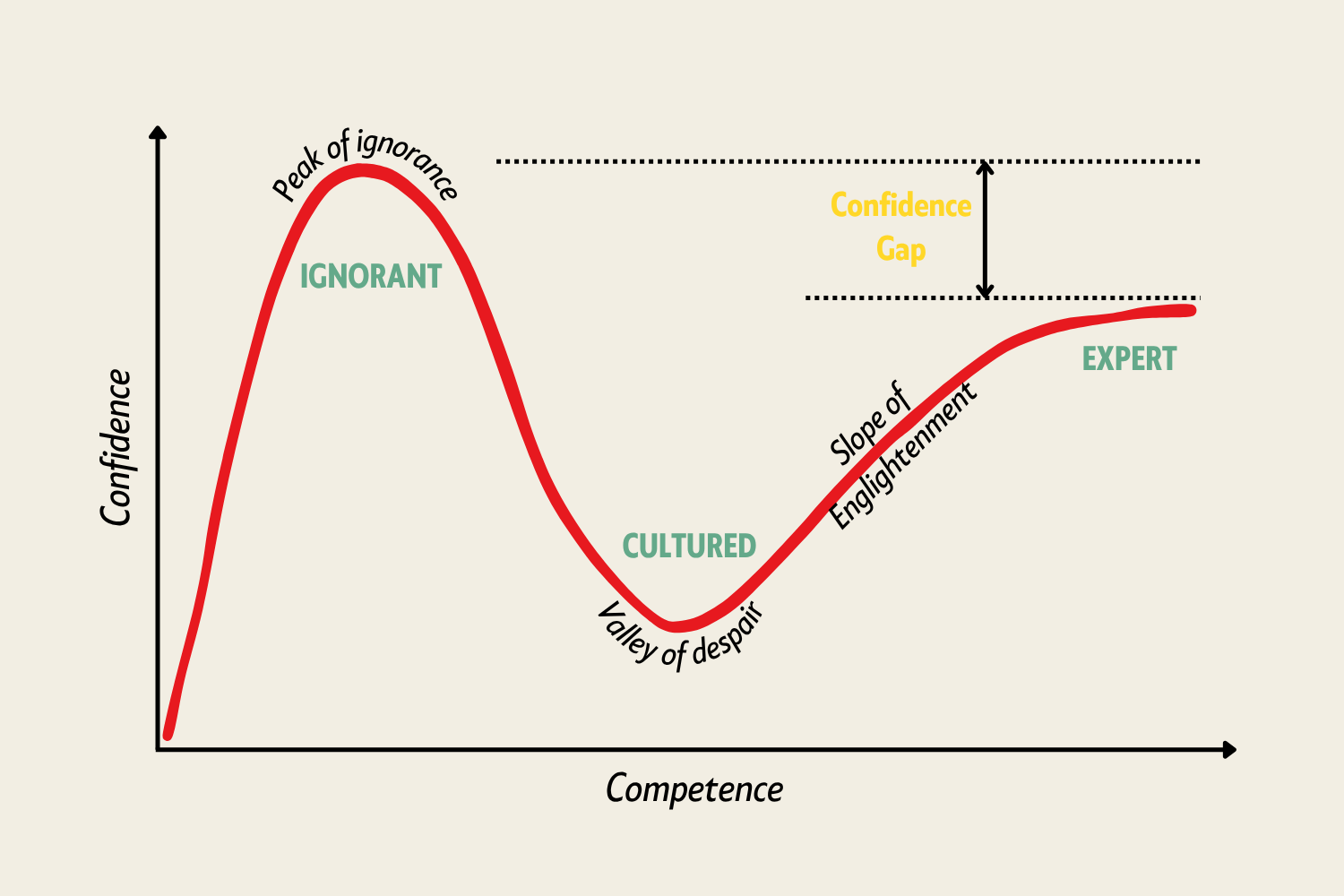
Dunning-Kruger Effect
Knowing little makes you feel unstoppable; knowing more makes you hesitate — the loudest voice is rarely the most reliable one.
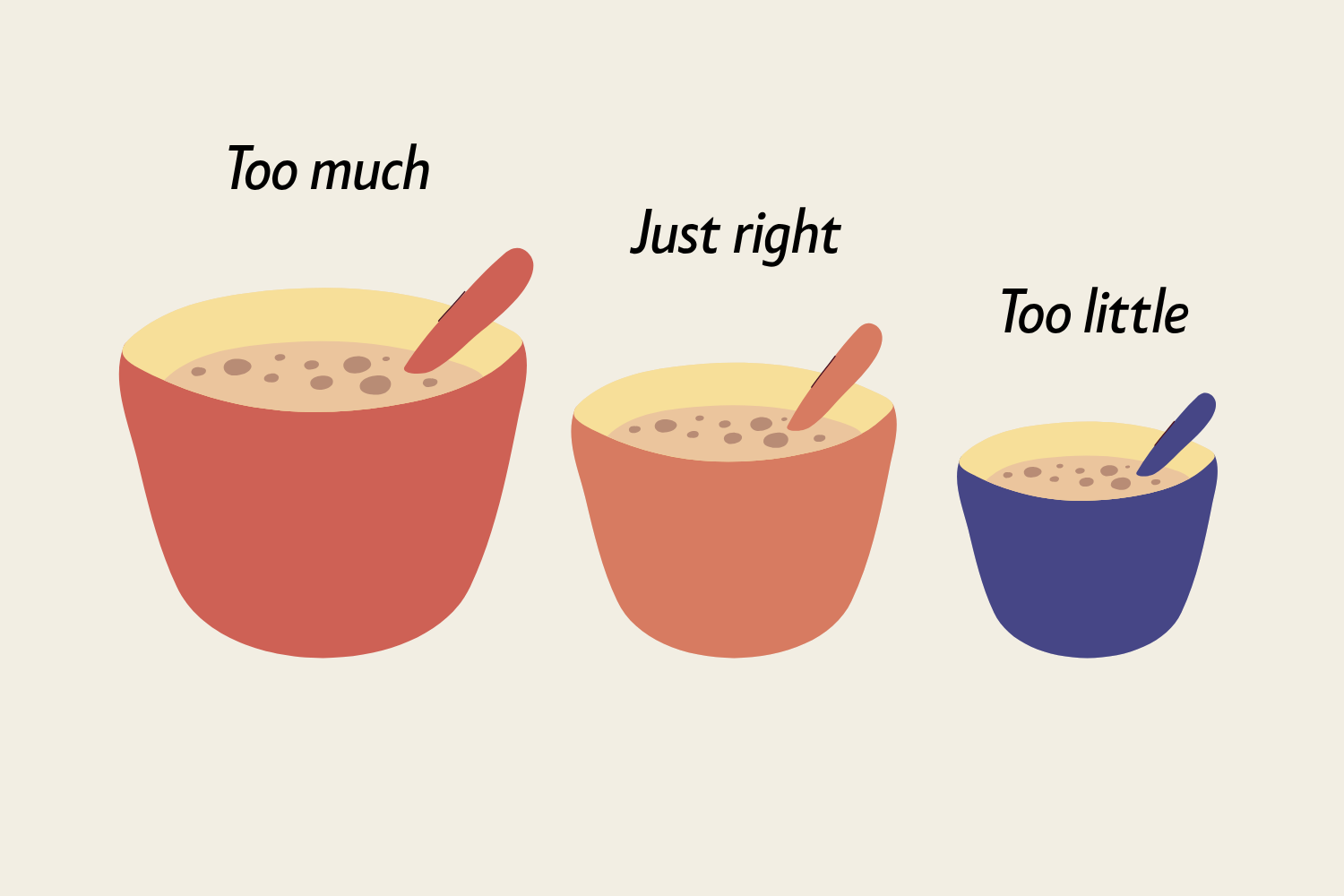
Goldilocks Principle
Support runs on a dial between micromanagement and abdication — enough direction for clarity, enough space for ownership, always moving.

Hawthorne Effect
People change how they behave when they know they're watched — your attention is an intervention that changes what you see.
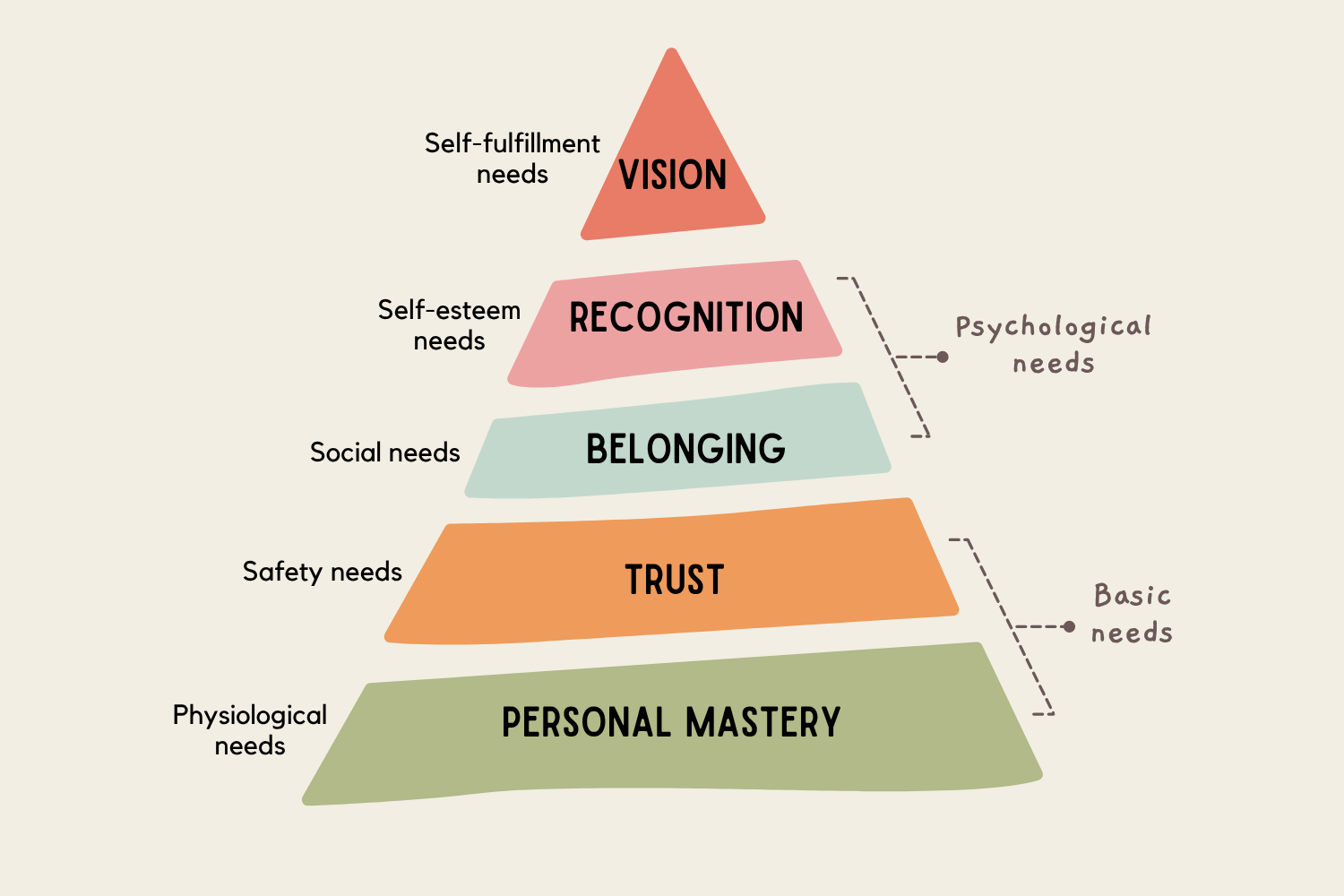
Maslow's Hierarchy of Needs
Abraham Maslow's five-level model of motivation, applied to leadership as a stack — mastery, trust, belonging, up through recognition and vision.
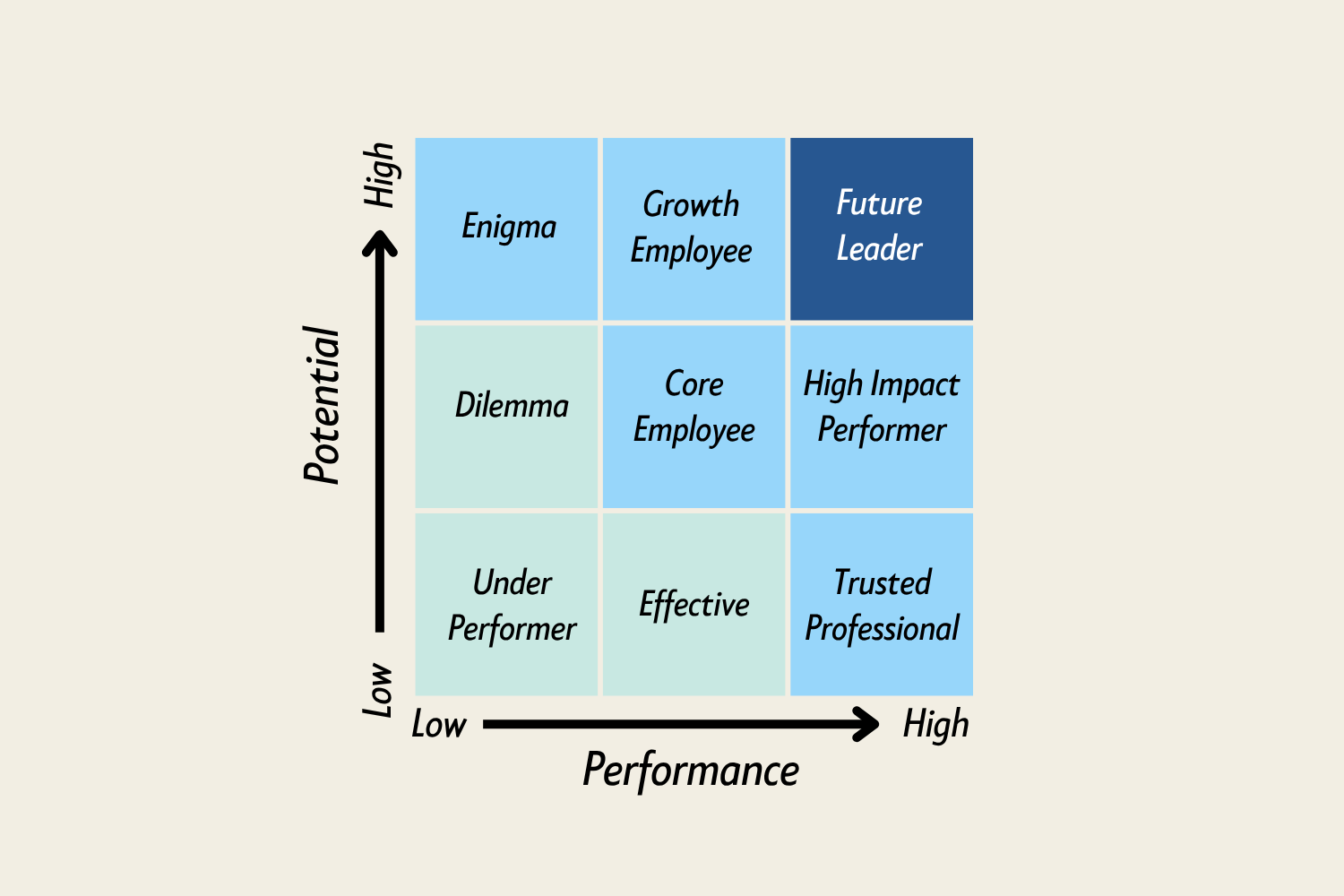
McKinsey 9-Box Model
A 3x3 grid that plots each person on performance against potential, giving nine distinct calls instead of one blurry verdict.

Multipliers and Diminishers
Liz Wiseman's split between leaders who bring out best thinking in people around them, and those who shut it down.
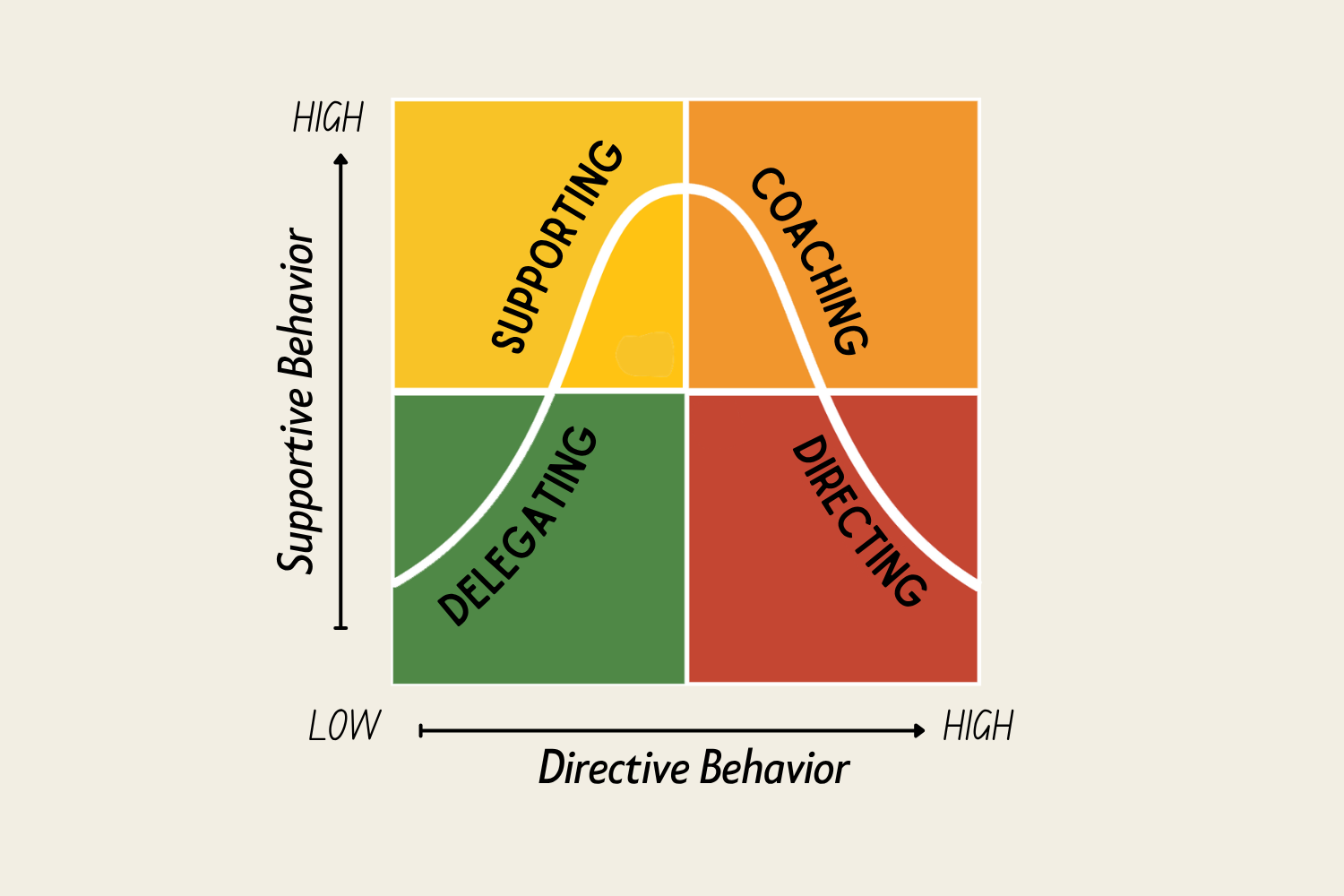
Situational Leadership
There's no right way to lead — only the right way for this person right now: direct, coach, support, or delegate.

The 6 Human Needs
Every behavior at work is really an unmet need in disguise — six needs, popularized by Tony Robbins, worth checking first.
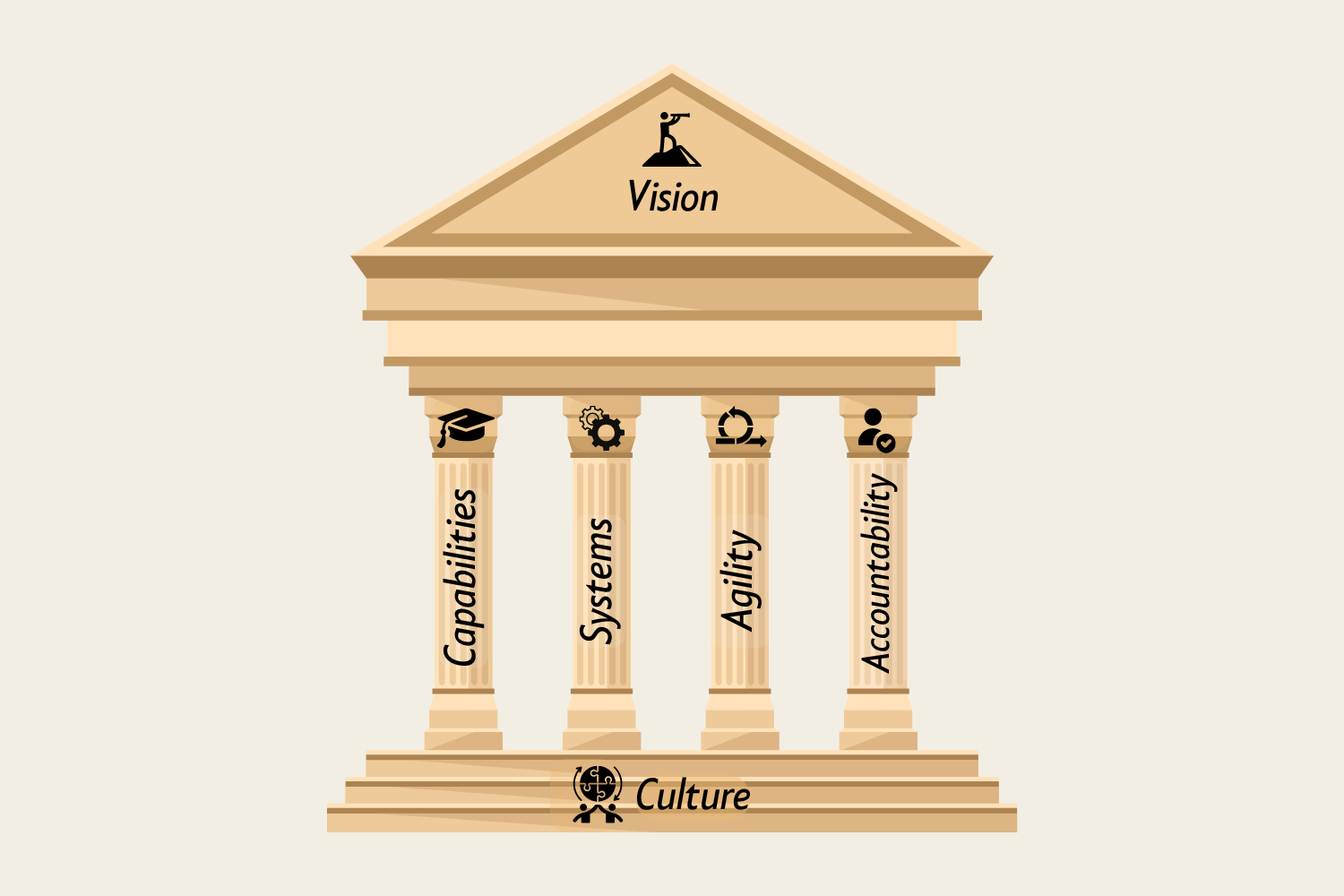
The Architecture of High-Performing Teams
Six elements, built like a temple — culture as the base, four pillars, vision as the roof — name the missing piece.

The Bannister Effect
One person breaking a barrier makes it stop being fixed for everyone else — break the unspoken belief in public first.

The Five Dysfunctions of a Team
Lencioni's pyramid of five team-killing behaviors — a lack of trust at the base drags everything above it down.

The Inner Drive
A leadership take on Daniel Pink's *Drive* that turns three conditions for motivation — autonomy, mastery, purpose — into habits for 1:1s.

The Pygmalion Effect
What you expect from someone leaks into how you treat them, which shapes what they become — for better or worse.

The Thomas-Kilmann (TKI) Model
Five conflict styles, two dials — how hard you push, how much room you give — chosen on purpose, not by default.
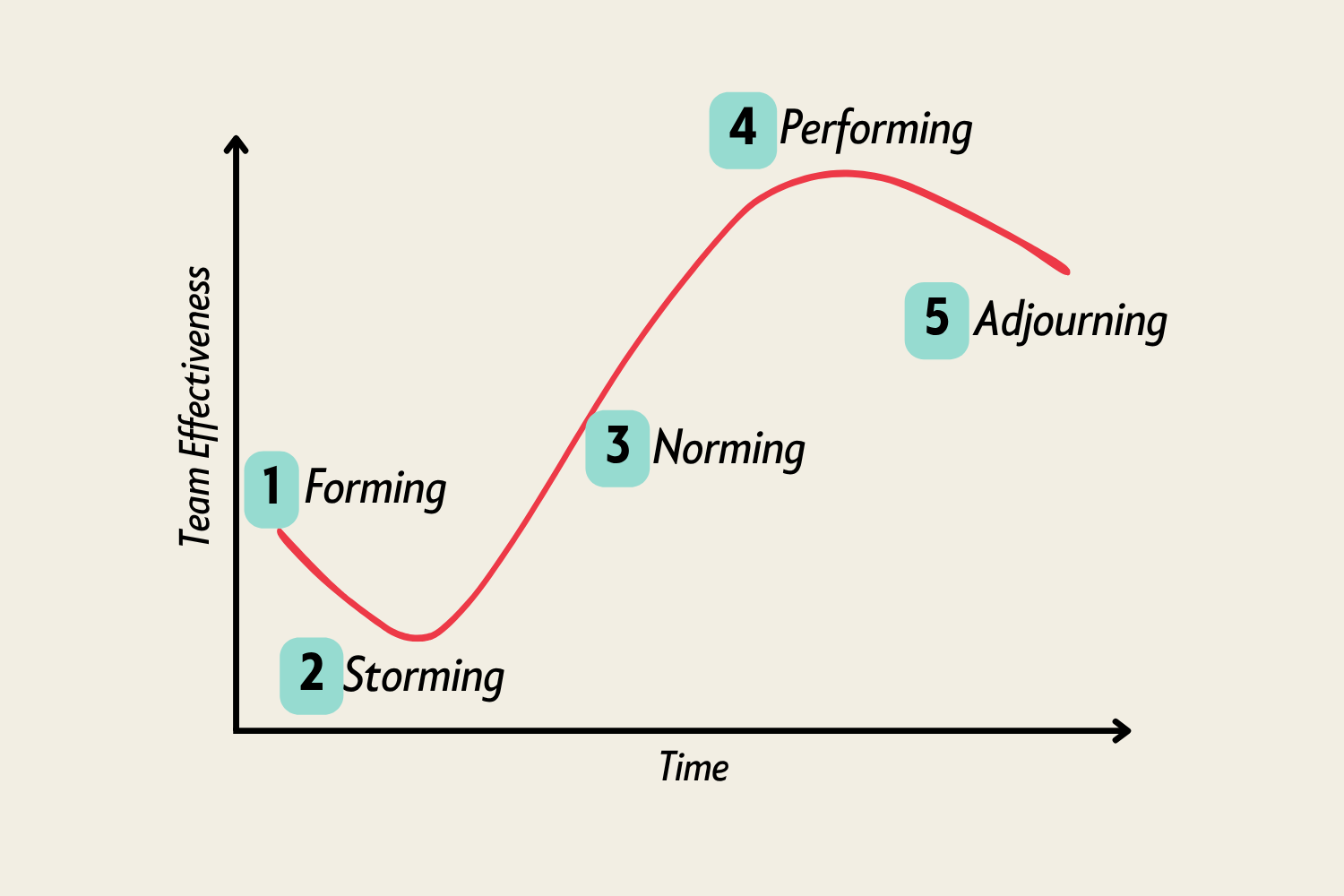
Tuckman's Stages of Team Development
Every team moves through five predictable stages — forming, storming, norming, performing, adjourning — each demanding a different move from you.