The Goal
Eliyahu Goldratt's business novel about a plant manager racing to save his factory. Hidden inside the story is the Theory of Constraints: every system has exactly one bottleneck at a time, and polishing everything that isn't it is effort dressed up as progress.
 Find this on the mind-map
Introduction
Eliyahu Goldratt wrote The Goal as a novel on purpose. A plant manager, Alex Rogo, has ninety days to save a failing factory, guided by a former professor named Jonah who answers almost every question with another question. Underneath the fiction is the Theory of Constraints: every system, at any given moment, has exactly one bottleneck that limits its total output, and almost everything managers do to optimize the parts that aren't the bottleneck is wasted effort dressed up as productivity.
The Bottleneck Is the System
A plant, or a team, can have every individual station running at high efficiency and still ship late, because the one slowest station sets the pace for everything downstream of it. Goldratt's point is unforgiving: the capacity of the whole system equals the capacity of its most limited part, full stop. Improving anything else doesn't increase total output. It just builds up unfinished work in front of the bottleneck.
The Hiking Trail Problem
Jonah illustrates this with a troop of hikers: the whole line moves at the pace of the slowest boy, Herbie, no matter how fast the others walk, and the gaps that open up ahead of Herbie are wasted capacity, not progress. Moving Herbie to the front of the line, making the bottleneck visible and giving everyone a reason to pace around it instead of around themselves, is the entire fix. Most teams keep Herbie buried in the middle of the line and wonder why the project is always "almost done" at every station except one.
The Five Focusing Steps
Goldratt's practical loop: identify the constraint, decide how to exploit it (get everything possible out of it without new investment), subordinate every other step to that decision (everything else slows down or speeds up to match the constraint's pace, not its own), elevate the constraint if exploiting it wasn't enough (invest, add capacity), and then repeat, because fixing one bottleneck reveals the next one.
Local Efficiency Is a Trap
Rosa, a plant manager, is proud that every station in her factory hits 95% utilization. She still can't ship on time, because the stations downstream of the real bottleneck produce more than it can absorb, which just becomes excess inventory, not finished product. Chasing local efficiency everywhere, rather than global throughput, is Goldratt's central villain: it looks like good management and produces a factory full of unsold parts.
Three Measures: Throughput, Inventory, Operational Expense
Goldratt reduces every operational decision to three questions: Is this increasing throughput (the rate of making money through sales)? Is it reducing inventory (money tied up in things not yet sold)? Is it reducing operational expense (money spent turning inventory into throughput)? A decision that improves one of these while worsening another isn't automatically good. It has to be weighed against the system as a whole, not judged station by station.
Putting It Together
Find the constraint, don't improve everything equally around it, and measure success by whether the whole system's output actually moved, not by how busy any individual part looks. The five focusing steps are the loop; the hiking-trail problem is the intuition; throughput, inventory, and operational expense are the scoreboard that keeps you honest about whether local effort actually produced global results.

Why It Matters for Leaders
Most managers respond to a slipping team the way Rosa runs her factory: push everyone to work harder, measure everyone's output, reward whoever looks busiest. Goldratt's argument is that this is effort spent in the wrong place almost every time, because one step is setting the pace for all the others, and pushing on the rest just builds a bigger pile of unfinished work in front of it.
The useful move is to stop asking "who's underperforming" and start asking "where does work consistently pile up and wait." That's not always the step that looks the busiest. The overloaded senior reviewer, the one approval that needs a specific person's sign-off, the single person who knows how to configure the one system everyone depends on: these rarely look like the problem, because everyone around them looks appropriately busy too.
Once you've found it, the discipline is in what you don't do. You don't add headcount everywhere. You don't push every team to go faster. You protect the bottleneck's time first, and you let everything else slow down or speed up to match its pace, even when that feels like you're deliberately leaving other parts of the system "underused." That's the counterintuitive part leaders resist most, because it looks like tolerating slack instead of fixing it.
Picture a manager, Oskar, running an engineering team where every individual developer hits their sprint commitments but releases still slip by weeks. Instead of pushing the team to work faster, he traces where work actually sits waiting and finds one senior engineer approving nearly every pull request, including routine ones. He reroutes the routine reviews to two other engineers, keeps only the genuinely hard reviews on the senior engineer's plate, and the backlog that had been building unnoticed for months clears in two sprints.
What to do next
Reinforce your understanding of The Goal
Books related to The Goal

Skills related to The Goal

Frameworks referenced from this book
Frameworks related to The Goal

Kaizen
A continuous improvement philosophy built on small, repeated changes to the system your team works in — not big transformation programs.

Six Sigma
A data-driven way to remove root causes of defects, via the DMAIC cycle: define, measure, analyze, improve, control.
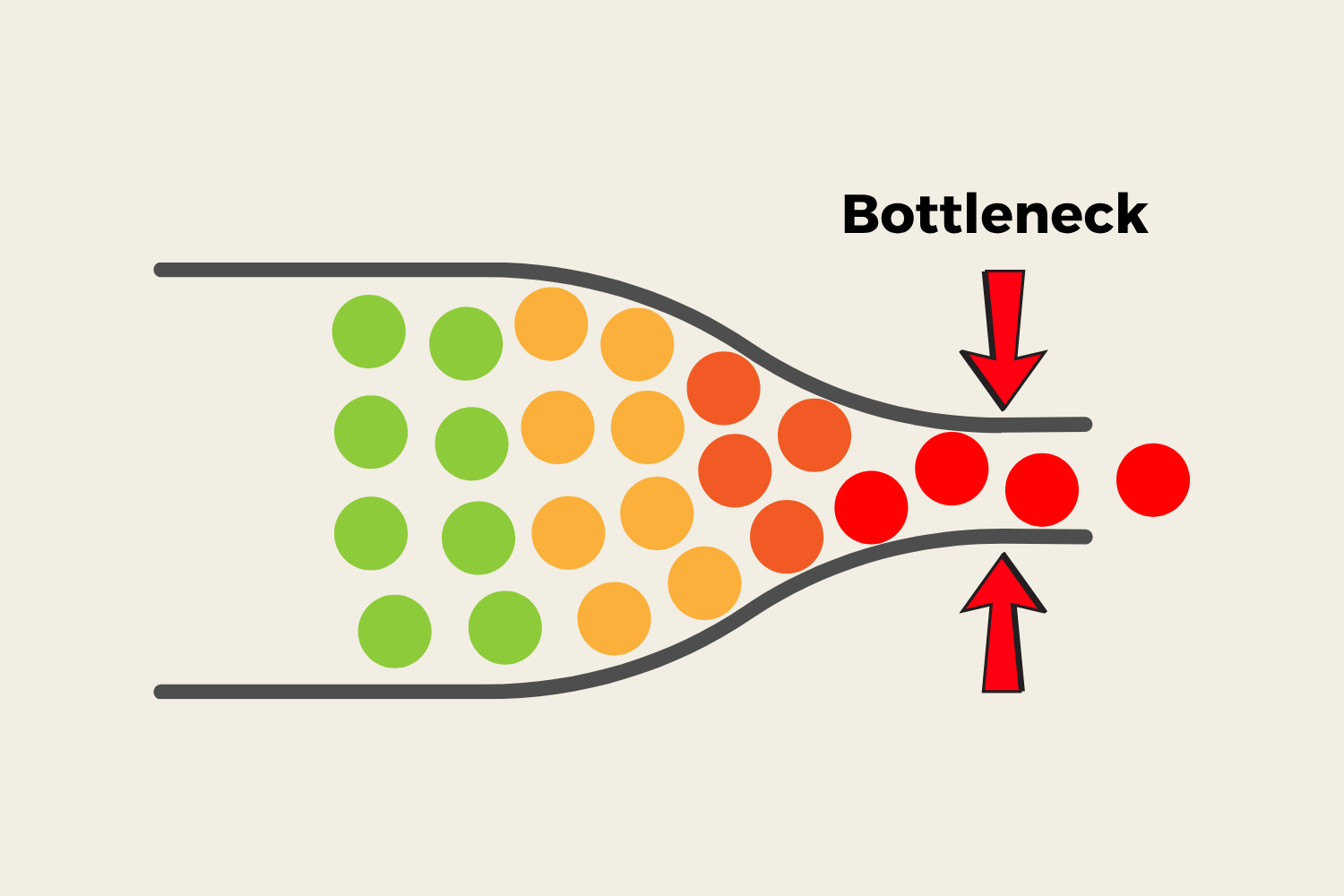
The Theory of Constraints
Every system has a bottleneck that caps everything it can produce — find that one constraint and put your energy there.