The Black Swan
Nassim Nicholas Taleb's argument that the events that actually reshape your business, your market, or your life are by definition the ones your models didn't see coming, and that the right response isn't better predicting, it's building something that survives being wrong.
 Find this on the mind-map
Introduction
A black swan, in Taleb's definition, is an event that's rare, has enormous impact, and, critically, gets explained afterward as if it had been predictable all along, even though almost nobody saw it coming beforehand. His argument isn't that forecasting is slightly imperfect. It's that the events that actually matter most, in markets, history, and careers, are structurally the ones forecasting methods are worst equipped to catch, and that the fix isn't a better model. It's building something that doesn't need to predict the black swan to survive it.
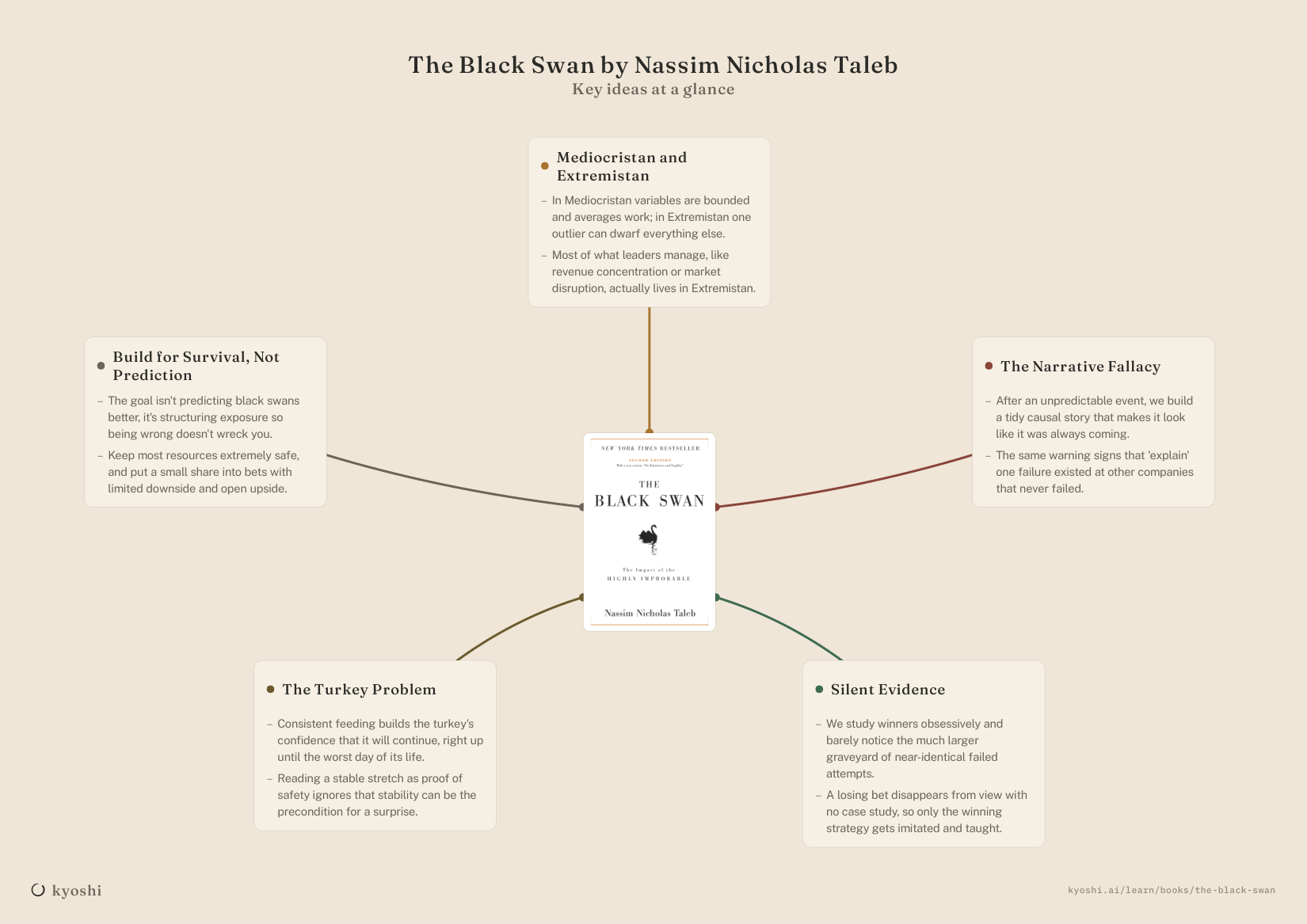
Mediocristan and Extremistan
Taleb splits the world into two kinds of statistical terrain. In "Mediocristan," variables are bounded and well-behaved. Human height, for instance, can't be dramatically more extreme than the average, so the bell curve and its tools (averages, standard deviations) work fine. In "Extremistan," a single outlier can dwarf everything else combined. One bestselling book, one market crash, one catastrophic failure can outweigh thousands of ordinary data points. Most of what leaders actually manage, like revenue concentration, market disruption, and reputational risk, lives in Extremistan, yet gets measured with Mediocristan-style tools that assume, without saying so, that the extreme outlier can't happen, right up until it does.
The Narrative Fallacy
Humans are compulsive pattern-finders, and once an unpredictable event has happened, we construct a tidy causal story that makes it look like it was always going to happen: "of course the company failed, look at all these warning signs," conveniently ignoring that identical warning signs existed at a dozen companies that didn't fail. The story feels like insight. It's mostly a comforting illusion built backward from a known outcome.
Silent Evidence: You Only See the Survivors
We study winners obsessively and barely notice the much larger graveyard of near-identical attempts that failed, because the failures mostly stopped generating visible evidence. Picture two founders with nearly identical strategies, risk appetites, and initial luck. Carlos's bet hits, gets written up, studied, and imitated as a case of visionary strategy. Renata's near-identical bet doesn't hit, and simply disappears from view. No retrospective, no case study, nothing to weigh against Carlos's story. Studying only the visible winner teaches the wrong lesson, because the losing version of the same strategy never got a seat in the room.
The Turkey Problem
A turkey fed consistently every single day grows more confident, with each passing day, that the feeding will continue, right up until the one day it doesn't, which happens to be the worst day of its life. The turkey's confidence peaked at exactly the moment its risk peaked, because it was reading stability as a trend rather than recognizing that stability can be the precondition for the worst surprise, not evidence against one.
Build for Survival, Not Prediction
Taleb's practical answer isn't "get better at predicting black swans." He's explicit that this mostly can't be done reliably. It's structuring your exposure so you can survive being wrong, and even benefit from it: keep the bulk of your resources extremely safe, and take a small portion in exposures with limited downside but open-ended upside, rather than spreading everything across a comfortable, moderate middle that looks safe but has hidden, unbounded downside risk.
Putting It Together
Every idea here points the same direction: stop trying to see the unpredictable coming, and start building whatever you're responsible for (a team, a strategy, a portfolio) so that being wrong about the future doesn't wreck it, and being lucky about it pays off disproportionately.
Why It Matters for Leaders
The practical use of this book for a manager isn't forecasting better, it's noticing which parts of the business can't be forecast well at all, and building those parts so a bad surprise doesn't take the whole thing down. Most planning processes assume the future looks roughly like a smoothed-out version of the past. Taleb's point is that the events that actually matter, a key client leaving, a competitor's product landing wrong, a market shifting underneath you, are exactly the ones that pattern doesn't cover.
The turkey problem is the one worth checking against your own team regularly. A quarter of nothing going wrong doesn't mean the plan is sound. It can just as easily mean the risk hasn't shown up yet. A manager who reads a calm stretch as proof of safety is set up to be the most surprised person in the room when something finally breaks, precisely because their confidence had nowhere to go but up the whole time.
The most useful habit this book builds is asking what would happen if you're wrong, before you're wrong, on the decisions that actually matter. Not every decision needs a downside plan. But the ones with real exposure, a big bet on one client, one platform, one person's judgment, deserve the question "can the team survive if this specific assumption turns out to be false," not just "is this likely to work."
Picture a manager, Deepak, whose team's roadmap depends almost entirely on one enterprise client renewing a contract next year. Everyone treats the renewal as close to certain, because it's always renewed before. Deepak spends an afternoon asking what the team would actually do if it didn't, and realizes nobody has a plan, just an assumption. He doesn't need to predict whether the client leaves. He just needs the team to survive either way, and right now it can't.
What to do next
Reinforce your understanding of The Black Swan
Skills related to The Black Swan

Frameworks related to The Black Swan
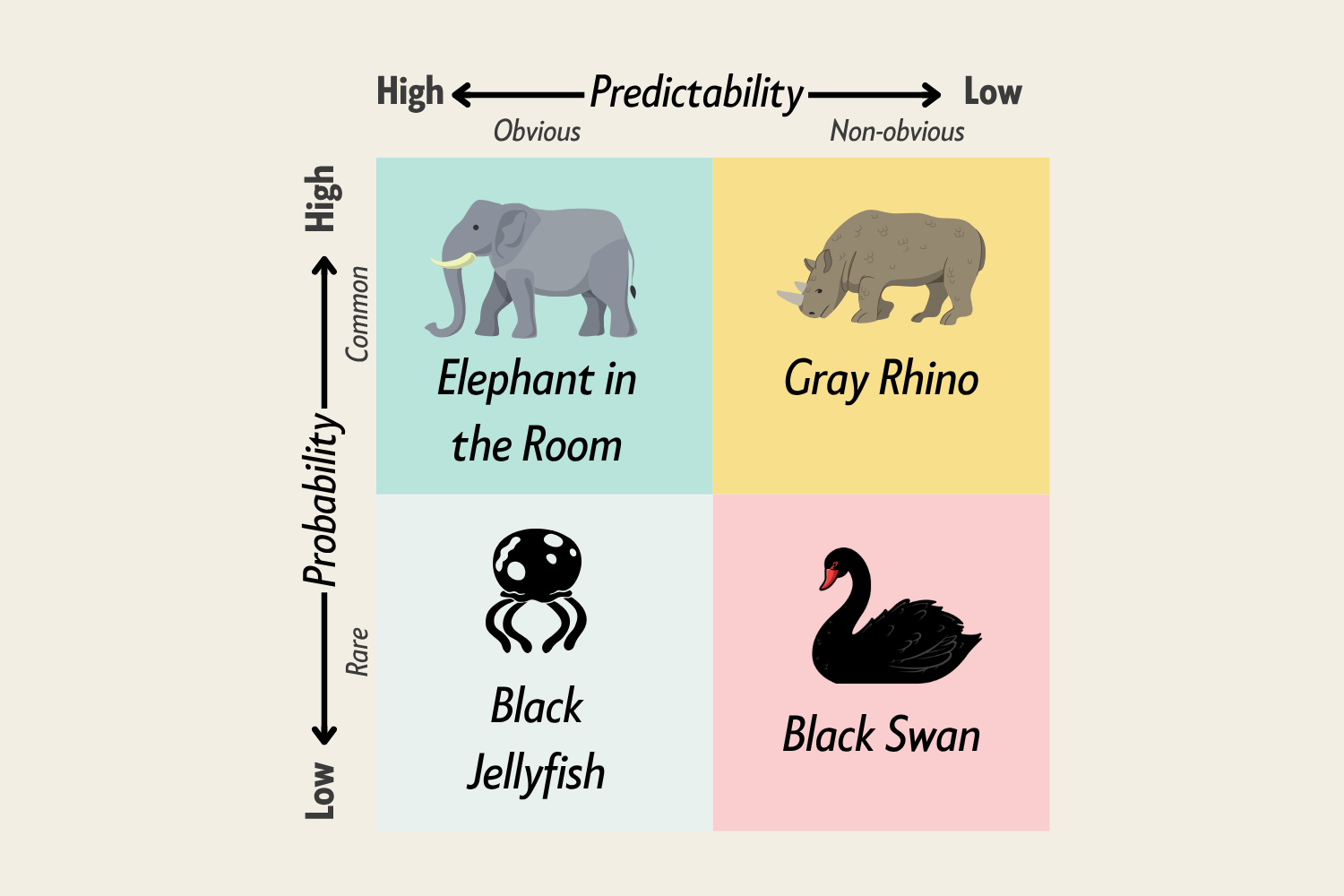
Animal Risk Matrix
Sort risk by predictability and probability into shapes — Elephant, Gray Rhino, Black Jellyfish, Black Swan — each needs a different response.

Inversion Principle
A thinking tool that swaps "how do I succeed?" for "how would this fail?" — surfacing failure modes forward planning misses.

Premortem Technique
Assume the project has failed by a specific date, then explain why — hindsight gets your team saying what they thought.
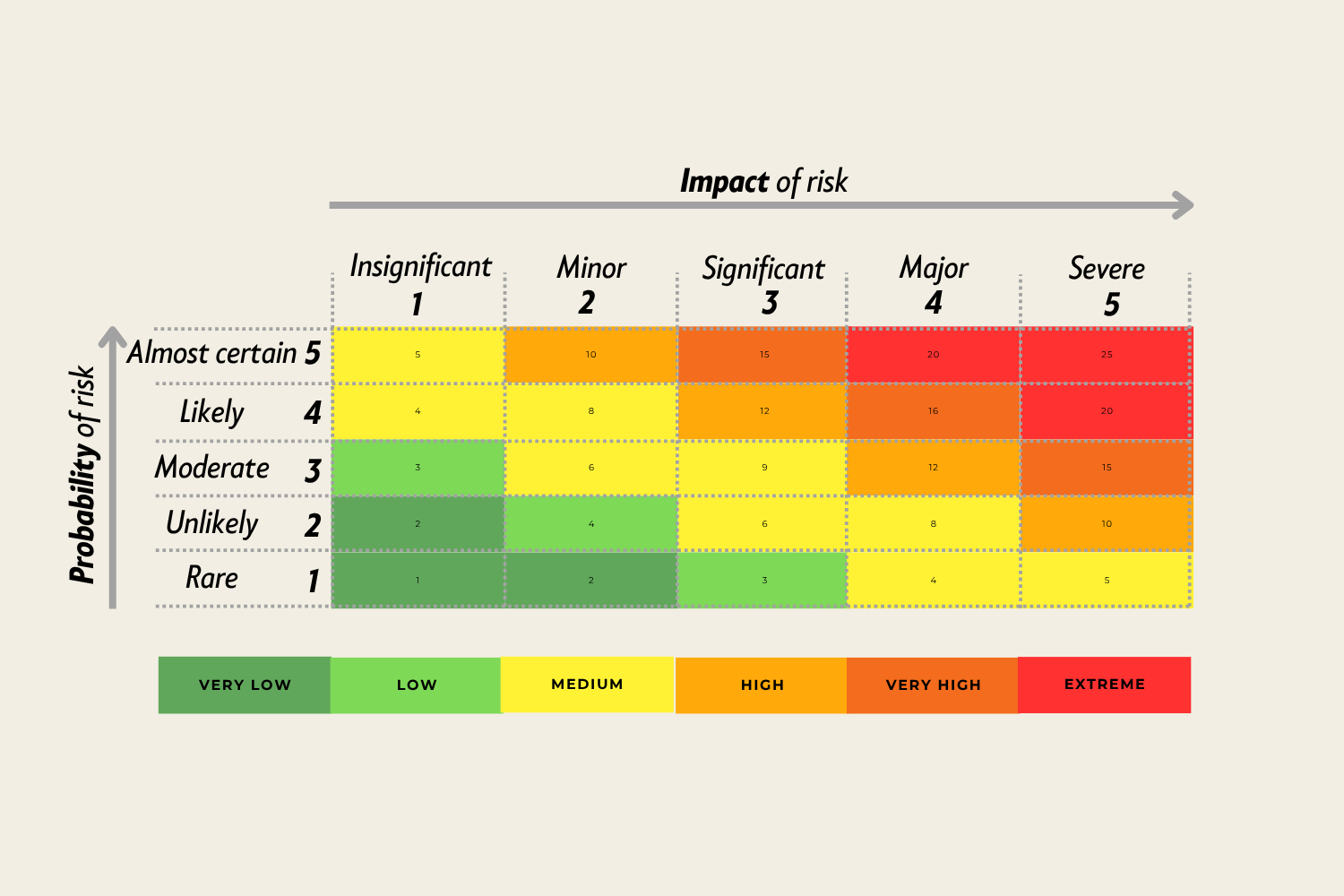
Risk Assessment Matrix
The grid for scoring risks by likelihood and impact, turning a messy list of worries into a ranked priority order.
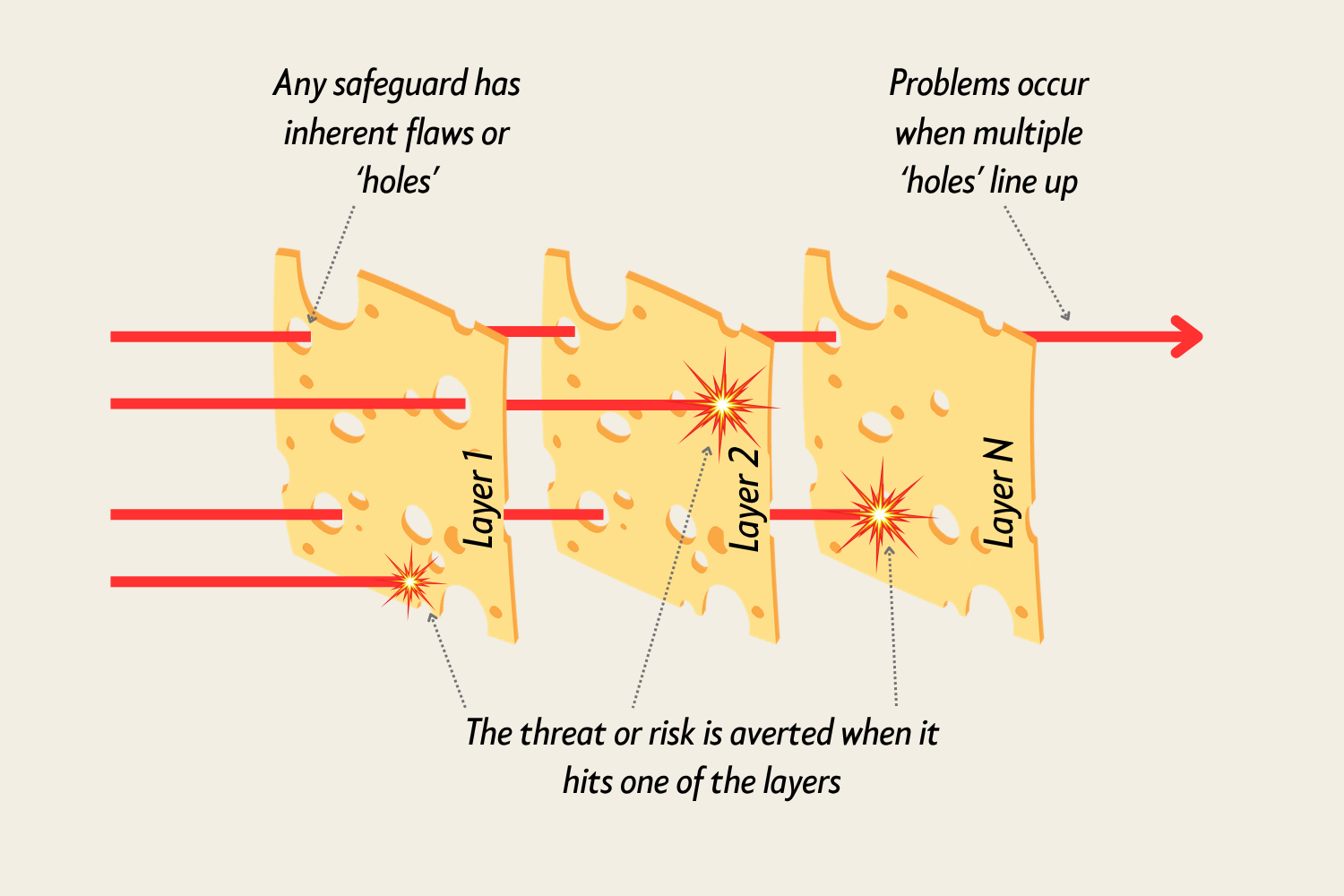
Swiss Cheese Model
Every layer of defense has holes — failure gets through only when several holes line up — fix is redundancy, not perfection.