High Output Management
Andy Grove's field manual for management as a production problem. Your output is the output of the people you influence, which reframes nearly everything a manager does as a question of leverage, not effort.
 Find this on the mind-map
Introduction
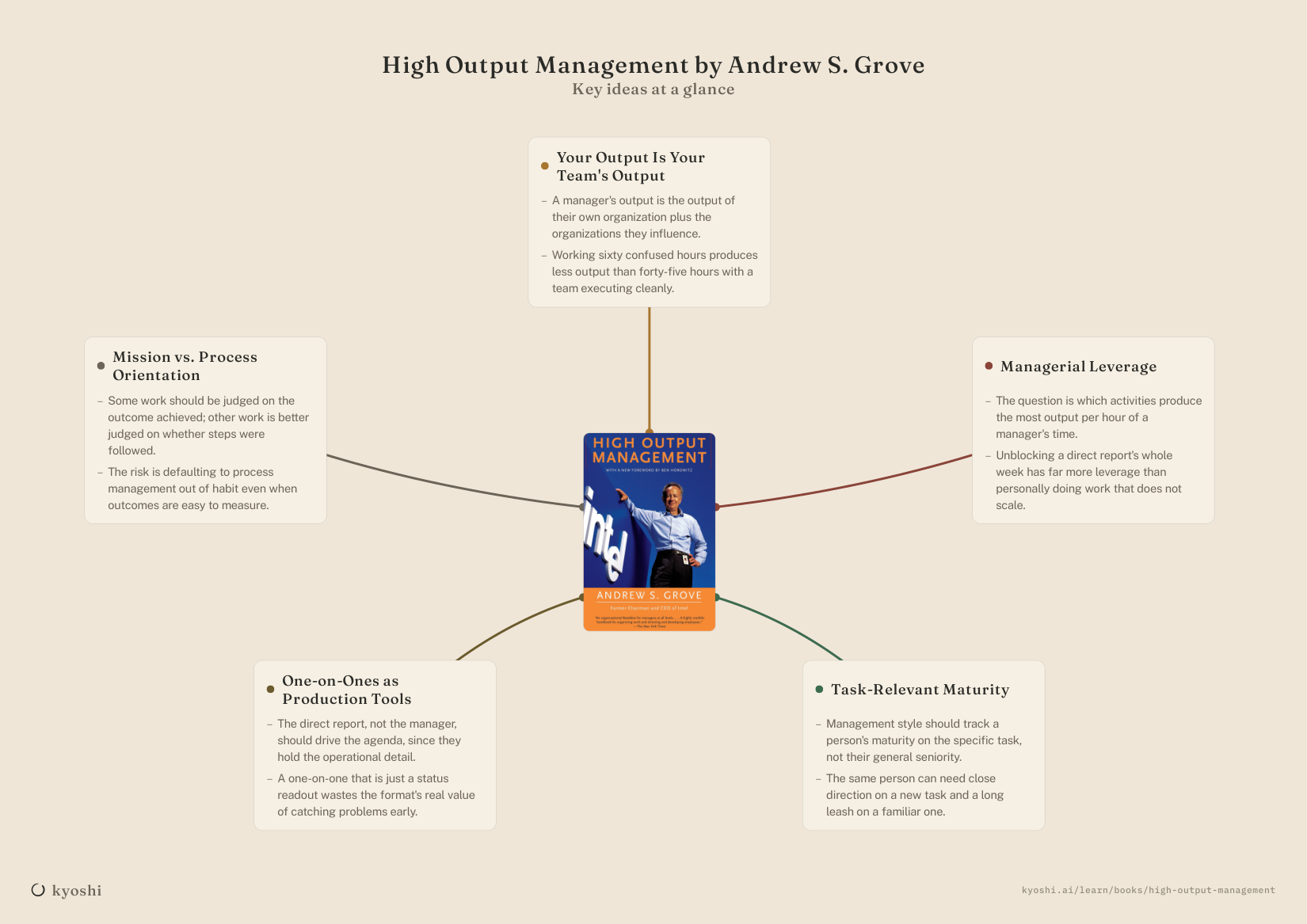
Andrew Grove ran Intel, and High Output Management reads like a field manual written by someone allergic to abstraction. His central claim: a manager's output isn't their own personal productivity, it's the output of the organization they influence, which reframes almost every managerial activity as a question of leverage, not effort.
Your Output Is Your Team's Output
Grove's formula for a manager's output: the output of your own organization, plus the output of the organizations under your influence. This sounds obvious until you apply it honestly. A manager who personally works sixty hours a week but whose team is confused about priorities has lower output than one who works forty-five hours and has a team executing cleanly. Busy-ness is not the metric; organizational output is.
Managerial Leverage
If output is the goal, Grove asks which activities produce the most output per hour of a manager's time: managerial leverage. A well-run one-on-one that unblocks a direct report for the rest of their week has enormous leverage; an hour spent personally doing a piece of work someone else could do has very little, because it doesn't scale past that hour.
Task-Relevant Maturity
Ben, a new manager, gives the same light-touch, autonomy-first instruction style to every direct report, including one brand new to the role. Priya, managing a similarly mixed team, adjusts her style to each person's task-relevant maturity: close, structured direction for someone new to a specific task, and a long leash for someone who's done it dozens of times, regardless of their seniority elsewhere. The same person can have high task-relevant maturity on one task and low maturity on a brand-new one; the management style should track the task, not the title.
The One-on-One as a Production Tool
Grove treats the one-on-one not as a courtesy check-in but as a scheduled production process. The direct report, not the manager, should drive the agenda, because they hold the operational detail the manager needs surfaced. A one-on-one that's just a status readout wastes the format's real value: catching problems and decisions early enough that the manager's limited leverage-hours go to exactly the right place.
Mission-Oriented vs. Process-Oriented Teams
Some functions should be managed by mission: judged on whether the real-world outcome was achieved, with latitude on how. Others should be managed by process: judged on whether the defined steps were followed correctly, because the outcome is too delayed or too hard to measure day to day. Grove's warning is against defaulting to process management out of habit even when a team's work is genuinely better judged by its outcome.
Putting It Together
Treat your own time as a scarce resource to be spent on the highest-leverage activities, size your management style to the task in front of each person rather than their general seniority, run one-on-ones as the operational tool they're meant to be, and choose mission- versus process-orientation deliberately rather than by default. All four point at the same underlying idea: management is a production problem, and Grove's whole book is really asking how to maximize the output of a system you don't personally do the work in.
Why It Matters for Leaders
The question this book forces on you is uncomfortable for anyone who got promoted for being personally excellent at the work: your own output stopped being the point the day you became a manager. If you're the hardest-working person on your team and the team is still missing its numbers, the problem isn't your effort, it's where that effort is going.
That reframe changes how you spend your week. A status-update meeting where you ask everyone what they did is low leverage, it reports on work that already happened. A one-on-one where you unblock someone before Tuesday's deadline, or a decision you make once that a dozen people stop guessing about, is high leverage, because it changes output you'd otherwise never see or touch directly.
Task-relevant maturity is the piece that saves you from managing everyone the same way, which is the default most new managers fall into. Your most senior engineer still needs close direction on the one system they've never touched before, and your newest hire might need almost none on the one thing they did for three years at their last job. Matching the style to the task, not the resume, is what actually produces good output instead of good vibes.
Picture Raj, a manager who prides himself on giving his team full autonomy, true to the "trust your people" ethos he's read about everywhere. One of his engineers, strong and experienced everywhere else, struggles for three weeks without saying much about it on a migration she's never done before, afraid that asking for structure will look like she can't handle the job. Raj finally notices in a one-on-one she was supposed to run herself, and switches to detailed, step-by-step check-ins just for this one task. She finishes it in four days. The autonomy wasn't wrong as a general style. It was wrong for this specific task, and Raj's job was to notice the difference.
What to do next
Reinforce your understanding of High Output Management
Books related to High Output Management

Skills related to High Output Management

Frameworks related to High Output Management

Agile Methodology
Short cycles beat long plans — build a slice, ship it, get real feedback, adjust, and repeat until it fits.

Dreamboxing
A model for turning vision into disciplined execution by cycling through three stages — Dream, Drive, Do — rather than favoring one.

Lean Startup
Eric Ries's Build-Measure-Learn loop: test your riskiest assumption with the smallest product, measure what people do, then pivot or persist.
The 4 Disciplines of Execution
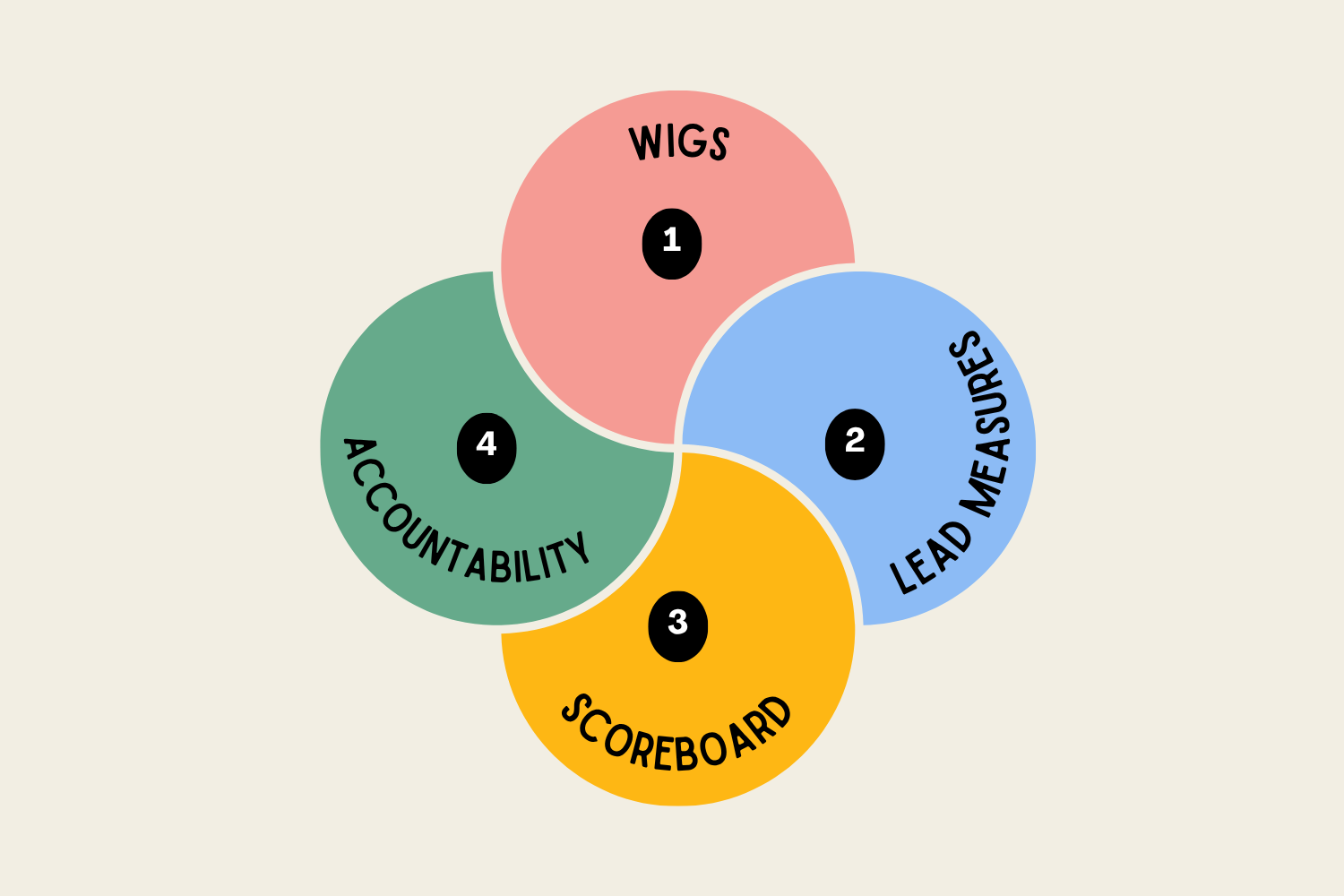
Four disciplines for hitting your important goals: narrow focus, act on lead measures, keep a visible scoreboard, run weekly accountability.

The Value Triangle
A modern replacement for the Iron Triangle — swap cost, time, scope for investment, frequency, and incremental value — levers, not constraints.