Team of Teams
General Stanley McChrystal, Tantum Collins, David Silverman & Chris Fussell
General Stanley McChrystal's account of rebuilding a special-operations task force to fight a decentralized enemy network, and the argument that efficient hierarchy, the thing most organizations are explicitly built for, is the wrong design for a fast, complex environment.
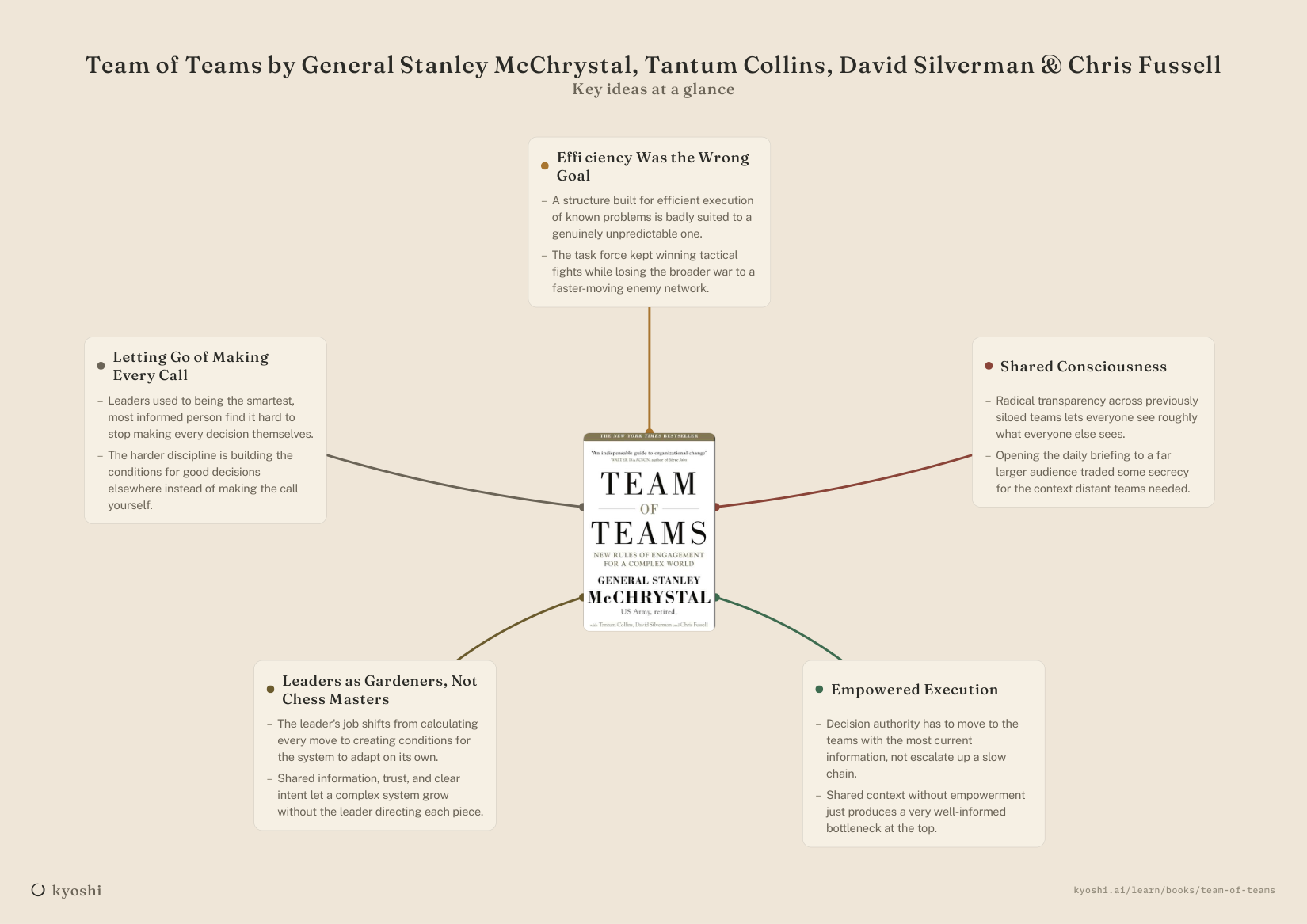
 Find this on the mind-map
Introduction
General Stanley McChrystal's account starts with a problem the U.S. military's own organizational design had created: his Joint Special Operations task force was efficient, disciplined, and hierarchical, and it was losing to a decentralized, networked enemy in Iraq that could adapt and communicate faster than the task force's chain of command could approve a single operation. The book's argument is that efficiency, the thing most organizations are explicitly built to optimize, is the wrong goal in a fast, complex, interconnected environment, and that the fix wasn't a better hierarchy, it was a fundamentally different shape.
Efficiency Was the Wrong Goal
Traditional military and corporate structure is built on specialization and centralized control, which is extremely efficient at solving predictable problems. McChrystal's task force kept winning tactical engagements and losing the broader fight, because the enemy's decentralized network could sense, decide, and act faster across the whole battlefield than any approval chain could, no matter how skilled each individual unit was. The lesson generalizes well past the battlefield: an organization optimized for efficient execution of known problems is often badly suited to a genuinely unpredictable, fast-moving one.
Shared Consciousness
The fix wasn't to decentralize decision-making blindly, it was to first build shared consciousness: a level of situational awareness, radical transparency, and mutual understanding across previously siloed teams (intelligence, different units, even partner agencies) that let everyone see roughly what everyone else saw. McChrystal's task force opened its daily operations-and-intelligence briefing to a far larger, cross-functional audience, deliberately trading some secrecy and some efficiency for the kind of shared context that let distant teams make good decisions without waiting for headquarters.
Empowered Execution
Shared consciousness only pays off if it's paired with empowered execution: pushing actual decision authority down to the teams with the most direct, current information, rather than having them escalate every call up a chain that's structurally too slow for the pace of the fight. The combination matters: empowering teams without shared context produces fragmented, locally optimized chaos; shared context without empowerment just produces a very well-informed bottleneck at the top.
Leaders as Gardeners, Not Chess Masters
McChrystal reframes the senior leader's job: not a chess master calculating every piece's next move, but a gardener who creates the conditions, shared information, trust, clear intent, for a complex system to grow and adapt on its own, intervening only when the environment genuinely calls for it. This is a harder discipline than it sounds for leaders used to being the smartest, most informed person making every call; it asks them to build the conditions for good decisions elsewhere instead of making all the decisions themselves.
Putting It Together
Shared consciousness without empowerment is just better-informed paralysis; empowerment without shared consciousness is chaos with good intentions. McChrystal's "team of teams" only works because both pieces are built together, under a leader who's deliberately shifted from directing every move to cultivating the conditions that let a network of smaller teams move at the speed the problem actually requires.
Why It Matters for Leaders
The managers who need this book most are usually the ones who are genuinely good at making calls, which is exactly what makes the habit hard to break. Being the person every decision routes through feels like leadership. Past a certain size or speed, it's actually the bottleneck.
The practical shift is sharing context before you share control. Pushing decisions down to a team that doesn't actually know what the rest of the organization is seeing just produces confident, uncoordinated mistakes. The fix isn't to pull decisions back up, it's to widen who sees what you see, a weekly update that goes to the whole team instead of just your peers, a shared doc instead of a status meeting that only three people attend.
Once people genuinely have the same picture you do, the harder move is actually letting them decide. That means sitting through a call you would have made differently and not overriding it just because you would have gone another way, as long as the reasoning was sound given what they knew.
Watch what happens the first time something goes wrong after you've pushed a decision down. The instinct is to pull all authority back to yourself "just for now." That's the moment the whole approach either holds or dies without much notice, and it's usually decided in a single conversation right after the mistake.
Picture a manager named Aisha who finds out a regional team made a pricing call she disagrees with, one that technically cost the company money this quarter. Her first instinct is to require her sign-off on every pricing decision going forward. Instead, she asks the team to walk her through what they knew at the time, confirms the call was reasonable given that information, and spends the next week making sure every regional team actually gets the same pricing data hers does. Three months later, that team is making calls faster and better than before, and Aisha isn't the bottleneck on a single one of them.
What to do next
Reinforce your understanding of Team of Teams
Books related to Team of Teams

Skills related to Team of Teams

Frameworks related to Team of Teams

Agile Methodology
Short cycles beat long plans — build a slice, ship it, get real feedback, adjust, and repeat until it fits.

Dreamboxing
A model for turning vision into disciplined execution by cycling through three stages — Dream, Drive, Do — rather than favoring one.

Lean Startup
Eric Ries's Build-Measure-Learn loop: test your riskiest assumption with the smallest product, measure what people do, then pivot or persist.
The 4 Disciplines of Execution
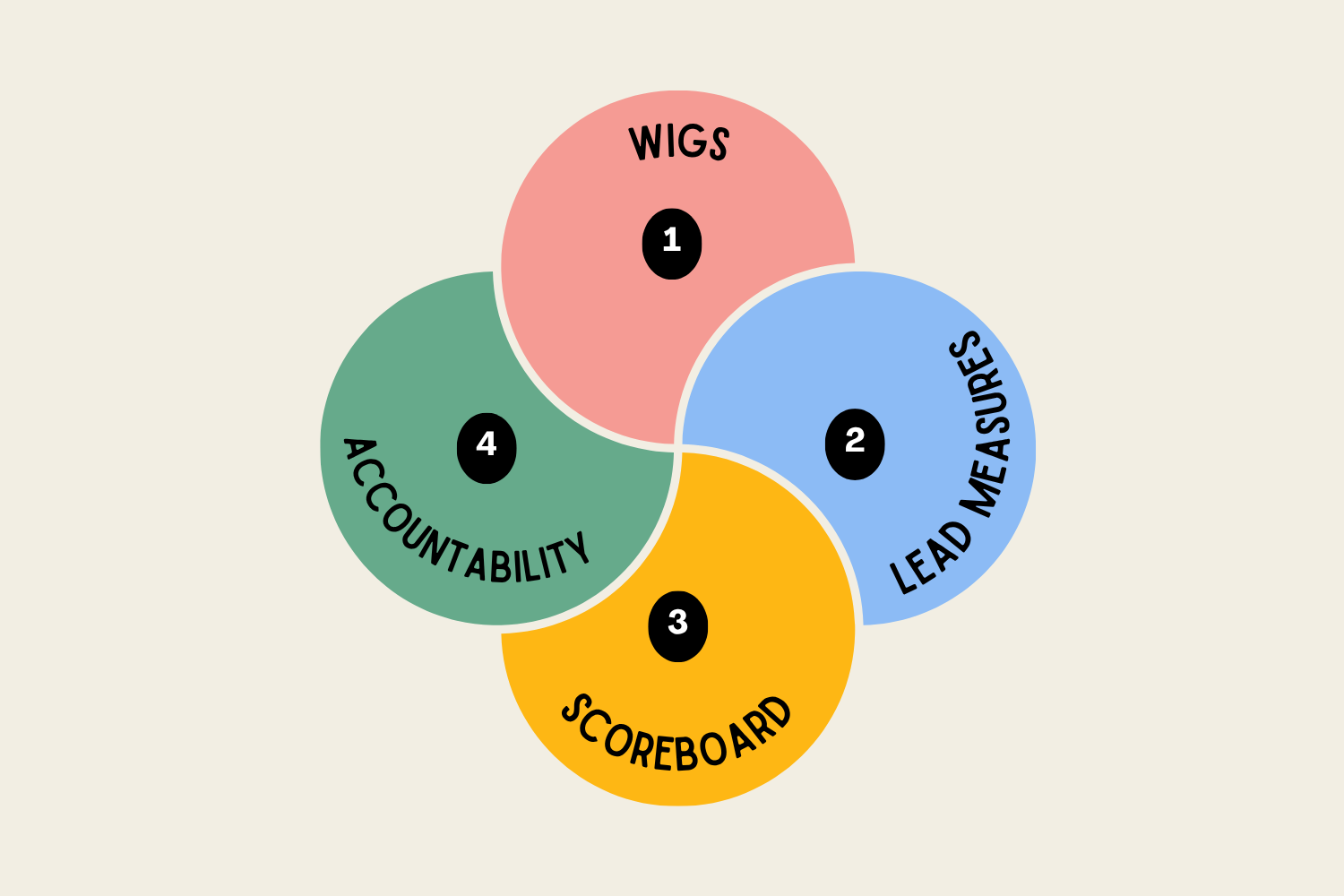
Four disciplines for hitting your important goals: narrow focus, act on lead measures, keep a visible scoreboard, run weekly accountability.

The Value Triangle
A modern replacement for the Iron Triangle — swap cost, time, scope for investment, frequency, and incremental value — levers, not constraints.