The 4 Disciplines of Execution
Four disciplines for hitting your important goals: narrow focus, act on lead measures, keep a visible scoreboard, run weekly accountability.
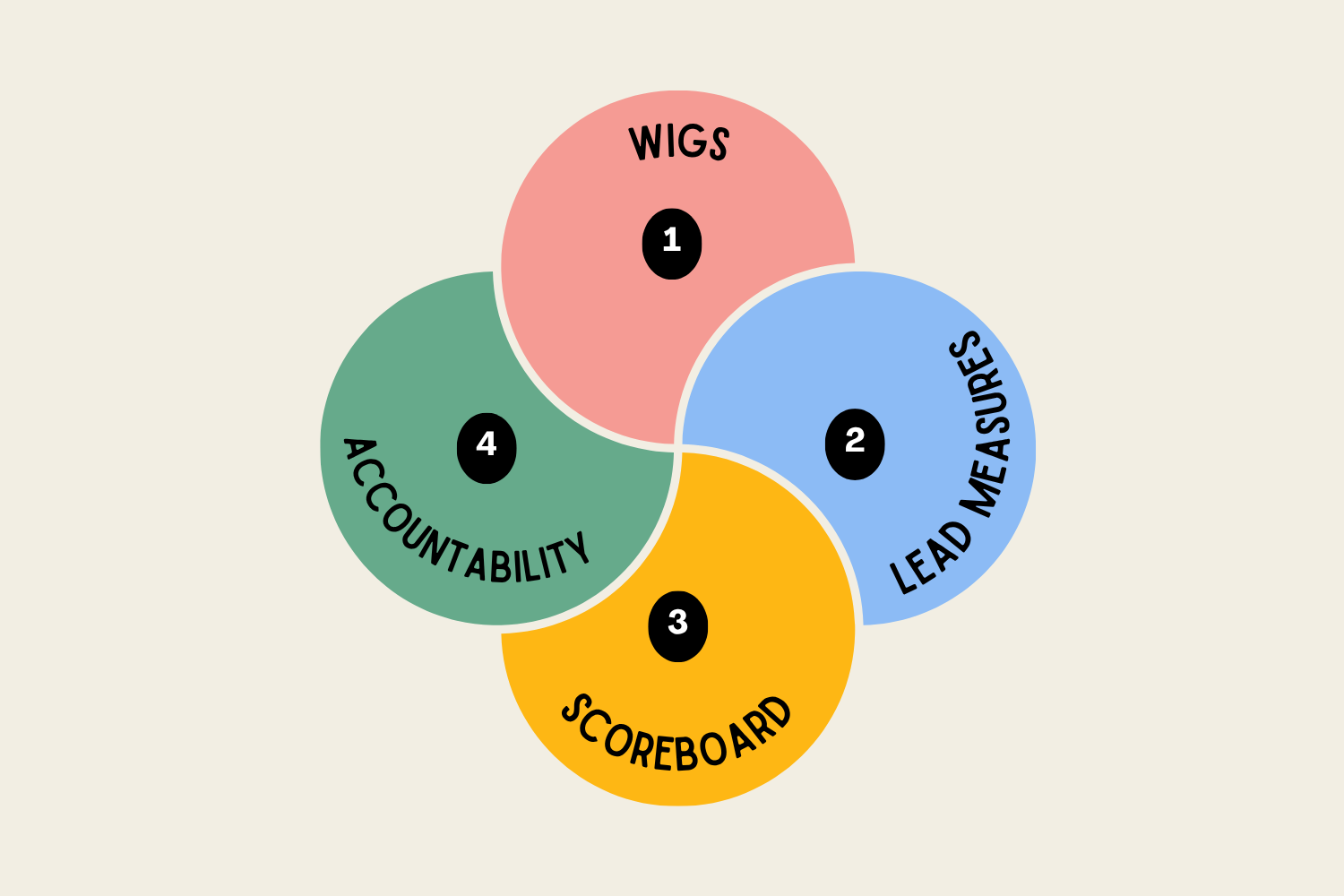 Find this on the mind-map
Introduction
The 4 Disciplines of Execution, usually shortened to 4DX, comes from a book of the same name by Chris McChesney, Sean Covey, and Jim Huling, published by FranklinCovey in 2012. It grew out of FranklinCovey's work with thousands of teams, and its central observation is blunt: strategy usually dies not from bad thinking, but from the day job.
How It Works
The authors call the day job the whirlwind — the urgent, recurring work required to keep the business running. The whirlwind isn't the enemy; it's the reason your business exists. But it will consume every hour you offer it, so any goal that requires new behavior loses to it by default. The four disciplines exist to protect that new behavior from getting swallowed.
| Discipline | What it does | The test |
|---|---|---|
| 1. Focus on the wildly important | Cut to one or two Wildly Important Goals (WIGs), each written as "from X to Y by when" | Can every team member name the WIG without looking it up? |
| 2. Act on lead measures | Track the behaviors that drive the outcome, not just the outcome | Is the measure predictive of the WIG and influenceable by the team? |
| 3. Keep a compelling scoreboard | Make winning and losing visible at a glance, owned by the team, not by management | Can a player tell in five seconds whether they're winning? |
| 4. Create a cadence of accountability | Hold a short weekly WIG session where each person reports last week's commitment and makes the next | Does it take under twenty minutes and stay off whirlwind topics? |
Discipline 2 is the core of this whole model. A lag measure is the result you want — revenue, retention, defect rate. You can't act on it directly, you can only find out about it after the fact. A lead measure is the behavior that actually moves the lag measure — customer visits per week, pre-release test coverage. Lead measures feel small, and that's exactly why they get dropped first.
Why It Matters for Leaders
You probably don't have a goal-setting problem. You have a goal-quantity problem. A team with two goals will usually achieve both. A team with a dozen goals will achieve none of them well, because attention, not effort, is the actual constraint.
4DX also closes the accountability gap that annual and quarterly goals leave wide open. A goal reviewed every quarter gets reviewed too late to change anything. A weekly commitment made out loud to peers is short enough to be believed, and short enough to be corrected before it goes off track.
The scoreboard matters more than it sounds like it should. People behave differently when they can see the score — a pickup game with a scoreboard is played harder than the exact same game without one. A goal that lives in a slide deck nobody opens isn't being executed. It's being remembered, at best.
This framework pairs naturally with OKR Model: OKRs are excellent at naming the ambitious outcome, and 4DX supplies the weekly discipline that actually makes it happen.
What to do next
Test your knowledge of The 4 Disciplines of Execution
Apply The 4 Disciplines of Execution to a real situation
Skills related to The 4 Disciplines of Execution

Frameworks related to The 4 Disciplines of Execution

Agile Methodology
Short cycles beat long plans — build a slice, ship it, get real feedback, adjust, and repeat until it fits.

Dreamboxing
A model for turning vision into disciplined execution by cycling through three stages — Dream, Drive, Do — rather than favoring one.

Lean Startup
Eric Ries's Build-Measure-Learn loop: test your riskiest assumption with the smallest product, measure what people do, then pivot or persist.

The Value Triangle
A modern replacement for the Iron Triangle — swap cost, time, scope for investment, frequency, and incremental value — levers, not constraints.
Books related to The 4 Disciplines of Execution

High Output Management
Andy Grove's field manual for management as a production problem. Your output is the output of the people you influence, which reframes nearly everything a manager does as a question of leverage, not effort.

Team of Teams
General Stanley McChrystal's account of rebuilding a special-operations task force to fight a decentralized enemy network, and the argument that efficient hierarchy, the thing most organizations are explicitly built for, is the wrong design for a fast, complex environment.