The Culture Map
Erin Meyer's field guide to why a management style that works perfectly in one country reads as either rude or weak in another, and why "just be yourself" is actually terrible advice for anyone leading across cultures.
 Find this on the mind-map
Introduction
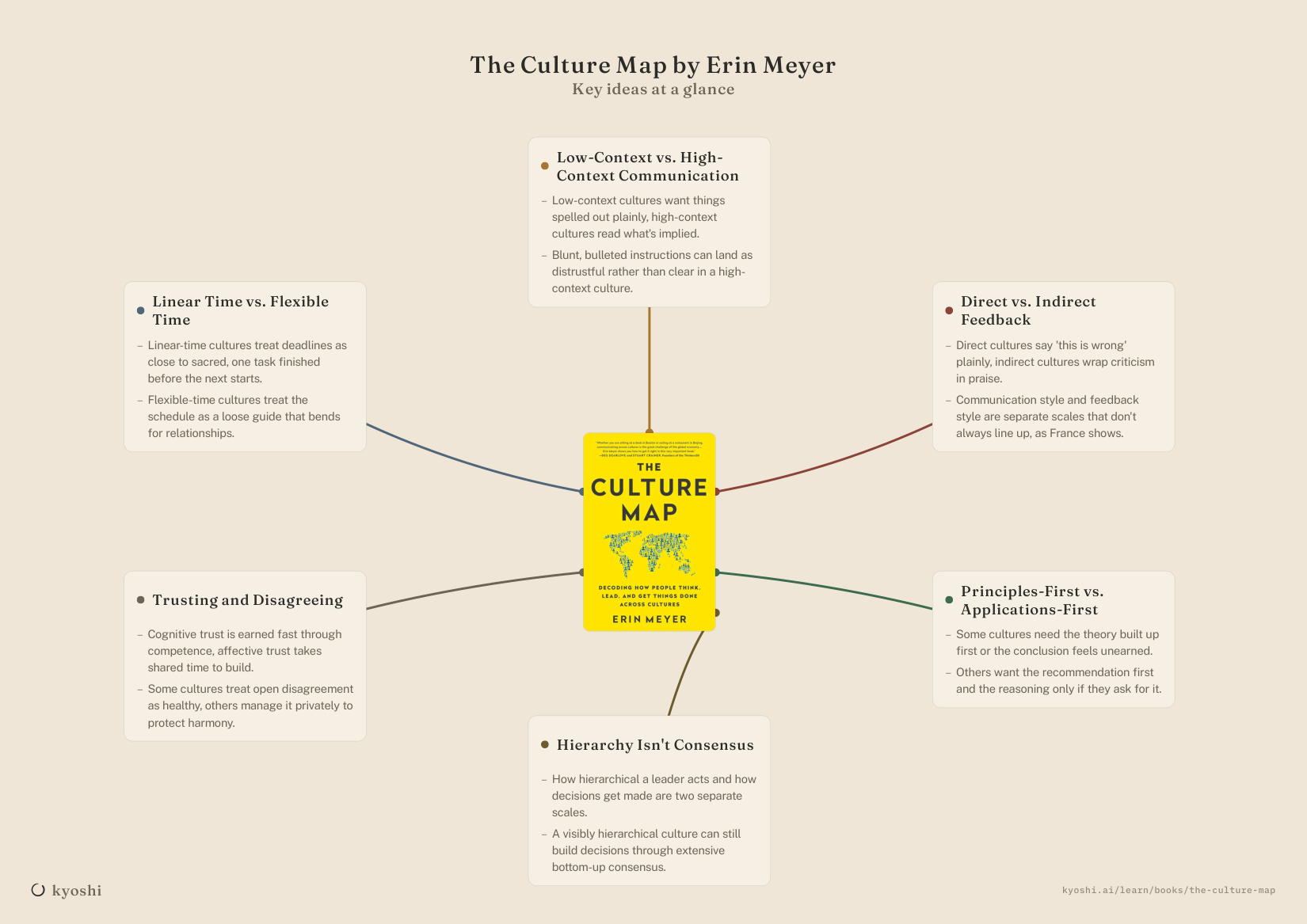
Erin Meyer's core argument is that leadership behaviors which feel neutral or obviously correct in your own culture are rarely neutral anywhere else. The manager who assumes "good communication" or "good feedback" means the same thing everywhere is the one who keeps getting cross-cultural teams wrong without understanding why. The Culture Map gives a set of scales for locating where a culture sits, relative to others, on specific dimensions of working together: not a stereotype chart, a relative-positioning tool.
Communicating: Low-Context vs. High-Context
In low-context cultures (the US, Germany, the Netherlands among them), good communication means explicit, precise, spelled-out: say what you mean, in writing if it matters. In high-context cultures (Japan and much of East Asia, among others), good communication means reading what's implied, layered, and often deliberately indirect; spelling things out too plainly can come across as condescending. A manager who sends crisp, bulleted instructions to a high-context team isn't being clear, from their recipients' point of view. They're being blunt in a way that reads as distrustful.
Evaluating: Direct vs. Indirect Negative Feedback
This is a separate scale from communicating, and the two don't always line up the way you'd expect. France, for instance, communicates in a fairly high-context way but gives negative feedback quite directly, which surprises people who assume the two scales move together. Cultures toward the direct end (the Netherlands, Russia, Israel, Germany) say "this is wrong" plainly; cultures toward the indirect end (Japan, Thailand, much of Southeast Asia) wrap criticism in praise or imply it so heavily that someone from a direct culture can miss it was criticism at all.
Persuading: Principles-First vs. Applications-First
Some cultures (France, Germany among them) expect an argument to build from theory and principle up to the conclusion. Skip the theory and the conclusion looks unearned. Others (the US, the UK, among them) want the practical recommendation first and the reasoning only if asked. Lead with theory there and you've lost the room before you got to the point.
Leading and Deciding: Hierarchy Isn't the Same as Consensus
Two separate scales get conflated constantly: how hierarchical a culture expects its leaders to act (egalitarian vs. hierarchical) and how decisions actually get made (consensual vs. top-down). They don't always track together. A culture can expect visibly hierarchical leadership while still making decisions through extensive bottom-up consensus-building before the top ever signs off, which looks contradictory only if you assume hierarchy and decision-making have to move in lockstep.
Trusting and Disagreeing
Trust is built two different ways: task-based ("cognitive") trust, earned quickly through demonstrated competence and reliable delivery, versus relationship-based ("affective") trust, built slowly through personal time and shared meals long before the first real piece of work. Disagreement follows a similar split. Some cultures treat open, even heated, disagreement as a healthy and normal part of getting to the right answer, while others treat visible disagreement as a threat to group harmony that should be managed privately, if at all.
Scheduling: Linear-Time vs. Flexible-Time
Linear-time cultures treat the schedule as close to sacred: one task finished before the next starts, deadlines as commitments. Flexible-time cultures treat the schedule as a loose guide that bends for relationships and changing circumstances, with multiple things happening at once as the normal mode, not a sign of disorganization.
Putting It Together
None of these scales is about which culture is right. They're about relative position: your own culture's "normal" is a position on each scale, not the neutral center everyone else is measured against. The practical use is specific: before assuming a colleague's directness, silence, hierarchy, or pace is a personal trait or a mistake, locate where their culture and yours actually sit on the relevant scale. Most cross-cultural friction turns out to be two reasonable defaults colliding, not one side being unreasonable.
Why It Matters for Leaders
The trap in cross-cultural management isn't malice, it's certainty. A manager assumes their own sense of "clear," "respectful," or "on time" is just what those words mean, full stop, and reads anyone who does it differently as rude, weak, or unreliable. Meyer's scales are useful precisely because they take that certainty away. Your default isn't neutral. It's one position on a scale, and the people reading you differently are reacting to a real signal, not misunderstanding a simple one.
The practical habit this builds is a pause before judgment. When a report from a different culture seems to bury the real point in three paragraphs of context, or answers a direct question in a way that feels evasive, the useful question isn't "why are they being difficult." It's "where does their culture sit on this scale relative to mine, and does that explain what I'm seeing better than a story about their character does." Almost every time, it does.
This matters most in the moments that feel the most personal: feedback and disagreement. A manager who gives feedback the way they'd want to receive it, without checking how the other person actually wants it, will either wound someone who needed it softer or completely miss someone who needed it blunter to even register it as feedback. The fix isn't picking one style and applying it consistently. It's asking, directly, how a specific person prefers to hear hard news, and adjusting for them rather than for your own comfort.
Picture a manager, Nora, leading a team split between Amsterdam and Tokyo. She sends her Tokyo report the same blunt, bulleted feedback she'd send anyone in Amsterdam, and he goes quiet for two weeks. Instead of assuming he can't take criticism, she asks a colleague who's worked in both offices how feedback usually lands there, learns it needs more context and less directness to be heard as help rather than attack, and rewrites her next note accordingly. The content barely changes. The response does.
What to do next
Reinforce your understanding of The Culture Map
Books related to The Culture Map

Inclusify
Stefanie Johnson's argument that most leaders miss inclusion by over-indexing on one of two basic human needs, belonging or uniqueness, and her six named archetypes for exactly how that imbalance shows up, from the "Meritocracy Manager" to the "White Knight."

Leaders Eat Last
Simon Sinek's case that leadership is a biological deal, not a rank. The people at the top give up safety and comfort first, so everyone below them doesn't have to spend their energy watching their back instead of doing the work.

Lean In
Sheryl Sandberg's argument that the barriers keeping women out of leadership are real on both sides: structural bias in how organizations operate, and self-imposed caution in how women are taught to see their own ambition. Fixing only one side leaves the other fully intact.

No Rules Rules
Netflix co-founder Reed Hastings, with culture researcher Erin Meyer, on why Netflix removed vacation policies, expense approvals, and most of the rulebook most companies treat as non-negotiable, and the two things that have to be true first, or the whole thing backfires.

Rebel Ideas
Matthew Syed's case that the smartest team in the room is rarely the one stacked with the highest individual IQs, it's the one with the widest range of genuinely different ways of seeing the same problem. A pointed argument against hiring people who think like you, no matter how impressive they are.

The Culture Code
Daniel Coyle's reverse-engineering of highly successful groups: not through their strategy or talent, but through small, repeated signals that most leaders never notice they're sending, or failing to send.

The Fearless Organization
Amy Edmondson's case that psychological safety isn't a soft perk for making people feel nice. It's a hard performance requirement, because teams without it make worse decisions, catch fewer errors, and learn slower than teams that have it.

The Person You Mean to Be
Dolly Chugh's case for giving up on being a "good person" (a fixed, defensive identity) in favor of becoming a "good-ish person": someone actively building toward better, who treats their own blind spots as something to work on instead of something to deny.

Tribal Leadership
A model for diagnosing a team's culture by literally listening to how people talk: five stages of "tribal" language, from "life sucks" to "life is great," and a surprisingly specific playbook for moving a team up one stage at a time.
Skills related to The Culture Map

Frameworks related to The Culture Map

IKEA Effect
You value things more when you helped build them — which is why a strategy handed to a team lands flat.
Maslow's Hierarchy of Needs
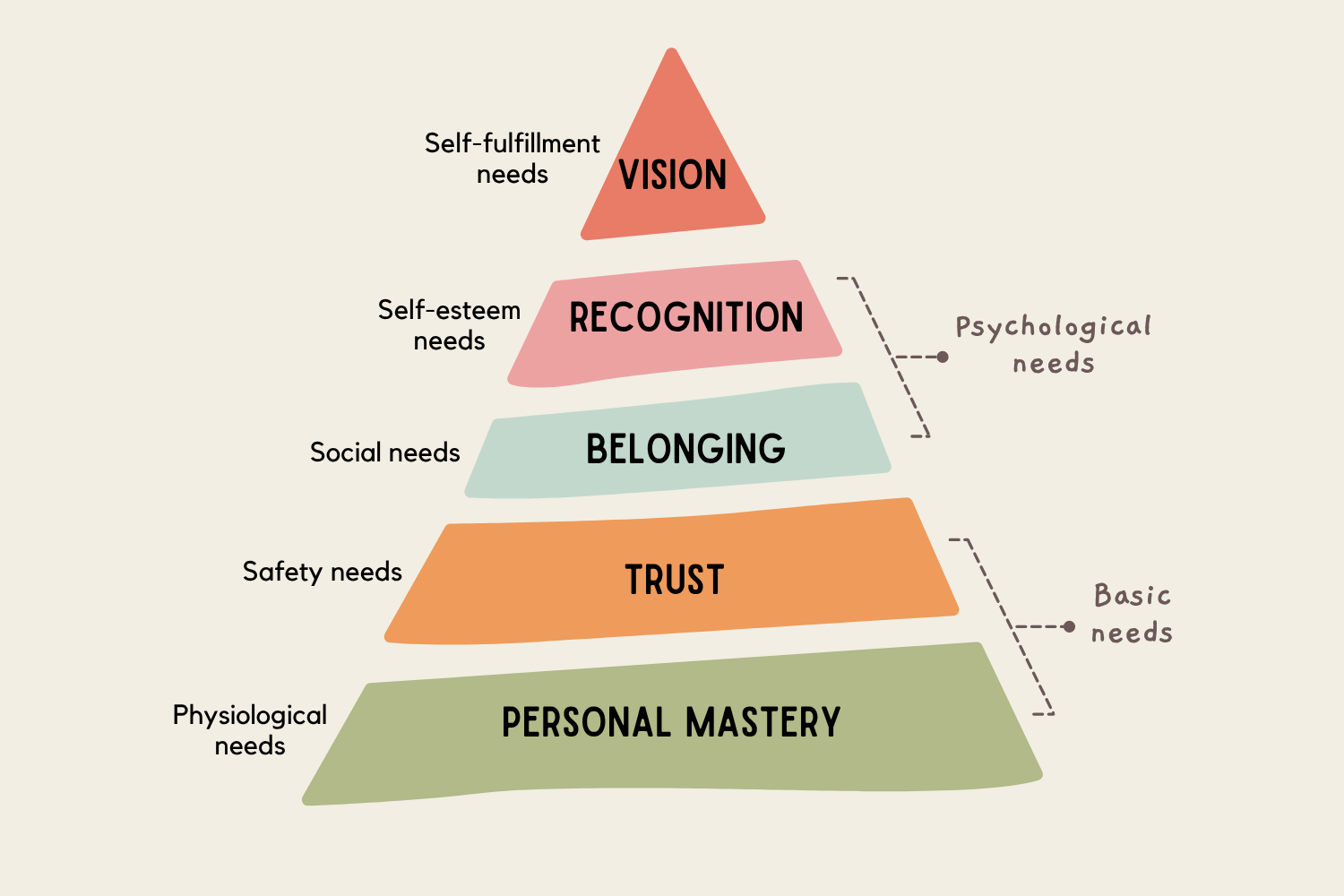
Abraham Maslow's five-level model of motivation, applied to leadership as a stack — mastery, trust, belonging, up through recognition and vision.
Psychological Safety
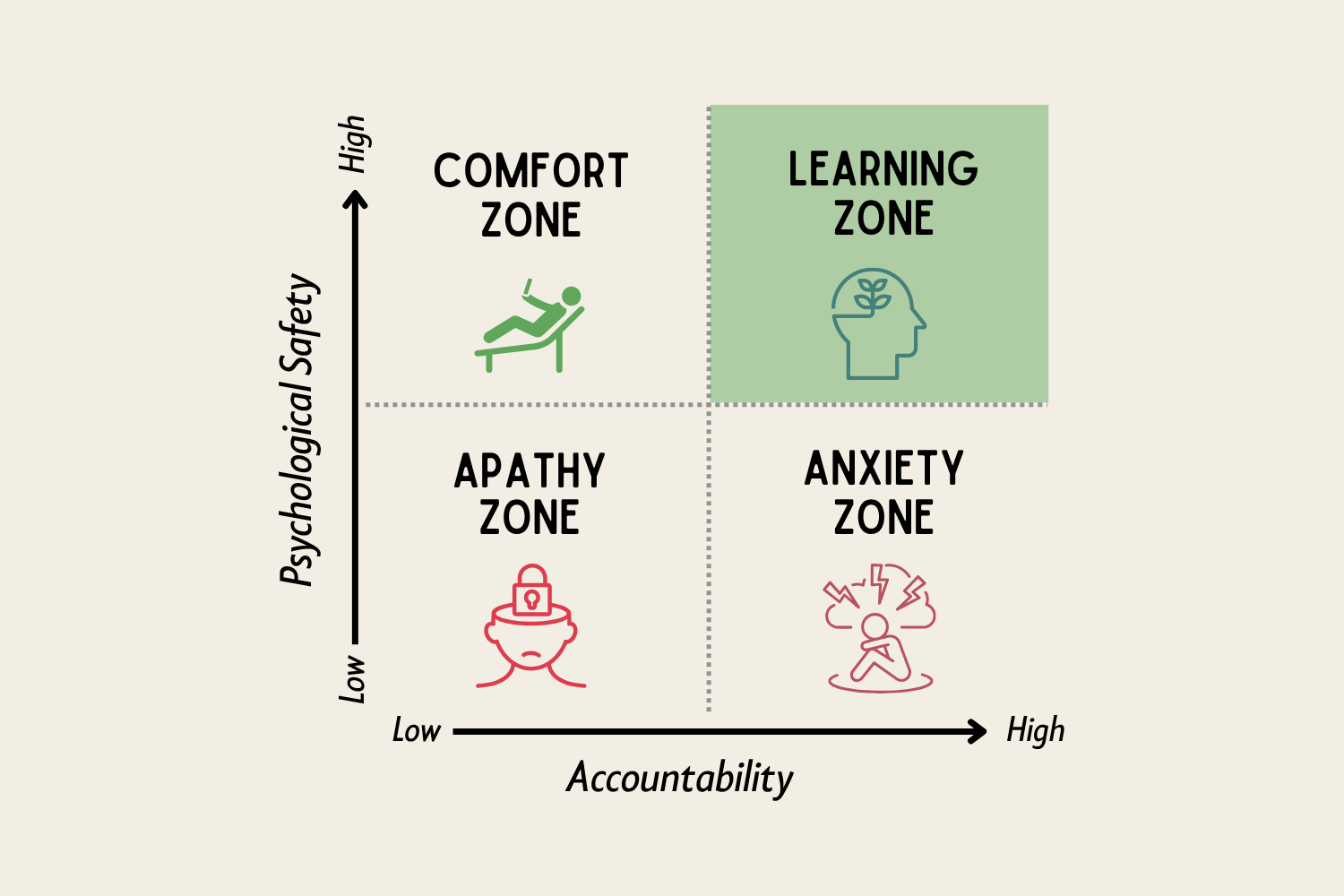
Amy Edmondson's finding that people must feel safe taking risks — a dumb question, a mistake — before a team can perform.

Spiral Dynamics
Eight color-coded value systems shaping what people care about at work — success, purpose, relationships — matched to stop guessing motivation.

The AI Culture Stack
Same AI tools and budget, wildly different results — the gap isn't the technology, it's three layers underneath: permission, fluency, judgment.

The Bannister Effect
One person breaking a barrier makes it stop being fixed for everyone else — break the unspoken belief in public first.
The Four Leadership Support Roles
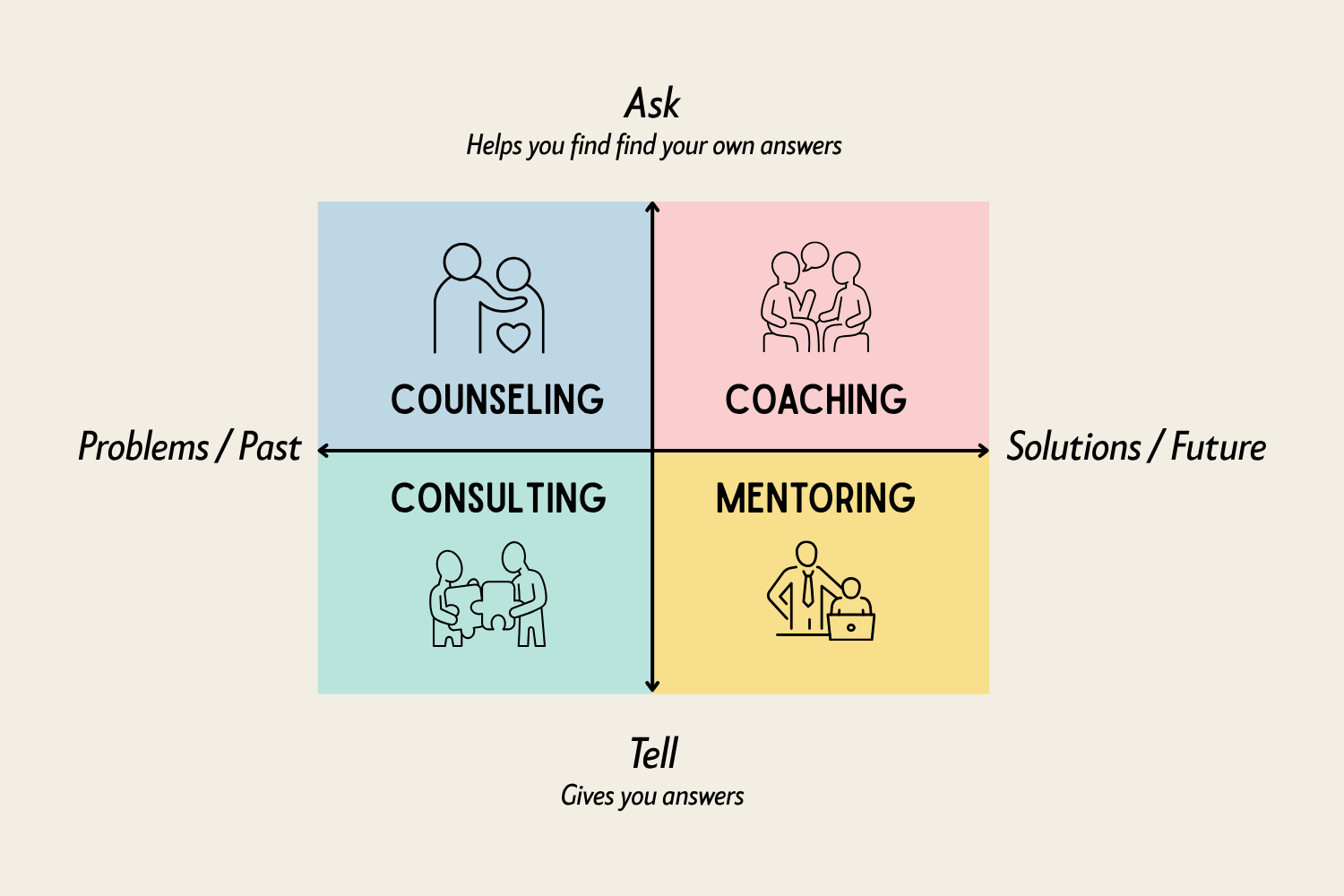
A 2x2 separating four modes for helping someone — coaching, mentoring, counseling, consulting — plus a test for picking the right one.

The Inner Drive
A leadership take on Daniel Pink's *Drive* that turns three conditions for motivation — autonomy, mastery, purpose — into habits for 1:1s.
The State of Flow
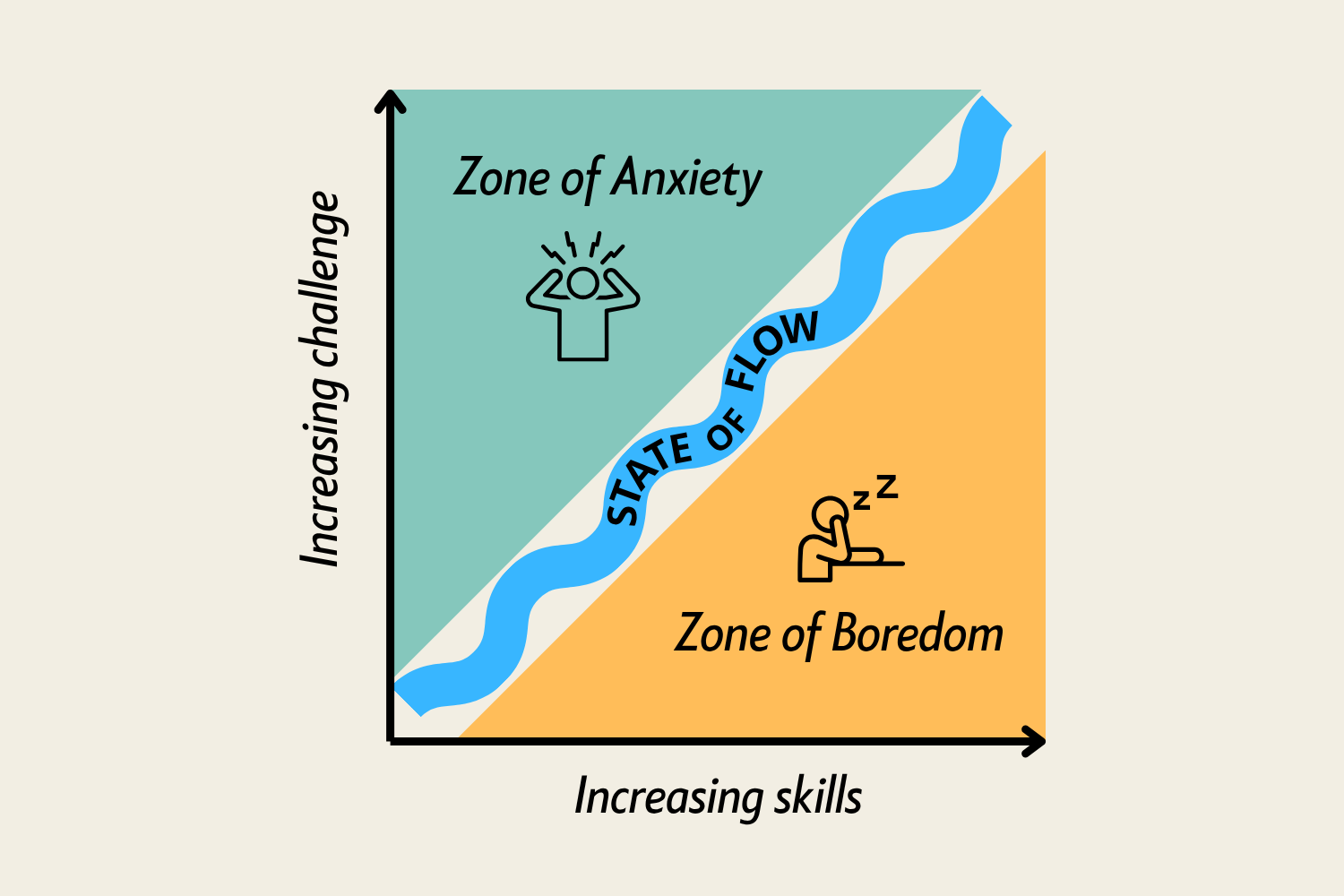
The zone between anxiety and boredom, where challenge meets skill — your job is moving each person, with a different push.