The Heart of Change
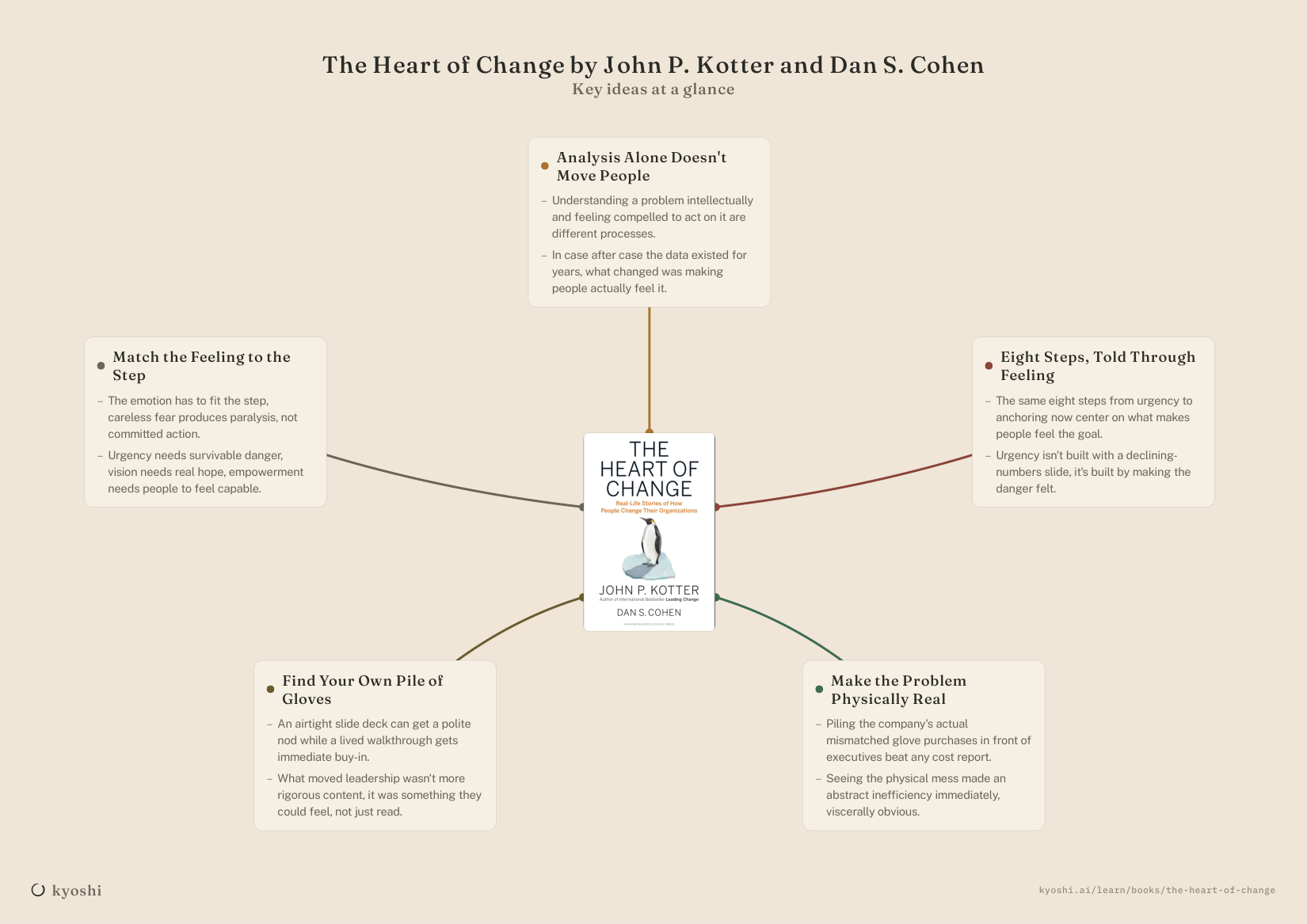
Kotter's own follow-up to Leading Change, built on a single correction: people don't change their behavior because an analysis changed their thinking. They change because something made them actually feel differently first.
 Find this on the mind-map
Introduction
Most leaders assume change works like this: give people a clear analysis, they think it through, they change their behavior. John Kotter and Dan Cohen's follow-up to Leading Change argues this sequence is backward for most real change efforts. The pattern that actually moves people is see-feel-change: people are shown a vivid, concrete truth, it makes them feel something, and the feeling is what produces new behavior, not the spreadsheet that technically proved the same point with more rigor and less impact.
Why Analysis Alone Doesn't Move People
A thorough analysis can be completely correct and still fail to change a single behavior, because understanding something intellectually and feeling compelled to act on it are different processes, and most organizational communication only targets the first one. Kotter and Cohen's case studies repeatedly show the same shape: the data had existed for months or years before the change effort succeeded; what changed wasn't the data, it was finding a way to make people actually feel its implications.
The Same Eight Steps, Told Through Feeling
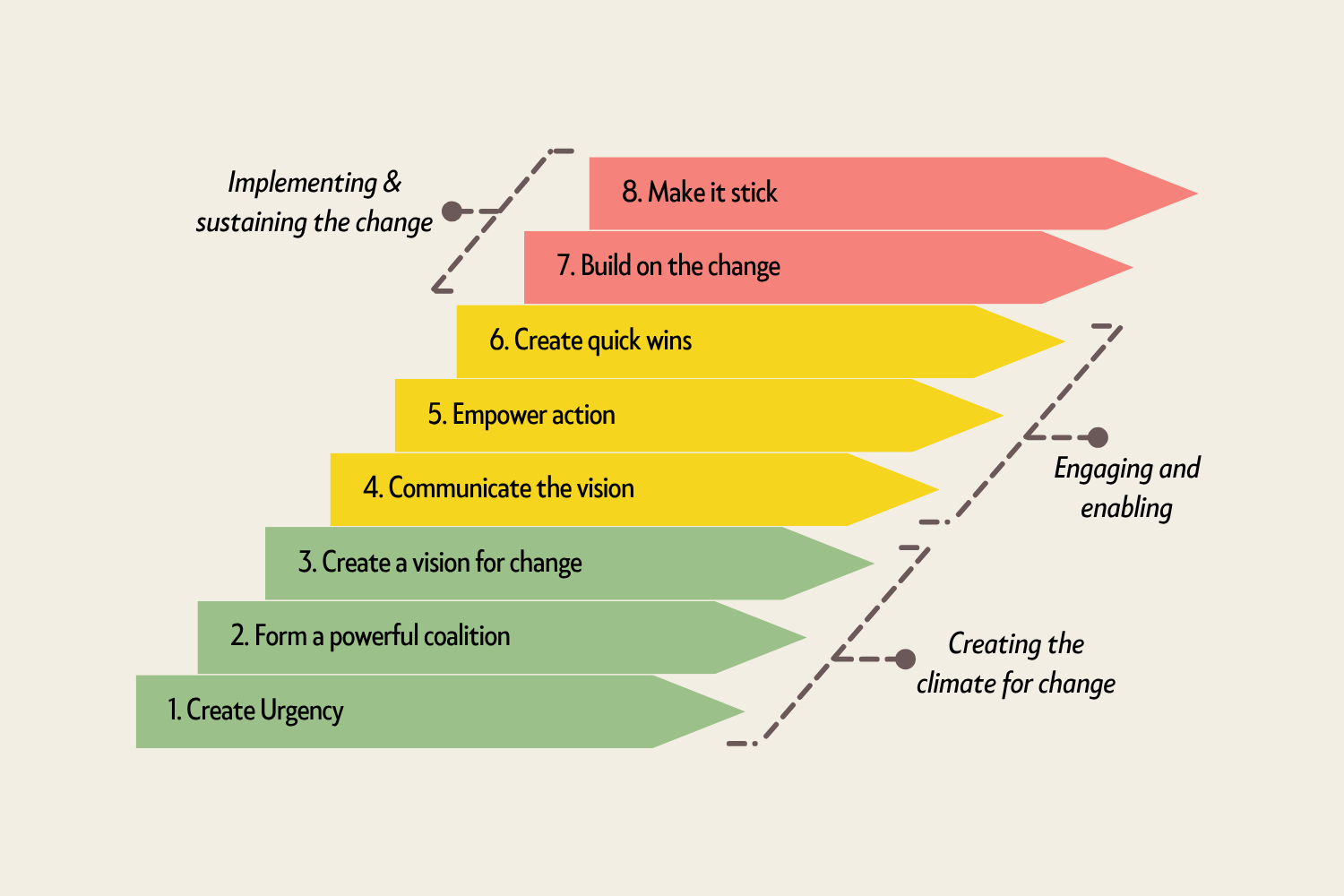
The book keeps the eight-step structure from Leading Change (urgency, coalition, vision, communication, empowerment, short-term wins, persistence, anchoring) but reframes each step around what makes people feel the step's goal rather than just understand it. Urgency isn't built by presenting a slide of declining numbers; it's built by finding whatever will make people viscerally feel the current path is dangerous.
Make the Abstract Problem Physically Real
One of the book's best-known illustrations involves a leader trying to convince executives that the company's purchasing process was wasteful, not by presenting a cost report, but by physically gathering the actual range of different work gloves the company was separately buying across departments and piling them, visibly, in front of the group: a mess of inconsistent, redundant purchasing nobody's spreadsheet had made anyone feel. Seeing the physical pile did something a cost report couldn't: it made an abstract inefficiency viscerally, immediately obvious.
Find Your Own Version of the Pile of Gloves
Picture two managers each trying to convince leadership that a process is broken. Theo builds an exhaustive slide deck with every relevant statistic, methodologically airtight, and gets a polite nod and no action. Mireille instead walks leadership through the actual customer journey, in person, hitting the same frustrating dead ends a real customer hits, and gets immediate buy-in to fix it. The content of Mireille's case wasn't more rigorous than Theo's. It was something leadership could feel, not just read.
Emotion Has to Attach to the Right Feeling
The authors are careful that this isn't about manipulating people with any strong emotion. Fear used carelessly produces paralysis or resentment, not committed action. The feeling has to be the right one for the step: urgency needs a feeling of real but survivable danger, vision needs a feeling of genuine hope and possibility, and empowerment needs people to feel capable, not just told they're empowered.
Putting It Together
The Heart of Change isn't a rejection of rigorous analysis. It's an argument that analysis is necessary but not sufficient, and that every one of the eight change steps needs a deliberate answer to the question "what will actually make people feel this," not just "what will prove this is true."
Why It Matters for Leaders
The leadership instinct under pressure is to make the case better: a tighter deck, a cleaner chart, one more data point nobody can argue with. Kotter and Cohen's finding is that this usually isn't the problem. People already believe the numbers. What's missing isn't proof, it's a reason to feel something about it today instead of filing it away as "yes, that's concerning" and moving on.
The practical shift is to ask a different question before every pitch: not "what do I need to prove" but "what do I need someone to feel." If you can't answer that second question, you probably have a report, not a change effort. A leader who skips straight to the recommendation, however well-supported, is handing people a conclusion to agree with instead of a reason to act on it.
This also changes how you should treat a win. Reporting a metric ("retention is up three points") rarely moves anyone who wasn't already convinced. Telling the specific story behind that metric, who it affected and how their day actually got better, does a lot more work, because it gives people something to feel good about rather than something to file.
Picture a manager, Grace, who's spent two months building the case that her team's intake process is costing the company real time and money. Leadership nods politely at her numbers and nothing changes. Instead of refining the deck further, she invites three executives to sit through an actual customer intake call with her, start to finish, and watch them hit the same frustrating dead end her data had already described. The approval to fix it comes the same week.
What to do next
Reinforce your understanding of The Heart of Change
Books related to The Heart of Change

Leading Change
John Kotter's eight-step anatomy of organizational change, built from studying why most change efforts fail, and a blunt diagnosis that most failures trace back to skipping step one, not step eight.

Switch
Chip and Dan Heath's case that most change efforts fail from a basic misdiagnosis, treating a willpower problem as if it were an information problem, and a three-part framework for directing the rational mind, motivating the emotional one, and reshaping the environment around both.

The Ride of a Lifetime
Disney CEO Bob Iger's own account of betting the company three times, on Pixar, Marvel, and Lucasfilm, and then again on streaming, and the specific discipline of leaving what you just paid billions for alone long enough for it to actually work.
Skills related to The Heart of Change

Frameworks related to The Heart of Change

ADKAR Model
Five building blocks — Awareness, Desire, Knowledge, Ability, Reinforcement — track change person by person, pinpointing exactly where it's stuck.
Amara's Law
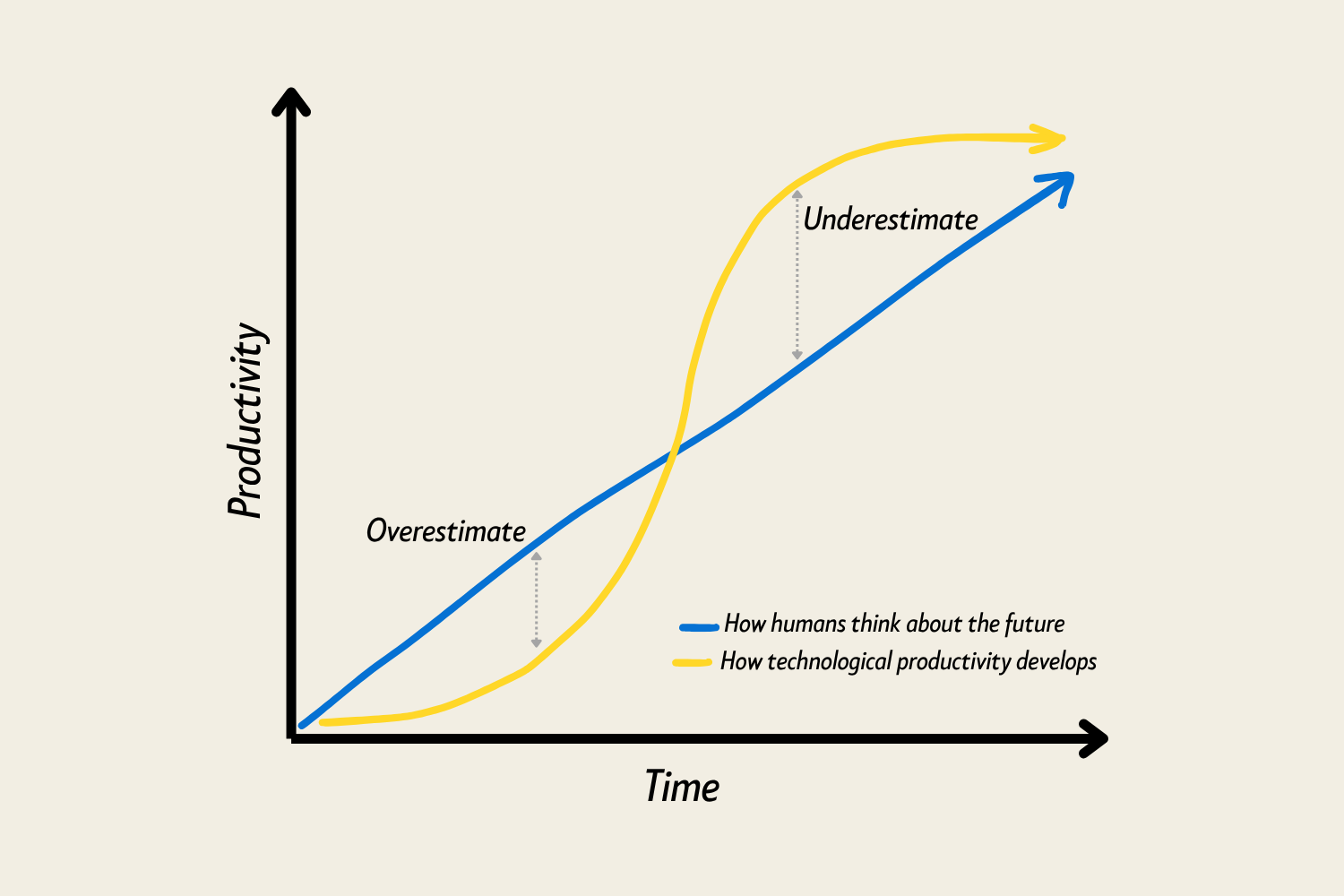
You overestimate new tech's short-run impact and underestimate its long-run impact — so ask if you're early, not whether it's working.

IKEA Effect
You value things more when you helped build them — which is why a strategy handed to a team lands flat.
Kotter's 8-Step Change Model
John Kotter's eight-step process for leading change, from creating urgency to anchoring new behavior in culture — keeping transformations from reversing.

The 3 Conditions for Change
A team can agree in the room and change nothing after — change needs three conditions at once: Willingness, Desire, Courage.