AI 2041
Ten speculative-fiction stories set in the year 2041, each in a different country and paired with Kai-Fu Lee's nonfiction breakdown of the real technology underneath. A way of making abstract AI trends concrete by showing, not just telling, how they might actually land in ordinary lives.
 Find this on the mind-map
Introduction
AI 2041 pairs a science-fiction writer, Chen Qiufan, with an AI scientist and investor, Kai-Fu Lee, in a deliberate two-part structure: each of the book's ten chapters opens with a short story imagining a slice of life in the year 2041, set in a different country, followed by Lee's own essay unpacking which parts of that story are technically plausible, which are already happening in some form today, and what the open policy questions are. The device is a deliberate choice: abstract AI trend lines are hard to feel, but a specific character navigating a specific consequence isn't.
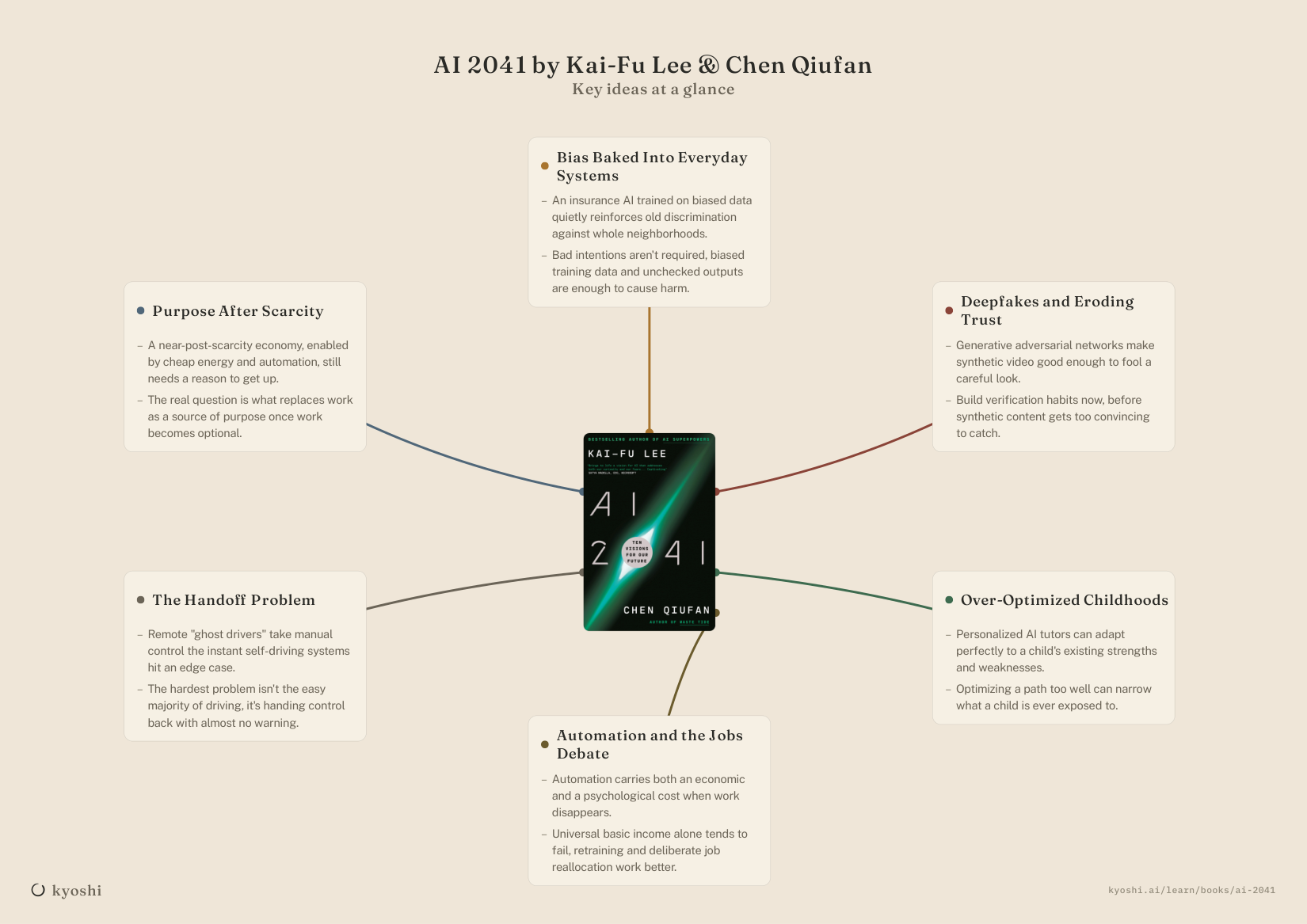
Algorithmic Bias Baked Into Everyday Systems
The opening story, "The Golden Elephant," is set in Mumbai and follows an AI-driven insurance product that grows steadily more intrusive, pulling in behavioral data on family members and, because it's trained on historically biased data, reproducing and reinforcing old patterns of discrimination against entire neighborhoods without anyone noticing until it's already happened. Lee's essay treats this as one of the nearest-term, least speculative risks in the book: an algorithm doesn't need bad intentions to cause real harm, it just needs biased training data and a lack of anyone checking its outputs against lived outcomes.
Deepfakes and the Erosion of Trust
"Gods Behind the Masks," set in Lagos, follows a hacker who specializes in deepfake video, hired to unmask and subvert the propaganda of an anonymous online figure manipulating politics behind synthetic footage. Lee's technical essay treats generative adversarial networks and synthetic media less as a distant risk and more as a near-term arms race between generation and detection, where the practical takeaway for any organization is building verification habits now, before synthetic content is good enough to fool a careful look, not after.
AI Tutors and the Risk of an Over-Optimized Childhood
"Twin Sparrows," set in South Korea, follows identical twins raised with personalized AI tutors and companions, and uses their diverging paths to dramatize a real tension in large-scale AI-driven education: a system that adapts perfectly to a child's existing strengths and weaknesses can also narrow what that child is ever exposed to, optimizing a path rather than opening one.
Automation, Jobs, and the Policy Debate
"The Job Savior," set in the United States, follows someone working at a firm built to help people displaced by automation, and dramatizes both the economic and the psychological cost of work disappearing for people whose sense of purpose was built around it. Consistent with Lee's other writing, the essay takes job displacement seriously as a near-term, uneven disruption, walking through why a universal basic income alone tends to fail as a solution and arguing for retraining and deliberate job reallocation instead.
Autonomous Systems and Who Takes Over When They Fail
"The Holy Driver" follows a talented young gamer from Sri Lanka recruited into a program using elite gamers as remote "ghost drivers," humans who take manual control of autonomous vehicles the instant they hit an edge case the self-driving system can't handle. Lee's essay maps the real levels of vehicle autonomy and argues the hardest, most underdiscussed problem isn't the easy 95% of driving. It's designing for the moment control has to hand back to a human with almost no warning.
A Post-Scarcity Future and What Still Motivates People
The closing story, "Dreaming of Plenitude," set in Australia, imagines a near-post-scarcity economy, enabled by cheap clean energy and pervasive automation, organized around a two-tiered system called Project Jukurrpa. Its most pointed character thread follows someone whose sense of self was built entirely around a job that no longer needs doing, and the essay uses it to ask the question underneath all the book's optimism about abundance: what replaces work as a source of purpose, once work itself becomes optional for most people.
Putting It Together
The story-then-essay structure is itself the argument: AI's consequences are easiest to reason about concretely, person by person, country by country, rather than as an abstract global trend line. And the honest response to nearly every chapter is the same one Lee keeps returning to: the technology in each story is more plausible, sooner, than most readers initially assume, and the organizational and policy groundwork for it needs to start now rather than once it's already arrived.
Why It Matters for Leaders
The managers who get blindsided by AI usually aren't the ones ignoring it. They're the ones who only think about it as an abstraction, a slide about "disruption" or "the next wave," right up until a specific tool they rolled out does something that slide never warned them about.
That's the real value of this book for a manager: it forces you to ask what a risk looks like for one actual person, not what it looks like on a roadmap. An algorithm that screens résumés or prices risk doesn't announce its bias. It slowly produces worse outcomes for the same group of people, and nobody notices until someone adds up the pattern. The fix isn't more caution in general, it's a specific habit: before trusting an automated decision, ask what data trained it, and whether that history is one worth repeating rather than correcting for.
The same logic applies to the handoff problem the book keeps coming back to. Any process you automate will hit an edge case the system can't handle, and the question that matters isn't whether that edge case exists, it's who's responsible for catching it and how much warning they get. Most teams design carefully for the easy majority of cases and treat the rest as a problem for later.
Picture a manager named Owen who rolls out an AI tool to triage customer support tickets. It handles routine cases well, and the team is glad to have the time back. Three weeks in, a ticket involving a safety complaint gets auto-closed as low priority because the model has never seen that exact phrasing before. Nothing in the dashboard flags it. Owen's fix isn't to distrust the tool. It's to build the rule he skipped at launch: anything the system scores as low-confidence gets a person's eyes before it closes, no exceptions.
What to do next
Reinforce your understanding of AI 2041
Books related to AI 2041

AI Superpowers
Kai-Fu Lee's argument, from inside both Silicon Valley and the Chinese tech industry, that the AI race has shifted from who has the best research to who can actually ship and scale it. On that axis, the competitive map looks very different than Western coverage usually suggests.

Co-Intelligence
Wharton professor Ethan Mollick's field guide to actually working with generative AI day to day, treating it less like software and more like a fast, occasionally brilliant, occasionally confidently wrong new colleague.

Competing in the Age of AI
Two Harvard Business School professors' argument that AI-native firms aren't running a better version of your business. They're running a fundamentally different machine, one built to scale decisions at almost zero marginal cost.

Empire of AI
Investigative journalist Karen Hao's case, built from years covering OpenAI and hundreds of interviews, that the leading AI labs should be understood not as idealistic research nonprofits but as empires in the old sense: extracting data, labor, and natural resources to concentrate power, dressed in the language of a mission to benefit humanity.

Prediction Machines
Three economists' reframing of AI, stripped of the hype: what modern machine learning actually does is make prediction cheap, and once prediction is cheap, the scarce, valuable thing left is judgment.
Skills related to AI 2041

Frameworks related to AI 2041
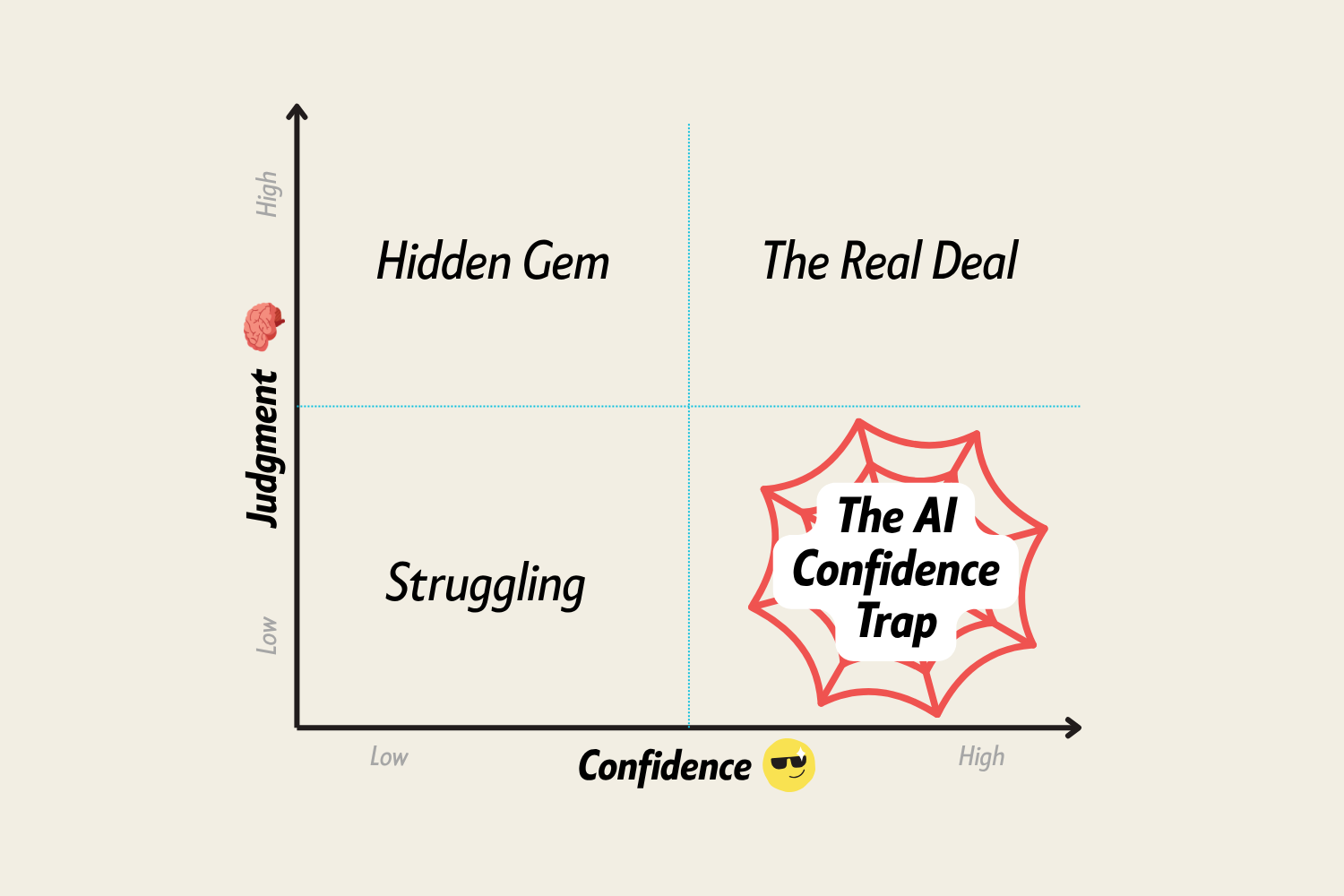
The AI Confidence Trap
AI-polished output can look like real competence when the thinking behind it isn't there — judge the reasoning, not the polish.

The AI Culture Stack
Same AI tools and budget, wildly different results — the gap isn't the technology, it's three layers underneath: permission, fluency, judgment.

The AI Fluency Framework
AI fluency isn't a prompting skill — it's the same four competencies that make someone a good manager: delegating, briefing, reviewing, and owning.
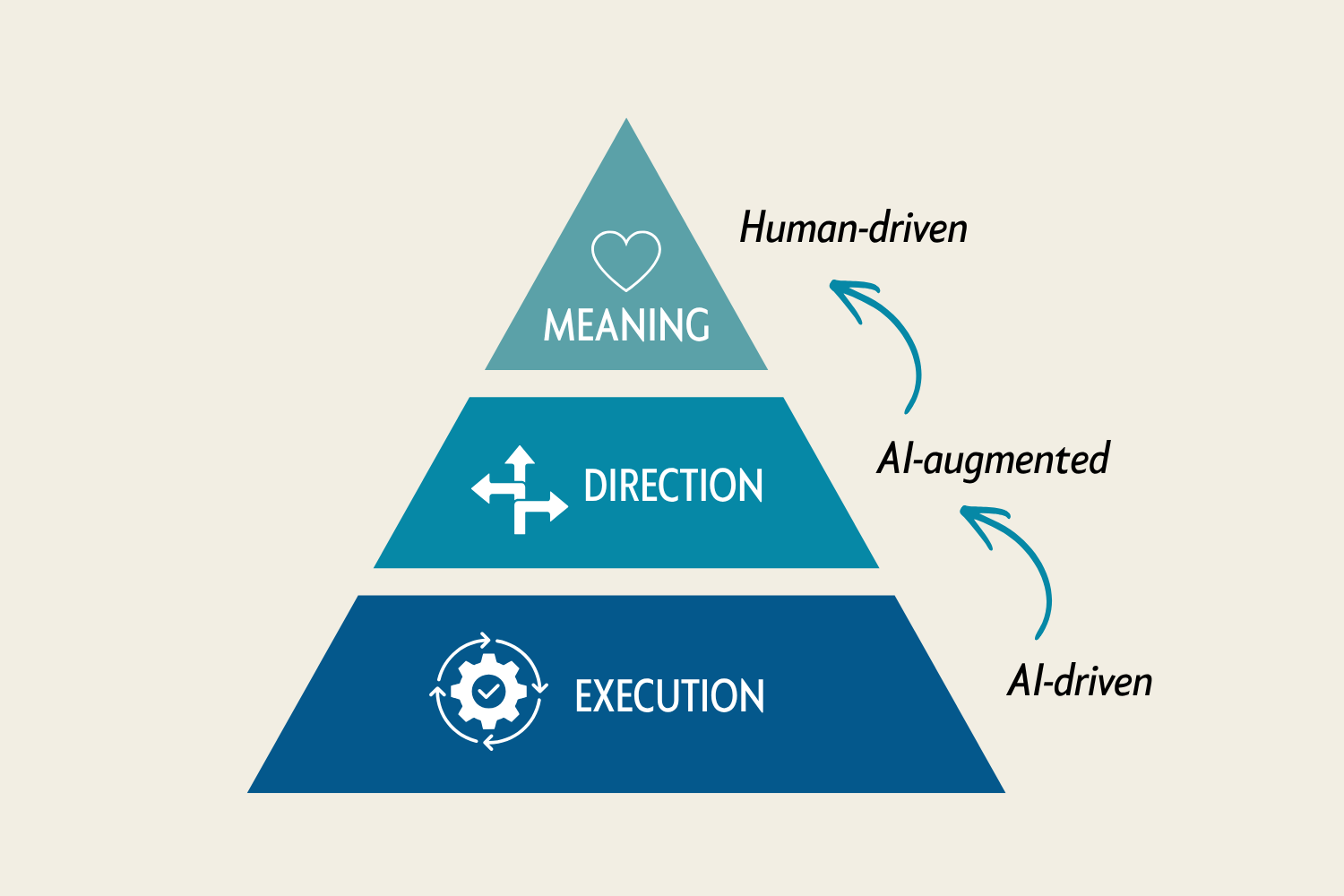
The Three Layers of Leadership
A pyramid — Execution, Direction, Meaning — where your value has to move up as AI automates execution.