Prediction Machines
Ajay Agrawal, Joshua Gans & Avi Goldfarb
Three economists' reframing of AI, stripped of the hype: what modern machine learning actually does is make prediction cheap, and once prediction is cheap, the scarce, valuable thing left is judgment.
 Find this on the mind-map
Introduction
Agrawal, Gans, and Goldfarb make an economist's argument, not a technologist's: the breakthrough in modern AI isn't "intelligence" in any broad sense, it's a sharp drop in the cost of prediction: filling in a missing piece of information from related information you already have. Treat AI as a cheap-prediction technology, and a lot of confusing claims about what it will and won't do start making more sense.
Decisions Are Prediction Plus Judgment
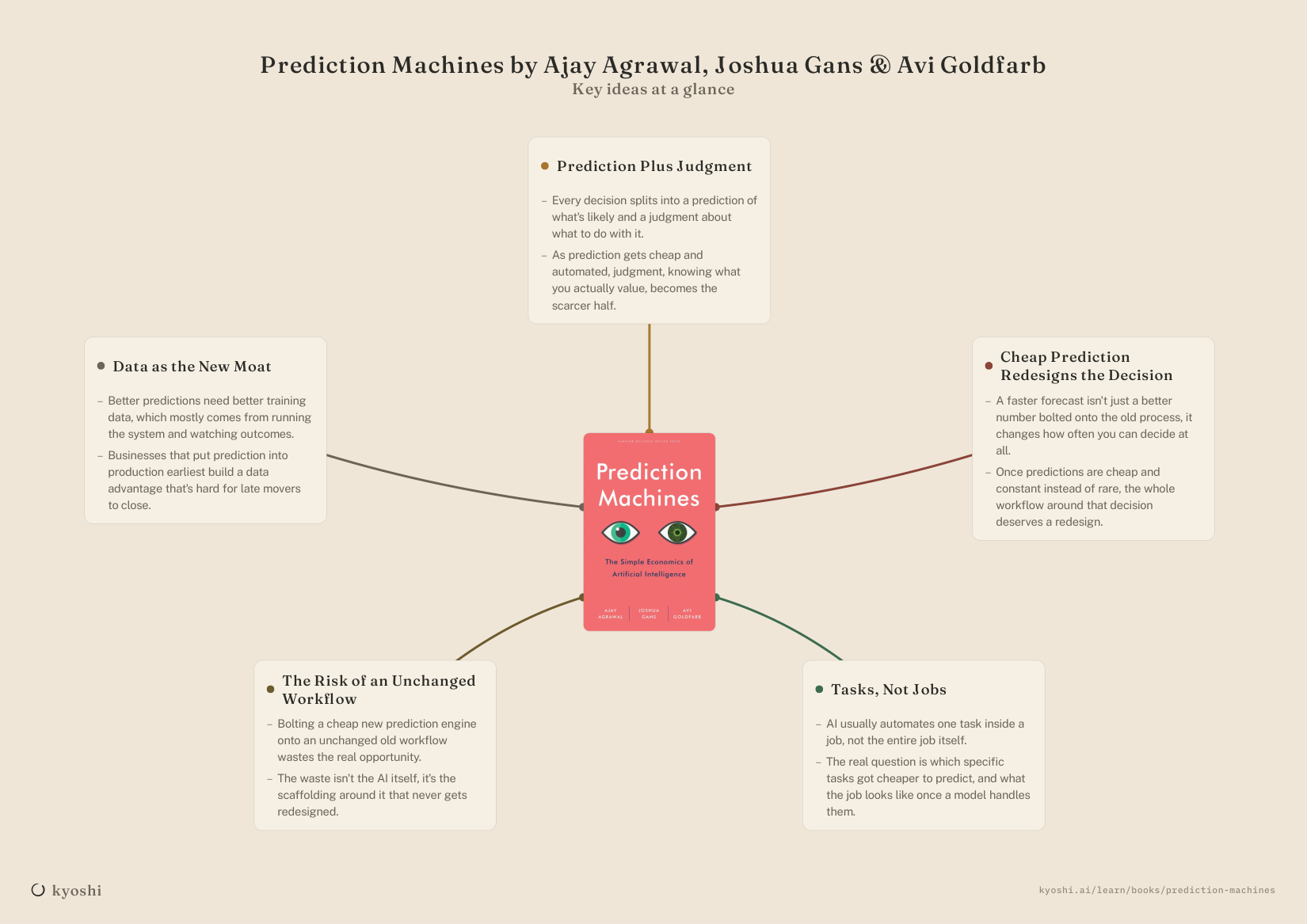
Every decision breaks into pieces: prediction (what's likely to happen) and judgment (given that prediction, what outcome do we actually want, and what should we do about it). A loan approval needs a prediction of default risk and a judgment about how much risk the business is willing to accept. As prediction gets cheap and increasingly automated, judgment (the part that requires knowing what you actually value) becomes the scarcer, more valuable half of the equation, not the part that disappears.
Cheap Prediction Changes the Whole Decision, Not Just One Step
It's tempting to think of AI as a faster calculator bolted onto an unchanged process. In practice, when prediction gets cheap enough, the entire decision workflow often gets redesigned around it. A manager, Felix, assumes a new forecasting model just replaces a spreadsheet one of his analysts used to build by hand. But once forecasts are cheap and constant instead of rare and manual, the business starts making decisions (reordering, staffing, pricing) far more frequently than the old process ever allowed, because the cost of getting a new prediction dropped to nearly nothing.
Tasks, Not Jobs
AI typically automates a task inside a job, not the whole job. A radiologist's job includes image review, but also patient conversations, judgment calls on ambiguous cases, and coordination with other doctors. The practical question for a manager isn't "will this job be automated," it's "which specific tasks inside this job just got cheaper to do by prediction, and what does the job look like once those tasks are mostly handled by a model instead of a person."
The Risk of Leaving the Old Workflow in Place
When a business keeps running its old workflow unchanged around a new prediction capability, it ends up with a decision pipeline still organized around a world where prediction was expensive and rare, bolted together with a prediction engine that's now cheap and constant. The waste isn't the AI; it's the unchanged scaffolding around it that never gets redesigned to take advantage of what changed.
Data as the New Moat
Better predictions require better training data, and better training data mostly comes from running the system and observing outcomes. That means the businesses that get prediction into production earliest build a data advantage that's hard for a late mover to close, independent of who has access to the same underlying model architecture.
Putting It Together
The chain runs: cheap prediction changes the economics of a decision, which should trigger a redesign of the whole workflow around that decision, not a one-for-one swap of an old manual step. The business that actually redesigns around cheap prediction, rather than leaving the old workflow bolted onto a new engine, is the one that captures the data advantage that compounds from there.
Why It Matters for Leaders
The managers who get the most wrong about AI right now aren't the ones ignoring it, they're the ones bolting it onto a process designed for a world where getting a forecast or a risk score took a person a day. If you just hand that old process a faster number and change nothing else about how often you act on it, you've paid for a new engine and kept the old car.
The useful question before adopting any AI tool isn't "what can this predict." It's "what decision does this prediction feed, and what should we do differently now that getting this answer costs almost nothing." Those are very different conversations, and most teams skip straight to buying the tool without ever having the second one.
It also reframes what you should be worried about losing to automation. The task that gets automated is rarely the whole job. The real planning question is which specific piece of someone's job just got a lot cheaper to do by prediction, and what that frees them up to spend their judgment on instead.
Picture an operations manager, Sana, whose team gets a new model that predicts weekly demand far more accurately than their old manual forecast. If she keeps the same monthly ordering meeting and just plugs the better number into the same old process, she's captured almost none of the actual value. The real move is to ask why ordering only happens monthly in the first place, now that a good forecast is available every day instead of once a quarter. Redesigning the cadence around the cheap prediction, not just swapping in a better number, is where the real gain sits.
What to do next
Reinforce your understanding of Prediction Machines
Books related to Prediction Machines

AI 2041
Ten speculative-fiction stories set in the year 2041, each in a different country and paired with Kai-Fu Lee's nonfiction breakdown of the real technology underneath. A way of making abstract AI trends concrete by showing, not just telling, how they might actually land in ordinary lives.

AI Superpowers
Kai-Fu Lee's argument, from inside both Silicon Valley and the Chinese tech industry, that the AI race has shifted from who has the best research to who can actually ship and scale it. On that axis, the competitive map looks very different than Western coverage usually suggests.

Co-Intelligence
Wharton professor Ethan Mollick's field guide to actually working with generative AI day to day, treating it less like software and more like a fast, occasionally brilliant, occasionally confidently wrong new colleague.

Competing in the Age of AI
Two Harvard Business School professors' argument that AI-native firms aren't running a better version of your business. They're running a fundamentally different machine, one built to scale decisions at almost zero marginal cost.

Empire of AI
Investigative journalist Karen Hao's case, built from years covering OpenAI and hundreds of interviews, that the leading AI labs should be understood not as idealistic research nonprofits but as empires in the old sense: extracting data, labor, and natural resources to concentrate power, dressed in the language of a mission to benefit humanity.
Skills related to Prediction Machines

Frameworks related to Prediction Machines
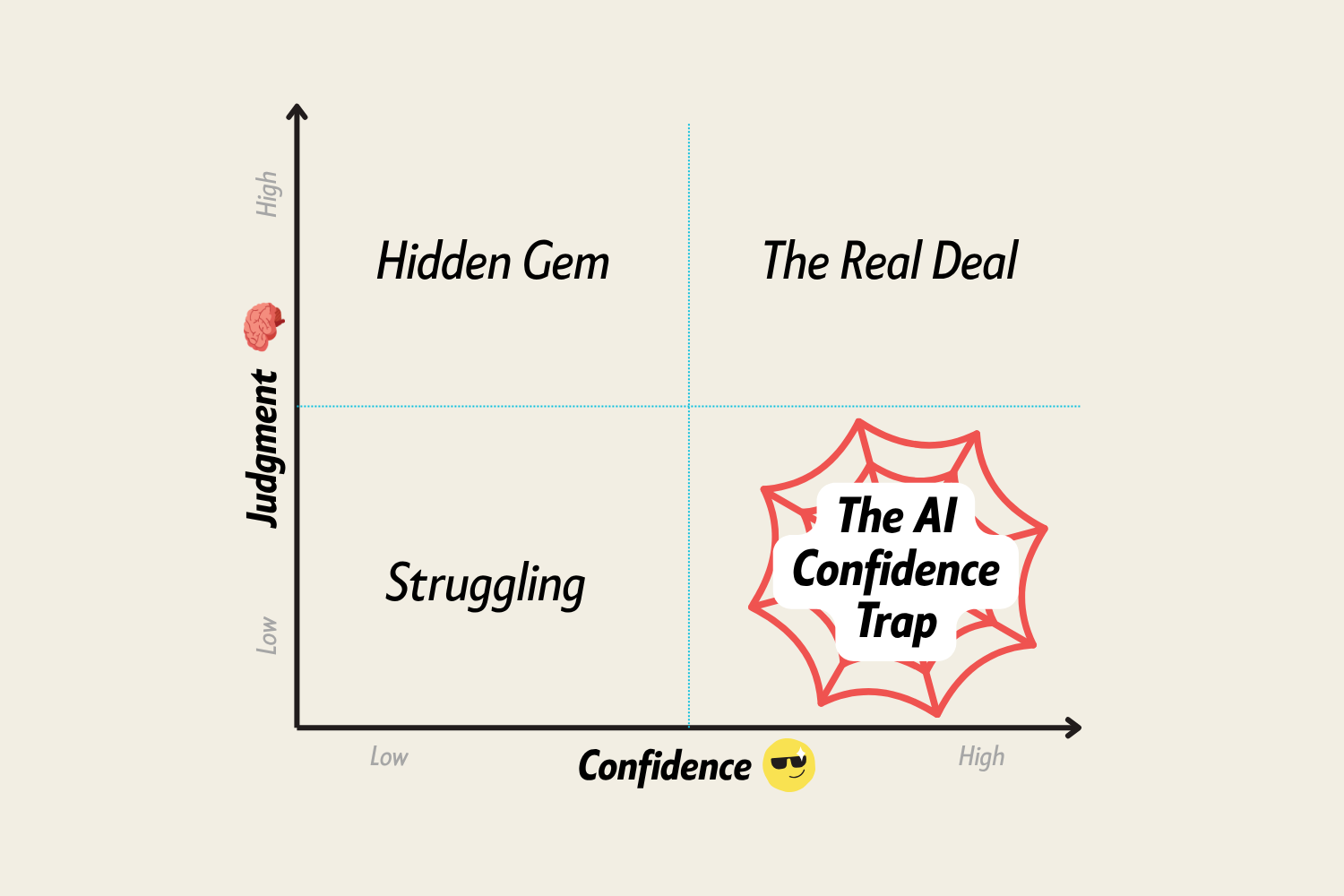
The AI Confidence Trap
AI-polished output can look like real competence when the thinking behind it isn't there — judge the reasoning, not the polish.

The AI Culture Stack
Same AI tools and budget, wildly different results — the gap isn't the technology, it's three layers underneath: permission, fluency, judgment.

The AI Fluency Framework
AI fluency isn't a prompting skill — it's the same four competencies that make someone a good manager: delegating, briefing, reviewing, and owning.
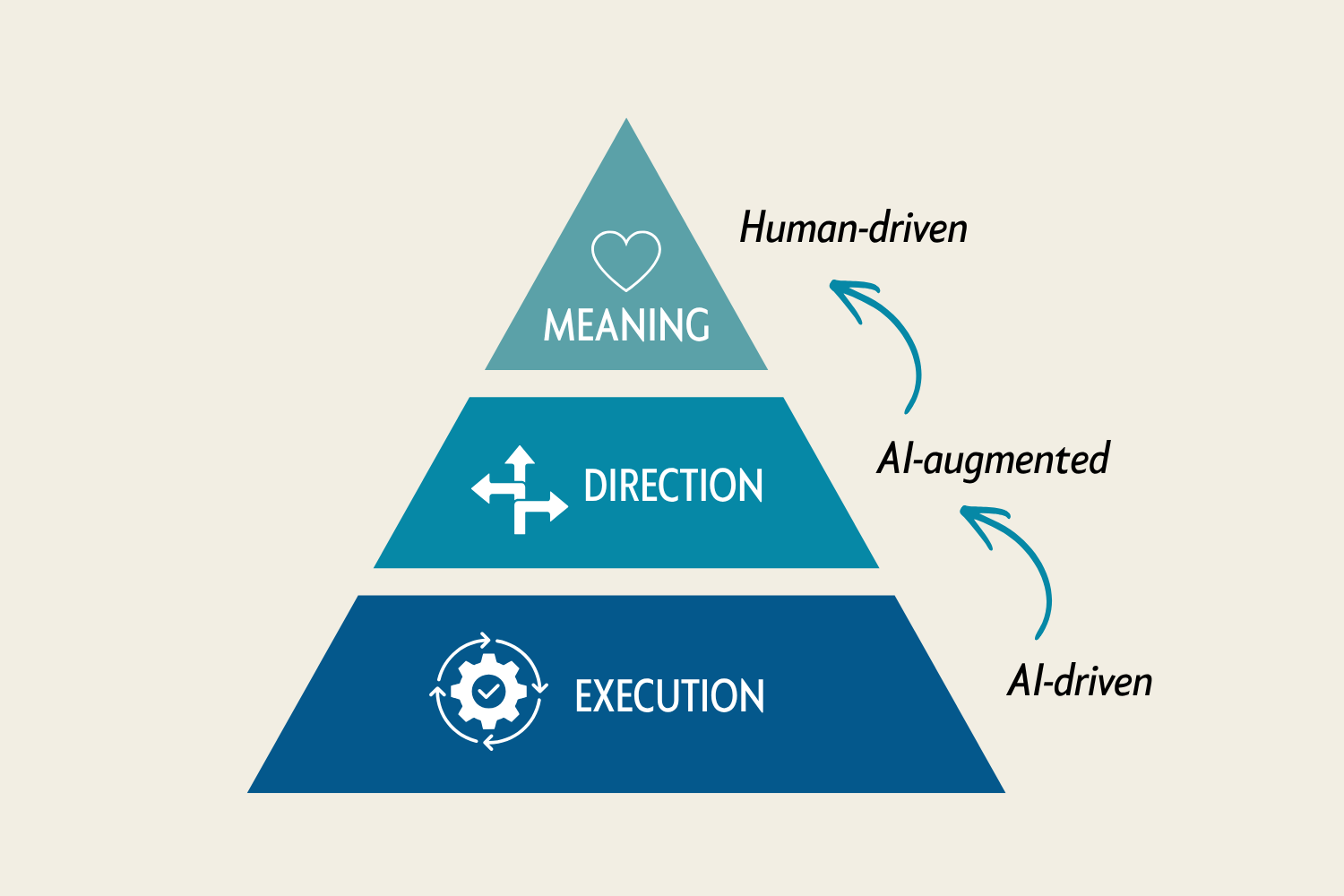
The Three Layers of Leadership
A pyramid — Execution, Direction, Meaning — where your value has to move up as AI automates execution.