Competing in the Age of AI
Marco Iansiti & Karim R. Lakhani
Two Harvard Business School professors' argument that AI-native firms aren't running a better version of your business. They're running a fundamentally different machine, one built to scale decisions at almost zero marginal cost.
 Find this on the mind-map
Introduction
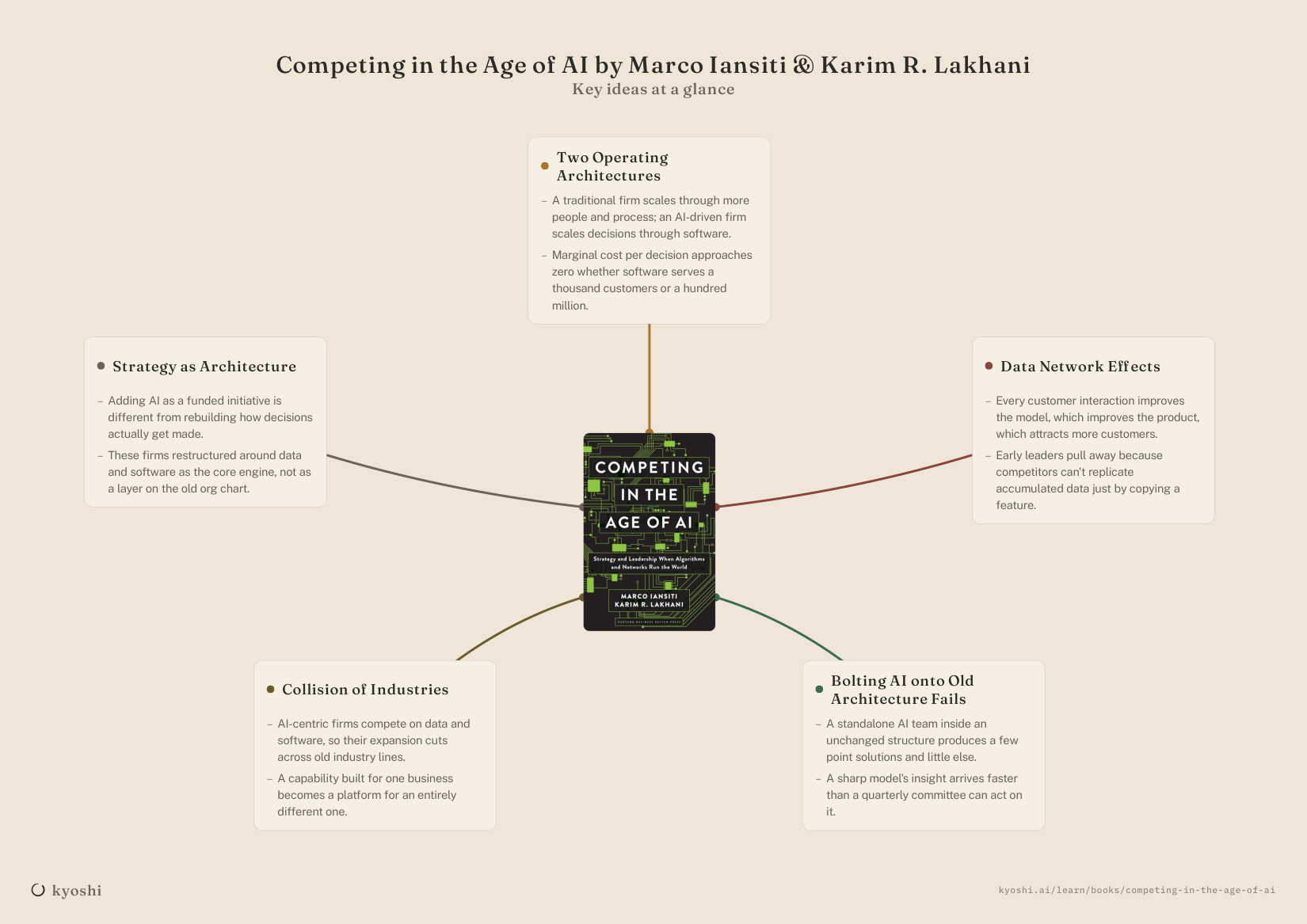
Iansiti and Lakhani's central claim is that firms like Amazon, Google, and Alibaba don't just use more AI than everyone else. They're organized around a different "operating architecture" entirely, one where software and data, not people and process, do the scaling. Bolting AI onto a traditional firm's existing structure doesn't produce the same advantage, because the advantage comes from the architecture, not the tool.
Two Operating Architectures
A traditional firm scales roughly linearly: more customers require more people, more locations, more process to coordinate it all, and quality is bounded by how well those humans execute, consistently, at scale. An AI-driven firm scales its decisions (pricing, recommendations, fraud detection, logistics routing) through software that runs the same way whether it's serving a thousand customers or a hundred million, with marginal cost per additional decision approaching zero. The firms winning aren't smarter; they built a different machine.
Data Network Effects
Every interaction an AI-centric firm has with a customer generates data that improves the underlying model, which improves the product, which attracts more customers, who generate more data. This compounding loop is why early leaders in a category tend to pull away rather than get caught. The gap isn't capital. It's accumulated data advantage feeding a model competitors can't replicate just by copying the feature.
Why Bolting AI onto an Old Architecture Fails
A traditional firm that stands up an "AI team" inside an otherwise unchanged structure usually gets a few useful point solutions and little else, because the firm's actual decision-making still runs through the old human-process rails. Picture a retailer that builds a strong recommendation model but still routes every pricing decision through a quarterly committee. The model's insight arrives too fast for the organization around it to use.
Collision of Industries
Because AI-centric firms compete on data and software rather than the specific product category they started in, their natural expansion path cuts across industries that used to be separate. A logistics capability built for one business becomes a platform for an entirely different one. Traditional industry boundaries, built around what a company makes, stop protecting incumbents once the real competitive edge is the operating architecture underneath, which travels easily between categories.
Strategy as Architecture, Not Initiative
For a leader, the uncomfortable implication is that "adding AI" as a strategic initiative, however well-funded, is a different thing from rebuilding how the organization actually makes decisions. The firms this book studies didn't layer AI on top of their old org chart. They restructured around data and software as the core engine and treated the human organization as what wraps around that engine, not the other way around.
Putting It Together
Scaling architecture (software-driven, near-zero marginal cost per decision) and scaling data (compounding advantage from every interaction) reinforce each other, and together they explain why point-solution AI projects inside an otherwise unchanged firm rarely produce the change leadership hoped for. The architecture has to change, not just the tool stack sitting on top of it.
Why It Matters for Leaders
Most leaders who read this book will come away thinking it's about strategy. It's really about where the decisions in your company actually get made. Before you buy another AI tool, trace one real decision end to end: a price change, a refund, a shipping exception. If the software produces a recommendation and then a person, or a committee, still has to approve it before anything happens, you haven't changed how the business runs. You've added a step.
The diagnostic question isn't "are we using AI," it's "which decisions still require a human to be in the room before they can happen." A team that can answer that specifically, decision by decision, knows far more about its real competitive position than a team that can only point to its AI roadmap slide.
This also reframes who your competition is. A traditional leader scans their own industry for threats. A leader thinking in this book's terms asks a different question: who, in a completely different business, has built a data and software engine that could be pointed at my customers tomorrow with very little retooling. That's a harder threat to see coming, because it doesn't look like your industry until it's already inside it.
Picture a VP of operations at a mid-sized retailer who's proud of the new demand-forecasting model her data team shipped. It's genuinely good. But every forecast still lands in a spreadsheet that a planning committee reviews every other Tuesday before any inventory actually moves. The model is fast. The company around it is not. Her real job this quarter isn't buying a better model, it's going to that committee and asking what would have to be true for the model's output to trigger the order directly, with a human checking exceptions instead of approving every case. That one change, not the model itself, is what starts to make the company run the way the firms in this book do.
What to do next
Reinforce your understanding of Competing in the Age of AI
Books related to Competing in the Age of AI

AI 2041
Ten speculative-fiction stories set in the year 2041, each in a different country and paired with Kai-Fu Lee's nonfiction breakdown of the real technology underneath. A way of making abstract AI trends concrete by showing, not just telling, how they might actually land in ordinary lives.

AI Superpowers
Kai-Fu Lee's argument, from inside both Silicon Valley and the Chinese tech industry, that the AI race has shifted from who has the best research to who can actually ship and scale it. On that axis, the competitive map looks very different than Western coverage usually suggests.

Co-Intelligence
Wharton professor Ethan Mollick's field guide to actually working with generative AI day to day, treating it less like software and more like a fast, occasionally brilliant, occasionally confidently wrong new colleague.

Empire of AI
Investigative journalist Karen Hao's case, built from years covering OpenAI and hundreds of interviews, that the leading AI labs should be understood not as idealistic research nonprofits but as empires in the old sense: extracting data, labor, and natural resources to concentrate power, dressed in the language of a mission to benefit humanity.

Prediction Machines
Three economists' reframing of AI, stripped of the hype: what modern machine learning actually does is make prediction cheap, and once prediction is cheap, the scarce, valuable thing left is judgment.
Skills related to Competing in the Age of AI

Frameworks related to Competing in the Age of AI
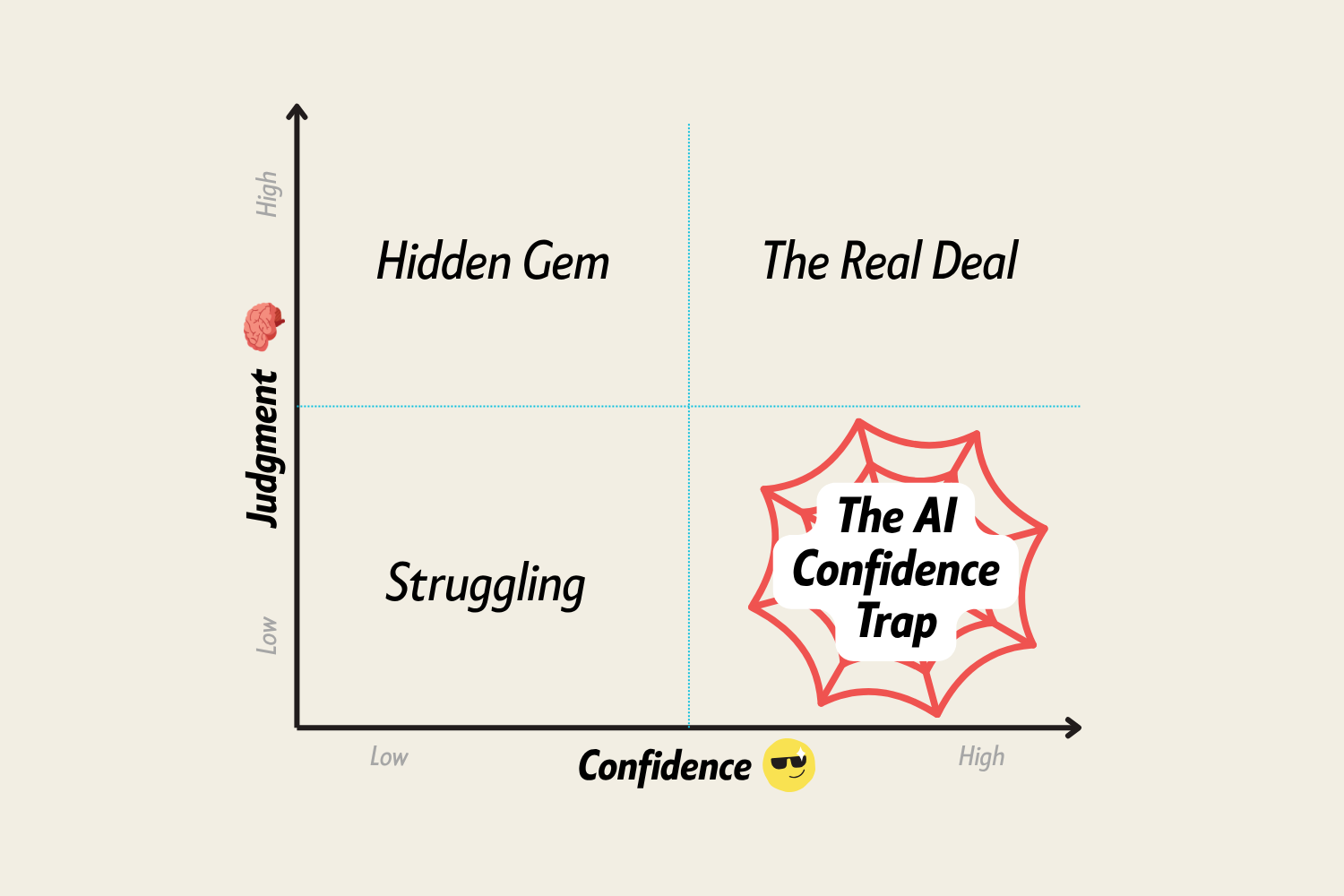
The AI Confidence Trap
AI-polished output can look like real competence when the thinking behind it isn't there — judge the reasoning, not the polish.

The AI Culture Stack
Same AI tools and budget, wildly different results — the gap isn't the technology, it's three layers underneath: permission, fluency, judgment.

The AI Fluency Framework
AI fluency isn't a prompting skill — it's the same four competencies that make someone a good manager: delegating, briefing, reviewing, and owning.
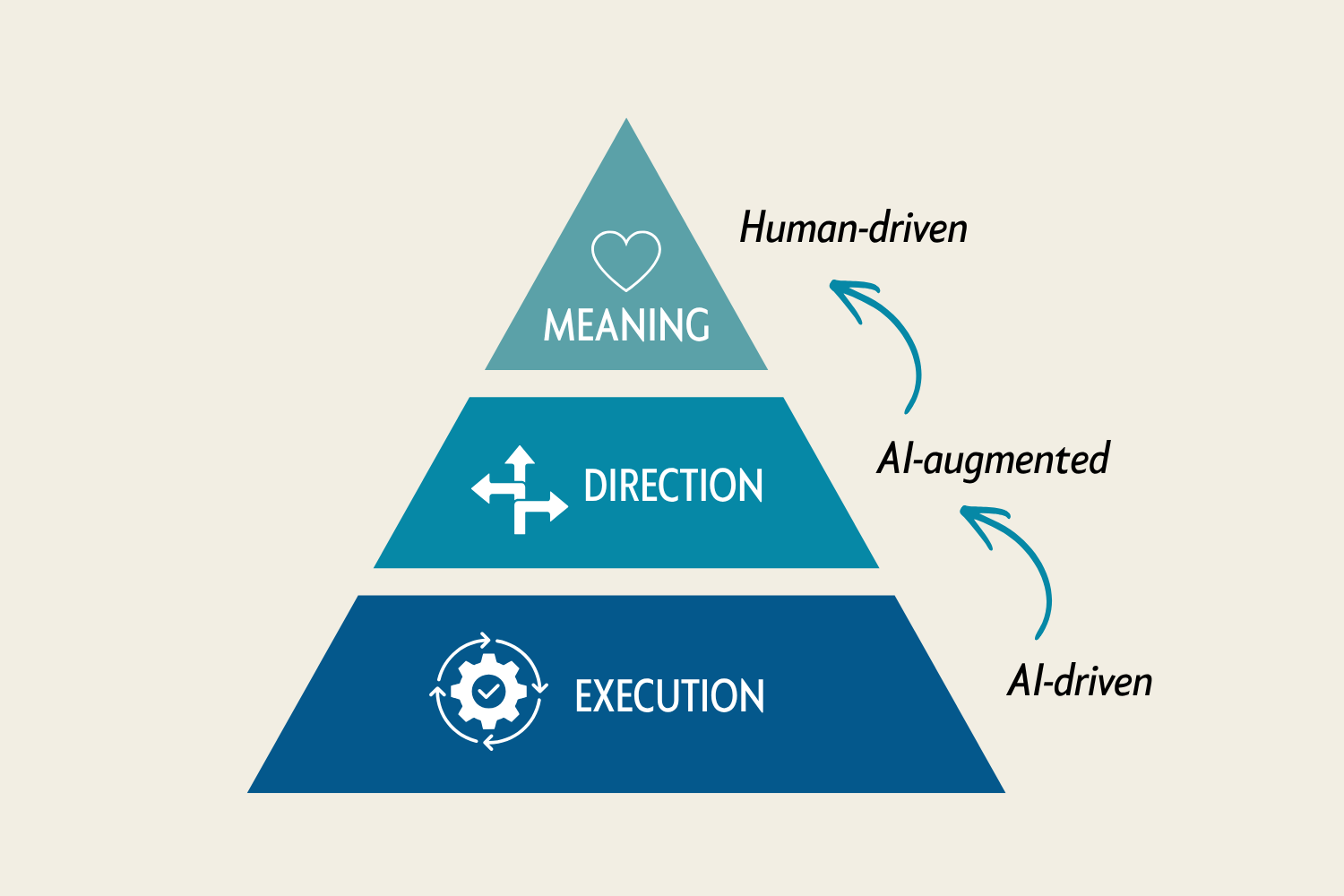
The Three Layers of Leadership
A pyramid — Execution, Direction, Meaning — where your value has to move up as AI automates execution.