The AI Fluency Framework
AI fluency isn't a prompting skill — it's the same four competencies that make someone a good manager: delegating, briefing, reviewing, and owning.
 Find this on the mind-map
Introduction
The AI Fluency Framework comes from Anthropic's free AI Fluency course on Claude Academy — also called the 4D Framework, for the four competencies it names, Delegation, Description, Discernment, and Diligence, that all happen to start with the same letter.
What stands out about it is how familiar it feels. Every one of the four Ds is a skill good managers already practice with people — the only thing that changes is who's on the other side of the handoff, a person or an AI.
Most leaders chasing "AI fluency" on their team reach straight for better prompts. That mistakes the symptom for the skill. The people who struggle most with AI are usually the same people who already struggled to delegate clearly, brief well, or review someone else's work honestly. AI doesn't create a new skill gap on a team — it exposes an old one.
How It Works
Four competencies, each one a management skill wearing a new name, plus three modes that describe how directly a person is driving the work versus letting AI drive it.
| The D | What it is | Its management twin |
|---|---|---|
| Delegation | Deciding what you do yourself, what you do with AI, and what you let AI handle alone | Delegating |
| Description | How clearly you brief AI — on product, process, and performance | Briefing |
| Discernment | Evaluating what AI gives back — on product, process, and performance | Reviewing |
| Diligence | Working with AI responsibly and owning the outcome | Owning |
Delegation breaks into three parts: problem awareness (knowing the goal and the work involved), platform awareness (knowing what a given AI tool can and can't do), and task delegation itself (splitting the work so each side does what it's good at). Someone who struggles to delegate to a new hire will struggle to delegate to AI for the same reasons.
Description is the brief — and a complete one has three layers, not one: product (what you want), process (how you want it approached), and performance (how you want the AI to behave while it works with you — concise or detailed, challenging or supportive). Most briefs name the product and skip the other two, then the result comes back technically correct and still wrong.
Discernment evaluates what comes back, using those same three layers: is the output actually good (product), did it get there sensibly (process), and was it a good partner to work with (performance)? It's the same muscle a manager uses giving a team member feedback — except most people only ever check the first layer.
Diligence is accountability. AI isn't accountable for what it produced on someone's instruction — the person who directed it is. "AI wrote it" holds up no better than "the intern wrote it." Diligence also covers whether someone is open about how AI was involved, which matters more the more visible the work is.
Layered on top of the four Ds are three modes, describing how much a person is driving versus letting AI drive: Automation (instruct, AI executes a specific task), Augmentation (AI as a thinking partner), and Agency (AI works on the person's behalf without a step-by-step). Anyone who knows Situational Leadership will recognize the shape — Automation tracks with directing, Augmentation with coaching, Agency with delegating. And just as with people, the right mode depends on the task and on how much trust has actually been built with that AI setup, not on how capable the model is in the abstract.
Why It Matters for Leaders
Most companies track AI adoption with usage numbers — seats activated, tokens burned, percentage of code written with AI. Those numbers earn their keep early in a rollout, when the job is just getting people to try the tools. Once everyone's already using them, which is most teams by now, usage stops telling you anything about whether the results are actually better — a straightforward case of Goodhart's Law: once usage becomes the target, it stops measuring what it was meant to.
As AI absorbs more of the producing, a manager's real job — and the team's — shifts from producing to judgment: deciding what to hand off, catching mistakes in what comes back, and deciding whether something is actually ready to ship. That's not a tools problem. It's a leadership problem wearing a tools costume.
Picture the pattern that plays out on most teams that roll out a coding agent: usage climbs, PR volume climbs, it looks great — until the review queue backs up, CI gets blocked, and the incidents start arriving. Nobody's prompts got worse. What was missing was Discernment: nobody had agreed on how the team would evaluate AI-assisted work before it started showing up at this volume.
The framework also predicts where teams get stuck first. Discernment is usually the weakest of the four, for a simple reason — it takes the most effort and gets the least training. Most "AI training" covers Description almost exclusively, which leaves Delegation, Discernment, and Diligence to develop by accident, if they develop at all.
Get this right and the payoff shows up exactly where it should: in results, not usage. A team with real Discernment catches a bad plan before it ships instead of after. A team with real Diligence doesn't produce work nobody will own. And a leader who's built all four Ds personally is modeling the only thing that actually transfers to a team — not "use the tool," but how to think about using it well.
What to do next
Test your knowledge of The AI Fluency Framework
Practice The AI Fluency Framework
Apply The AI Fluency Framework to a real situation
Skills related to The AI Fluency Framework

Frameworks related to The AI Fluency Framework
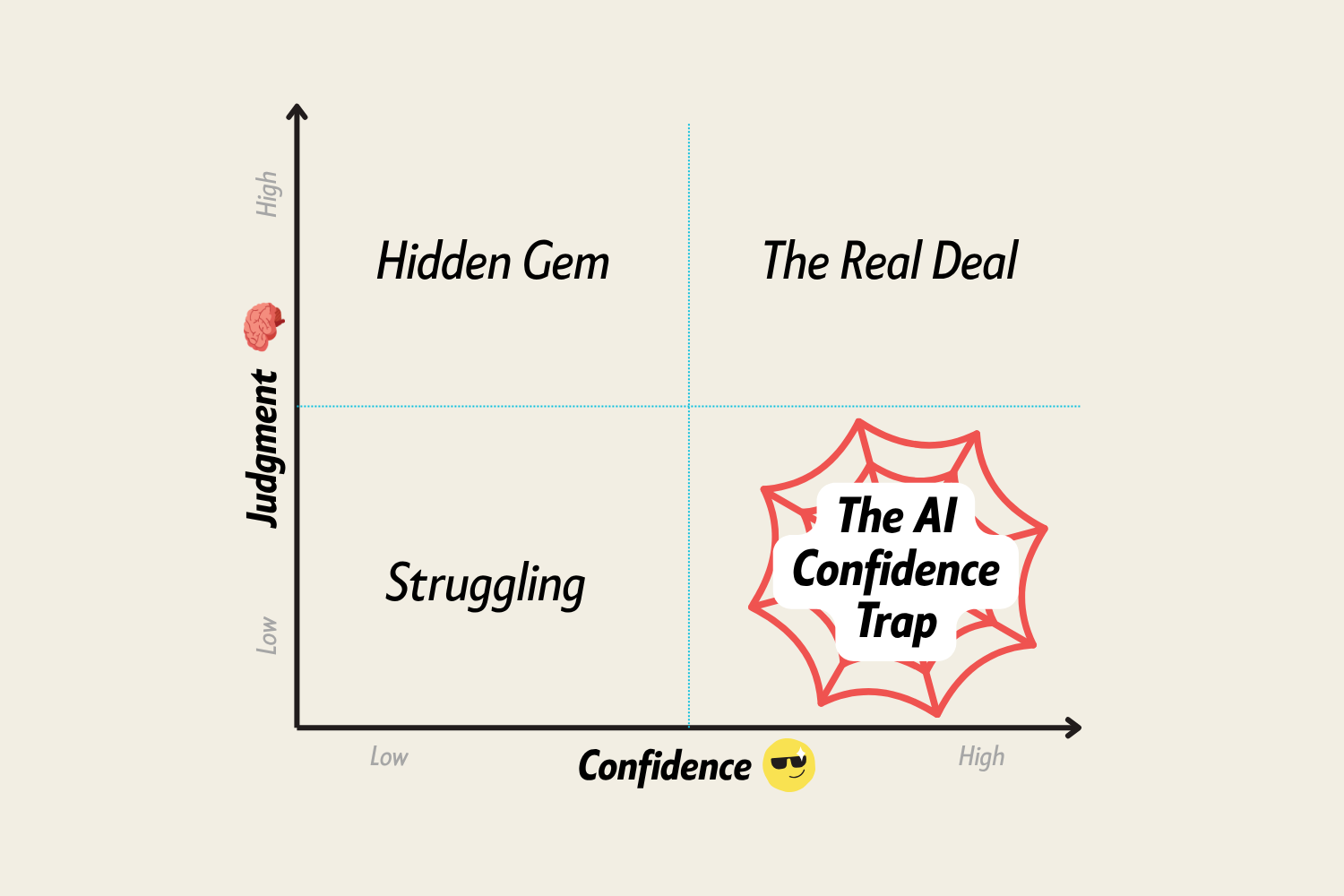
The AI Confidence Trap
AI-polished output can look like real competence when the thinking behind it isn't there — judge the reasoning, not the polish.

The AI Culture Stack
Same AI tools and budget, wildly different results — the gap isn't the technology, it's three layers underneath: permission, fluency, judgment.
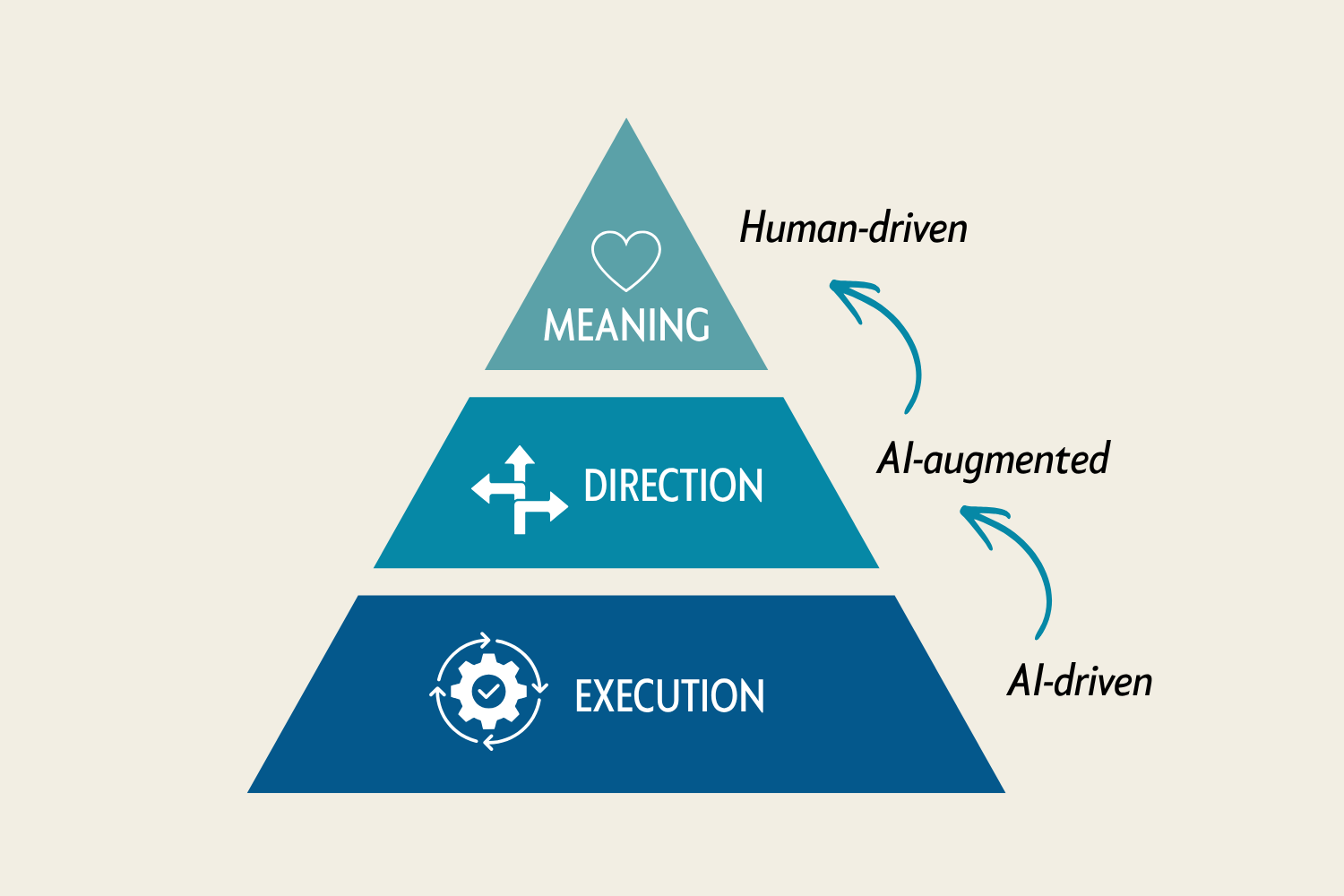
The Three Layers of Leadership
A pyramid — Execution, Direction, Meaning — where your value has to move up as AI automates execution.
Books related to The AI Fluency Framework

AI 2041
Ten speculative-fiction stories set in the year 2041, each in a different country and paired with Kai-Fu Lee's nonfiction breakdown of the real technology underneath. A way of making abstract AI trends concrete by showing, not just telling, how they might actually land in ordinary lives.

AI Superpowers
Kai-Fu Lee's argument, from inside both Silicon Valley and the Chinese tech industry, that the AI race has shifted from who has the best research to who can actually ship and scale it. On that axis, the competitive map looks very different than Western coverage usually suggests.

Co-Intelligence
Wharton professor Ethan Mollick's field guide to actually working with generative AI day to day, treating it less like software and more like a fast, occasionally brilliant, occasionally confidently wrong new colleague.

Competing in the Age of AI
Two Harvard Business School professors' argument that AI-native firms aren't running a better version of your business. They're running a fundamentally different machine, one built to scale decisions at almost zero marginal cost.

Empire of AI
Investigative journalist Karen Hao's case, built from years covering OpenAI and hundreds of interviews, that the leading AI labs should be understood not as idealistic research nonprofits but as empires in the old sense: extracting data, labor, and natural resources to concentrate power, dressed in the language of a mission to benefit humanity.

Prediction Machines
Three economists' reframing of AI, stripped of the hype: what modern machine learning actually does is make prediction cheap, and once prediction is cheap, the scarce, valuable thing left is judgment.