Empire of AI
Investigative journalist Karen Hao's case, built from years covering OpenAI and hundreds of interviews, that the leading AI labs should be understood not as idealistic research nonprofits but as empires in the old sense: extracting data, labor, and natural resources to concentrate power, dressed in the language of a mission to benefit humanity.
 Find this on the mind-map
Introduction
Karen Hao, a journalist who has covered OpenAI since 2019, makes a provocative framing choice in Empire of AI: Dreams and Nightmares in Sam Altman's OpenAI: she reads the major AI labs through the lens of historical empire-building rather than startup mythology. In her account, empires claim resources that aren't theirs (land, labor, data, creative work) and justify the taking with a "civilizing mission" that benefits everyone. The "benefit all of humanity" language the frontier labs use to describe themselves, she argues, is doing the same rhetorical work the old mission did, just rebuilt around compute, data, and cheap digital labor instead of land and raw materials.
From Nonprofit Safeguard to Capped-Profit Competitor
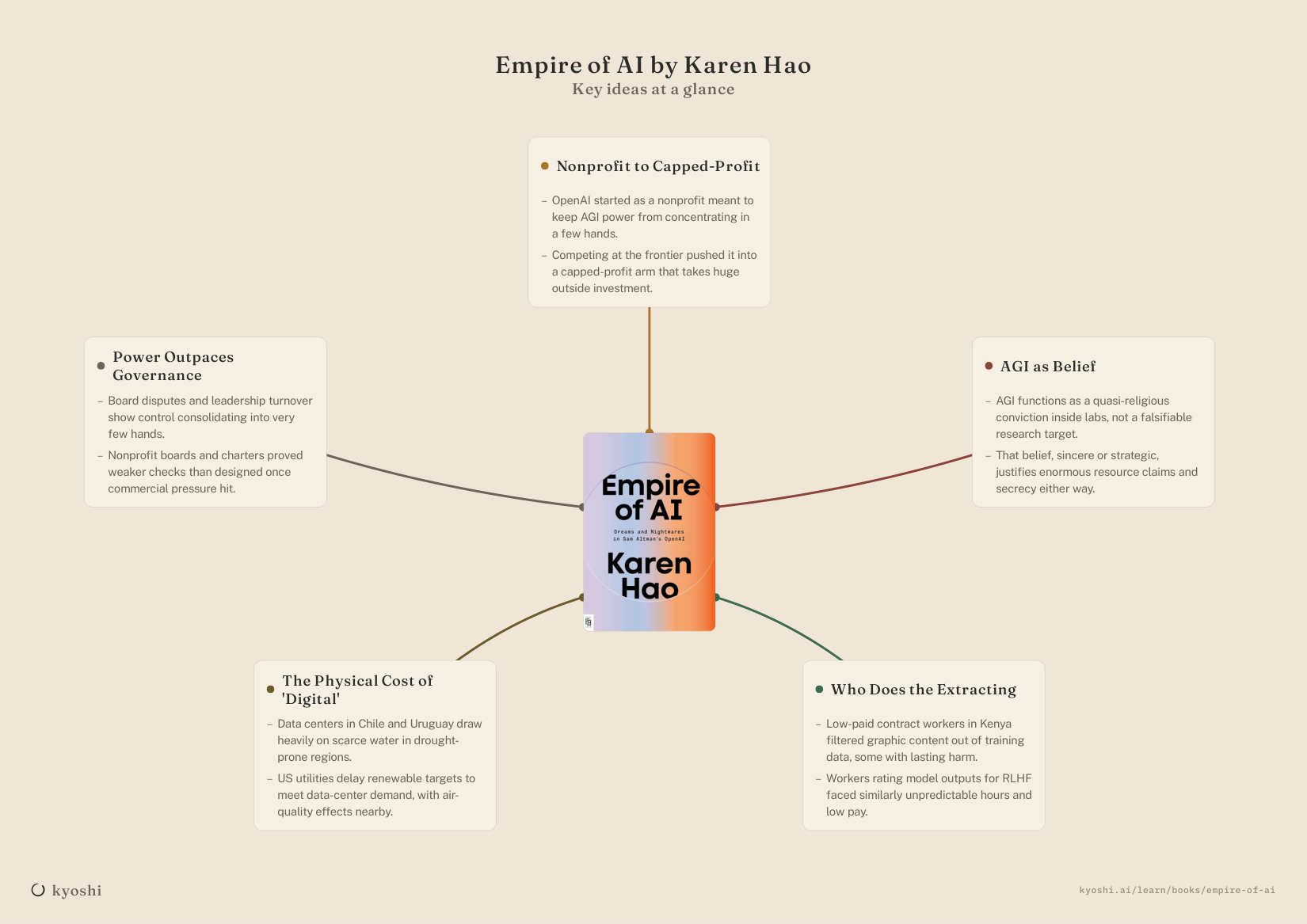
OpenAI was founded as a nonprofit built around a specific worry: that artificial general intelligence, left to a handful of corporate actors racing each other, would be dangerous. So the organization's job was to develop it safely and keep that power from concentrating. Hao's reporting traces how that founding structure bent under the real cost of competing at the frontier, leading to the creation of a "capped-profit" arm able to take in massive outside investment and operate much more like the commercial labs it was originally built to check. She treats this restructuring as one of the most consequential pivots in the company's history, not a technical footnote. The organization meant to prevent concentrated AI power ended up building it.
AGI as Belief, Not Just a Research Goal
One of Hao's sharper arguments is that the pursuit of artificial general intelligence functions inside these labs less like an ordinary research roadmap and more like a quasi-religious conviction: a goal treated as inevitable and civilization-defining in a way that insulates it from the kind of scrutiny a narrower, more falsifiable research claim would get. Whether individual leaders privately believe it or find the belief strategically useful, she argues, matters less than the fact that the belief justifies enormous resource claims and secrecy either way.
Who Actually Does the Extracting
A central thread is the hidden human labor behind a product marketed as pure software. Hao's reporting follows contract workers in Kenya, hired through an outsourcing firm called Sama, who filtered graphic violent and sexual content, including material depicting child abuse, out of OpenAI's training data, reviewing large volumes of disturbing material for low pay, with some developing lasting psychological harm. A separate layer of workers doing reinforcement-learning-from-human-feedback work, rating and ranking model outputs, faced similarly unpredictable hours and low pay. The polish at the surface, in Hao's account, is subsidized by working conditions the end user never sees and the company has, at times, said it didn't know about.
The Physical Cost of a "Digital" Technology
Large models require enormous, concrete infrastructure. Hao's reporting on data centers in Chile and Uruguay describes AI infrastructure drawing heavily on scarce water in drought-prone regions, competing directly with local communities and agriculture, while in the U.S. she reports utility companies delaying their own renewable-energy targets to meet data-center demand, with air-quality effects on nearby communities. She frames this as another extraction most users never connect to the chatbot they're using, because the resource cost is geographically and socially distant from the convenience it produces.
Power Concentrates Faster Than Governance Can Check It
Hao's account of internal power struggles (board disputes, leadership turnover, competing factions over speed versus caution) is used to argue that control over frontier AI is consolidating into a remarkably small number of hands, regardless of the governance structure on paper. Nonprofit boards and public charters, in her telling, have repeatedly proven weaker checks on that concentration than they were designed to be once real commercial and competitive pressure hit.
Putting It Together
The empire framing ties the threads together: an idealistic founding mission provided the legitimacy to raise enormous resources; those resources were converted into products built on labor and physical infrastructure whose real costs are borne far from where the value is captured; and the resulting power concentrated into a small number of leaders and labs faster than the governance structures meant to check it could keep up. Hao, drawing on hundreds of interviews, closes the book less with a single prescription than with a case for refusing, interrogating, and reimagining the current path rather than accepting it as inevitable. She points to narrower, more specialized AI tools that support human work (she cites DeepMind's AlphaFold as an example) as a contrast to the race toward one all-purpose, all-powerful system.
Why It Matters for Leaders
Most managers rolling out an AI tool are evaluating it the way they'd evaluate any new software: does it work, is it fast, does it save time. Hao's book is a case for adding a second question that almost nobody asks in a vendor meeting: who and what is this actually built on, and what happens to my team's judgment if we lean on it without checking.
The practical habit worth borrowing is simple. Before you standardize your team on an AI vendor, ask a direct question about where the data, labeling, and content-review work behind the tool actually comes from, and treat a vague or evasive answer as a real signal, not a technicality to skip past. Hao's reporting makes the case that a company's mission statement, "we're built to benefit everyone," tells you almost nothing about how it behaves once it's under real competitive pressure. What tells you more is what the organization actually restructures into when the money and the competition show up.
This also applies inside your own team, not just to outside vendors. A manager who justifies a decision by appealing to a big mission, "this is what the company stands for," "this is the future of the industry," is using the exact same move Hao documents at the level of an entire company. The question worth asking is whether that mission is actually doing real work in the decision, or whether it's being used to wave through something that wouldn't survive scrutiny on its own merits.
Picture a manager, Tomás, whose team is under pressure to adopt a new AI coding assistant company-wide. He's excited about the productivity numbers in the vendor's pitch deck and ready to sign off. Before he does, he asks one more question in the follow-up call: how is the model trained, and who reviewed the data behind it. The vendor can't give him a straight answer. That non-answer doesn't kill the deal by itself, but it changes what Tomás does next: he builds in a review period and asks his team to flag anything that feels off, instead of rolling it out company-wide on day one.
What to do next
Reinforce your understanding of Empire of AI
Books related to Empire of AI

AI 2041
Ten speculative-fiction stories set in the year 2041, each in a different country and paired with Kai-Fu Lee's nonfiction breakdown of the real technology underneath. A way of making abstract AI trends concrete by showing, not just telling, how they might actually land in ordinary lives.

AI Superpowers
Kai-Fu Lee's argument, from inside both Silicon Valley and the Chinese tech industry, that the AI race has shifted from who has the best research to who can actually ship and scale it. On that axis, the competitive map looks very different than Western coverage usually suggests.

Co-Intelligence
Wharton professor Ethan Mollick's field guide to actually working with generative AI day to day, treating it less like software and more like a fast, occasionally brilliant, occasionally confidently wrong new colleague.

Competing in the Age of AI
Two Harvard Business School professors' argument that AI-native firms aren't running a better version of your business. They're running a fundamentally different machine, one built to scale decisions at almost zero marginal cost.

Prediction Machines
Three economists' reframing of AI, stripped of the hype: what modern machine learning actually does is make prediction cheap, and once prediction is cheap, the scarce, valuable thing left is judgment.
Skills related to Empire of AI

Frameworks related to Empire of AI
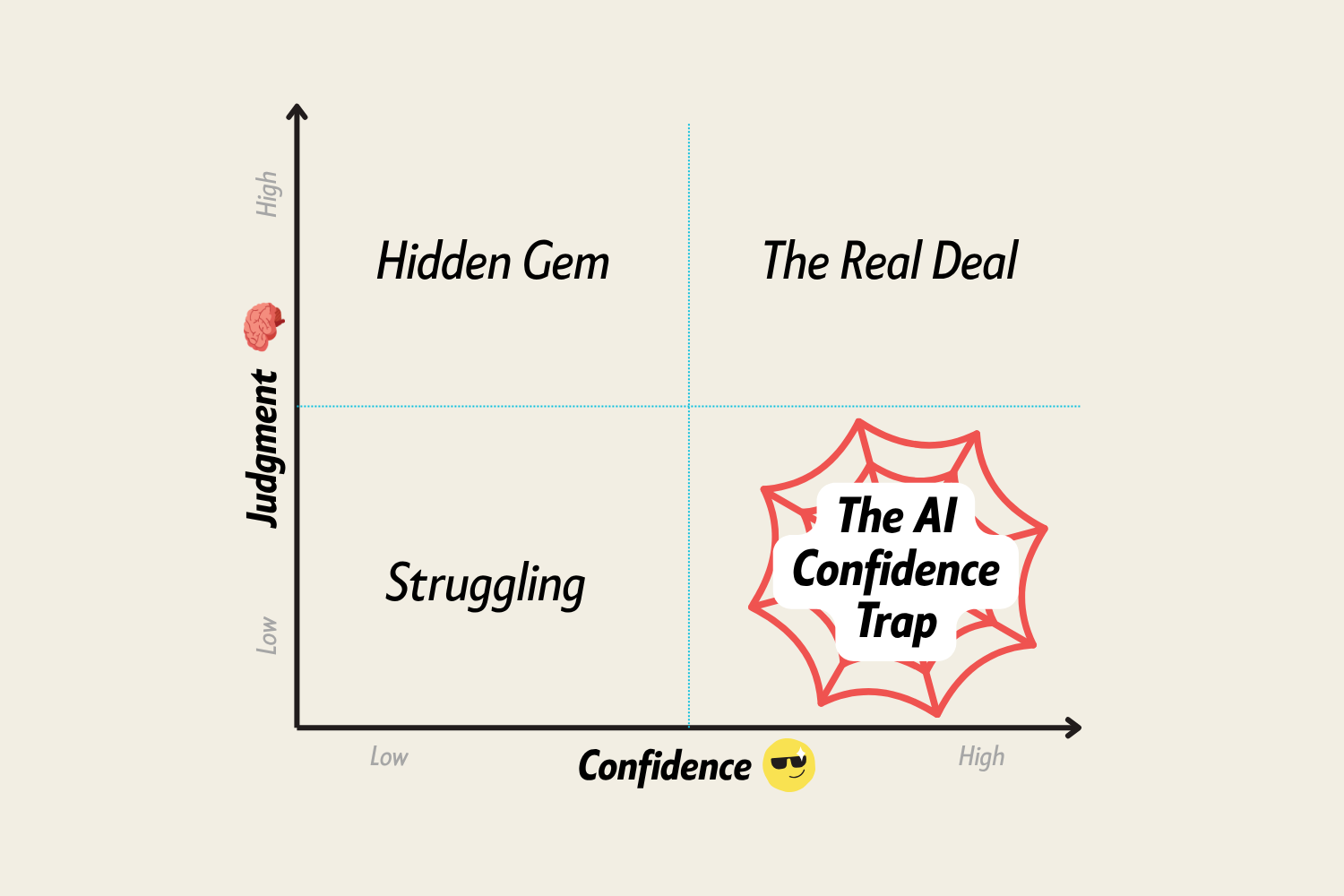
The AI Confidence Trap
AI-polished output can look like real competence when the thinking behind it isn't there — judge the reasoning, not the polish.

The AI Culture Stack
Same AI tools and budget, wildly different results — the gap isn't the technology, it's three layers underneath: permission, fluency, judgment.

The AI Fluency Framework
AI fluency isn't a prompting skill — it's the same four competencies that make someone a good manager: delegating, briefing, reviewing, and owning.
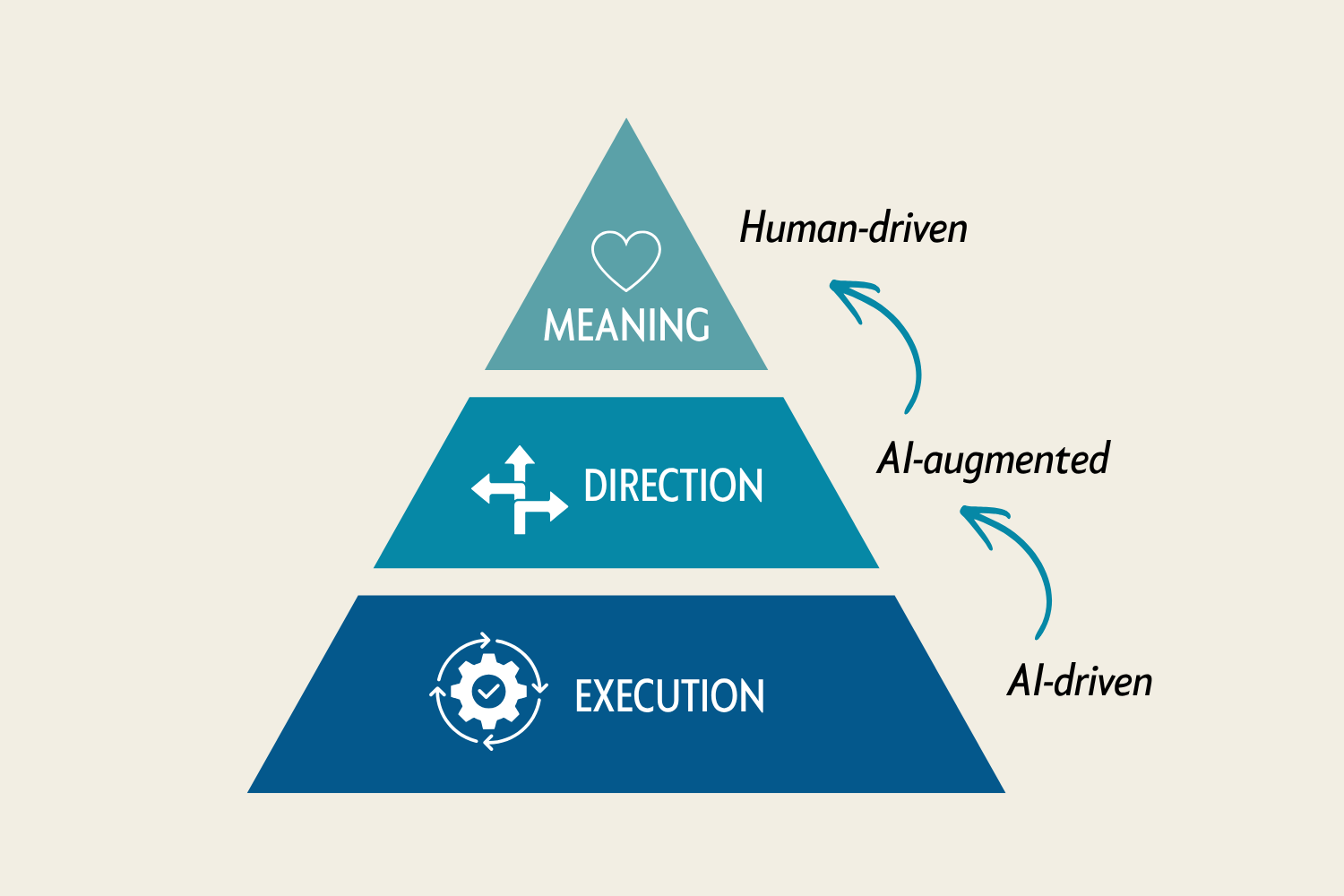
The Three Layers of Leadership
A pyramid — Execution, Direction, Meaning — where your value has to move up as AI automates execution.