Co-Intelligence
Wharton professor Ethan Mollick's field guide to actually working with generative AI day to day, treating it less like software and more like a fast, occasionally brilliant, occasionally confidently wrong new colleague.
 Find this on the mind-map
Introduction
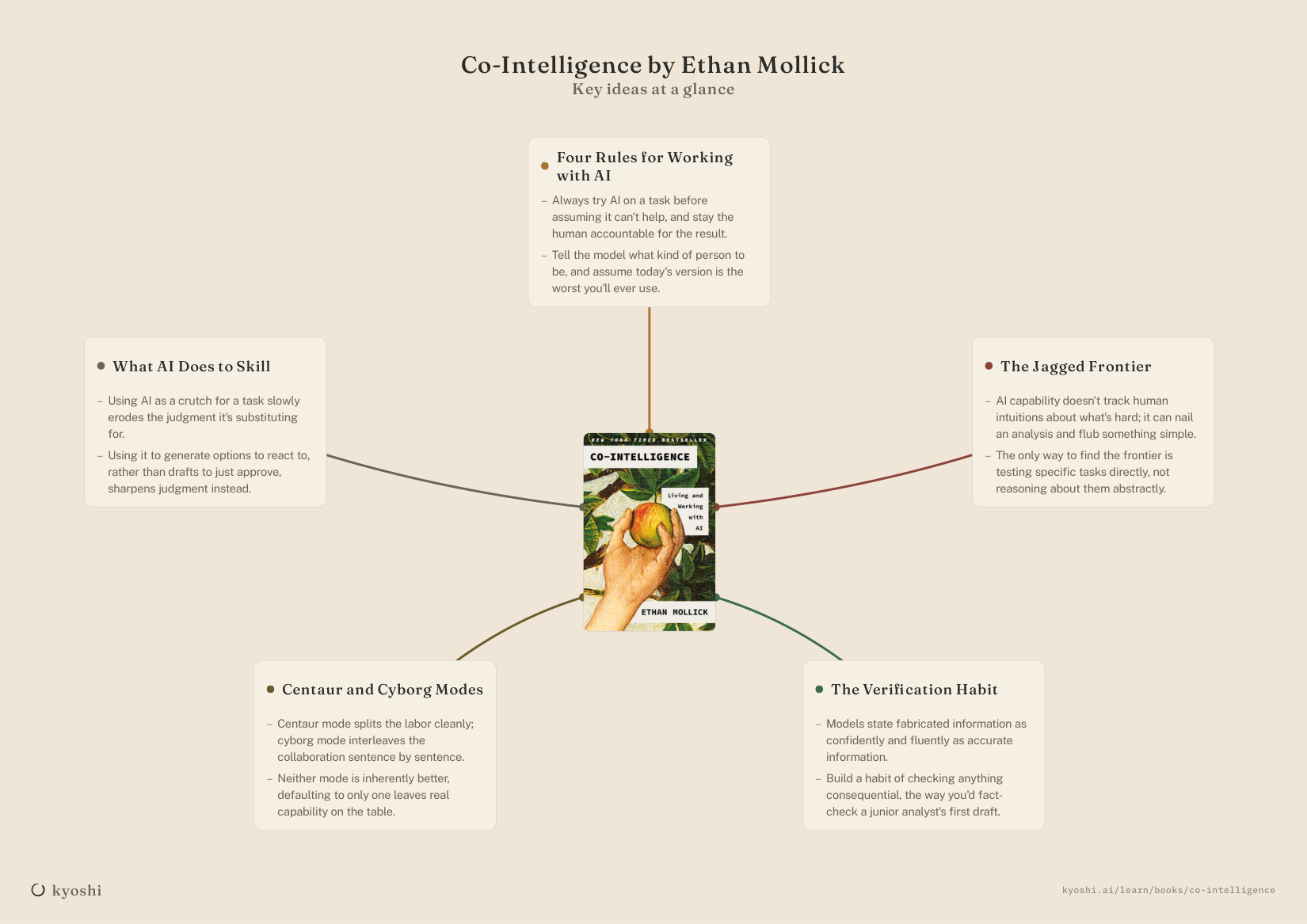
Ethan Mollick's argument is that most people are using generative AI wrong: either ignoring it because early attempts underwhelmed, or treating it like a search engine that should just give correct answers. His framing is "co-intelligence": AI as something you collaborate with, with real but genuinely strange capabilities, rather than a tool that either works perfectly or doesn't work at all.
Four Rules for Working with AI
Mollick's practical starting point: always invite AI to the table (try it on tasks before assuming it can't help), be the human in the loop (you're accountable for the output, not the model), treat AI like a person, but tell it what kind of person, since the persona and context you give it changes the quality of what comes back, and assume this is the worst AI you'll ever use, because the pace of improvement means today's limitations are a snapshot, not a ceiling.
The Jagged Frontier
AI capability doesn't map cleanly onto human intuitions about what's "hard" versus "easy." A model can write a sophisticated analysis in seconds and then fail at a task a ten-year-old would get right, with no obvious warning before the failure. A manager, Soo-jin, assumes the tool will be bad at a nuanced client email and surprisingly good at simple scheduling logic. She gets exactly the opposite result. The only way to find the frontier is to probe specific tasks directly rather than reason about them in the abstract.
Hallucination and the Verification Habit
Models produce fluent, confident, and sometimes entirely fabricated information, with no visible difference in tone between the accurate answer and the invented one. The discipline this demands isn't suspicion of everything the model says. It's building a habit of verifying anything consequential before it leaves your hands, the same way you'd fact-check a junior analyst's first draft without assuming either competence or incompetence in advance.
Centaur and Cyborg Modes
Mollick distinguishes two ways of actually working with AI: "centaur" mode, where you divide the labor cleanly (you do the strategic thinking, AI drafts the first pass), and "cyborg" mode, where the collaboration is tightly interleaved, sentence by sentence, with constant back-and-forth. Neither is inherently better; the right mode depends on the task, and defaulting to only one of them leaves real capability on the table.
What AI Does to Skill
Used as a crutch, AI slowly erodes the skill it's substituting for. A manager who never drafts a hard email without the model first may lose the underlying judgment faster than they realize. Used deliberately, generating options to react to and improve on rather than first drafts to approve, it can sharpen judgment instead of replacing it. The difference isn't the tool; it's whether you're still doing the thinking or just approving someone else's.
Putting It Together
The jagged frontier means you can't reason your way to knowing what AI is good at. You have to test it directly, task by task. Once you know where it's strong, the real skill is choosing centaur or cyborg mode deliberately, verifying anything that matters before it goes out the door, and staying honest with yourself about whether you're using the tool to think harder or to stop thinking at all.
Why It Matters for Leaders
Most managers treat AI as a single verdict question: is it good enough to trust, yes or no. That question has no stable answer, because the jagged frontier means the tool can be excellent at one task and surprisingly bad at the next one that looks just as hard. The useful question isn't "is AI good," it's "where exactly does it break on this specific kind of work," and you only find that out by testing, not by debating it in a meeting.
That changes how you roll AI out on a team. Instead of a blanket policy ("use it for first drafts," "don't use it for client-facing work"), the real lever is naming, task by task, where to hand off cleanly (centaur) and where to stay interleaved the whole way through (cyborg). A status report you'll heavily edit anyway is a clean handoff. A sensitive performance-review summary isn't, because the cost of a wrong inference is higher than the time saved.
The skill risk is the one most managers miss until it's already happened. If a report stops drafting hard emails, running tricky analyses, or working through ambiguous problems because the model does it first, their judgment on that specific skill fades without anyone noticing, until they're asked to do it alone and can't. The fix isn't banning the tool. It's noticing which of your people have stopped doing their own first pass, and asking them to do one occasionally even when the model would be faster.
Picture a manager named Teodora who assumes her team's AI-drafted client proposals are consistently solid because they read smoothly and come back fast. She starts spot-checking the numbers in them the way she'd check a new hire's first few weeks of work, not because she distrusts her team, but because fluent and correct aren't the same thing. The first proposal she checks has a subtly wrong growth assumption on page two, stated with total confidence, and nobody had caught it because it sounded right. She doesn't stop using the tool. She builds the five-minute check into the process instead.
What to do next
Reinforce your understanding of Co-Intelligence
Books related to Co-Intelligence

AI 2041
Ten speculative-fiction stories set in the year 2041, each in a different country and paired with Kai-Fu Lee's nonfiction breakdown of the real technology underneath. A way of making abstract AI trends concrete by showing, not just telling, how they might actually land in ordinary lives.

AI Superpowers
Kai-Fu Lee's argument, from inside both Silicon Valley and the Chinese tech industry, that the AI race has shifted from who has the best research to who can actually ship and scale it. On that axis, the competitive map looks very different than Western coverage usually suggests.

Competing in the Age of AI
Two Harvard Business School professors' argument that AI-native firms aren't running a better version of your business. They're running a fundamentally different machine, one built to scale decisions at almost zero marginal cost.

Empire of AI
Investigative journalist Karen Hao's case, built from years covering OpenAI and hundreds of interviews, that the leading AI labs should be understood not as idealistic research nonprofits but as empires in the old sense: extracting data, labor, and natural resources to concentrate power, dressed in the language of a mission to benefit humanity.

Prediction Machines
Three economists' reframing of AI, stripped of the hype: what modern machine learning actually does is make prediction cheap, and once prediction is cheap, the scarce, valuable thing left is judgment.
Skills related to Co-Intelligence

Frameworks related to Co-Intelligence
The AI Confidence Trap
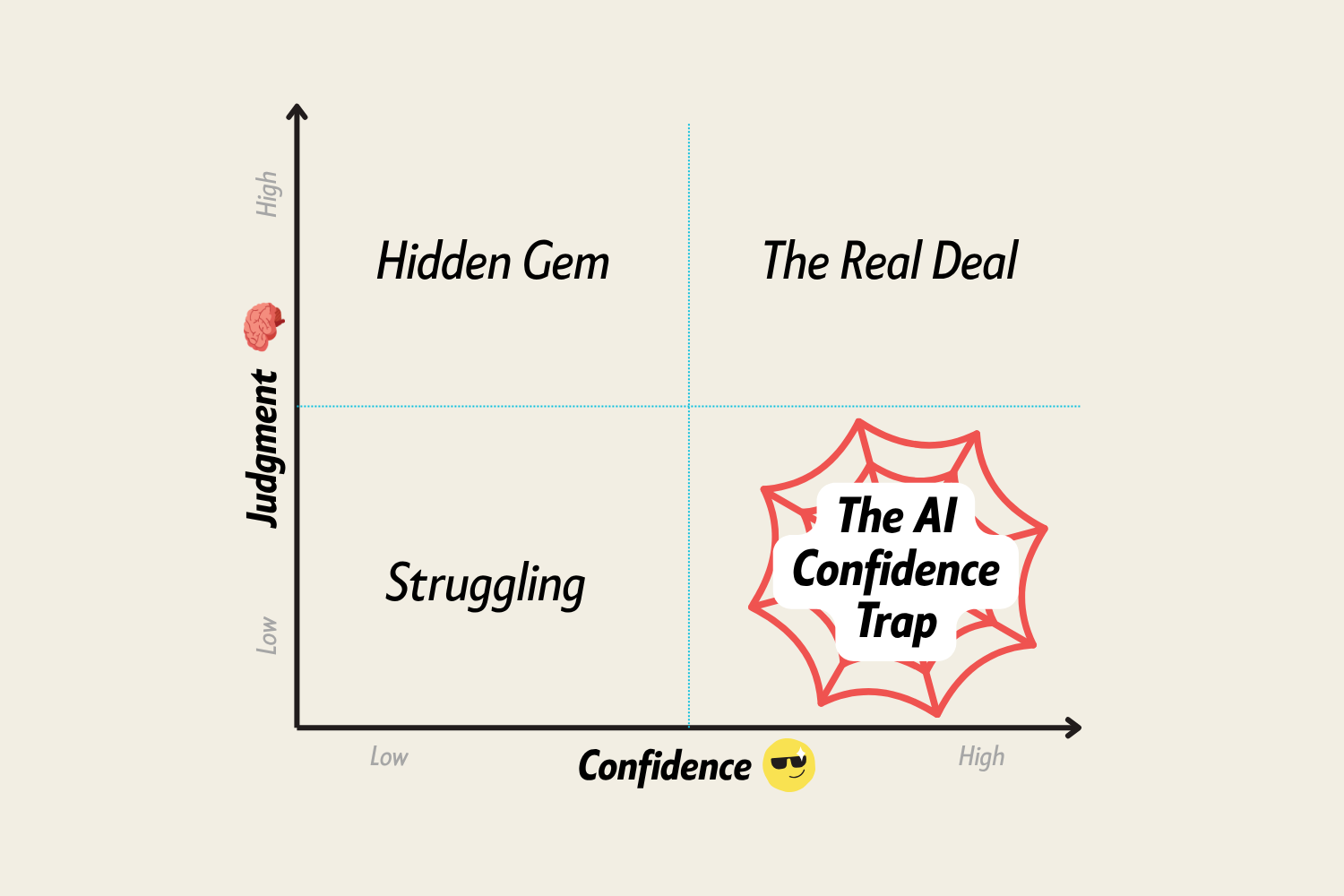
AI-polished output can look like real competence when the thinking behind it isn't there — judge the reasoning, not the polish.

The AI Culture Stack
Same AI tools and budget, wildly different results — the gap isn't the technology, it's three layers underneath: permission, fluency, judgment.

The AI Fluency Framework
AI fluency isn't a prompting skill — it's the same four competencies that make someone a good manager: delegating, briefing, reviewing, and owning.
The Three Layers of Leadership
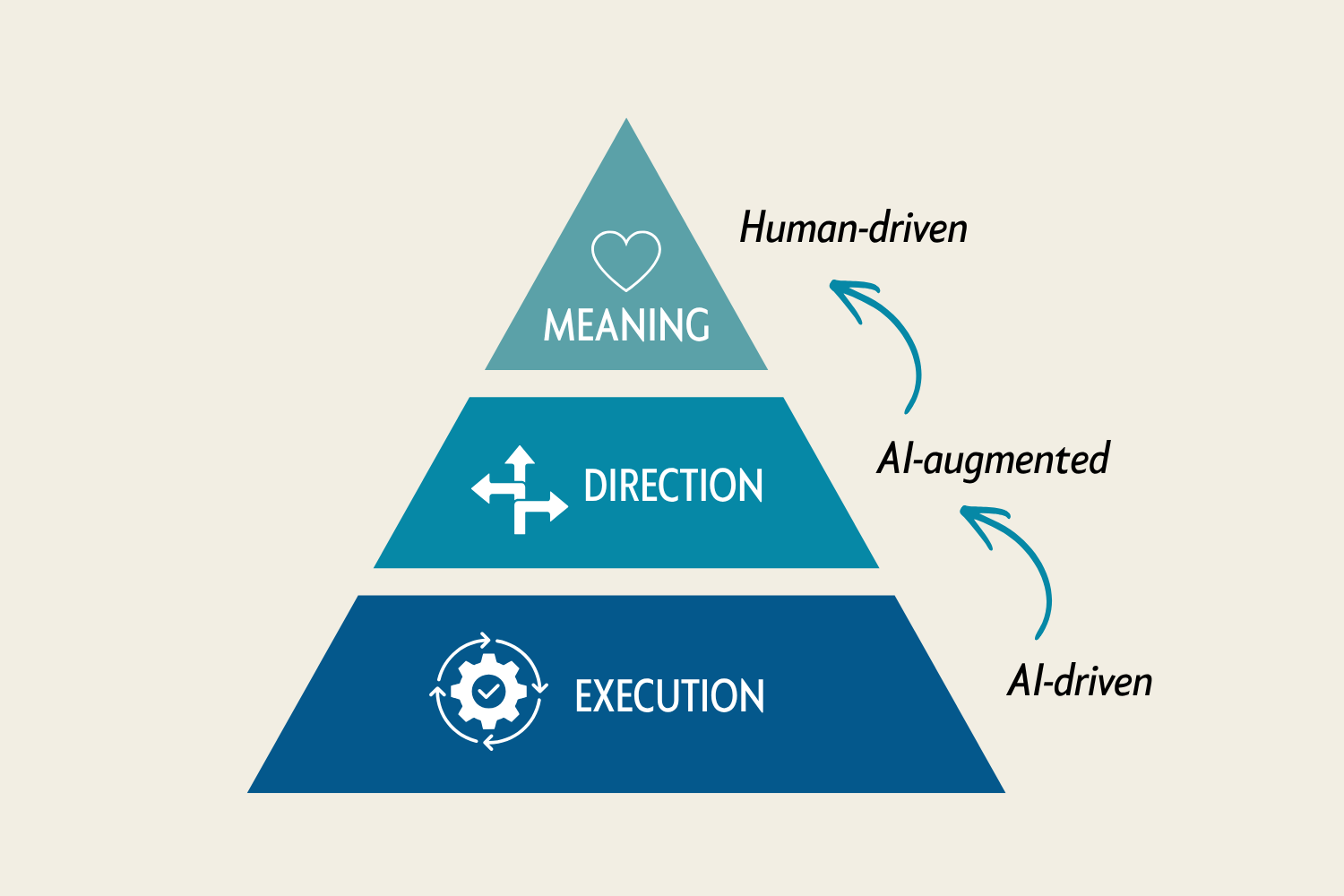
A pyramid — Execution, Direction, Meaning — where your value has to move up as AI automates execution.