Emotional Intelligence
Daniel Goleman's case that how you handle emotion, your own and everyone else's, predicts success better than raw intellect. The book that put "EQ" into every manager's vocabulary, for good reason.
 Find this on the mind-map
Introduction
Daniel Goleman's central claim is that IQ, long treated as the main predictor of success, is a weak explanation for why some capable people thrive while others stall or self-destruct. The missing variable, in his framing, is emotional intelligence: the capacity to recognize, understand, and manage your own emotions, and to recognize and respond well to the emotions of others. A brilliant strategist who can't manage their temper under pressure, or can't read a room before delivering hard news, is operating with a serious blind spot that intellect alone doesn't fix.
Self-Awareness: Knowing What You're Feeling, While You're Feeling It
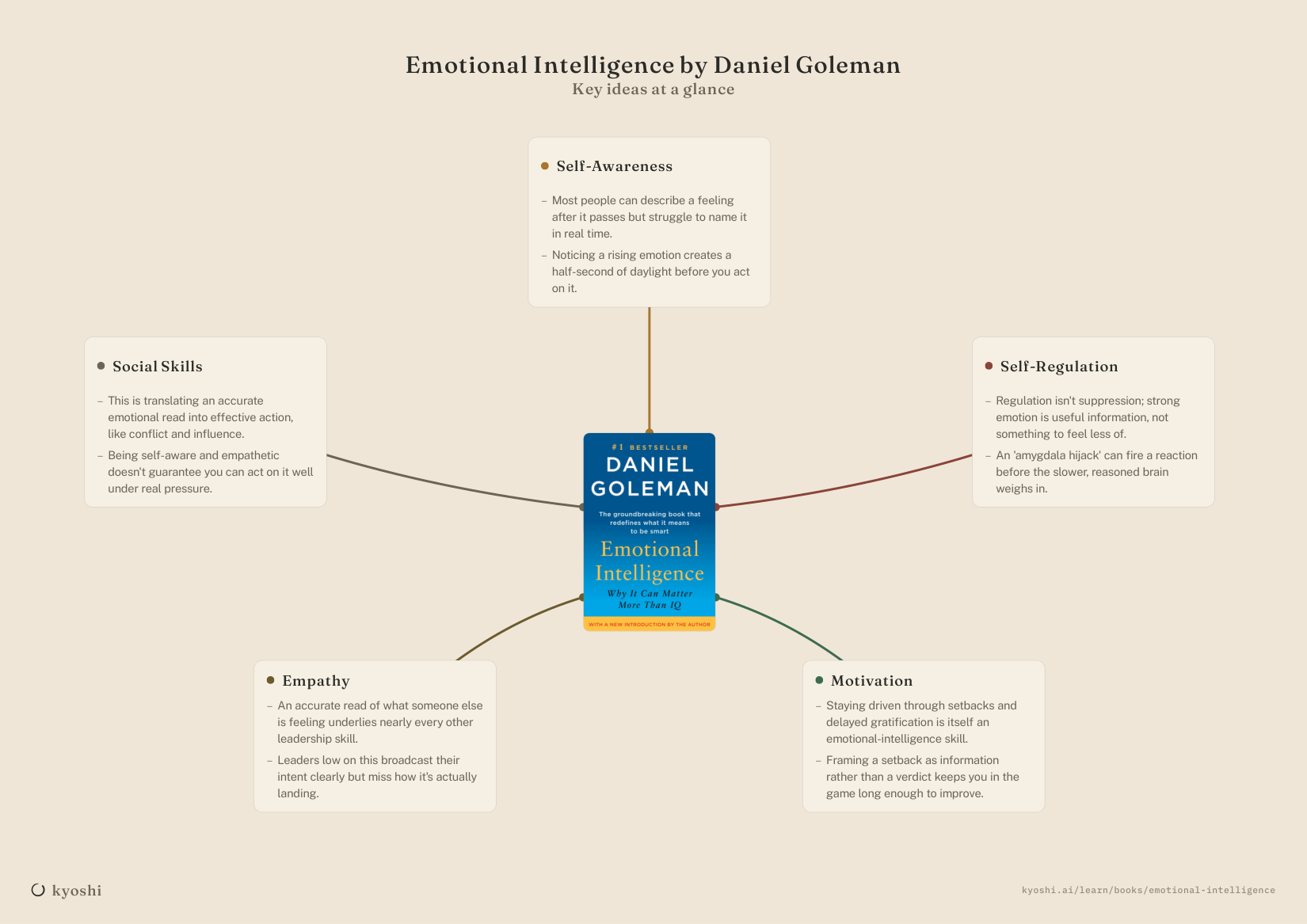
The foundation of the whole model is noticing your own emotional state as it's happening, not reconstructing it afterward. Most people are reasonably good at describing a feeling once it's passed and much worse at naming it in real time, while it's actively shaping their judgment. Consider two managers receiving sharp pushback in a meeting. Jordan feels the defensiveness rising, names it internally ("I'm getting defensive"), and chooses the next sentence deliberately. Priya feels the same rise and acts straight out of it, snapping back before she's even registered what happened. The emotion was identical; only one of them had the self-awareness to put a half-second of daylight between feeling it and acting on it.
Self-Regulation: Managing the Emotion, Not Suppressing It
Goleman is careful to distinguish regulation from suppression. The goal isn't to feel less. Strong emotion is useful information. The goal is to avoid being hijacked by it, particularly in the fast, high-stakes moments when an emotional reaction outruns a reasoned one. He draws on the brain's fast threat-response pathway to explain why this happens so quickly: under perceived threat, a reaction can fire before the slower, more deliberate parts of the brain have had a chance to weigh in. Goleman calls this an amygdala hijack. Leaders who regulate well aren't calmer by temperament; they've built the habit of catching the hijack a beat earlier than everyone else.
Motivation: The Internal Drive That Outlasts External Reward
Goleman treats motivation as an emotional-intelligence skill, not a personality trait. Specifically, it's the capacity to stay driven toward a goal through setbacks, delayed gratification, and the absence of immediate reward. People high in this dimension tend to frame setbacks as information rather than as verdicts on their ability, which keeps them in the game long enough for persistence to pay off. This connects directly to how a leader frames failure for their team: as a dead end, or as data.
Empathy: Reading What Other People Are Actually Feeling
Empathy, in Goleman's model, isn't softness. It's an accurate read of what's going on for someone else, which turns out to be a prerequisite for almost every other leadership skill: giving feedback that lands, negotiating well, knowing when to push and when to back off. Leaders low on this dimension tend to broadcast their own intent clearly and completely miss how it's landing on the other end, which is how a "clear, direct" message gets received as a cold one.
Social Skills: Turning Emotional Read Into Effective Action
The final piece is translating accurate emotional awareness, of yourself and others, into effective action: building relationships, managing conflict, influencing people, leading teams through change. Goleman's point is that the first four skills are preconditions, not substitutes, for this one. Plenty of self-aware, empathetic people still struggle to act on what they know, because translating emotional insight into effective behavior under real pressure is its own skill.
Putting It Together
The five components build on each other in order: you can't regulate an emotion you haven't noticed (self-awareness before self-regulation), you can't sustain motivation without some capacity to manage the discouragement along the way (self-regulation supports motivation), and you can't apply strong social skills without an accurate read of what other people are actually feeling (empathy before social skill). Goleman's broader point for any manager is blunt: technical competence gets you in the room, but emotional intelligence is what determines whether you're still effective once you're in it.
Why It Matters for Leaders
Most management training skips straight to the social-skills layer: how to run a 1:1, how to delegate, how to handle a hard conversation. Goleman's model says that's backwards. If you can't catch your own emotional state in the moment, no script for a hard conversation saves you once you're actually in it.
Here's a practical test: the next time your temper rises in a meeting, you'll know you're applying this model if you can name what you're feeling, in words, before you act on it. Most people skip straight from feeling it to doing it, and the gap between those two moments is where most of what a manager regrets saying actually happens.
This also changes how you read your own team. A manager who's strong on self-awareness and self-regulation but weak on empathy can still blindside people, because they're managing their own reaction well while missing how their delivery lands on the other side of the table. The fix isn't more discipline. It's a habit of checking: after a hard message, actually asking how it landed, instead of assuming clarity on your end means it landed clearly on theirs.
Picture a manager, Ravi, who prides himself on staying calm under pressure. He never raises his voice, never visibly loses his temper, and thinks of himself as emotionally intelligent because of it. But his team describes him as cold and hard to read, because he's so focused on managing his own emotional display that he never tunes in to what anyone else in the room is actually feeling. Ravi has built self-regulation and stopped there. The missing piece isn't more control. It's turning that same attention outward.
What to do next
Reinforce your understanding of Emotional Intelligence
Books related to Emotional Intelligence

Emotional Intelligence 2.0
The practical, test-and-strategies follow-up to the emotional intelligence conversation: less theory, more "here's exactly what to do on Tuesday," built around four skills you can actually practice and measure.

Primal Leadership
The case that a leader's mood isn't a private matter. It's contagious through the whole team, which makes emotional intelligence the real infrastructure underneath every other leadership skill.

Stillness Is the Key
Ryan Holiday's case that the people who handle pressure, power, and chaos best aren't the busiest or the most driven, they're the ones who've built real stillness into their mind, body, and sense of purpose, usually against the current of everything around them.

The Daily Stoic
A year of short, daily meditations drawn from Marcus Aurelius, Seneca, and Epictetus, organized into one practical claim: the ancient Stoics weren't writing philosophy for philosophers. They were writing a manual for getting through hard days without losing yourself.

Think Again
Adam Grant's case that rethinking, actually changing your mind when the facts say you should, is a skill most smart people are terrible at, and a direct challenge to any manager who treats changing position as a sign of weakness.
Skills related to Emotional Intelligence

Frameworks referenced from this book
Frameworks related to Emotional Intelligence
Circle of Competence
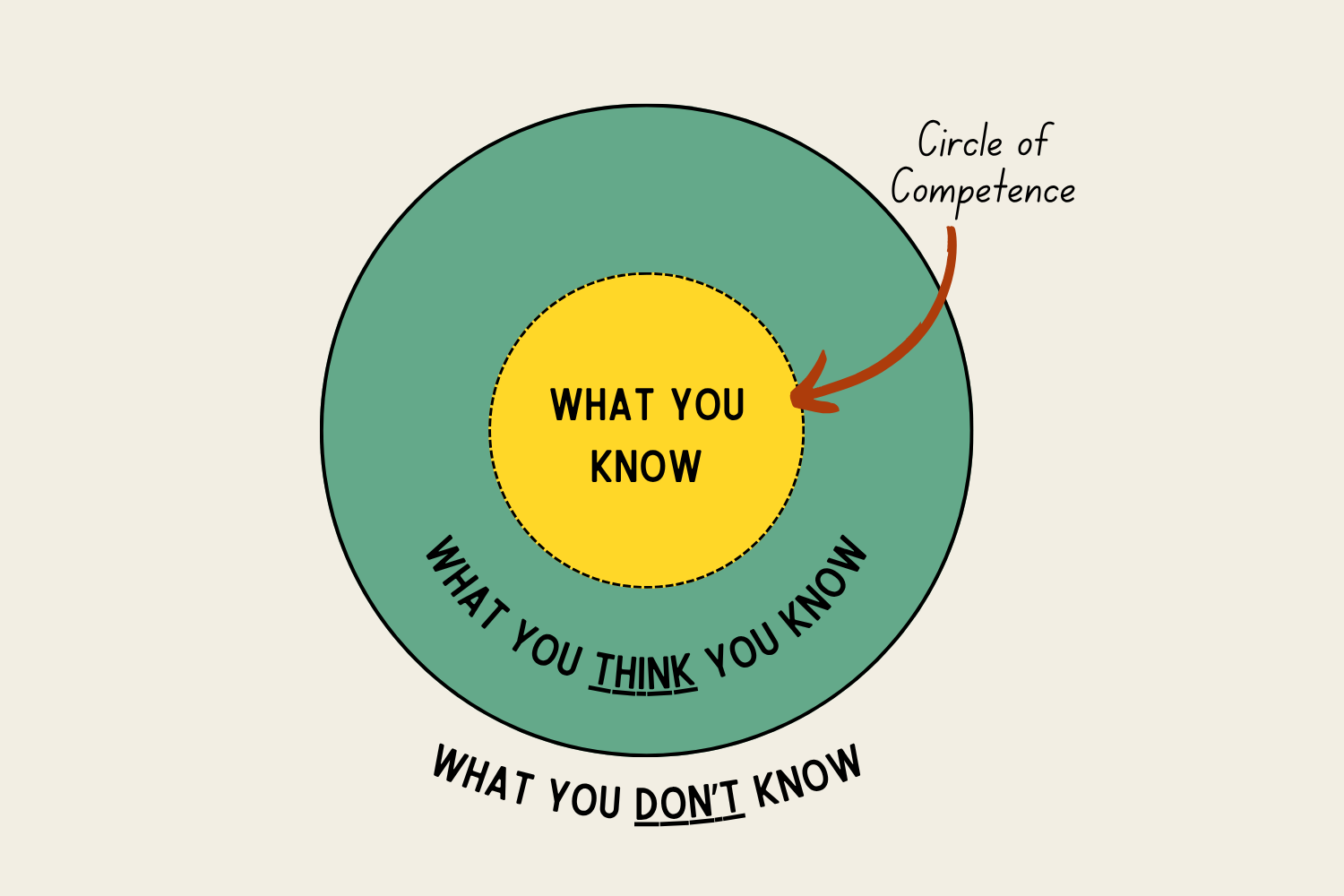
Buffett and Munger's model for knowing exactly where your understanding ends — size doesn't matter, honesty about the edge does.

EQ Framework
A 2x2 of emotional intelligence — self or social, noticing or acting — giving four skills: self-awareness, self-management, social awareness, relationship management.

Johari Window
A 2x2 mapping what you know about yourself against what others know — exposing blind spots, building trust through disclosure.
Ladder of Inference
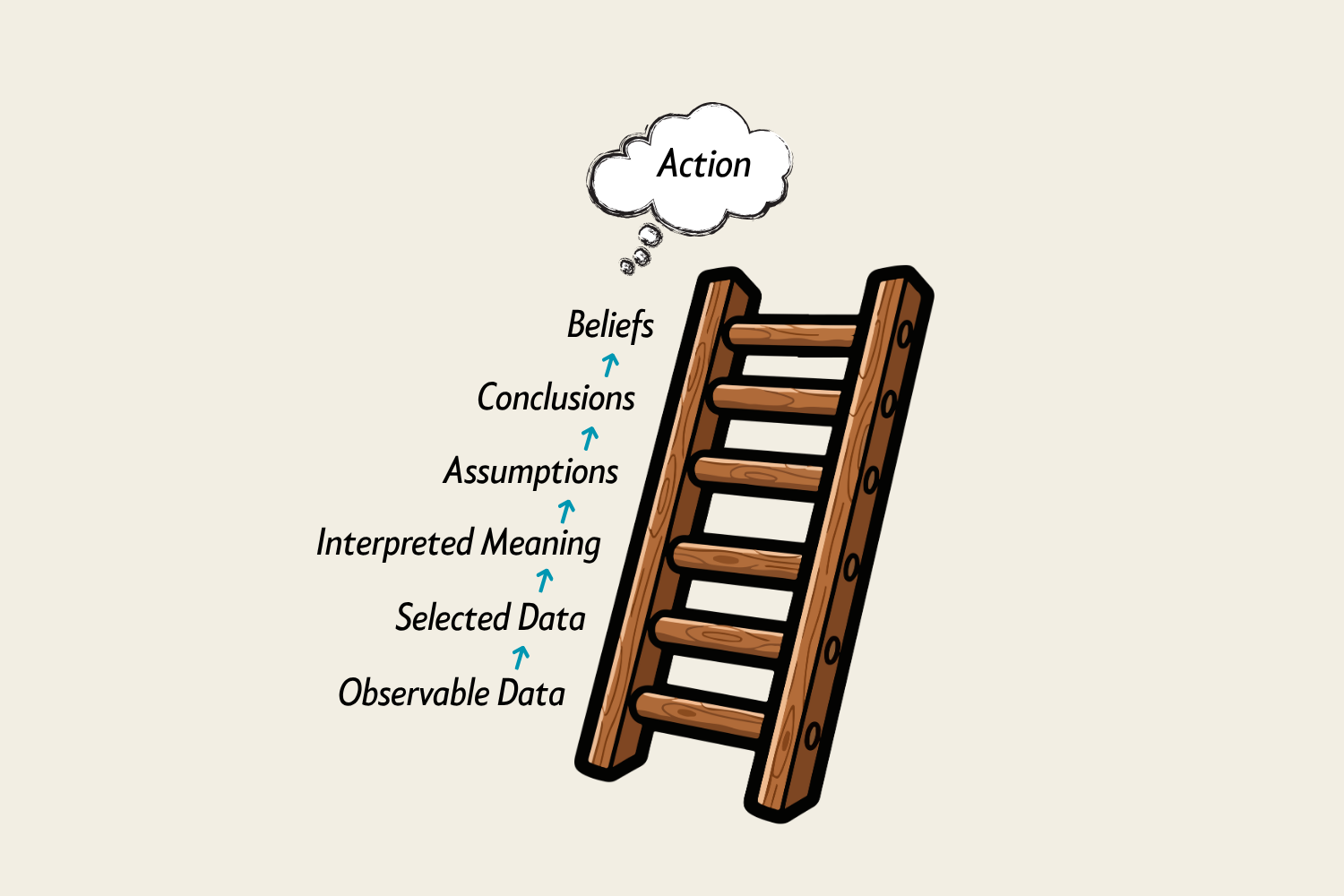
Your mind turns a fact into belief through selection and assumption — you end up arguing with a story, not reality.

The Four Temperaments
An ancient personality model — Sanguine, Choleric, Melancholic, Phlegmatic — a fast vocabulary for reading your style, your team, and your boss.