Think Again
Adam Grant's case that rethinking, actually changing your mind when the facts say you should, is a skill most smart people are terrible at, and a direct challenge to any manager who treats changing position as a sign of weakness.
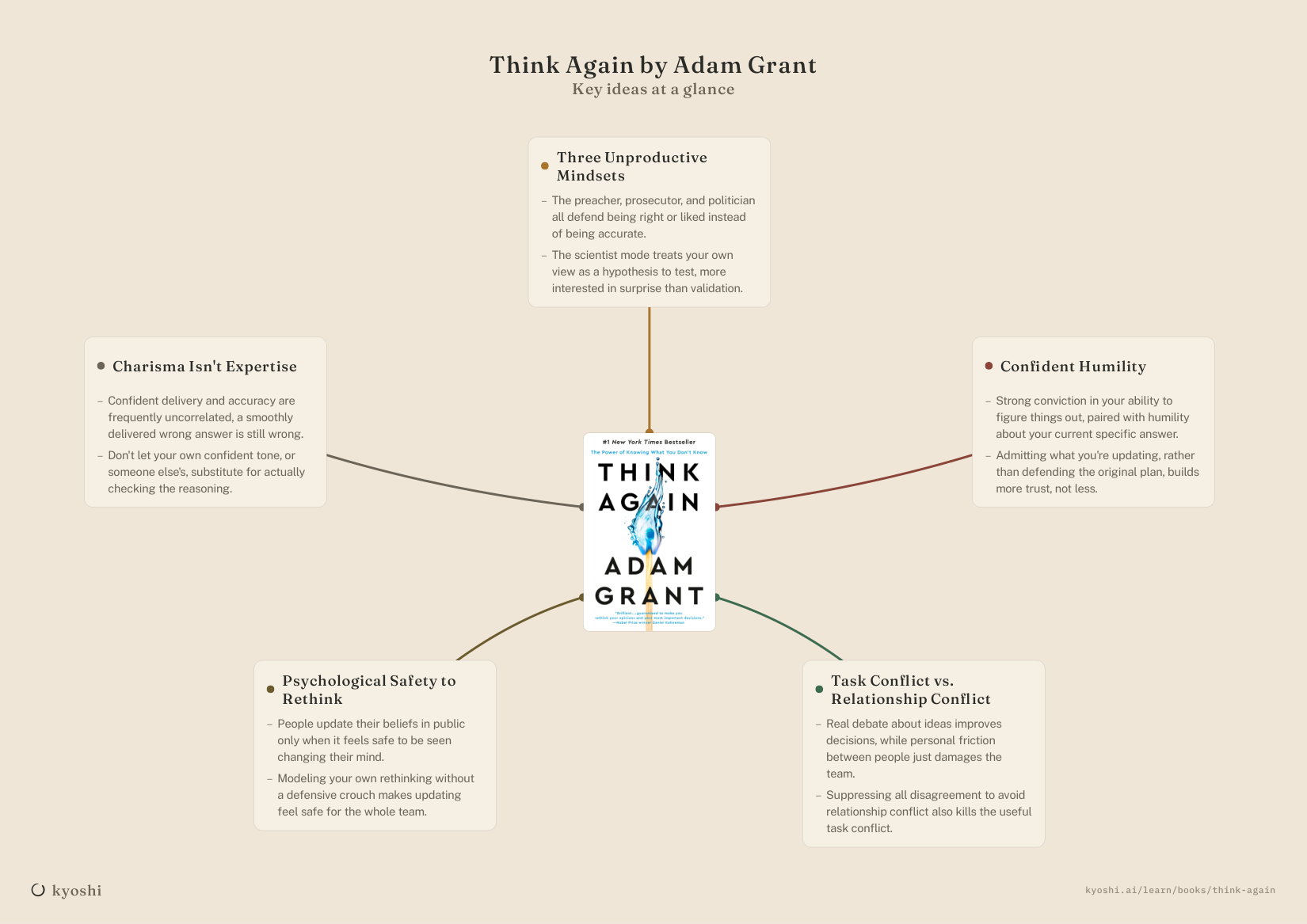
 Find this on the mind-map
Introduction
Adam Grant's starting observation is almost paradoxical: the smarter and more successful someone is, the more likely they are to get attached to their existing beliefs and resist updating them, precisely because being right has worked out well for them before. The book's core argument is that rethinking, actively questioning your own opinions, strategies, and even identity, and genuinely updating them when what you've seen calls for it, is a distinct, learnable skill, and one that most capable, confident people have never deliberately practiced.
Three Mindsets That Get in the Way
Grant describes three familiar but unproductive modes people slip into when their beliefs are challenged: the preacher, who defends a sacred conviction with moral certainty; the prosecutor, who attacks the other side's reasoning to win the argument; and the politician, who campaigns for approval from whichever audience is in the room. All three are focused on being right or being liked, not on being accurate. Against these, Grant proposes a fourth mode, the scientist, who treats their own current view as a hypothesis to be tested rather than an identity to be defended, and who's more interested in being surprised than being validated.
Confident Humility
The book's central disposition is what Grant calls confident humility: strong conviction in your ability to figure things out, paired with humility about whether your current specific answer is actually correct. This isn't the same as being unsure of yourself. It's being sure of your process, your ability to learn and adjust, while holding your current conclusion loosely. Consider two VPs defending a product bet that isn't working. Renée argues forcefully for the original plan because conceding would feel like admitting she was wrong about something she championed. Marcus says, "Here's what I believed, here's what's actually happening, and here's what I'm updating." His team trusts his calls more afterward, not less.
Task Conflict Is Good; Relationship Conflict Isn't
Grant draws a useful distinction for how disagreement plays out on a team: task conflict (a real debate about ideas and strategy, backed by what people have actually seen) tends to improve decisions when it's handled well, while relationship conflict (personal friction and animosity between people) tends to just damage the team regardless of outcome. The mistake many managers make is suppressing all disagreement to avoid relationship conflict, which also kills the task conflict that was actually producing better decisions.
Rethinking Requires Psychological Safety, Not Just Intellectual Openness
A theme that runs underneath the whole book: people don't update their beliefs in public just because they've been shown something convincing. They update when it feels safe to be seen changing their mind. A team that mocks or penalizes someone, even in small ways, for reversing a position teaches everyone to defend bad calls longer than they should, purely to avoid the social cost of admitting it. Grant's practical implication for leaders is that modeling your own rethinking, visibly and without a defensive crouch, does more to make updating feel safe for a team than any argument about the value of open-mindedness.
Charisma Doesn't Beat Expertise, It Just Feels Like It Does
Grant pushes back on the instinct to be persuaded by confident delivery over careful reasoning, pointing out that charisma and accuracy are frequently uncorrelated. A smoothly delivered wrong answer is still wrong. For a manager, this cuts both ways: don't let your own confident tone substitute for actually having checked your reasoning, and don't let someone else's confident tone substitute for you checking theirs.
Putting It Together
The scientist mindset, confident humility, protecting task conflict while limiting relationship conflict, and building the psychological safety for public rethinking are really one skill practiced from different angles: treating your current belief as provisional, your reasoning process as the thing worth being confident about, and disagreement as useful information rather than a threat to manage away.
Why It Matters for Leaders
The usual story about changing your mind is that it's a weakness, a sign the first call was wrong and you got caught. Most leaders act on that story even when they don't believe it, which is why so many bad calls get defended long after everyone in the room can see they're bad. The actual risk runs the other way. A leader who can't be seen updating teaches their whole team to do the same thing: defend, don't adjust.
Here's where this shows up day to day. You're in a meeting and someone pushes back hard on a plan you built. The reflex is to defend it, because conceding feels like losing the argument, or losing standing. The useful move is almost the opposite: treat the plan as a hypothesis you were testing, not a position you're defending, and ask what would actually change your mind about it. That's a different conversation than winning or losing, and it tends to surface the real problem faster.
It also changes how you run disagreement on your team. A debate about the actual plan, where people argue the merits, is doing real work, even when it gets heated, and shutting it down to keep the peace usually costs you the better decision that debate was building toward. What you want to kill instead is personal friction, people getting at each other rather than at the problem, which is a different thing entirely and worth naming out loud when you see it starting.
The highest-leverage version of this is modeling it yourself, in public, before you ask anyone else to. Picture a director named Omar who pushed hard for a product bet six months ago and has been watching the numbers come in soft ever since. He has two options in the next leadership review: defend the original case harder, or say plainly, "here's what I believed, here's what's actually happening, and here's what I'm changing." The second option costs him something in the room that day. It buys him a team that will tell him the truth next time, instead of a team that's learned to just agree with whatever he said last.
What to do next
Reinforce your understanding of Think Again
Books related to Think Again

Emotional Intelligence
Daniel Goleman's case that how you handle emotion, your own and everyone else's, predicts success better than raw intellect. The book that put "EQ" into every manager's vocabulary, for good reason.

Emotional Intelligence 2.0
The practical, test-and-strategies follow-up to the emotional intelligence conversation: less theory, more "here's exactly what to do on Tuesday," built around four skills you can actually practice and measure.

Primal Leadership
The case that a leader's mood isn't a private matter. It's contagious through the whole team, which makes emotional intelligence the real infrastructure underneath every other leadership skill.

Stillness Is the Key
Ryan Holiday's case that the people who handle pressure, power, and chaos best aren't the busiest or the most driven, they're the ones who've built real stillness into their mind, body, and sense of purpose, usually against the current of everything around them.

The Daily Stoic
A year of short, daily meditations drawn from Marcus Aurelius, Seneca, and Epictetus, organized into one practical claim: the ancient Stoics weren't writing philosophy for philosophers. They were writing a manual for getting through hard days without losing yourself.
Skills related to Think Again

Frameworks related to Think Again
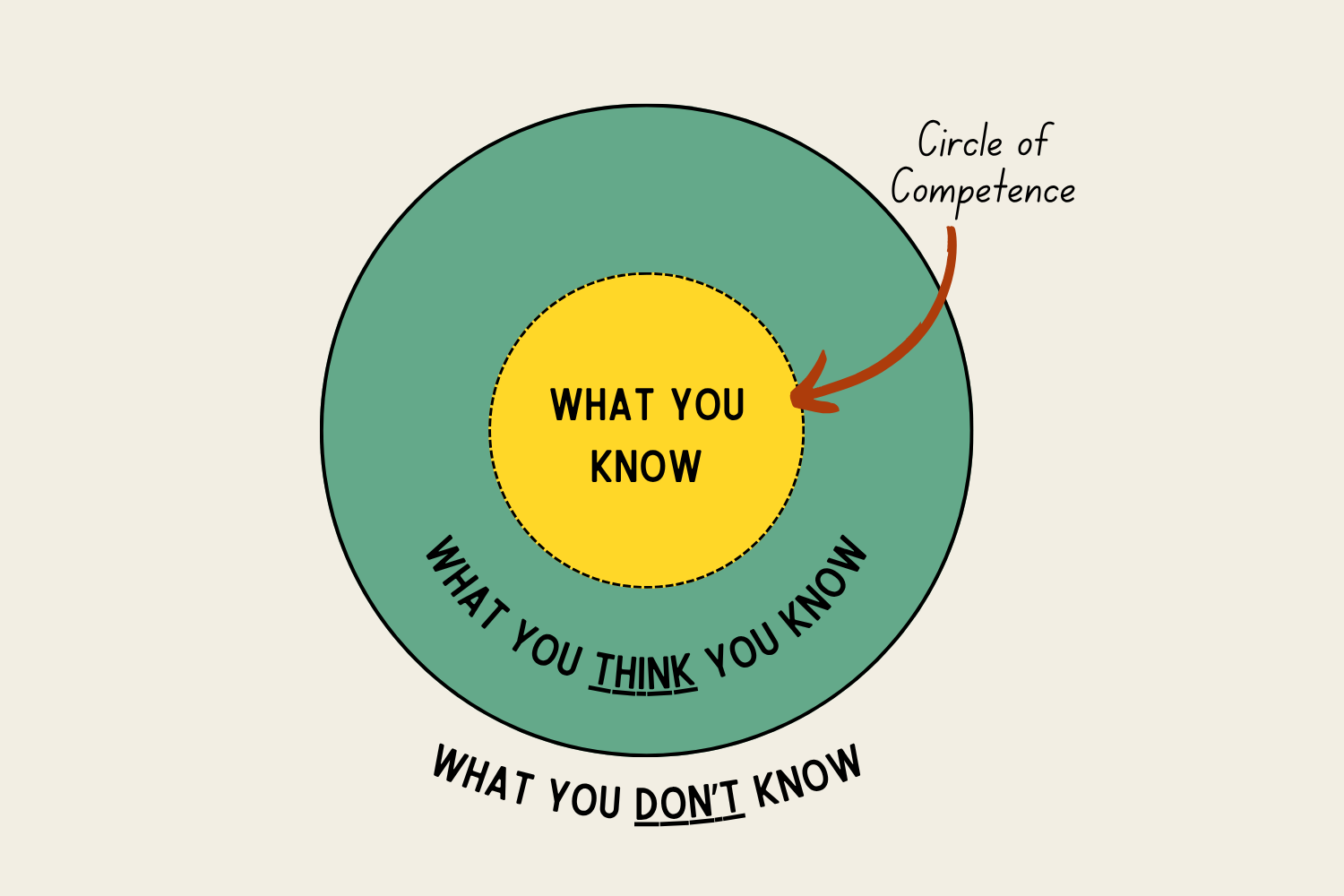
Circle of Competence
Buffett and Munger's model for knowing exactly where your understanding ends — size doesn't matter, honesty about the edge does.

EQ Framework
A 2x2 of emotional intelligence — self or social, noticing or acting — giving four skills: self-awareness, self-management, social awareness, relationship management.

Johari Window
A 2x2 mapping what you know about yourself against what others know — exposing blind spots, building trust through disclosure.
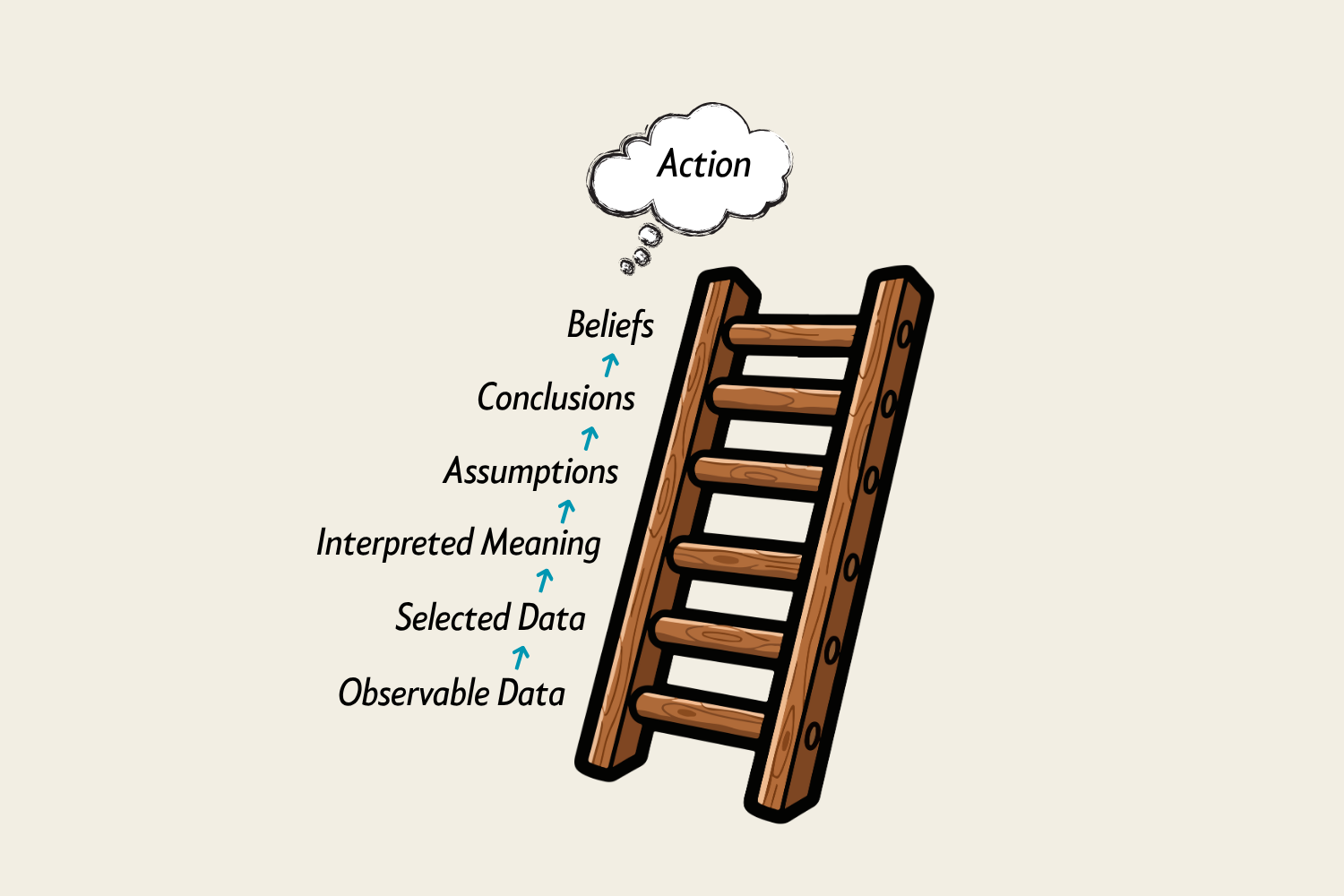
Ladder of Inference
Your mind turns a fact into belief through selection and assumption — you end up arguing with a story, not reality.

The Four Temperaments
An ancient personality model — Sanguine, Choleric, Melancholic, Phlegmatic — a fast vocabulary for reading your style, your team, and your boss.