Emotional Intelligence 2.0
Travis Bradberry & Jean Greaves
The practical, test-and-strategies follow-up to the emotional intelligence conversation: less theory, more "here's exactly what to do on Tuesday," built around four skills you can actually practice and measure.
 Find this on the mind-map
Introduction
Where the original emotional intelligence research established that EQ matters, Bradberry and Greaves's book is deliberately built as the practitioner's manual: a structured self-assessment paired with a long list of specific, repeatable strategies for improving each component. The underlying claim that makes the whole approach worth taking seriously is that emotional intelligence, unlike IQ, is substantially trainable. It moves with deliberate practice in a way raw intellect mostly doesn't, which is the whole justification for a workbook instead of just a theory.
The Four-Skill Model
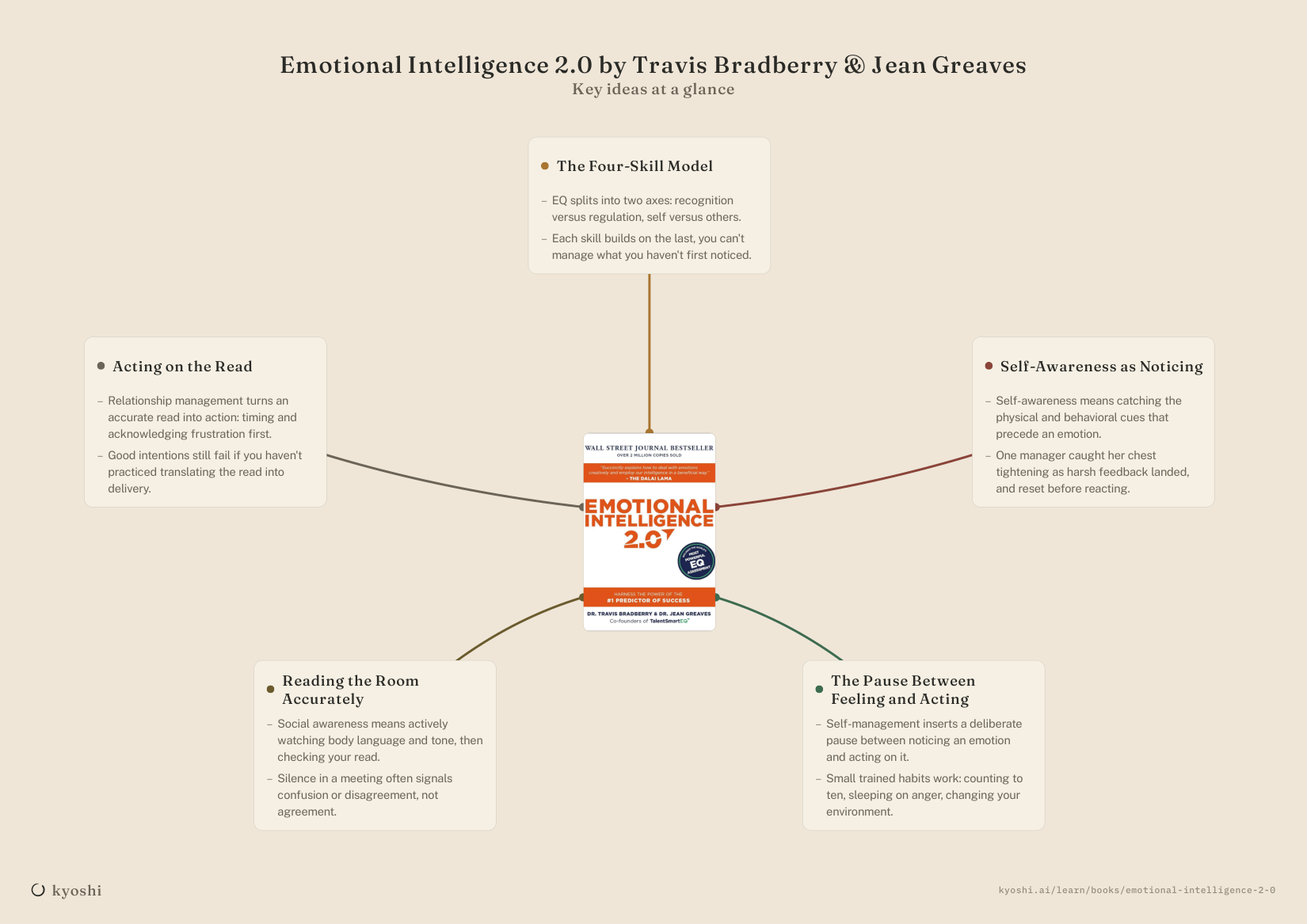
The book organizes emotional intelligence into four skills arranged on two axes, recognition versus regulation, and self versus others: self-awareness (recognizing your own emotions), self-management (regulating your own emotions and behavior), social awareness (recognizing what others are feeling), and relationship management (using that awareness to handle interactions well). The ordering is deliberate and sequential: you largely can't manage what you haven't first noticed, and you can't manage a relationship well without an accurate read of what the other person is experiencing.
Self-Awareness as a Discipline of Noticing
The book pushes self-awareness past "know your personality" into something closer to a repeatable practice: noticing your emotional reactions in the moment, and specifically noticing the physical and behavioral patterns that tend to precede them. Two managers get the same piece of harsh client feedback. One notices only after the fact that she snapped at her team all afternoon. The other catches the tightness in her chest right when the email lands, names it, and consciously resets before her next interaction. Both had the same trigger; only one had built the habit of catching it early enough to matter.
Self-Management: The Pause Between Feeling and Acting
Self-management, in this model, is the practiced skill of inserting a deliberate pause between noticing an emotion and acting on it. The point isn't eliminating the emotion, but choosing the response instead of defaulting to the reflex. The book frames this as trainable through small, specific habits: counting to ten before replying to a provocative message, sleeping on a decision made in anger, physically changing your environment when you notice you're escalating. None of these are clever. The book's bet is that unglamorous and repeated beats clever and occasional.
Social Awareness: Reading the Room Accurately
Social awareness is presented as an active skill of observation rather than a passive trait some people have and others don't: watching body language, tone, and what's left unsaid, and checking your read rather than assuming it. A common failure mode the book calls out: assuming someone's silence in a meeting means agreement, when it might mean confusion, disengagement, or disagreement nobody's asked about.
Relationship Management: Acting on the Read, Not Just Having It
The final skill is turning an accurate emotional read into an effective interaction: timing a hard conversation well, acknowledging someone's frustration before addressing the content of it, adjusting your delivery to the person rather than defaulting to one style for everyone. The book treats this as the place where good intentions most often fail in practice: a manager can be self-aware and socially perceptive and still handle the actual conversation badly if they haven't practiced translating the read into action.
Putting It Together
The four skills are deliberately sequential and mutually reinforcing: self-awareness feeds self-management (you can't regulate what you haven't noticed), and social awareness feeds relationship management (you can't handle an interaction well without first reading it accurately). The book's real contribution isn't a new theory of emotional intelligence. It's the insistence that each of these four skills is a specific, practicable habit, not a trait you either have or lack.
Why It Matters for Leaders
The gap this book is trying to close is the one between "I know I should manage my reactions better" and actually doing it on a Tuesday afternoon when someone sends you a sharp email. Most managers already believe self-awareness and empathy matter. What they don't have is a repeatable move for the moment it counts.
The most useful habit to borrow is the deliberate pause: noticing the emotion, then inserting a beat before you act on it, instead of reacting straight out of it. Practically, that could be as plain as not replying to a heated message for an hour, or taking one slow breath before you speak in a meeting that just went sideways. It feels almost too small to matter. The book's bet, and a reasonable one, is that small and repeated beats clever and occasional.
The social-awareness piece is where a lot of managers fall short without ever noticing. It's easy to run a meeting, ask "any questions," hear silence, and move on, reading that silence as agreement. The more accurate habit is to ask a direct follow-up of the quietest person in the room, because silence just as often means confusion or disengagement as it means buy-in.
Picture a manager, Alicia, who considers herself even-tempered and gets genuinely surprised when a round of 360 feedback comes back saying her team finds her hard to read in tense moments. She doesn't yell or lose her composure. But she also never names what she's feeling out loud, never checks how a hard message landed, and defaults to the same flat delivery with everyone on her team regardless of how they take feedback. Alicia isn't short on emotional intelligence. She's short on the specific, practiced habits that would let her actually use it.
What to do next
Reinforce your understanding of Emotional Intelligence 2.0
Books related to Emotional Intelligence 2.0

Emotional Intelligence
Daniel Goleman's case that how you handle emotion, your own and everyone else's, predicts success better than raw intellect. The book that put "EQ" into every manager's vocabulary, for good reason.

Primal Leadership
The case that a leader's mood isn't a private matter. It's contagious through the whole team, which makes emotional intelligence the real infrastructure underneath every other leadership skill.

Stillness Is the Key
Ryan Holiday's case that the people who handle pressure, power, and chaos best aren't the busiest or the most driven, they're the ones who've built real stillness into their mind, body, and sense of purpose, usually against the current of everything around them.

The Daily Stoic
A year of short, daily meditations drawn from Marcus Aurelius, Seneca, and Epictetus, organized into one practical claim: the ancient Stoics weren't writing philosophy for philosophers. They were writing a manual for getting through hard days without losing yourself.

Think Again
Adam Grant's case that rethinking, actually changing your mind when the facts say you should, is a skill most smart people are terrible at, and a direct challenge to any manager who treats changing position as a sign of weakness.
Skills related to Emotional Intelligence 2.0

Frameworks related to Emotional Intelligence 2.0
Circle of Competence
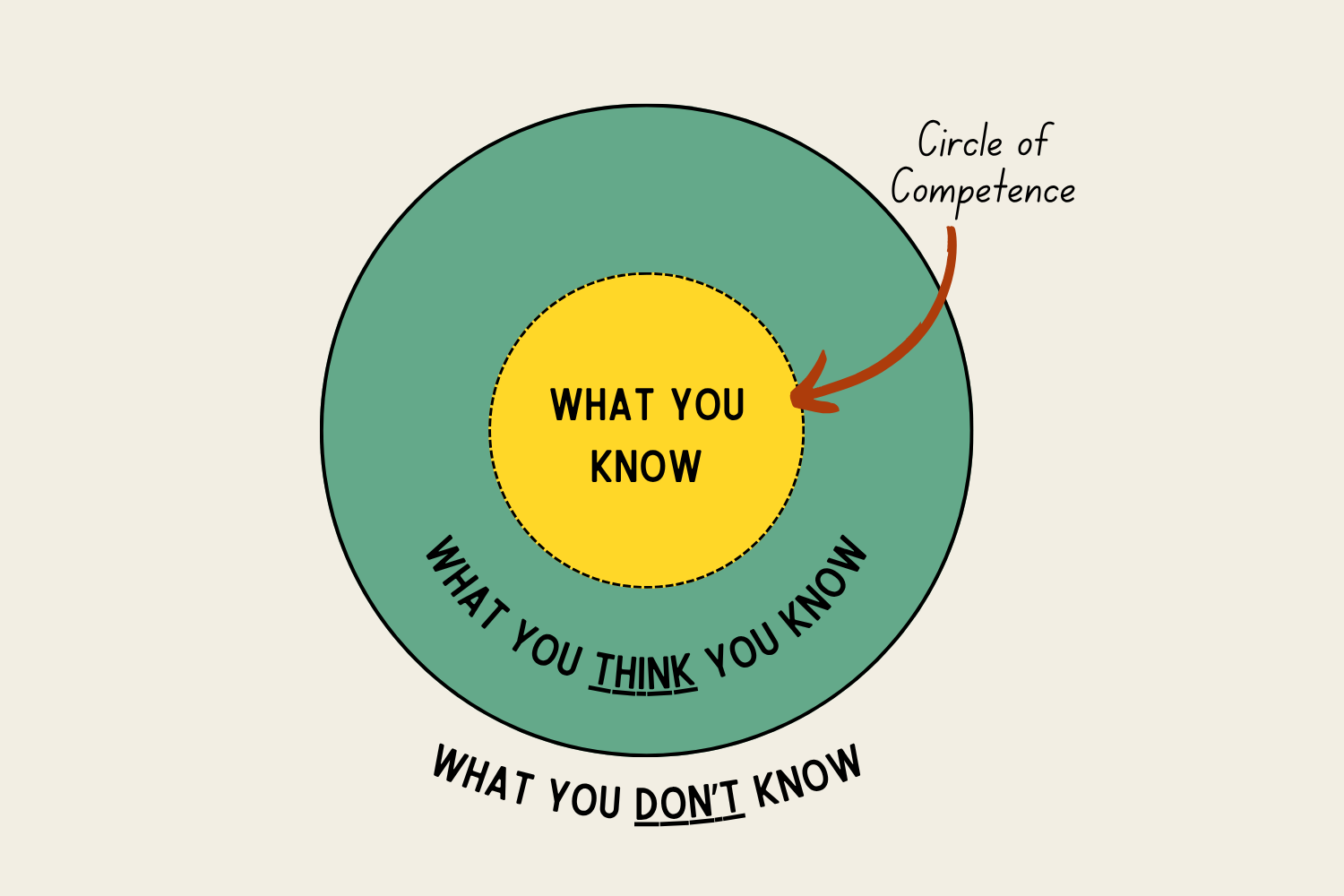
Buffett and Munger's model for knowing exactly where your understanding ends — size doesn't matter, honesty about the edge does.

EQ Framework
A 2x2 of emotional intelligence — self or social, noticing or acting — giving four skills: self-awareness, self-management, social awareness, relationship management.

Johari Window
A 2x2 mapping what you know about yourself against what others know — exposing blind spots, building trust through disclosure.
Ladder of Inference
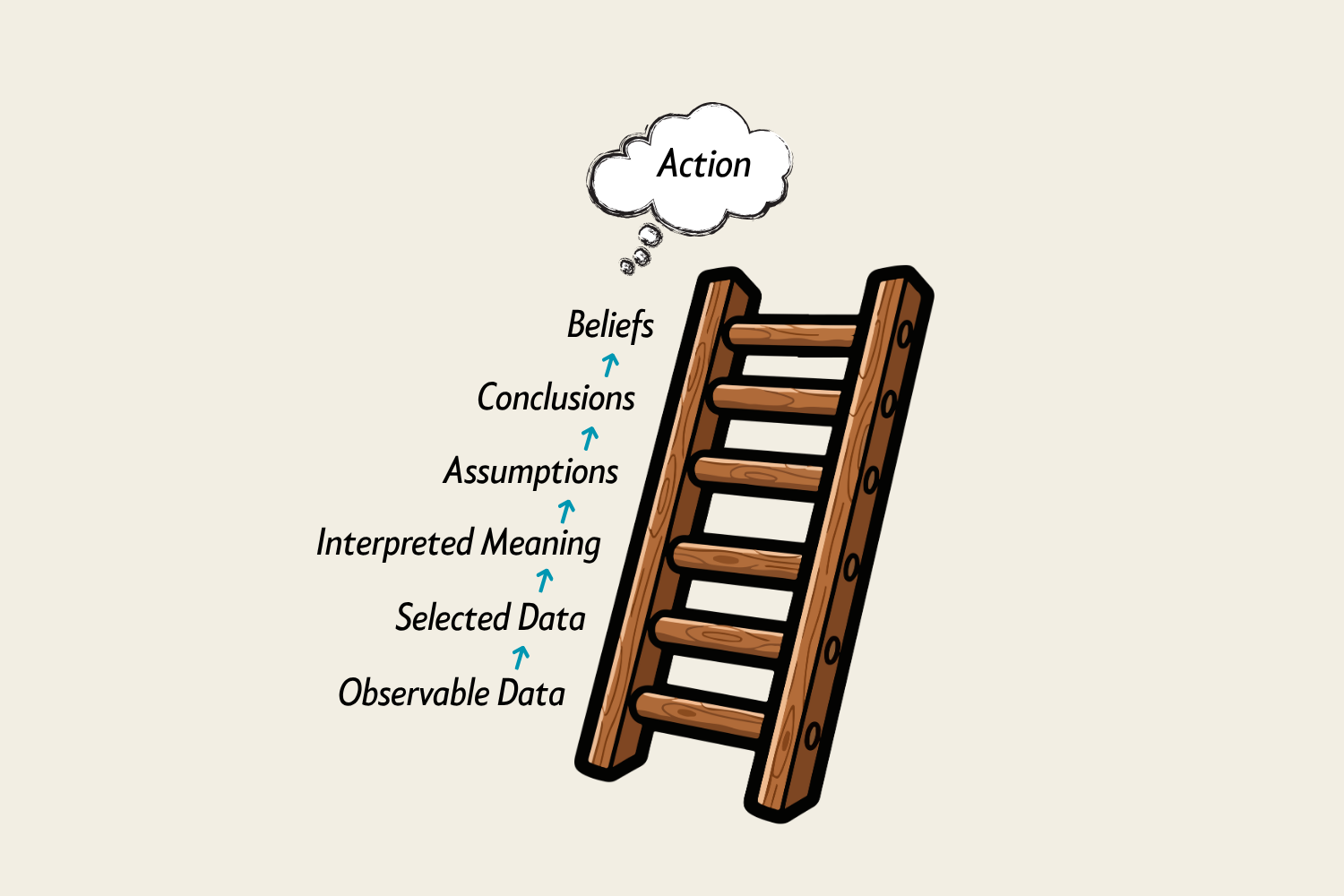
Your mind turns a fact into belief through selection and assumption — you end up arguing with a story, not reality.

The Four Temperaments
An ancient personality model — Sanguine, Choleric, Melancholic, Phlegmatic — a fast vocabulary for reading your style, your team, and your boss.