Ladder of Inference
Your mind turns a fact into belief through selection and assumption — you end up arguing with a story, not reality.
 Find this on the mind-map
Introduction
Organizational psychologist Chris Argyris spent decades studying why smart, well-intentioned people talk past each other in meetings. His answer was that nobody actually reacts to what happens — they react to a chain of quiet, fast jumps their own mind makes first. Peter Senge picked up the idea and gave it its name and shape in his 1990 book The Fifth Discipline, and it has stuck around ever since because it names something everyone has felt: the moment you go from "here's what happened" to "here's what it means" without ever noticing the jump.
Here's the core claim: you don't respond to raw facts. You respond to a story you build in a fraction of a second, and by the time you feel the reaction, you're already standing several rungs up a ladder, reacting to a belief you constructed yourself out of a thin slice of what actually happened.
How It Works
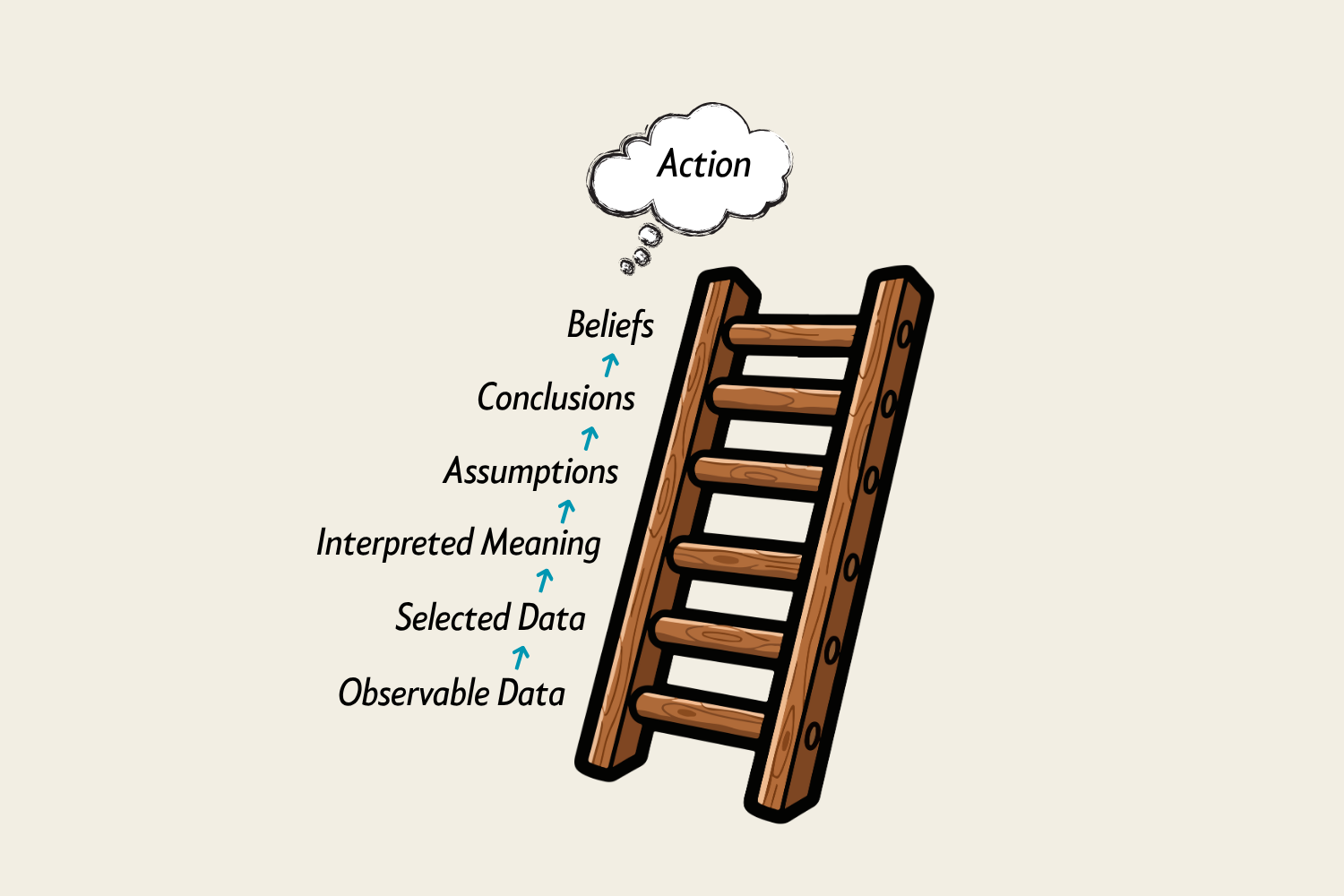
Picture the climb as six rungs you go up without noticing, ending in an action you take.
| Rung | The question | Worked example: a manager replies "Let's discuss." to a proposal |
|---|---|---|
| 1. Observable data | What would a camera have recorded? | The manager typed "Let's discuss." That is all that happened. |
| 2. Selected data | What did you notice, and what did you filter out? | Noticed: the message was short and unenthusiastic. Filtered out: he replied within the hour, which suggests he read it closely. |
| 3. Interpreted meaning | What meaning did you attach to what you selected? | "No enthusiasm" became "he found a problem with it." |
| 4. Assumptions | What are you assuming that you have not checked? | A standing worry that the proposal was more ambitious than practical filled the gap. |
| 5. Conclusions | What verdict did you land on? | "He is going to say no, or water it down." |
| 6. Beliefs | What standing belief is that verdict now feeding? | The idea is dead on arrival. |
| Action | What did you do? | Rehearsed a defence and braced for pushback. |
Turns out the proposal was fine — the manager just wanted five minutes to talk through timing before it went upward. Nothing about the situation changed between the email landing and the conversation the next morning. Only the reading of it did.
The climb takes seconds. Coming back down takes a conscious decision to look again. That gap — fast up, slow down — is the whole practical problem with this model, and it's the reason you can build an entire narrative in your head before lunch that has nothing to do with what's actually going on.
Why It Matters for Leaders
You run on interpretation all day. Most of your job is short messages, quick reactions, and partial context — exactly the raw material the ladder feeds on.
It shows up in three places you'll recognize immediately. In feedback conversations, a flat tone reads as resistance when it's usually just fatigue or nerves. In cross-team friction, "they're blocking us on purpose" is almost always an assumption built on a missed Slack message or a different set of priorities you never saw. In remote and async work, you have less real data to select from, so you climb faster and land further from the truth.
The pattern underneath all three: the less context you have, the faster you climb — and the more confident you feel doing it.
The stakes go up the moment a belief lands in a permanent record. Picture this: you're running a skip-level with a senior engineer. He pauses before answering, and defers a couple of times with "let me think about that." You walk away with a private read that he's not strategic enough for the next level, and you nearly write it into calibration notes — until you check your own rungs and realize he actually has strong opinions, he just doesn't voice them on the spot.
Or this one: you're a product manager convinced a platform team is deprioritizing your roadmap out of politics, after two sprints of slow responses. You're one Slack message away from escalating to your VP. Turns out that team has been buried in incident response for three straight weeks — completely invisible from where you're sitting.
Most of your leadership mistakes won't come from bad intent. They'll come from the gap between what actually happened and what you decided it meant. The same pattern plays out at the group level too, in the Abilene Paradox, where a whole room climbs separate ladders about what everyone else is thinking and lands on the same wrong conclusion together.
What to do next
Test your knowledge of Ladder of Inference
Practice Ladder of Inference
Apply Ladder of Inference to a real situation
Skills related to Ladder of Inference

Self-Awareness
Knowing your own strengths, blind spots, and emotional patterns — and knowing how they actually land on the people around you.

Self-Management
Managing your own emotional reactions — especially fear and insecurity — so they stop quietly driving your behavior under pressure.
Frameworks related to Ladder of Inference
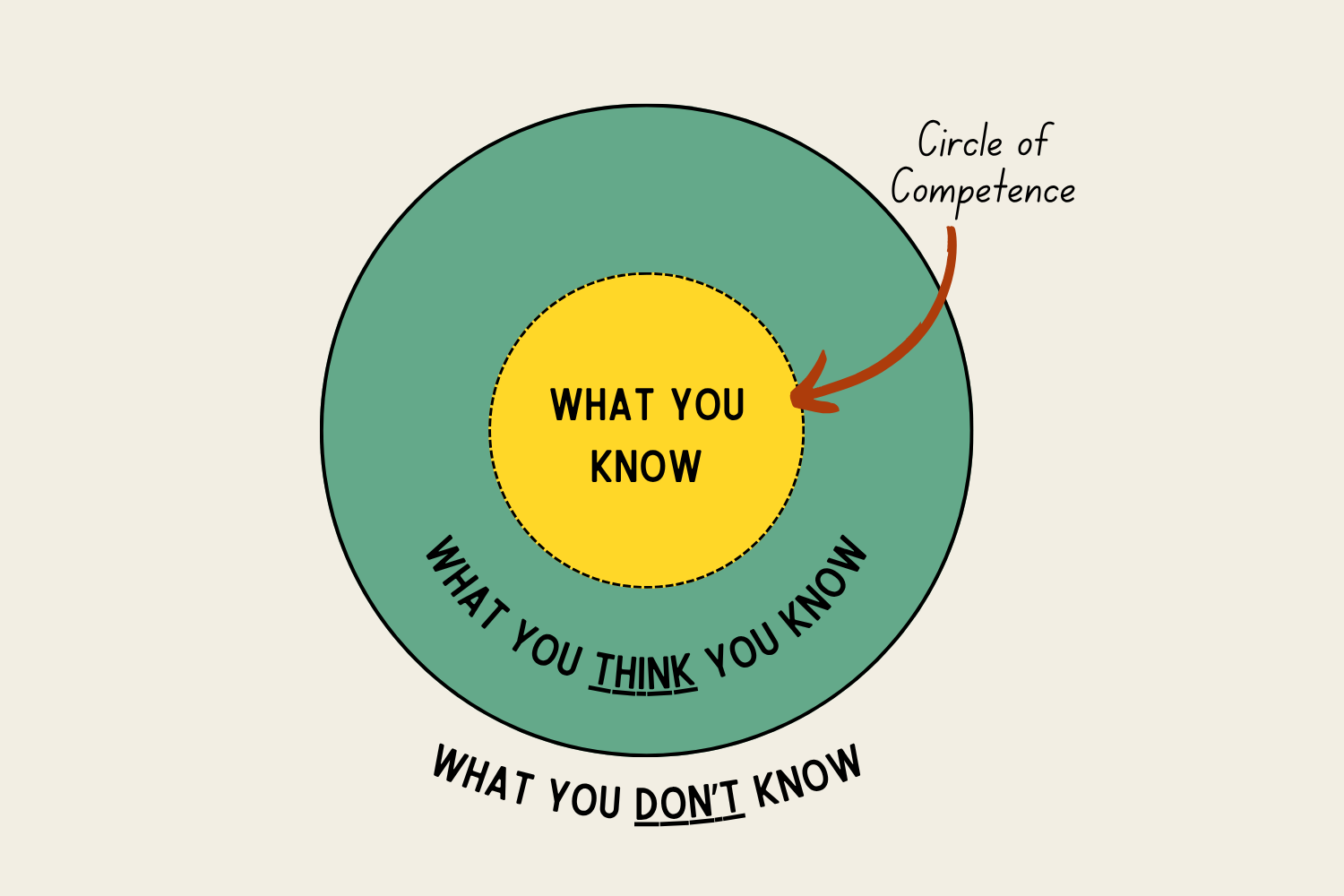
Circle of Competence
Buffett and Munger's model for knowing exactly where your understanding ends — size doesn't matter, honesty about the edge does.
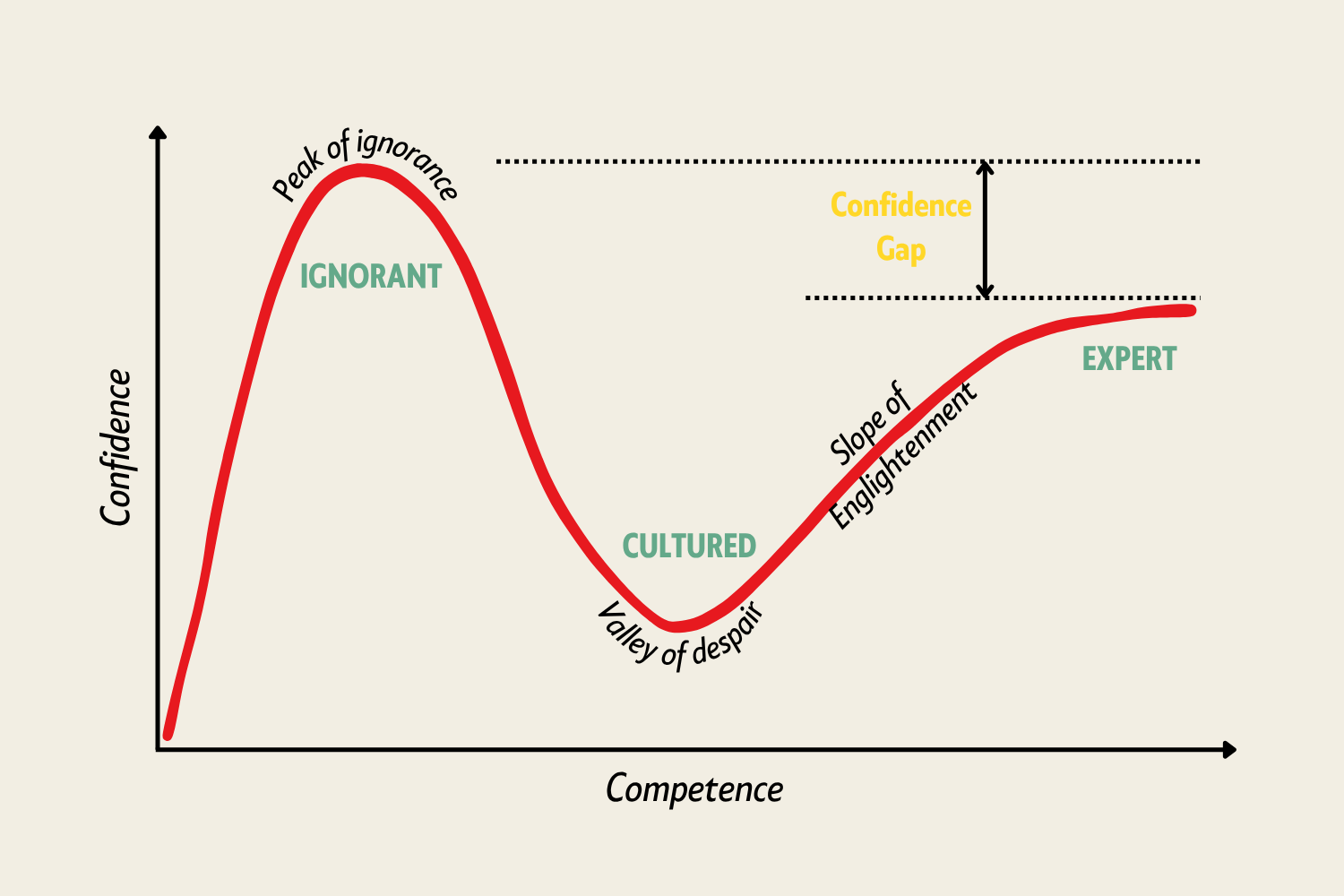
Dunning-Kruger Effect
Knowing little makes you feel unstoppable; knowing more makes you hesitate — the loudest voice is rarely the most reliable one.

EQ Framework
A 2x2 of emotional intelligence — self or social, noticing or acting — giving four skills: self-awareness, self-management, social awareness, relationship management.

Johari Window
A 2x2 mapping what you know about yourself against what others know — exposing blind spots, building trust through disclosure.

The Four Temperaments
An ancient personality model — Sanguine, Choleric, Melancholic, Phlegmatic — a fast vocabulary for reading your style, your team, and your boss.

The Insecurity Loop
A model of how insecurity, disguised as ego, shame, or control, drives a self-feeding cycle that pushes your team away.

The Leadership Code
Leadership runs on three traits — head, gut, heart — each toxic alone: competence without character is arrogance, courage without it reckless.

The Pygmalion Effect
What you expect from someone leaks into how you treat them, which shapes what they become — for better or worse.

The Three Brains Framework
Three systems compete to drive your response — reactive, emotional, thinking. Pause, align, choose — that's how you decide which one leads.
Books related to Ladder of Inference

Burnout
The Nagoski sisters' sharp distinction between a stressor and the stress itself, and why removing the stressor from your life doesn't automatically get the stress out of your body. A rethink for any manager who treats "just manage your workload better" as the fix.

Crucial Conversations
A manager's guide to the book about the story you make up before you open your mouth. It's not really a book about talking, but about the half-second before you talk that decides whether the conversation goes well or badly.

Emotional Intelligence
Daniel Goleman's case that how you handle emotion, your own and everyone else's, predicts success better than raw intellect. The book that put "EQ" into every manager's vocabulary, for good reason.

Emotional Intelligence 2.0
The practical, test-and-strategies follow-up to the emotional intelligence conversation: less theory, more "here's exactly what to do on Tuesday," built around four skills you can actually practice and measure.

Four Thousand Weeks
Oliver Burkeman's blunt reminder that the average human life is about four thousand weeks long, and that every productivity system built to escape that limit is making the anxiety worse, not better.

Grit
Angela Duckworth's research-backed case that sustained passion and perseverance beat raw talent, a useful gut-check for any manager who keeps betting on the "naturally gifted" hire over the stubborn one.

Hidden Potential
Adam Grant's argument that where you start matters far less than how far you're willing to grow, and that the character skills enabling that growth are learnable, not innate, no matter how your scorecard looks on day one.

Mindset
Carol Dweck's research on why some people treat ability as fixed and others treat it as something built, and why the belief you hold about yourself shapes how your whole team learns, fails, and improves, often without anyone noticing it happening.

Primal Leadership
The case that a leader's mood isn't a private matter. It's contagious through the whole team, which makes emotional intelligence the real infrastructure underneath every other leadership skill.

Rest
Alex Soojung-Kim Pang's argument that rest isn't the opposite of great work. It's part of how great work gets made. A useful corrective for any manager who treats recovery as what's left over after hustle.

Slow Productivity
Cal Newport's challenge to "busy equals productive": a case that most knowledge work rewards visible activity over actual output, and a different model built on doing less, at a sustainable pace, to a genuinely higher standard.

Stillness Is the Key
Ryan Holiday's case that the people who handle pressure, power, and chaos best aren't the busiest or the most driven, they're the ones who've built real stillness into their mind, body, and sense of purpose, usually against the current of everything around them.

Stolen Focus
Johann Hari's argument that your attention problem probably isn't a personal willpower failure, it's a predictable outcome of systems deliberately engineered to fragment it. Uncomfortable reading for any manager who's told a struggling employee to "just focus better."

The 5AM Club
Robin Sharma's parable-driven case for owning the first hour of your day before the world gets a vote. Less about waking up early for its own sake, and more about who's actually running your mornings.

The 7 Habits of Highly Effective People
Stephen Covey's classic, read through a modern-manager lens. Many of the ideas taught today as "new" leadership frameworks were already captured here decades ago.

The Daily Stoic
A year of short, daily meditations drawn from Marcus Aurelius, Seneca, and Epictetus, organized into one practical claim: the ancient Stoics weren't writing philosophy for philosophers. They were writing a manual for getting through hard days without losing yourself.

The Obstacle Is the Way
Ryan Holiday's modern take on Stoic philosophy, built around a single claim: the obstacle in front of you isn't blocking the path, it is the path. A sharp antidote to managers who treat setbacks as proof the plan was wrong.

Think Again
Adam Grant's case that rethinking, actually changing your mind when the facts say you should, is a skill most smart people are terrible at, and a direct challenge to any manager who treats changing position as a sign of weakness.

Triggers
Executive coach Marshall Goldsmith's case that you don't fail to become the leader you intend to be because of weak character. You fail because your environment is triggering the wrong behavior all day without much notice, and nobody built a structure to catch it.

When the Body Says No
Gabor Maté's case, drawn from decades of clinical practice, that chronically suppressing your own needs and emotions to keep the peace has a real physical cost. A hard look at the leader who's never once said no and wears it as a point of pride.

Wintering
Katherine May's case that the fallow, difficult stretches of life, a loss, a burnout, an illness, a plain bad year, aren't failures to snap out of, but seasons with their own logic. An uncommon lens for leaders who treat every low point as a problem to solve away fast.