The 7 Habits of Highly Effective People
Stephen Covey's classic, read through a modern-manager lens. Many of the ideas taught today as "new" leadership frameworks were already captured here decades ago.
 Find this on the mind-map
Introduction
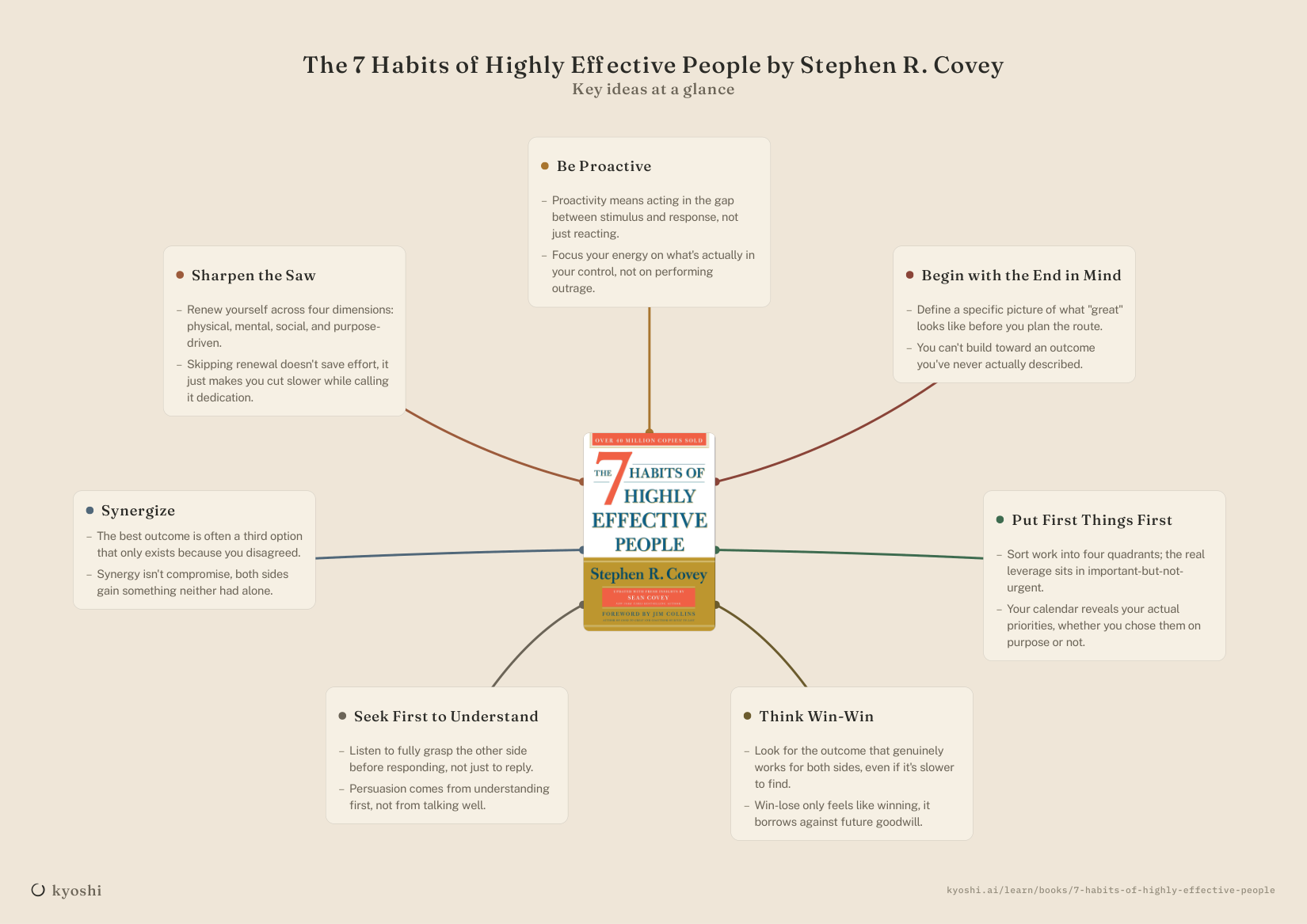
Many of the ideas now taught as modern leadership frameworks and strategies were already captured in this book decades ago. Covey's seven habits build in order: the first three are about mastering yourself, the next three are about working with others, and the seventh renews all six.
Habit 1: Be Proactive
Proactivity isn't optimism. It's the gap between stimulus and response, and the discipline to act inside that gap instead of just reacting. Being upset about bad news is fine. The habit isn't "stay positive," it's this: control what's yours, and stop spending your only real leverage, your response, on performing outrage over what isn't yours to control.
Habit 2: Begin with the End in Mind
Most managers can describe, in detail, what's broken about their team right now. Few can describe what "great" looks like six months from now. Covey's second habit says define the destination before you plan the route. Not a vague vision statement, but a real, specific picture of the outcome you're building toward. You can't build toward an outcome you've never actually described.
Habit 3: Put First Things First
"Important" and "urgent" work can look deceptively similar. Covey's time management matrix sorts everything into four quadrants: urgent/important, not-urgent/important, urgent/not-important, not-urgent/not-important. Most real leverage lives in the second quadrant: important but not urgent. Nobody forces you into it; you have to choose it, daily, or it never happens. Your calendar isn't a record of your priorities. It's a record of what you decided was important, whether you did it on purpose or not.
Habit 4: Think Win-Win
Win-lose thinking wrecks more working relationships, slowly and without much notice, than any single bad decision does. Win-win means genuinely looking for the version of the outcome that works for both sides, even if it takes longer to find. Win-lose can feel like winning in the moment, but it's really just borrowing against next month's or next quarter's goodwill.
Habit 5: Seek First to Understand, Then to Be Understood
Most feedback conversations fail before a word is said, because the other person walks in already knowing what they're going to say. This habit asks for the opposite: understand fully before you respond at all. Not listening so you can respond, but listening so you could accurately restate the other person's position before offering your own. You're persuasive not because you talk well, but because you understood first.
Habit 6: Synergize
The best outcome usually isn't your idea or their idea. It's a third option that only exists because you disagreed first. Synergy isn't compromise, because compromise implies both sides lose a little. Synergy means the disagreement itself produced something neither side had on their own.
Habit 7: Sharpen the Saw
The habit every burned-out manager skips first and needs most: renewal, across four dimensions: physical, mental, social/emotional, and "spiritual" (the sense that your work connects to something you actually value). Many managers only notice the physical dimension, and only once it's already failing. You don't get credit for the saw that never gets sharpened. You just cut slower, with more effort, and call it dedication.
Putting It Together
- Habits 1–3 are about mastering yourself (Be Proactive, Begin with the End in Mind, Put First Things First).
- Habits 4–6 are about working with others (Think Win-Win, Seek First to Understand, Synergize).
- Habit 7 renews all six.
Effectiveness was never about doing more. The whole argument, decades on, is still just: know what matters, and stop pretending you don't.
Why It Matters for Leaders
Most of these habits sound obvious once you hear them, which is exactly why managers skip them. Nobody disputes that you should know your priorities or listen before responding. The problem is that knowing a habit and running it under pressure are two different skills, and pressure is where most managers actually operate.
Here's the practical test: when a deadline moves or a budget gets cut, do you default to reacting, or do you still ask what's actually in your control? That's Habit 1, and it's the one that decides whether a bad week turns into a bad month. The managers who hold onto the first three habits under stress are the ones whose teams can still tell, in the middle of a crisis, what the plan actually is.
The second three habits show up differently, usually in conflict. A manager who skips Habit 5 walks into a disagreement already rehearsing a counterargument, and the other person can tell. A manager who never reaches for Habit 6 treats every disagreement as something to manage down to a compromise, instead of a chance to find an option neither side had on the table. Both habits cost nothing to practice and get skipped constantly, because listening fully and looking for a third option both take longer than just picking a side.
Take a manager named Dana, two weeks from a product deadline, with one engineer insisting the timeline is unrealistic and another insisting it's fine. Dana's instinct is to split the difference, push the deadline back by a week, and call it settled. Habit 6 asks a different question first: is there a version of this neither of them has proposed yet, maybe cutting scope on one feature instead of extending time on all of them? She asks the question, and the engineer who wanted more time ends up proposing the cut himself. That's the habit working, not a lucky meeting.
What to do next
Reinforce your understanding of The 7 Habits of Highly Effective People
Books related to The 7 Habits of Highly Effective People

Burnout
The Nagoski sisters' sharp distinction between a stressor and the stress itself, and why removing the stressor from your life doesn't automatically get the stress out of your body. A rethink for any manager who treats "just manage your workload better" as the fix.

Crucial Conversations
A manager's guide to the book about the story you make up before you open your mouth. It's not really a book about talking, but about the half-second before you talk that decides whether the conversation goes well or badly.

Difficult Conversations
The Harvard Negotiation Project's case that every hard conversation you're avoiding is actually three conversations tangled together: a dispute over facts, a buried argument about feelings, and a quiet question about identity, and most people only ever engage the first one.

Four Thousand Weeks
Oliver Burkeman's blunt reminder that the average human life is about four thousand weeks long, and that every productivity system built to escape that limit is making the anxiety worse, not better.

Games People Play
The psychiatrist who invented Transactional Analysis, explaining why so many conversations at work are really scripted performances with a hidden payoff. It's a guide to spotting the game before you're cast in a role you didn't agree to.

Getting to Yes
The original Harvard Negotiation Project playbook. Negotiate on interests and objective standards instead of trading positions back and forth, and you stop needing to choose between being "nice" and getting a good outcome.

Give and Take
Adam Grant's organizational-psychology case that how you handle reciprocity, giving, taking, or matching, predicts long-run success better than talent does, as long as you give the right way.

Good Leaders Ask Great Questions
John Maxwell's case that the single clearest sign a leader has stopped growing is that they've stopped asking real questions, and that the habit of asking, not the gift of answering, is what keeps a leader's judgment sharp over time.

Grit
Angela Duckworth's research-backed case that sustained passion and perseverance beat raw talent, a useful gut-check for any manager who keeps betting on the "naturally gifted" hire over the stubborn one.

Hidden Potential
Adam Grant's argument that where you start matters far less than how far you're willing to grow, and that the character skills enabling that growth are learnable, not innate, no matter how your scorecard looks on day one.

How to Win Friends and Influence People
The original relationship-building classic, decades before "emotional intelligence" had a name. Carnegie's bet is that nearly every influence problem is actually an ego-management problem, yours and theirs.

Influence
A social psychologist's field guide to the handful of automatic triggers that make people say yes, written so you can recognize them when they're used on you, and use them honestly when you're the one asking.

Leadership is Language
David Marquet's argument, built from his time commanding a nuclear submarine, that the exact words a leader habitually uses either keep an organization stuck in command-and-control execution mode or genuinely open it up to better thinking. Most leaders have no idea which one their default language is doing.

Made to Stick
Why urban legends, conspiracy theories, and your most forgettable all-hands deck follow completely different rules, and the six ingredients Chip and Dan Heath found in every idea that actually sticks in people's heads, whether or not it deserves to.

Mindset
Carol Dweck's research on why some people treat ability as fixed and others treat it as something built, and why the belief you hold about yourself shapes how your whole team learns, fails, and improves, often without anyone noticing it happening.

Never Split the Difference
A former FBI lead hostage negotiator's case against "splitting the difference," negotiation isn't a logic problem you solve at the table, it's an emotional one you solve before you ever get there.

Quiet
Susan Cain's case against the modern workplace's "Extrovert Ideal": the unexamined assumption that the loudest, fastest-talking, most group-comfortable person in the room is automatically the most capable one, and what gets lost, specifically, when organizations build around that assumption.

Radical Candor
Kim Scott's case that most managers who avoid giving hard feedback think they're being kind, and are actually doing the least kind thing possible, because withheld feedback doesn't disappear, it just shows up later as a surprise.

Rest
Alex Soojung-Kim Pang's argument that rest isn't the opposite of great work. It's part of how great work gets made. A useful corrective for any manager who treats recovery as what's left over after hustle.

Slow Productivity
Cal Newport's challenge to "busy equals productive": a case that most knowledge work rewards visible activity over actual output, and a different model built on doing less, at a sustainable pace, to a genuinely higher standard.

Stillness Is the Key
Ryan Holiday's case that the people who handle pressure, power, and chaos best aren't the busiest or the most driven, they're the ones who've built real stillness into their mind, body, and sense of purpose, usually against the current of everything around them.

Stolen Focus
Johann Hari's argument that your attention problem probably isn't a personal willpower failure, it's a predictable outcome of systems deliberately engineered to fragment it. Uncomfortable reading for any manager who's told a struggling employee to "just focus better."

Surrounded by Idiots
A blunt, color-coded field guide to why the person across the table from you seems to be speaking a different language, because, behaviorally, they basically are.

The 16 Undeniable Laws of Communication
John Maxwell's case that communication is not a personality trait some leaders are simply born with, it's sixteen learnable, named laws, grouped around who's speaking, what's said, how it's said, when it's said, and why it's said.

The 48 Laws of Power
Robert Greene's amoral compendium of how power actually moves through organizations and courts, stripped of any pretense that fairness or merit is what decides who wins. Useful as a decoder, dangerous as a playbook.

The 5AM Club
Robin Sharma's parable-driven case for owning the first hour of your day before the world gets a vote. Less about waking up early for its own sake, and more about who's actually running your mornings.

The Daily Stoic
A year of short, daily meditations drawn from Marcus Aurelius, Seneca, and Epictetus, organized into one practical claim: the ancient Stoics weren't writing philosophy for philosophers. They were writing a manual for getting through hard days without losing yourself.

The Obstacle Is the Way
Ryan Holiday's modern take on Stoic philosophy, built around a single claim: the obstacle in front of you isn't blocking the path, it is the path. A sharp antidote to managers who treat setbacks as proof the plan was wrong.

Triggers
Executive coach Marshall Goldsmith's case that you don't fail to become the leader you intend to be because of weak character. You fail because your environment is triggering the wrong behavior all day without much notice, and nobody built a structure to catch it.

When the Body Says No
Gabor Maté's case, drawn from decades of clinical practice, that chronically suppressing your own needs and emotions to keep the peace has a real physical cost. A hard look at the leader who's never once said no and wears it as a point of pride.

Wintering
Katherine May's case that the fallow, difficult stretches of life, a loss, a burnout, an illness, a plain bad year, aren't failures to snap out of, but seasons with their own logic. An uncommon lens for leaders who treat every low point as a problem to solve away fast.
Skills related to The 7 Habits of Highly Effective People

Communication & Influence
Using narrative, story, and structure to inspire, align, and actually move people, not just inform them.

Self-Management
Managing your own emotional reactions — especially fear and insecurity — so they stop quietly driving your behavior under pressure.
Frameworks related to The 7 Habits of Highly Effective People
Aristotle's Rhetoric
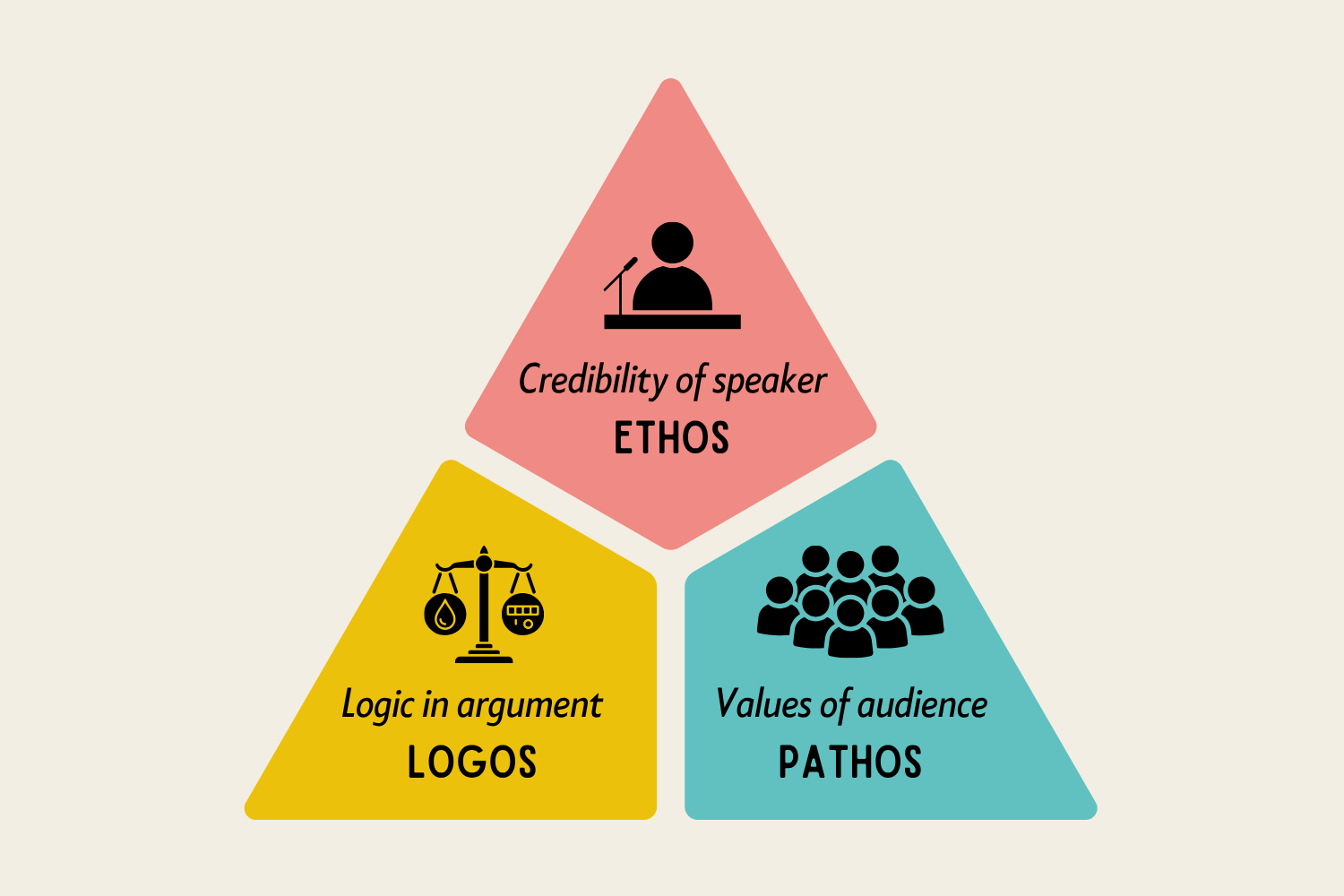
Aristotle's persuasion rests on three appeals — ethos (credibility), pathos (emotion), logos (logic) — use all three or your message won't land.
Cleverness to Clarity
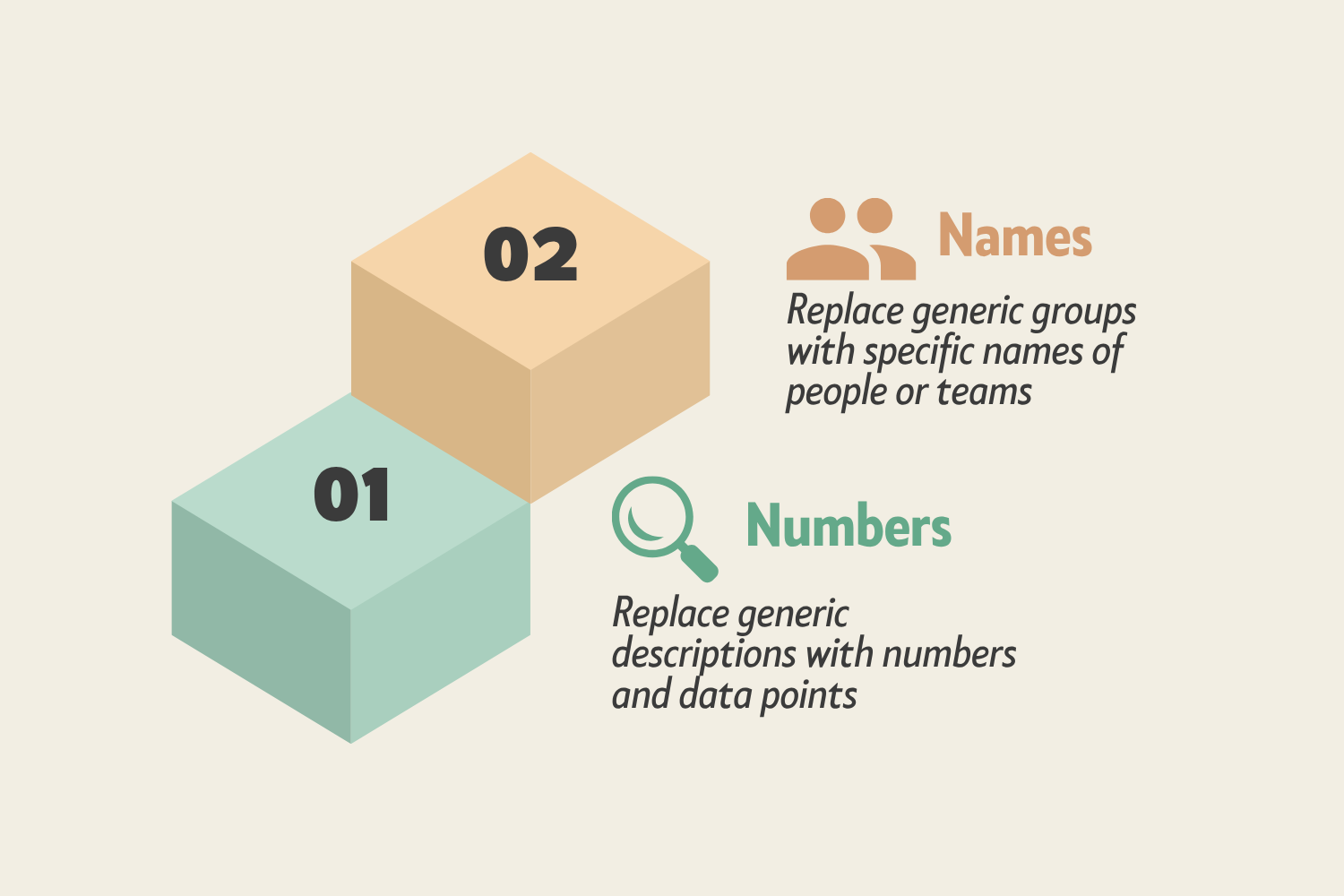
Drop corporate jargon for clear, direct language — three reasons (trust, speed, growth) and the 2N Formula for doing it.
Dunning-Kruger Effect
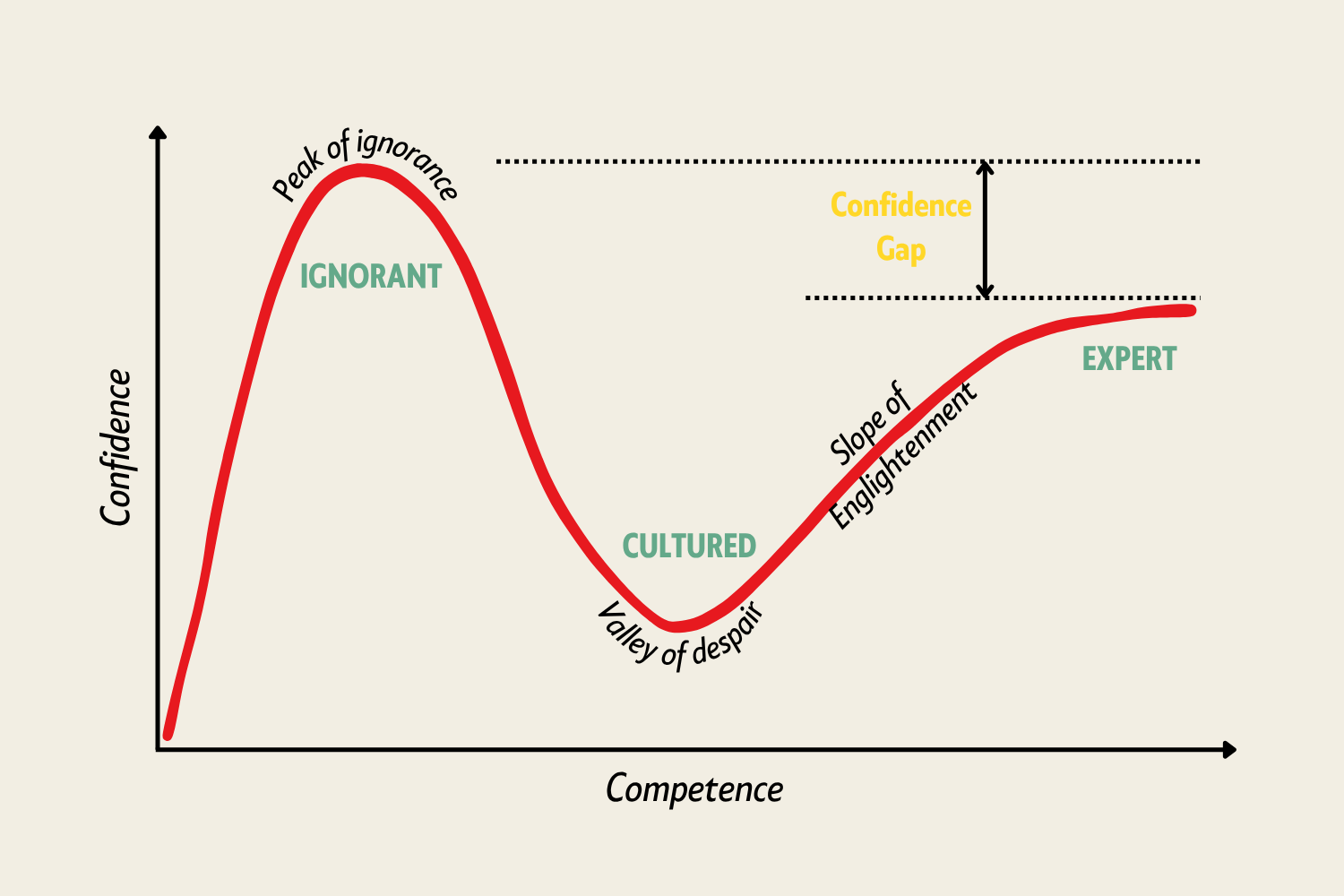
Knowing little makes you feel unstoppable; knowing more makes you hesitate — the loudest voice is rarely the most reliable one.
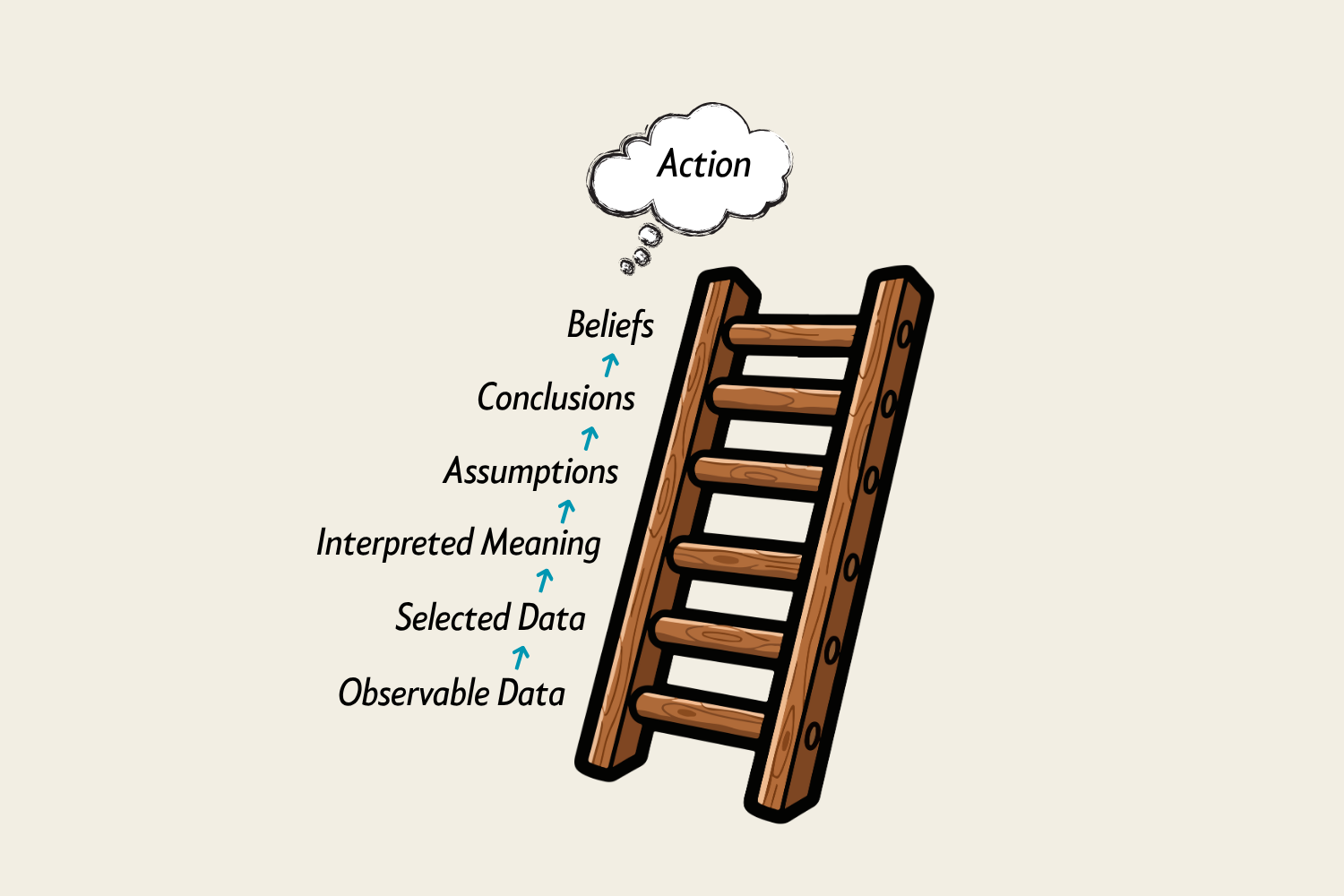
Ladder of Inference
Your mind turns a fact into belief through selection and assumption — you end up arguing with a story, not reality.

STAR Technique
Turn an experience into evidence in four parts — Situation, Task, Action, Result — to advocate for your people, make the case.
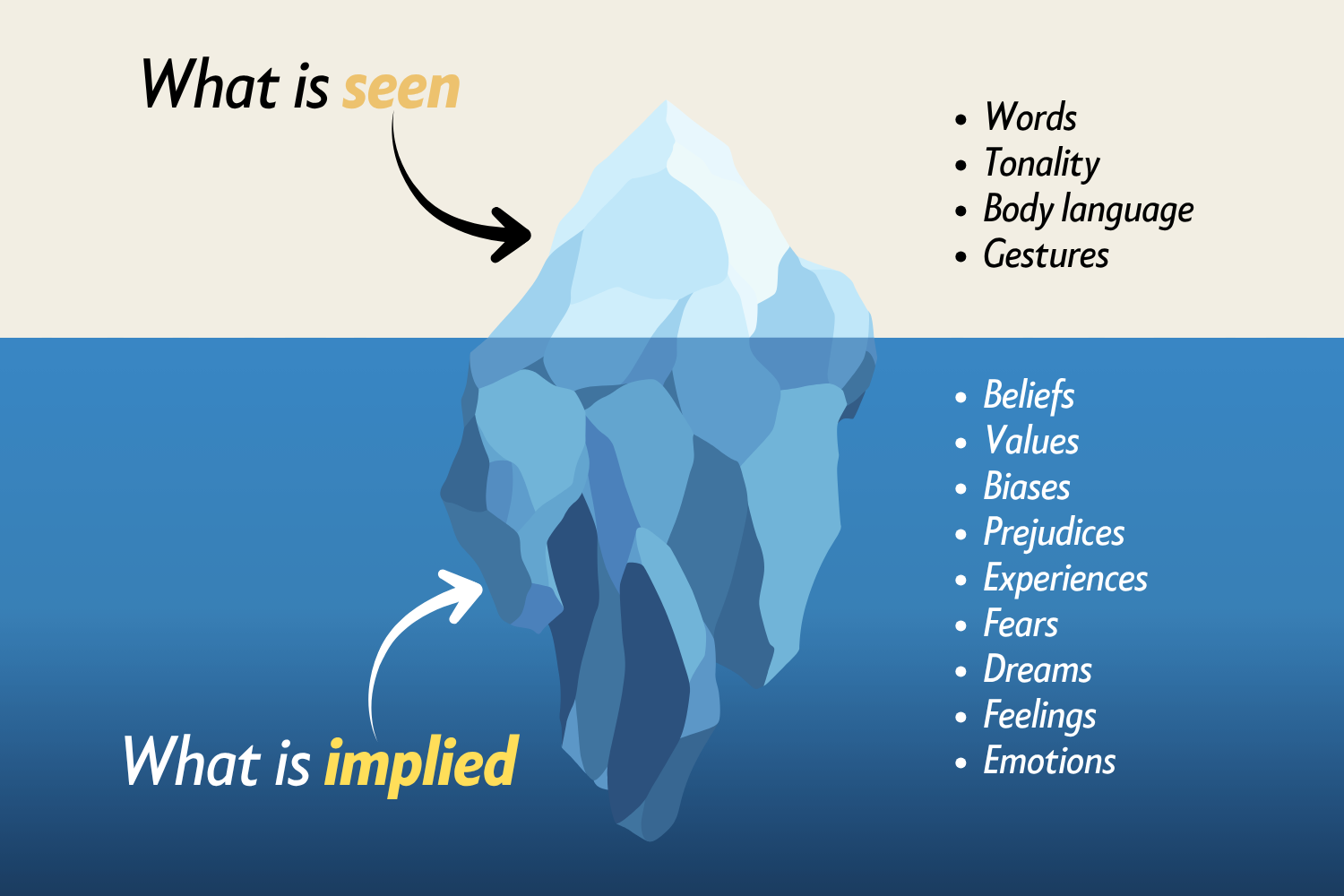
The Hemingway Iceberg Technique
A communication method from Hemingway's writing — say less, cut the padding, use specifics — letting what's unsaid carry the weight.
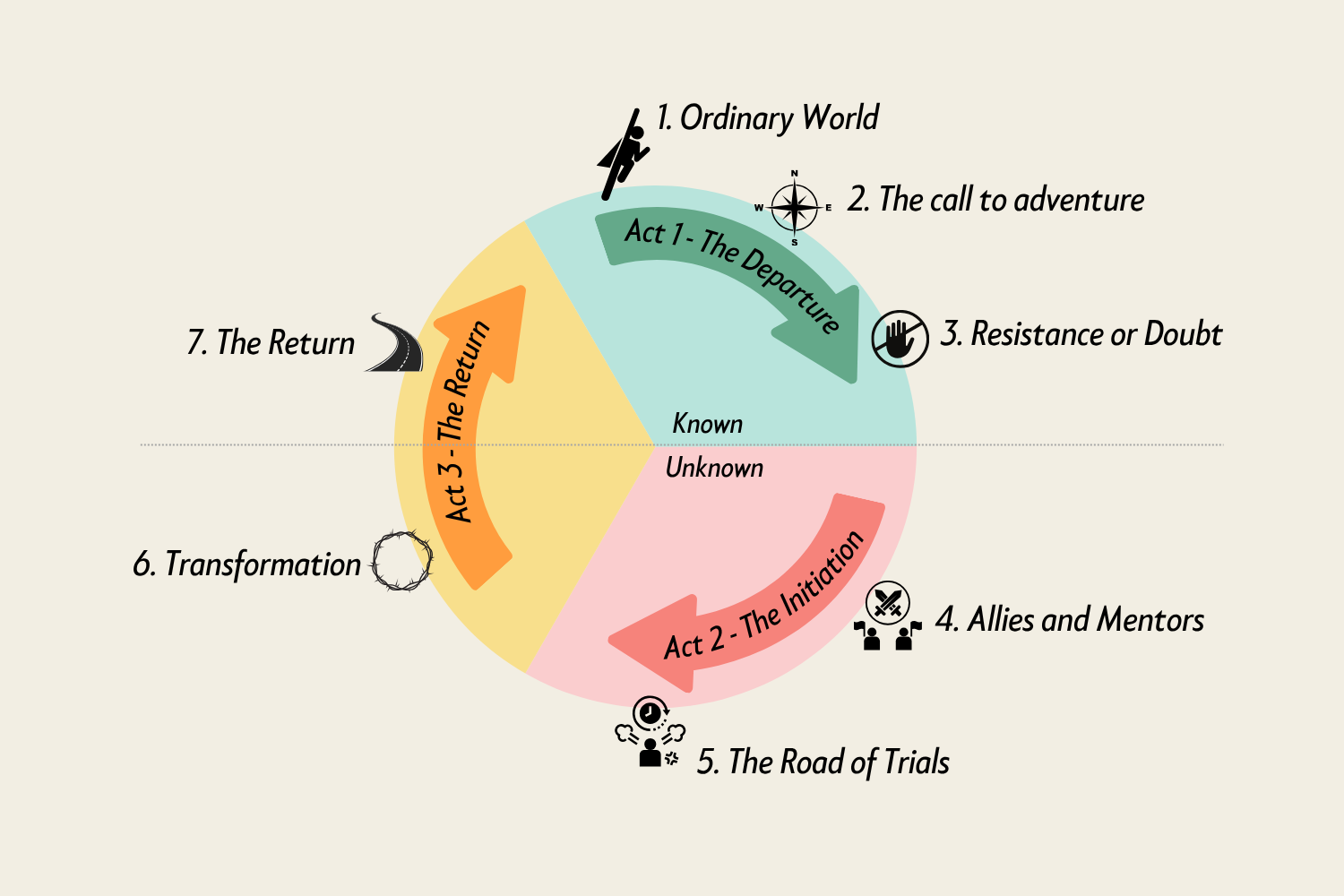
The Hero's Journey
Joseph Campbell's story arc — struggle, growth, return — turned into a structure for leadership storytelling people remember and act on.

The Influence Flywheel
A model for building influence without authority — five reinforcing spokes: Credibility, Connection, Clarity, Communication, Courage — building on each other.

The Insecurity Loop
A model of how insecurity, disguised as ego, shame, or control, drives a self-feeding cycle that pushes your team away.

The Leadership Code
Leadership runs on three traits — head, gut, heart — each toxic alone: competence without character is arrogance, courage without it reckless.

The Pygmalion Effect
What you expect from someone leaks into how you treat them, which shapes what they become — for better or worse.
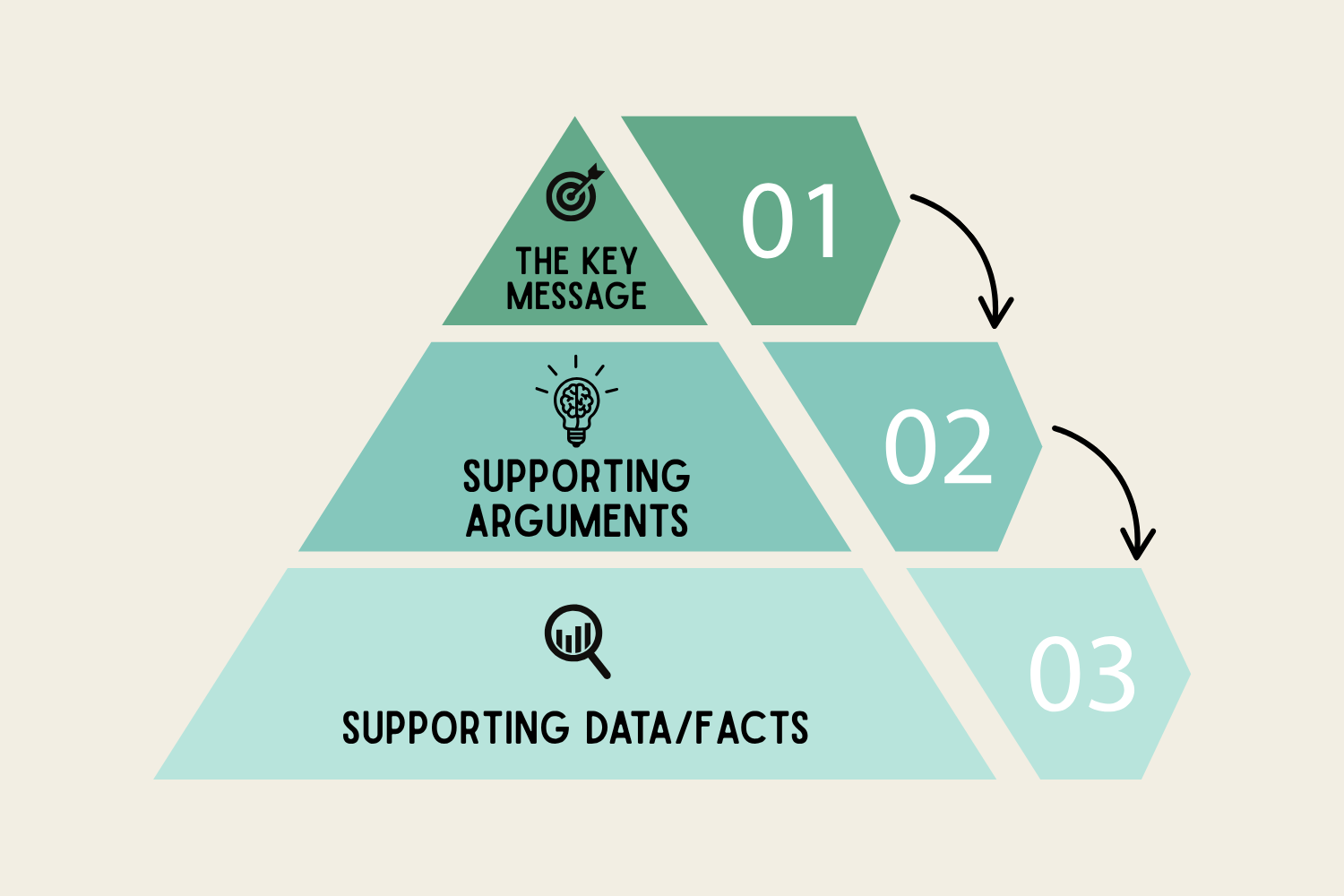
The Pyramid Principle
Barbara Minto's McKinsey-born rule: lead with your conclusion, back it with 2 to 4 grouped arguments, support each with evidence.

The Three Brains Framework
Three systems compete to drive your response — reactive, emotional, thinking. Pause, align, choose — that's how you decide which one leads.
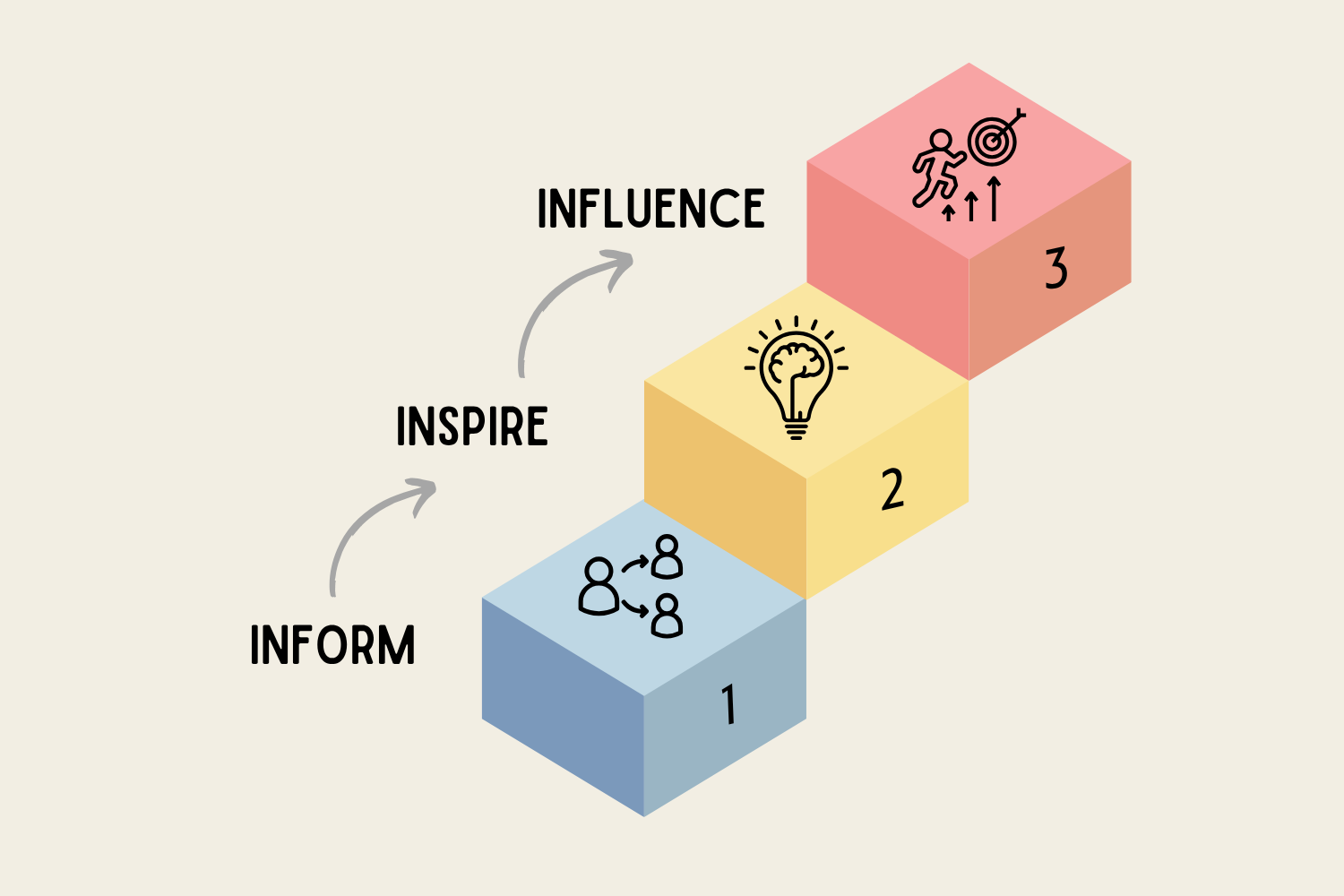
The Three Stages of Communication
Leadership communication runs in three stages — Inform (facts), Inspire (emotion), Influence (action) — the one you're stuck in reveals the problem.