The 4 Disciplines of Execution
Chris McChesney, Sean Covey & Jim Huling
Chris McChesney, Sean Covey, and Jim Huling draw on FranklinCovey's work with thousands of teams to explain why good strategy so often dies in the daily grind of running the business, and lay out the specific discipline a leader needs to protect a new goal from that grind.
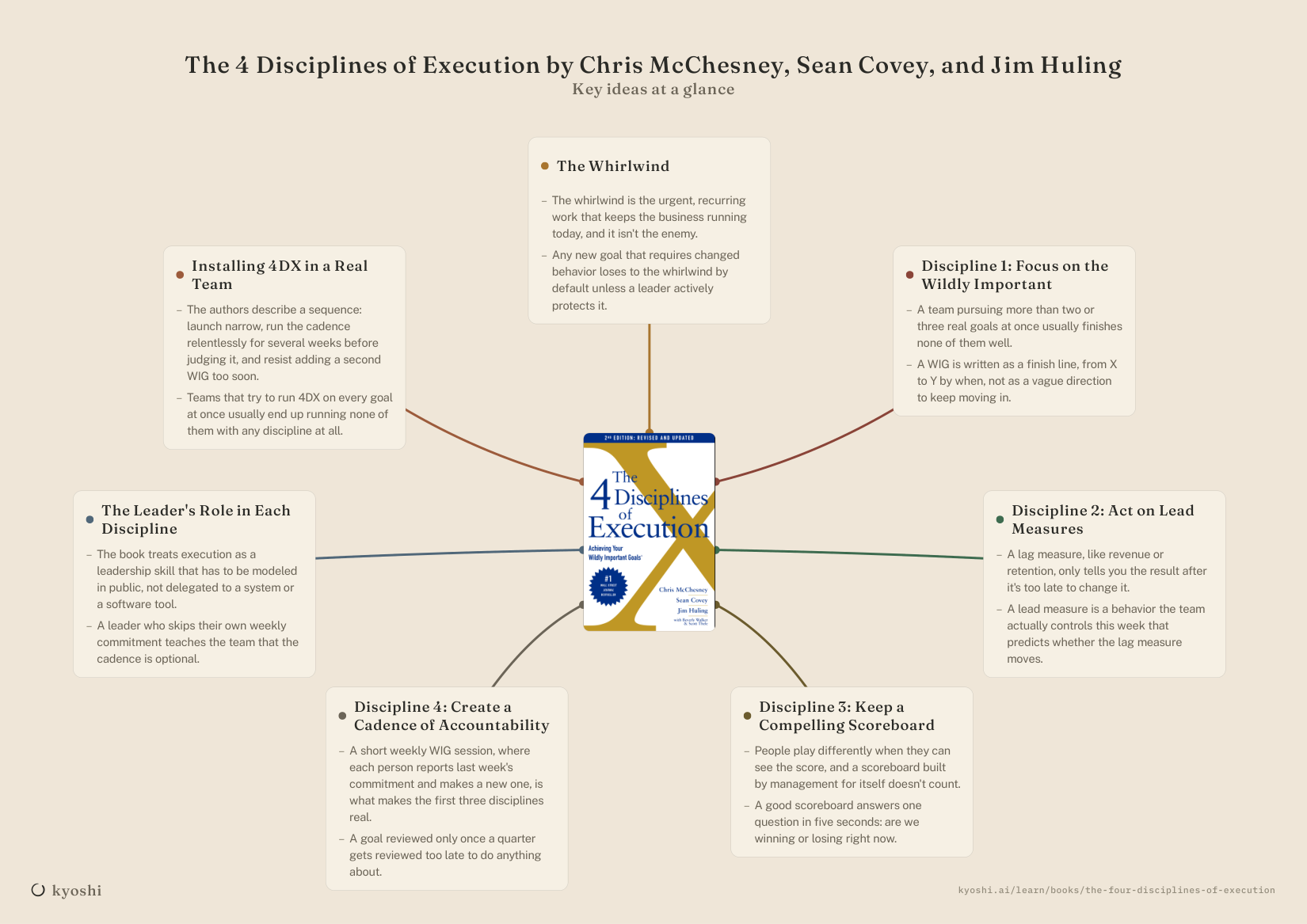
 Find this on the mind-map
Introduction
Chris McChesney, Sean Covey, and Jim Huling built this book, published by FranklinCovey's Free Press imprint in 2012, out of a specific and uncomfortable observation from years of consulting with thousands of teams: most strategies don't fail because the thinking behind them was bad. They fail because the team never actually changed its daily behavior, even after everyone agreed on the plan in the room. The strategy document was fine. The execution of it never happened.
Their explanation is the whirlwind: the volume of urgent, recurring work required just to keep a business or a team running today. Answering customer tickets, shipping the current release, handling the crisis of the week. The whirlwind isn't a distraction from the real work, it is the real work that pays the bills right now, which is exactly why it's so dangerous to a new goal. A new goal requires people to do something they weren't already doing, and the whirlwind will eat every hour offered to it without ever announcing that it's doing so.
The book's four disciplines aren't a theory of strategy. They're a specific operating system for protecting one or two important goals from a whirlwind that will otherwise absorb them completely, built from what the authors watched actually work across a large number of real teams trying to execute something that mattered.
The Whirlwind
The authors are careful to say the whirlwind isn't the villain of the book. It's the reason the organization exists, the thing customers are actually paying for today, and no leader should try to eliminate it. The problem is that the whirlwind has a natural advantage over any new strategic goal: it's urgent, it's familiar, and everyone already knows how to respond to it, while a new goal is unfamiliar and requires people to learn a new behavior under no particular time pressure.
Left alone, a leader's natural instinct is to let the whirlwind consume one hundred percent of the team's attention, because every individual decision to prioritize today's fire over this quarter's goal looks reasonable in the moment. The authors' answer isn't to work harder on top of the whirlwind. It's to carve out a small, protected discipline, maybe one or two hours a week, that the whirlwind is simply not allowed to touch.
A sales team drowning in the daily work of managing current accounts will always have a reason to skip this week's push on a new product line. The whirlwind will never clear itself out of the way voluntarily. Only a leader who treats the new goal as non-negotiable, in public, keeps it alive.
Discipline 1: Focus on the Wildly Important
The first discipline is a direct response to a common management habit: setting a long list of goals because all of them genuinely matter. The authors' finding is blunt. A team that commits to between four and ten goals at once will typically achieve none of them with real discipline, while a team that commits to one or two will usually hit both. The constraint isn't effort, it's attention, and attention doesn't scale the way a goal list does.
A Wildly Important Goal, or WIG, has a specific form: from X to Y by when. Not "improve customer satisfaction," which can't be won or lost, but "grow customer retention from 82 percent to 90 percent by December." The specificity is the point, because a vague goal can always be claimed as progress regardless of what actually happened, while a WIG written this way is either hit or it isn't.
The test the authors apply is simple: can anyone on the team state the WIG, in its exact numbers, without checking a document. If the answer is no, it isn't actually the team's wildly important goal yet, no matter how many times leadership has announced it.
Discipline 2: Act on Lead Measures
This discipline is the intellectual core of the book. A lag measure is the outcome a team actually wants: revenue, market share, customer retention, defect rate. The problem with lag measures is structural, not a matter of picking a bad one: by the time you know the number, the behavior that produced it already happened, so you can't act on a lag measure directly, only react to it after the fact.
A lead measure is different on two counts. It has to be predictive, meaning it genuinely moves the lag measure when it changes, and it has to be influenceable, meaning the team can directly affect it this week through their own behavior. A sales team's lag measure might be quarterly revenue; a lead measure might be the number of qualified discovery calls completed per week, something the team controls today and that reliably feeds the number they can't control directly.
Lead measures feel smaller and less important than the lag measure they drive, which is exactly why teams drop them first when the whirlwind gets loud. The authors' repeated warning is that a team that stops tracking its lead measures hasn't lost the goal yet, but it's already lost the ability to know, in real time, whether it's on track to hit it.
Discipline 3: Keep a Compelling Scoreboard
The authors draw a sharp line between a management scoreboard, built for leadership to track performance, and a player's scoreboard, built so the people doing the work can tell at a glance whether they're winning. A spreadsheet full of numbers that only a manager understands doesn't motivate anyone, because the people whose behavior actually needs to change can't read it fast enough to feel anything about it.
Their test is that a good scoreboard answers one question in about five seconds: are we winning or losing, right now. It shows both the lead measures the team controls and the lag measure they're chasing, side by side, so the team can see the connection between this week's behavior and the score moving. The authors point to something almost trivial but true: people play a pickup game of basketball differently the moment somebody starts actually keeping score, even though nothing else about the game changed.
A scoreboard that the team itself builds and owns, posted somewhere visible rather than buried in a shared drive, does more for behavior change than another memo reminding people the goal still matters.
Discipline 4: Create a Cadence of Accountability
The fourth discipline is the weekly WIG session, and the authors treat it as the discipline that makes the other three actually happen rather than just exist on paper. Each session is short, usually under thirty minutes, and follows a fixed structure: review the scoreboard, report on the specific commitment each person made last week, and make one new commitment for the coming week that will move a lead measure.
The accountability here is social, not administrative. Reporting a missed commitment out loud to peers every single week is a much stronger motivator than an annual review months later, because the gap between the commitment and the consequence is small enough to actually feel. A quarterly check-in reviews a goal too late to change anything about how last month went; a weekly one catches the drift while there's still time to correct it.
The authors are explicit that this meeting has to stay off whirlwind topics entirely. The moment a WIG session turns into a general status meeting about everything going on, it stops protecting the goal and just becomes one more meeting the whirlwind has successfully colonized.
The Leader's Role in Each Discipline
The book is unusually direct about what's actually required of the leader, not just the team. In Discipline 1, the leader has to say no to good ideas, since narrowing the goal list means leaving real opportunities on the table on purpose. In Discipline 2, the leader has to tolerate a lead measure that feels indirect and small compared to the lag measure everyone actually cares about, and defend it when someone asks why the team is tracking something that isn't the real goal.
In Discipline 3, the leader has to let the scoreboard be the team's own, resisting the urge to replace it with a more sophisticated management dashboard that nobody on the floor can read in five seconds. In Discipline 4, the leader's own weekly commitment matters more than anyone else's, because a leader who shows up to the WIG session without having done their own commitment teaches the entire team, faster than any policy could, that the cadence is optional.
The authors' case is that 4DX isn't a system a leader installs and then watches run. It's a set of behaviors the leader has to model first, every single week, before anyone else on the team will take it seriously enough to do the same.
Installing 4DX in a Real Team
The book walks through how teams actually adopt this, based on the authors' own consulting history, and the sequence matters as much as the content. Teams are told to launch with one WIG, not several, resist the temptation to add a second one before the first cadence is running smoothly, and expect the first few weeks of WIG sessions to feel awkward and a little forced before they become a habit nobody questions.
A recurring failure pattern the authors describe is a team that tries to run all four disciplines against every goal the organization has at once, which produces the same overload Discipline 1 was designed to prevent, just dressed up in 4DX language. Another is a team that drops the weekly cadence the first time a real crisis hits the whirlwind, treating the WIG session as the first thing to cancel rather than the last.
The authors' advice for getting through the early awkward weeks is blunt: run the cadence even when it feels like theater, because the discipline is what eventually produces the belief, not the other way around. Teams that wait to feel motivated before committing to the weekly session usually never start.
Putting It Together
Each discipline exists to defend the one before it from the whirlwind. Discipline 1 narrows the target so attention isn't spread thin. Discipline 2 gives the team something they can actually act on today instead of waiting for a lagging result. Discipline 3 makes that action visible enough to matter emotionally, not just numerically. Discipline 4 forces a weekly moment where the whirlwind is explicitly not allowed in the room. Skip any one of the four and the whole chain weakens, because a WIG without lead measures is just a wish, and lead measures without a weekly cadence stop getting tracked within a month, usually without anyone deciding to let that happen.
Why It Matters for Leaders
Most leaders already know how to set a goal. What this book targets is the much harder problem of keeping a goal alive against the daily work that will always feel more urgent. A goal announced in January and reviewed again in April isn't being executed in between, it's being hoped about, and the authors' real argument is that hope isn't a method.
The practical shift is to stop measuring a goal by whether it was announced well and start measuring it by whether a specific, weekly, team-controlled behavior is actually happening. That means picking a lead measure even when it feels smaller and less satisfying than the real outcome everyone wants, and it means holding a short weekly session even when the whirlwind is loud that particular week, especially when the whirlwind is loud that particular week.
It also changes what a leader has to give up. Discipline 1 requires turning down good ideas, not just bad ones, because a team with three wildly important goals doesn't have one more discipline than a team with one, it has one third of the attention on each. That's a harder conversation to have with an ambitious team than simply adding another initiative to the list.
Picture Dario, a regional operations manager whose team has spent two straight quarters trying to improve six different metrics at once, with none of them moving. Instead of adding a seventh dashboard, Dario picks one WIG: reduce order processing errors from 6 percent to 2 percent by the end of the quarter. He works with the team to find a lead measure, the percentage of orders double-checked against a short new checklist before shipping, something every person on the floor controls today. He puts a whiteboard scoreboard by the exit everyone walks past at the end of their shift, and he runs a fifteen-minute Friday session where each person reports whether they hit their checklist target and commits to next week's. Three weeks in, the error rate hasn't moved much, but the checklist number has, and Dario holds the line on the cadence instead of declaring it a failure early. By week eight, the error rate catches up, because it was always going to follow the lead measure, not the other way around.
Frameworks referenced from this book

What to do next
Reinforce your understanding of The 4 Disciplines of Execution
Books related to The 4 Disciplines of Execution

High Output Management
Andy Grove's field manual for management as a production problem. Your output is the output of the people you influence, which reframes nearly everything a manager does as a question of leverage, not effort.

Team of Teams
General Stanley McChrystal's account of rebuilding a special-operations task force to fight a decentralized enemy network, and the argument that efficient hierarchy, the thing most organizations are explicitly built for, is the wrong design for a fast, complex environment.

The Lean Startup
Eric Ries turns his own near-collapse at a startup called IMVU into a full method for building new products under uncertainty. The book argues that speed comes from validated learning, not from working harder, and gives managers a disciplined way to tell real progress from a good-looking slide.

Traction: Get a Grip on Your Business
Gino Wickman's case that most founders don't have a strategy problem, they have an execution problem, and his Entrepreneurial Operating System for closing the gap between the vision in a leader's head and what actually happens on a Tuesday.
Skills related to The 4 Disciplines of Execution

Frameworks related to The 4 Disciplines of Execution

Agile Methodology
Short cycles beat long plans — build a slice, ship it, get real feedback, adjust, and repeat until it fits.

Dreamboxing
A model for turning vision into disciplined execution by cycling through three stages — Dream, Drive, Do — rather than favoring one.

Lean Startup
Eric Ries's Build-Measure-Learn loop: test your riskiest assumption with the smallest product, measure what people do, then pivot or persist.

Managerial Leverage
Andy Grove's idea that a manager's output is their team's output, and that every meeting, decision, or process you run has a leverage value somewhere between high and negative.

The Value Triangle
A modern replacement for the Iron Triangle — swap cost, time, scope for investment, frequency, and incremental value — levers, not constraints.