Traction: Get a Grip on Your Business
Gino Wickman's case that most founders don't have a strategy problem, they have an execution problem, and his Entrepreneurial Operating System for closing the gap between the vision in a leader's head and what actually happens on a Tuesday.
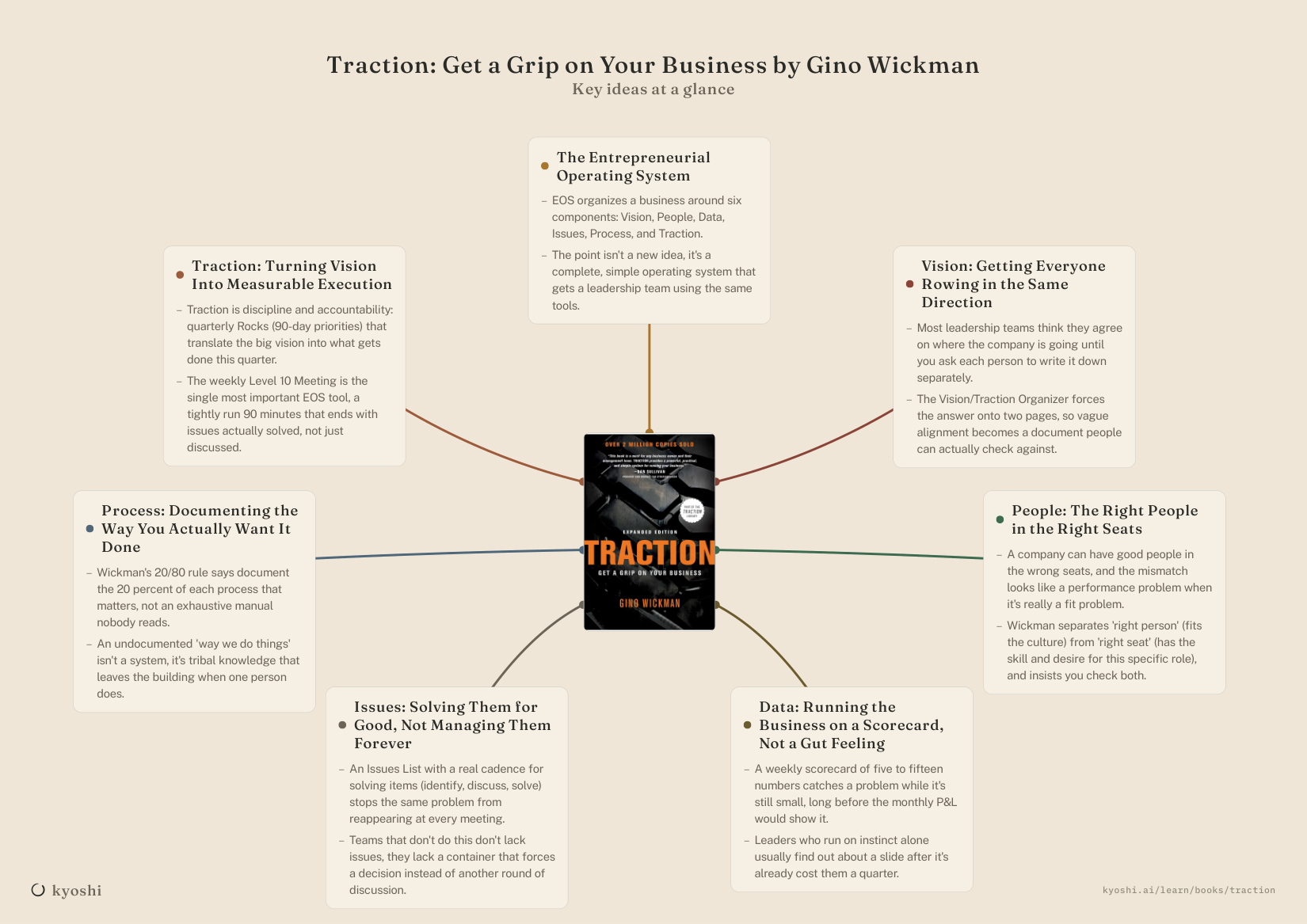
 Find this on the mind-map
Introduction
Gino Wickman built his argument from years of sitting in rooms with frustrated entrepreneurs who had real revenue, real customers, and a leadership team that still couldn't execute on anything consistently. His diagnosis wasn't that these founders lacked ambition or smarts. It was that they were running their company on instinct and a loose collection of habits instead of an actual operating system. Traction introduces the Entrepreneurial Operating System, EOS, as that missing system: a complete, practical set of tools built around six components that, together, cover everything a business needs to function well. The promise of the book isn't a clever new strategy. It's a way to finally execute the strategy you already have.
Wickman's framing is blunt: strategy sessions and vision statements are cheap, and most companies have plenty of both sitting in a drawer. What's rare is traction, the discipline to translate vision into specific numbers, specific owners, and specific weekly behavior. The book is organized around six components precisely because each one addresses a different way companies fail without anyone noticing, even while looking busy.
The Entrepreneurial Operating System
EOS isn't a single technique, it's a full operating system built from six interlocking components: Vision, People, Data, Issues, Process, and Traction. Wickman's claim is that a company is only as strong as its weakest component, and most leadership teams can name exactly which one is weak the moment they hear the list. A company with a crystal-clear vision but no data discipline is flying on feel. A company with great processes but the wrong people in key seats is optimizing a machine that's staffed wrong.
The reason EOS works as a system rather than a pile of tips is that each component has one or two concrete tools attached to it, not just a principle to remember. The Vision component has the Vision/Traction Organizer. The Traction component has Rocks and the Level 10 Meeting. A leadership team doesn't have to invent its own version of "run better meetings," it adopts the tool and uses it the way it's designed. The strongest companies in the book aren't the most talented ones, they're the ones that got all six components to a baseline level of health at the same time.
Vision: Getting Everyone Rowing in the Same Direction
Wickman opens with a diagnostic he's run with hundreds of leadership teams: ask each executive privately to write down the company's top three priorities for the year. The answers rarely match, even among people who would have sworn, five minutes earlier in the same room, that they were perfectly aligned. That gap between felt alignment and actual alignment is where companies waste a year of effort pulling in different directions, without anyone flagging it.
His fix is the Vision/Traction Organizer, a two-page document that forces a leadership team to write down the core values, core focus, ten-year target, marketing strategy, three-year picture, one-year plan, and quarterly Rocks in specific, checkable language. The V/TO isn't a poster for the lobby. It's a working document the team revisits every quarter, and disagreements surface while they're still cheap to resolve, not a year later when half the company has been executing against a vision that existed only in the CEO's head.
A founder who assumes the leadership team shares her read of "where we're going" because nobody's pushed back in a meeting is mistaking silence for agreement. The V/TO replaces that assumption with a document everyone actually had to commit to in writing.
People: The Right People in the Right Seats
Wickman separates two questions that leaders routinely collapse into one: is this the right person, someone who shares the company's core values and would be a good fit somewhere in the organization, and is this the right seat, does this specific role match their skill and their genuine desire to do it. A talented, values-aligned person in the wrong seat looks exactly like a performance problem from the outside, and managers who treat it as one just cycle through coaching plans that were never going to fix a fit issue.
The People Analyzer tool scores each person against the company's core values, giving a leader language for a conversation that otherwise stays vague ("something feels off about Marcus") for months. Wickman's bar is specific: you want people who get it, want it, and have the capacity to do it, in that exact role. Miss on any one of the three and the seat is wrong, regardless of how much the person is liked.
A VP of sales who's brilliant at closing enterprise deals but was promoted into managing a team of ten reps is often the right person sitting in the wrong seat, and no amount of leadership training fixes a structural mismatch that a seat change would solve in a conversation.
Data: Running the Business on a Scorecard, Not a Gut Feeling
Most leadership teams Wickman worked with ran on monthly financials and a general sense of how things were going. By the time a problem showed up in the P&L, it had often been building for two or three months. His fix is a weekly scorecard: five to fifteen numbers, each with a clear owner and a weekly target, reviewed every single week without exception.
The scorecard isn't a dashboard for the board, it's an early-warning instrument for the leadership team itself. A sales number that's been trending down for three weeks gets caught and discussed in week three, not discovered in the quarterly review when the hole is already too deep to climb out of in the current quarter. Wickman's insistence on weekly, not monthly, is the whole point: data loses almost all its value as an intervention tool the longer it sits unreviewed.
A COO who only finds out customer churn is climbing when the quarterly board deck gets built is, by Wickman's standard, running the business a month and a half behind reality at all times.
Issues: Solving Them for Good, Not Managing Them Forever
Every leadership team has an informal list of problems that get raised, discussed, and raised again the following month, no closer to resolved. Wickman's Issues component replaces that cycle with an actual Issues List and a disciplined process for working through it: identify the real issue, discuss it openly, and solve it, in that order, so a meeting ends with a decision instead of another round of "let's keep an eye on that."
The discipline here is resisting the urge to solve the first issue mentioned instead of the most important one. Wickman has teams list everything first, then prioritize, because the issue people lead with in a meeting is rarely the one costing the business the most. A team that works top three issues to an actual resolution every week makes more progress than a team that briefly touches ten issues and solves none of them.
A leadership team that's discussed the same staffing shortage in four consecutive meetings without a decision isn't short on issues, it's missing a mechanism that forces the conversation to end in a solve.
Process: Documenting the Way You Actually Want It Done
Wickman's Process component rests on something leaders underestimate: the "way we do things here" usually only exists in a few people's heads, which means it's not actually a system, it's a dependency on those specific people staying at the company. His fix is to document your core processes, the handful that define how the business actually runs, using what he calls the 20/80 rule: capture the 20 percent of each process that matters, the steps that actually drive the outcome, not a sprawling manual nobody will read.
A documented process also solves a quieter problem: it lets you check whether everyone is actually following the same version of "the way we do it," or whether five different people have five different informal versions that happen to produce similar-enough results most of the time. Once it's written down, onboarding a new hire into an existing role stops depending entirely on whoever trains them that week.
A company whose client-onboarding process lives entirely in one ops manager's memory isn't running a process, it's running a single point of failure that happens to work until that person takes a vacation.
Traction: Turning Vision Into Measurable Execution
Traction is the component that gives the book its title, and it's where vision actually gets tested against reality. The core mechanism is the Rock: a small number of 90-day priorities, each with a single owner and a measurable outcome, that translate the three-year and one-year goals in the V/TO into what the company is actually doing this quarter. A company can have a beautiful ten-year target and still fail completely if nobody can name the three things that have to happen in the next 90 days to move toward it.
The other half of Traction is the Level 10 Meeting, which Wickman calls the single most important tool in the whole system. It's a 90-minute weekly meeting with a fixed agenda, starting and ending on time, that works through the scorecard, Rock progress, and the Issues List, and ends with real decisions made, not just discussed. The name comes from the ritual of rating the meeting itself from 1 to 10 at the close, which keeps the team honest about whether the meeting is actually working or has slowly turned into status theater.
A leadership team that holds a Monday meeting every week but can't say, afterward, what got decided isn't running a Level 10 Meeting, it's running a status update that happens to have the same people in the room.
Putting It Together
The six components aren't independent best practices, they're a single system where weakness in one undermines the others: a clear vision without the data to track progress against it is just a slogan, and great process without the right people to run it is a machine nobody can operate well. Wickman's real claim is that a company doesn't need a smarter strategy nearly as often as it needs the discipline to run the strategy it already has through a consistent weekly rhythm, Rocks and a Level 10 Meeting, until the vision on paper and the business on the ground are the same thing.
Why It Matters for Leaders
Most leaders already believe in vision and alignment and accountability. What Traction demands isn't new belief, it's new behavior: a weekly cadence that doesn't move for convenience, a scorecard reviewed every single week, and a meeting structure that ends with decisions instead of more discussion. The system only works if a leader actually runs it with the same discipline every week, not just during the quarters when things are going well.
The hardest part for a lot of leaders isn't adopting the tools, it's the honesty the tools force. The People Analyzer makes you say out loud that someone you like isn't in the right seat. The scorecard makes a slipping number visible the week it starts slipping, not the quarter it becomes undeniable. The Vision/Traction Organizer exposes disagreement among executives who thought they were aligned. None of that is comfortable, and a leader who adopts the paperwork of EOS without adopting the honesty behind it will end up with a binder full of documents and the same unresolved issues as before.
This also changes what a leadership meeting is supposed to accomplish. A meeting isn't a status update, it's the mechanism that turns a quarterly Rock into actual weekly behavior, and a leader who lets meetings drift into updates and war stories is letting the whole system decay, one Monday at a time, without ever deciding to.
Picture a founder, Marcus, running a 40-person agency that's grown steadily but feels, to him, chronically chaotic. He's got a clear vision in his own head and three capable directors, but every week brings a fresh fire that somehow nobody saw coming. Instead of hiring another layer of management, Marcus builds a one-page V/TO with his leadership team and discovers, in the first session, that his ops director thinks the company's core focus is "operational excellence" while his head of sales has been selling against "boldest creative in the market." He sets up a weekly scorecard with eight numbers, starts a 90-minute Level 10 Meeting every Monday, and converts the team's three biggest priorities into Rocks with named owners. Six weeks in, the fires haven't disappeared, but they're getting caught on the Issues List on Monday instead of becoming a client emergency on Thursday, and for the first time his directors can say, without hedging, what the company is actually trying to do this quarter.
What to do next
Reinforce your understanding of Traction: Get a Grip on Your Business
Books related to Traction: Get a Grip on Your Business

Blue Ocean Strategy
W. Chan Kim and Renée Mauborgne's case that the biggest strategic wins come from creating uncontested market space instead of fighting over an existing one. They lay out a concrete method for finding it, built around dropping the trade-off between low cost and high value.

Built to Last
Collins and Porras' earlier, lesser-known study of visionary companies: the research that came before Good to Great, built around a single hard question: what actually survives past the founder, the product, and the current strategy?

Crossing the Chasm
Geoffrey Moore's explanation for why so many breakthrough technologies die right after their early fans love them. He maps the specific gap between early adopters and the mainstream market, and lays out the beachhead strategy that gets a product across it.

Good Strategy Bad Strategy
Richard Rumelt's blunt case that most of what gets called "strategy" in a typical planning meeting is actually a wish list dressed up in strategic language, plus a concrete test for telling the two apart.

Good to Great
Jim Collins' research into why some companies go from average to sustained market dominance, and others don't. Read less as a book about companies and more as a book about the kind of leader you have to become before a company (or a team) can get great.

High Output Management
Andy Grove's field manual for management as a production problem. Your output is the output of the people you influence, which reframes nearly everything a manager does as a question of leverage, not effort.

Playing to Win
A.G. Lafley and Roger Martin's case that strategy is not a plan or a mission statement, it is a small set of hard choices about where to compete and how to win there, made with the same discipline P&G used to double its revenue.

Start With Why
Simon Sinek's argument that people don't buy what you do, they buy why you do it, and that most organizations have never actually answered the question, even the ones that think they have.

Sun Tzu and The Art of Business
Mark McNeilly's translation of Sun Tzu's 2,500-year-old military strategy into six concrete business principles, built around a point most business books skip: the best wins are the ones nobody had to fight for.

Team of Teams
General Stanley McChrystal's account of rebuilding a special-operations task force to fight a decentralized enemy network, and the argument that efficient hierarchy, the thing most organizations are explicitly built for, is the wrong design for a fast, complex environment.

The 4 Disciplines of Execution
Chris McChesney, Sean Covey, and Jim Huling draw on FranklinCovey's work with thousands of teams to explain why good strategy so often dies in the daily grind of running the business, and lay out the specific discipline a leader needs to protect a new goal from that grind.

The Art of War
The original 2,500-year-old military treatise, read the way most modern leaders actually use it. Not as a manual for fighting better, but as a manual for needing to fight less.

The Infinite Game
Simon Sinek's case that most leaders are playing the wrong game entirely: treating an endless competition as something you can win, when the only real goal is staying in it, strong enough to keep playing.

The Innovator's Dilemma
Clayton Christensen's answer to a puzzle that looks impossible: well-run companies, doing everything their best customers ask for, still lose to products that look worse on every spec sheet, right up until the moment they don't. The book every leader cites and few actually apply to their own team.

The Lean Startup
Eric Ries turns his own near-collapse at a startup called IMVU into a full method for building new products under uncertainty. The book argues that speed comes from validated learning, not from working harder, and gives managers a disciplined way to tell real progress from a good-looking slide.

Walmart
A retail-industry case study of how Walmart built, and is now fighting to defend, the position it spent sixty years earning. Less a biography of Sam Walton and more a hard look at what scale economics can and can't protect you from in the age of Amazon.

Your Next Five Moves
Patrick Bet-David's chess-inspired framework for strategic leadership, built around five "moves" every founder or executive has to master in order, from knowing yourself to running power plays against bigger competitors, instead of just reacting to whatever just happened.
Skills related to Traction: Get a Grip on Your Business

Business Strategy
Making the focused calls about where to compete, what to prioritize, and what to say no to, because a strategy is defined as much by what it rules out as by what it commits to.

Driving Execution
Turning an agreed plan into delivered results through the focus, systems, and accountability that keep a team moving from decision to outcome.
Frameworks related to Traction: Get a Grip on Your Business

Agile Methodology
Short cycles beat long plans — build a slice, ship it, get real feedback, adjust, and repeat until it fits.

BCG Matrix
A 2x2 that sorts products or units by market growth and share — telling you what to fund, milk, or kill.

Dreamboxing
A model for turning vision into disciplined execution by cycling through three stages — Dream, Drive, Do — rather than favoring one.

Lean Startup
Eric Ries's Build-Measure-Learn loop: test your riskiest assumption with the smallest product, measure what people do, then pivot or persist.

Managerial Leverage
Andy Grove's idea that a manager's output is their team's output, and that every meeting, decision, or process you run has a leverage value somewhere between high and negative.

McKinsey's Three Horizons Model
Split your team's effort across three time frames — defend the core, grow what's emerging, seed future bets — without mortgaging tomorrow.

Porter's Five Forces
Porter's answer to why some industries are brutal for profit — five forces shaping any market, telling you where to compete.

Rumelt's Kernel
Richard Rumelt's test for telling a real strategy from a list of goals — a diagnosis, a guiding policy, and coherent actions. Miss any one of the three and what you have is a wish, not a strategy.

The 4 Disciplines of Execution
Four disciplines for hitting your important goals: narrow focus, act on lead measures, keep a visible scoreboard, run weekly accountability.

The Innovator's Dilemma
Clayton Christensen's explanation for why great companies fail doing everything right — serving your best customers blinds you to cheap newcomers.

The Value Triangle
A modern replacement for the Iron Triangle — swap cost, time, scope for investment, frequency, and incremental value — levers, not constraints.