Crossing the Chasm
Geoffrey Moore's explanation for why so many breakthrough technologies die right after their early fans love them. He maps the specific gap between early adopters and the mainstream market, and lays out the beachhead strategy that gets a product across it.
 Find this on the mind-map
Introduction
Geoffrey Moore wrote Crossing the Chasm in 1991 to answer a question that was wrecking promising technology companies: a product gets glowing reviews from its first customers, momentum looks real, and then sales stall out for no obvious reason. Moore's answer is that the market for a new technology isn't one continuous line of buyers who adopt earlier or later versions of the same decision. It's several distinct groups, each with a different psychology, and the handoff between the second group and the third group is where most products die.
He calls that gap the chasm, and the whole book is a strategy for getting a product across it: not by selling harder to everyone at once, but by picking one narrow beachhead, winning it completely, and using that win as the base for the next one. The ideas in this book came out of enterprise tech, but the pattern repeats anywhere a genuinely new offering has to go from a handful of believers to a market that doesn't believe in anything it hasn't already seen work.
The Technology Adoption Life Cycle and the Chasm
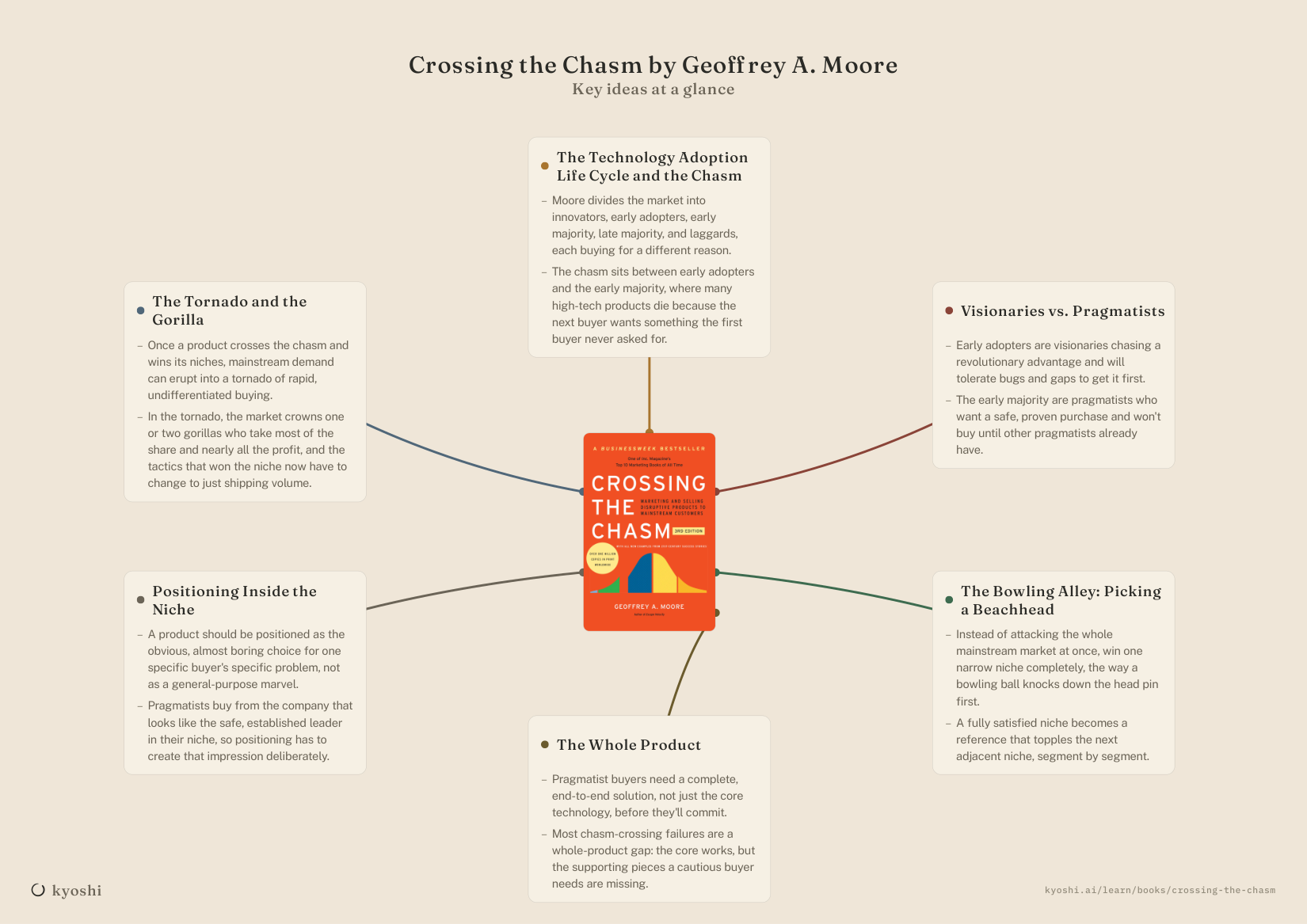
Moore starts from a bell curve marketers already used: innovators, early adopters, early majority, late majority, and laggards, moving left to right by how willing each group is to try something unproven. Innovators chase technology for its own sake and will put up with almost anything to get their hands on it first. Laggards, on the opposite end, only buy once a technology isn't really new anymore.
Moore's contribution was pointing out that this isn't a smooth curve, it's a series of distinct markets connected by cracks, and one crack is so wide it deserves its own name: the chasm between early adopters and the early majority. A product can win over every early adopter in its category and still collapse completely once it tries to reach the early majority, because the two groups aren't buying for related reasons. The early adopters already bought. The company just hasn't noticed that the next group needs an entirely different pitch.
A B2B software company lands a dozen enthusiastic early customers who love being first and happily tolerate rough edges. Sales flatten the next quarter, and the founders assume it's a sales execution problem. It's actually a market structure problem: they've saturated the one segment that buys the way they're currently selling, and the next segment buys on completely different terms.
Visionaries vs. Pragmatists
The psychological gap behind the chasm is the difference between a visionary and a pragmatist. Visionaries, Moore's early adopters, want a revolutionary advantage over their competitors and are willing to be the guinea pig to get it. A few bugs and a missing feature or two are the price of being first, and they'll often help you fix them.
Pragmatists, the early majority, want evolution, not revolution. They want proof the thing works at other companies like theirs before they'll risk their own budget and reputation on it. Crucially, a reference from a visionary carries almost no weight with a pragmatist, because the pragmatist assumes the visionary would have bought anything new regardless of whether it actually worked. Pragmatists only trust references from other pragmatists, which creates the chicken-and-egg problem that makes the chasm so dangerous: you need pragmatist customers to get pragmatist references, and you need pragmatist references to get pragmatist customers.
The Bowling Alley: Picking a Beachhead
Moore's prescription for crossing the chasm is counterintuitive to most sales organizations: narrow the target market down drastically instead of broadening it. Pick one specific niche, a single type of customer with a specific problem, and aim the entire company at winning that niche completely, rather than spreading effort across every segment that might eventually buy.
He calls this the bowling alley, because a fully won niche works the way the head pin works in bowling: knocked down correctly, it takes out the pins next to it. A reference from one satisfied customer in a tightly defined niche carries weight with the next customer in the same niche, because pragmatists trust proof from buyers who look exactly like them. Win niche by adjacent niche, and the market you're pursuing broadens on its own instead of being forced open from outside.
The Whole Product
Pragmatists don't buy a technology. They buy a solution to a specific problem, fully assembled, with every supporting piece already in place: integrations, documentation, training, support, the works. Moore calls this the whole product, and the gap between a company's core technology and the whole product a pragmatist actually needs is usually the real reason a promising product stalls at the chasm.
Most of that gap gets closed by partners, not by the core company building everything itself. A company that picks a beachhead niche and assembles the whole product that niche specifically needs, even borrowing pieces from other vendors to do it, looks finished to a pragmatist buyer in a way that a technically superior but incomplete product never will.
Positioning Inside the Niche
Once a company has a beachhead and a whole product to go with it, positioning has to change completely. Visionaries were drawn in by a vision of changing their industry entirely. Pragmatists are drawn in by looking safe: the obvious, almost boring choice that every other company in their specific situation is already choosing.
That means naming a specific target customer, a specific problem, and a specific reason this product is the established answer for exactly that combination, rather than describing the product's general capabilities. A positioning statement built for pragmatists reads less like a vision statement and more like a trade publication's description of the category leader, because that's precisely the impression a pragmatist is screening for.
The Tornado and the Gorilla
If the beachhead strategy works, Moore describes what happens next as a tornado: pragmatists across many adjacent niches suddenly decide the technology is safe all at once, and demand outruns supply so fast that buyers stop comparing vendors carefully and just buy whoever can ship. Market share won during the tornado tends to stick, because switching costs lock in once a company has standardized on a platform.
The tornado also changes what wins. The niche focus, customization, and high-touch service that won the bowling alley becomes a liability once volume is the entire game; now the market usually crowns one or two gorillas who grab most of the share and nearly all the profit, while everyone else fights over what's left. Moore's point for leaders is blunt: the company that refuses to change its playbook between the bowling alley and the tornado loses to the one that does, even if its underlying product never got worse.
Putting It Together
The chasm exists because a market for anything genuinely new isn't one group of buyers, it's a sequence of groups with different risk tolerances, and what sells to the first group actively fails to sell to the second. Winning a single beachhead niche with a true whole product builds the pragmatist references that make the next niche easier, and enough niches won in sequence can tip into a tornado where the rules of competition change again. Crossing the chasm isn't a single leap. It's a disciplined narrowing before any broadening is allowed to happen.
Why It Matters for Leaders
The instinct most leaders bring to a stalled launch is to sell harder or sell wider: more reps, more verticals, more messaging that tries to speak to everyone at once. Moore's argument is that this instinct makes the chasm worse, not better, because spreading a team's attention across many unrelated prospects means nobody ever gets the whole product finished for anybody, and a pragmatist won't buy an almost-finished solution no matter how promising it looks.
The harder discipline is saying no to real revenue. A deal from a company outside the chosen beachhead can look like exactly the win a stalled team needs, and taking it anyway is usually the decision that keeps the team from ever finishing the whole product for the niche that would actually tip into pragmatist references. Moore's advice is to turn that deal down, or at least not let it redirect the roadmap, because a single beachhead won completely is worth more than three niches each half-served.
It also changes what counts as good news early on. A leader watching for "we got another enthusiastic customer" is tracking the wrong signal once the early-adopter segment is saturated; the signal that actually matters is "a pragmatist bought because another pragmatist like them already had," since that's the only kind of proof the early majority accepts.
Picture a product lead, Derek, running a project-management tool that three early customers rave about in public, while four straight pipeline reviews show the deal count flat. His sales team wants to open two new verticals to find fresh volume. Derek does the opposite: he picks the one vertical, mid-size architecture firms, where two of the three happy customers already sit, builds the missing integration their billing software requires, and turns down a logo from an unrelated industry that would have blown the quarter's number. Three months later, a pragmatist buyer at a competing architecture firm signs because, in the sales call, Derek's rep says one sentence that actually lands: "ask the firm down the street how it's going for them." That's the whole strategy, reduced to one sentence a prospect actually trusts.
What to do next
Reinforce your understanding of Crossing the Chasm
Books related to Crossing the Chasm

Blue Ocean Strategy
W. Chan Kim and Renée Mauborgne's case that the biggest strategic wins come from creating uncontested market space instead of fighting over an existing one. They lay out a concrete method for finding it, built around dropping the trade-off between low cost and high value.

Built to Last
Collins and Porras' earlier, lesser-known study of visionary companies: the research that came before Good to Great, built around a single hard question: what actually survives past the founder, the product, and the current strategy?

Good Strategy Bad Strategy
Richard Rumelt's blunt case that most of what gets called "strategy" in a typical planning meeting is actually a wish list dressed up in strategic language, plus a concrete test for telling the two apart.

Good to Great
Jim Collins' research into why some companies go from average to sustained market dominance, and others don't. Read less as a book about companies and more as a book about the kind of leader you have to become before a company (or a team) can get great.

Playing to Win
A.G. Lafley and Roger Martin's case that strategy is not a plan or a mission statement, it is a small set of hard choices about where to compete and how to win there, made with the same discipline P&G used to double its revenue.

Start With Why
Simon Sinek's argument that people don't buy what you do, they buy why you do it, and that most organizations have never actually answered the question, even the ones that think they have.

Sun Tzu and The Art of Business
Mark McNeilly's translation of Sun Tzu's 2,500-year-old military strategy into six concrete business principles, built around a point most business books skip: the best wins are the ones nobody had to fight for.

The Art of War
The original 2,500-year-old military treatise, read the way most modern leaders actually use it. Not as a manual for fighting better, but as a manual for needing to fight less.

The Infinite Game
Simon Sinek's case that most leaders are playing the wrong game entirely: treating an endless competition as something you can win, when the only real goal is staying in it, strong enough to keep playing.

The Innovator's Dilemma
Clayton Christensen's answer to a puzzle that looks impossible: well-run companies, doing everything their best customers ask for, still lose to products that look worse on every spec sheet, right up until the moment they don't. The book every leader cites and few actually apply to their own team.

Traction: Get a Grip on Your Business
Gino Wickman's case that most founders don't have a strategy problem, they have an execution problem, and his Entrepreneurial Operating System for closing the gap between the vision in a leader's head and what actually happens on a Tuesday.

Walmart
A retail-industry case study of how Walmart built, and is now fighting to defend, the position it spent sixty years earning. Less a biography of Sam Walton and more a hard look at what scale economics can and can't protect you from in the age of Amazon.

Your Next Five Moves
Patrick Bet-David's chess-inspired framework for strategic leadership, built around five "moves" every founder or executive has to master in order, from knowing yourself to running power plays against bigger competitors, instead of just reacting to whatever just happened.
Skills related to Crossing the Chasm

Business Strategy
Making the focused calls about where to compete, what to prioritize, and what to say no to, because a strategy is defined as much by what it rules out as by what it commits to.

Strategic Thinking
Stepping back to see where things are heading, and actually letting that change what you do today.
Frameworks related to Crossing the Chasm

BCG Matrix
A 2x2 that sorts products or units by market growth and share — telling you what to fund, milk, or kill.

McKinsey's Three Horizons Model
Split your team's effort across three time frames — defend the core, grow what's emerging, seed future bets — without mortgaging tomorrow.

Mind Boxing
A six-box grid crossing People, Process, Product against Strategy and Tactics — deciding where your leadership time actually goes.

Porter's Five Forces
Porter's answer to why some industries are brutal for profit — five forces shaping any market, telling you where to compete.

Rumelt's Kernel
Richard Rumelt's test for telling a real strategy from a list of goals — a diagnosis, a guiding policy, and coherent actions. Miss any one of the three and what you have is a wish, not a strategy.

The Innovator's Dilemma
Clayton Christensen's explanation for why great companies fail doing everything right — serving your best customers blinds you to cheap newcomers.