Playing to Win
A.G. Lafley and Roger Martin's case that strategy is not a plan or a mission statement, it is a small set of hard choices about where to compete and how to win there, made with the same discipline P&G used to double its revenue.
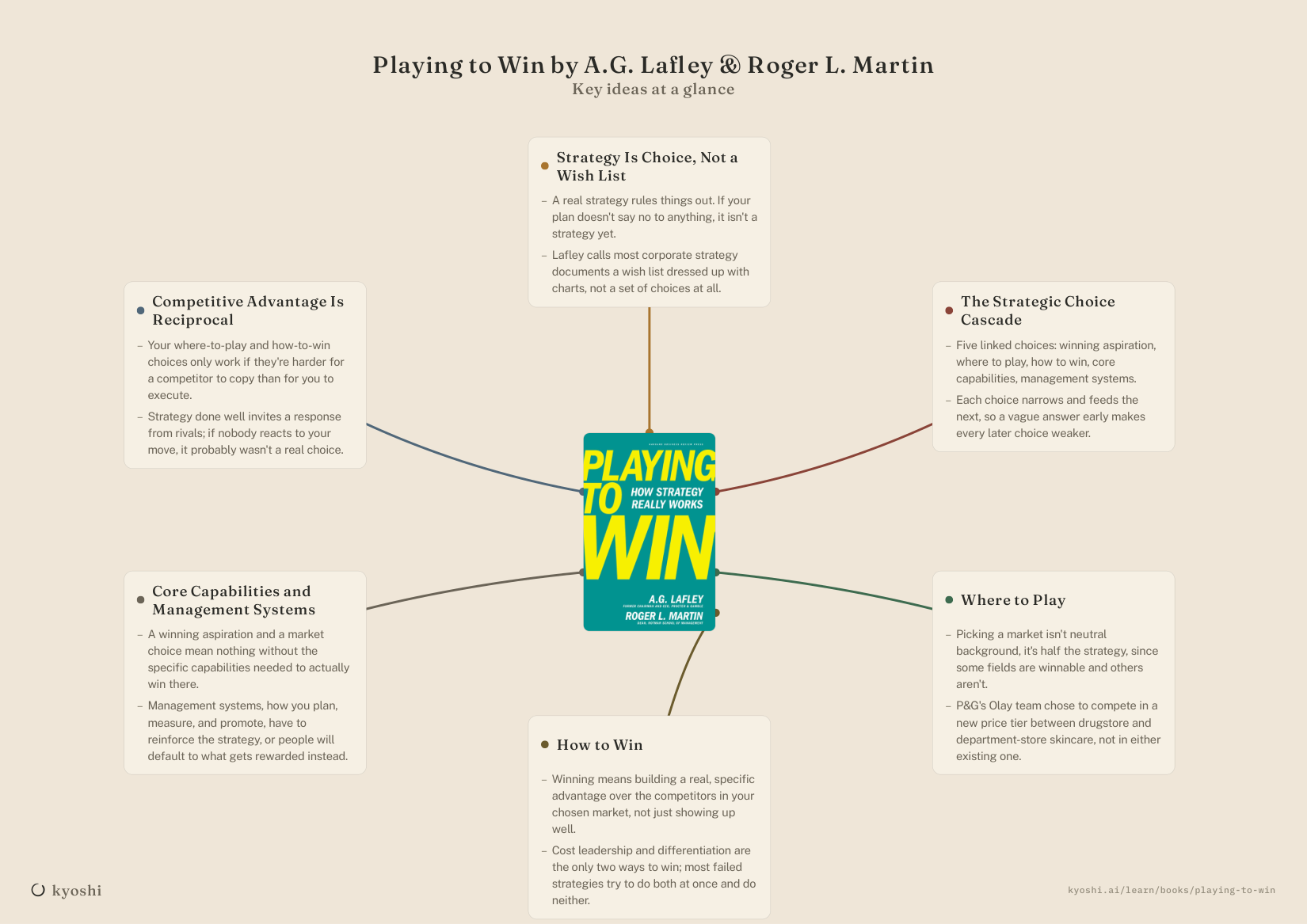
 Find this on the mind-map
Introduction
A.G. Lafley ran Procter & Gamble as CEO for most of the 2000s, and Roger Martin advised him for most of that decade as dean of the Rotman School of Management. Their shared argument in this book is that strategy fails far more often from vagueness than from bad judgment. Most leaders write mission statements, set financial targets, and call it strategy, when none of that actually commits the company to anything. Lafley and Martin insist that strategy is a set of integrated choices that position a company to win, and a real choice always means closing off other options, not keeping every door open.
Their proof is P&G itself. Under Lafley, the company's market capitalization grew by roughly 100 billion dollars and its sales roughly doubled, and the book works backward from specific brand decisions, Olay, Crest Whitestrips, Swiffer, to extract a repeatable way of thinking that produced those results. The book isn't a retrospective victory lap. It's a framework for making the next hard choice, built from having made several of them correctly in public, with real money on the table.
Strategy Is Choice, Not a Wish List
Lafley and Martin open with a blunt distinction: a wish list says what you'd like to happen, a strategy says what you're going to do about it, including what you're going to stop doing. A document full of aspirational language, "be the leader in innovation," "delight the customer," reads like strategy but commits nobody to any specific action, because it doesn't rule anything out.
The authors describe sitting through countless corporate strategy reviews where the plan was really a budget with a narrative wrapped around it, no actual choice about where to compete or how to beat a named competitor. A real strategic choice is falsifiable. You can point to it and say "if this is wrong, here's what will happen," because it staked out a specific position instead of hedging across all of them.
The test they offer is simple: if your company's strategy document would make equal sense with the name of any competitor swapped in, you haven't written a strategy. You've written an ambition. Strategy only exists the moment you choose a market and a way of winning that your specific company, not a generic one, is actually positioned to pull off.
The Strategic Choice Cascade
The book's central tool is what Lafley and Martin call the strategic choice cascade, five linked choices that together make up a strategy: what is our winning aspiration, where will we play, how will we win there, what capabilities must be in place, and what management systems are required to support those choices. They're drawn as a cascade rather than a checklist because each choice depends on the one above it and constrains the ones below it.
A winning aspiration that's too vague, "be a great company", gives the where-to-play choice nothing to work with. A where-to-play choice made without a real how-to-win plan just identifies an attractive market for someone else to win in. And a brilliant how-to-win idea that the organization lacks the capabilities to execute is just a slide, not a plan. The cascade forces each answer to be tested against the ones next to it, which is why the authors return to it, brand by brand, throughout the book rather than treating it as a one-time exercise.
What makes the cascade different from a generic strategy template is that it's meant to be run in both directions. You can start from an aspiration and cascade down, or notice a capability gap and climb back up to ask whether the how-to-win choice above it was ever realistic in the first place.
Where to Play
Where to play is the choice of which market, which customer segment, which geography, which channel, a company will compete in, and Lafley and Martin treat it as inseparable from how to win, because the right way to win changes completely depending on where you've chosen to compete. Choosing to serve budget-conscious shoppers in a discount channel calls for a different capability set than choosing to serve premium buyers through specialty retail, even if the underlying product category is identical.
The book's clearest illustration is Olay. The brand had been sold for years purely as a mass-market product through drugstores and discount retailers, competing on price against other mass skincare lines. Rather than attempt to move Olay upmarket into department stores against prestige competitors, P&G chose to create an entirely new tier it called masstige, a prestige-style product sold through existing mass channels at a price well above typical drugstore skincare but below department-store prestige brands. That where-to-play choice, a tier that didn't quite exist yet, was itself most of the strategy.
The lesson Lafley draws is that where to play is not a neutral staging decision you make before the real strategic thinking starts. Picking the wrong market can make even a well-executed how-to-win plan worthless, because you're fighting for share in a place where your particular strengths don't matter.
How to Win
Having chosen where to compete, a company then has to choose how it will build an actual advantage there, and Lafley and Martin argue there are fundamentally two ways: cost leadership, being the lowest-cost producer in your chosen arena, or differentiation, offering something distinct enough that customers will pay for it over the alternatives. Most companies that struggle, in their account, are trying to do a blurry version of both at once, which usually means they're not truly winning at either.
With Olay repositioned into the masstige tier, the how-to-win choice P&G made was to offer a product with the look, packaging, and claimed efficacy of a prestige skincare line, at a price point and through a purchasing experience that was dramatically more convenient than a department-store counter. The $18.99 Olay Total Effects launch embodied that choice directly: prestige-level product experience, mass-market price and access. The brand grew from a few hundred million dollars in sales to several billion within a handful of years once that specific combination clicked.
The authors are explicit that how-to-win only means something once it's tied to a specific where-to-play choice. "Win on quality" said about no particular market is not a strategy, it's a value. Said about a defined tier against named competitors, it becomes a testable claim.
Core Capabilities and Management Systems
The last two boxes in the cascade are easy to skip past, and Lafley and Martin insist they're where most strategies actually die. Core capabilities are the specific activities and resources a company needs to execute its how-to-win choice, not a generic list of strengths but the particular combination that this specific play requires. Winning the masstige tier required P&G to have skin-science research capability credible enough to support a prestige claim, manufacturing and packaging able to hit that premium look at mass-production cost, and a retail relationship strong enough to get prime shelf placement next to prestige competitors in a drugstore aisle.
Management systems are the plans, measures, and processes that keep the organization actually pursuing the chosen strategy day to day, not just on the slide that got approved. A company can make all four prior choices well and still drift away from them if its budgeting process rewards short-term volume over the brand investment the how-to-win choice requires, or if its promotion criteria favor managers who protect the old business over ones who build the new tier, without anyone deciding that on purpose.
Lafley and Martin's point is that capabilities and systems aren't implementation details bolted onto a strategy after the real thinking is done. They're part of the choice itself, because a how-to-win idea the organization structurally cannot support was never actually a viable choice in the first place.
Competitive Advantage Is Reciprocal
The authors close the cascade with a reminder that strategy isn't a solo exercise. Your where-to-play and how-to-win choices only produce an advantage if they're harder for competitors to copy or counter than they were for you to build, which means a real strategic choice should provoke a reaction. If competitors can shrug off your move without changing anything they do, you likely picked a battle nobody else wanted to fight, which isn't the same as winning one.
When P&G's Olay move succeeded, competitors eventually responded by trying their own entries into the masstige tier, which confirms the choice had been a real one worth reacting to. Lafley and Martin use this to push leaders past the comfort of a strategy that looks good on paper toward one that actually changes the competitive dynamics of the market they chose.
Putting It Together
Strategy, in Lafley and Martin's account, is the discipline of answering five connected questions honestly and specifically: what does winning look like, where exactly will we compete, how exactly will we beat specific rivals there, what do we need to be able to do that we can't do yet, and what systems will keep us doing it. Skip any one of them, or answer it vaguely enough to avoid real commitment, and you have an aspiration, not a strategy, no matter how polished the deck.
Why It Matters for Leaders
The hardest part of this book for most managers isn't understanding the cascade, it's accepting that a real strategic choice has to close doors. Leaders are trained to sound inclusive and keep options open, and a genuine where-to-play decision does the opposite: it means telling your team, and sometimes your boss, that you are choosing not to compete for a customer segment or a deal type that's sitting right there.
The practical shift is to stop writing strategy documents that could apply to any company in your industry and start writing ones that would be obviously wrong for your nearest competitor to copy verbatim. If your plan reads the same with a rival's logo on it, you haven't made a choice yet, you've made a wish. Run the cascade as five separate, specific sentences, not five bullet points that restate the same ambition five ways.
The second shift is further down the cascade than most leaders go. Teams get energized writing the winning aspiration and arguing over where to play, and then skip the capabilities and systems questions, usually without noticing, because they feel like operational detail rather than strategy. Lafley and Martin's point is that this is exactly where strategies actually fail: the where-to-play choice was fine, but nobody changed the budgeting process or the hiring plan to match it, so the organization kept behaving like it was still playing the old game.
Picture a product lead, Miguel, pitching a plan to move his software line from competing on raw feature count against every rival in the market to competing specifically for mid-size operations teams who need reliability over flashiness. The where-to-play choice is sharp, and the how-to-win story, fewer features, far higher uptime guarantees, lands well in the room. Before presenting it upward, Miguel forces himself through the last two boxes of the cascade: his team's current on-call rotation and incident response process are built for fast iteration, not five-nines reliability, and his manager's performance reviews still reward shipped features over uptime. He rewrites the proposal to include a specific capability investment, a dedicated reliability engineering function, and a change to how his managers get evaluated, before the strategy goes to his VP. The plan that gets approved commits to something a competitor would have to genuinely struggle to copy, because it isn't just a market choice, it's a market choice backed by the operational changes that make it real.
What to do next
Reinforce your understanding of Playing to Win
Books related to Playing to Win

Blue Ocean Strategy
W. Chan Kim and Renée Mauborgne's case that the biggest strategic wins come from creating uncontested market space instead of fighting over an existing one. They lay out a concrete method for finding it, built around dropping the trade-off between low cost and high value.

Built to Last
Collins and Porras' earlier, lesser-known study of visionary companies: the research that came before Good to Great, built around a single hard question: what actually survives past the founder, the product, and the current strategy?

Crossing the Chasm
Geoffrey Moore's explanation for why so many breakthrough technologies die right after their early fans love them. He maps the specific gap between early adopters and the mainstream market, and lays out the beachhead strategy that gets a product across it.

Good Strategy Bad Strategy
Richard Rumelt's blunt case that most of what gets called "strategy" in a typical planning meeting is actually a wish list dressed up in strategic language, plus a concrete test for telling the two apart.

Good to Great
Jim Collins' research into why some companies go from average to sustained market dominance, and others don't. Read less as a book about companies and more as a book about the kind of leader you have to become before a company (or a team) can get great.

Start With Why
Simon Sinek's argument that people don't buy what you do, they buy why you do it, and that most organizations have never actually answered the question, even the ones that think they have.

Sun Tzu and The Art of Business
Mark McNeilly's translation of Sun Tzu's 2,500-year-old military strategy into six concrete business principles, built around a point most business books skip: the best wins are the ones nobody had to fight for.

The Art of War
The original 2,500-year-old military treatise, read the way most modern leaders actually use it. Not as a manual for fighting better, but as a manual for needing to fight less.

The Infinite Game
Simon Sinek's case that most leaders are playing the wrong game entirely: treating an endless competition as something you can win, when the only real goal is staying in it, strong enough to keep playing.

The Innovator's Dilemma
Clayton Christensen's answer to a puzzle that looks impossible: well-run companies, doing everything their best customers ask for, still lose to products that look worse on every spec sheet, right up until the moment they don't. The book every leader cites and few actually apply to their own team.

Traction: Get a Grip on Your Business
Gino Wickman's case that most founders don't have a strategy problem, they have an execution problem, and his Entrepreneurial Operating System for closing the gap between the vision in a leader's head and what actually happens on a Tuesday.

Walmart
A retail-industry case study of how Walmart built, and is now fighting to defend, the position it spent sixty years earning. Less a biography of Sam Walton and more a hard look at what scale economics can and can't protect you from in the age of Amazon.

Your Next Five Moves
Patrick Bet-David's chess-inspired framework for strategic leadership, built around five "moves" every founder or executive has to master in order, from knowing yourself to running power plays against bigger competitors, instead of just reacting to whatever just happened.
Skills related to Playing to Win

Business Strategy
Making the focused calls about where to compete, what to prioritize, and what to say no to, because a strategy is defined as much by what it rules out as by what it commits to.

Strategic Thinking
Stepping back to see where things are heading, and actually letting that change what you do today.
Frameworks related to Playing to Win

BCG Matrix
A 2x2 that sorts products or units by market growth and share — telling you what to fund, milk, or kill.

McKinsey's Three Horizons Model
Split your team's effort across three time frames — defend the core, grow what's emerging, seed future bets — without mortgaging tomorrow.

Mind Boxing
A six-box grid crossing People, Process, Product against Strategy and Tactics — deciding where your leadership time actually goes.

Porter's Five Forces
Porter's answer to why some industries are brutal for profit — five forces shaping any market, telling you where to compete.

Rumelt's Kernel
Richard Rumelt's test for telling a real strategy from a list of goals — a diagnosis, a guiding policy, and coherent actions. Miss any one of the three and what you have is a wish, not a strategy.

The Innovator's Dilemma
Clayton Christensen's explanation for why great companies fail doing everything right — serving your best customers blinds you to cheap newcomers.