Blue Ocean Strategy
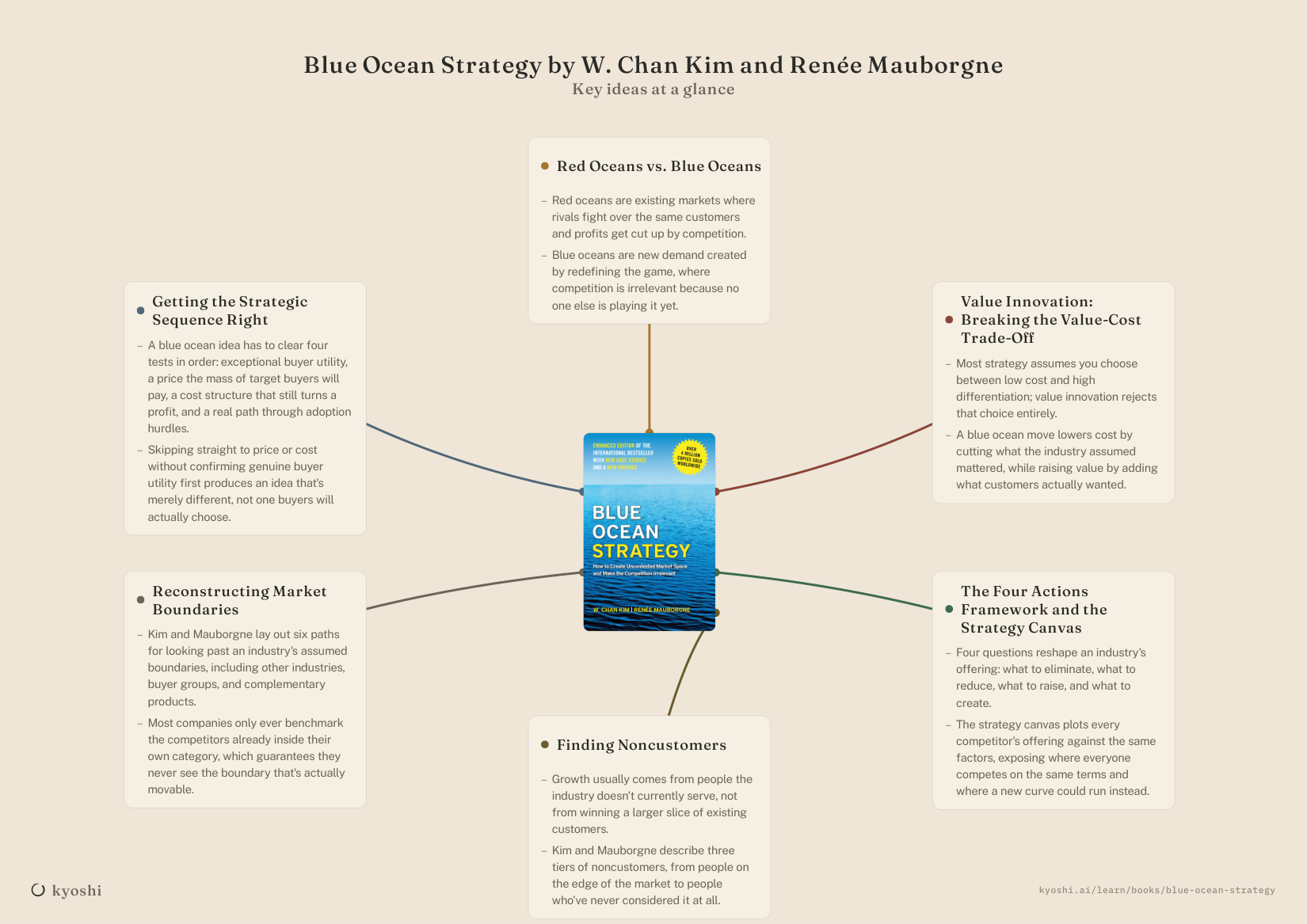
W. Chan Kim and Renée Mauborgne's case that the biggest strategic wins come from creating uncontested market space instead of fighting over an existing one. They lay out a concrete method for finding it, built around dropping the trade-off between low cost and high value.
 Find this on the mind-map
Introduction
Kim and Mauborgne's starting observation, published in 2005, is that most strategy work is really just competition work: companies study their rivals, match their features, undercut their prices, and fight for share inside a market everyone already agrees is the market. They call that a red ocean, bloodied by competitors fighting over the same customers. Their alternative is the blue ocean: a new market space a company creates by changing what's actually being competed on, where there's no established rival to out-compete because the space didn't exist as a category before.
The book's biggest departure from conventional strategy is refusing to accept the trade-off between low cost and high differentiation that most strategy frameworks treat as a law of nature. Kim and Mauborgne argue you can pursue both at once, not by compromising between them but by changing what you're even measuring, and they built a repeatable method for finding where that's possible rather than leaving it to inspiration.
Red Oceans vs. Blue Oceans
A red ocean is any market as currently defined: a known set of competitors, a known set of customers, and an established set of rules about what makes an offering better. Companies in a red ocean improve by beating the competition on the industry's existing terms, which eventually commoditizes everything and leaves profit margins thin for everybody.
A blue ocean isn't a market a company found. It's a market a company made, by offering something genuinely different on a different set of terms, so that existing competitors simply aren't relevant to the comparison a buyer is making. Cirque du Soleil, the book's opening example, didn't try to be a better circus than the traditional circus. It redefined what a circus performance could even be, dropping animal acts and star performers, built instead around theatrical storytelling, and ended up competing against neither traditional circuses nor theater, because it occupied a space between the two that nobody else had named.
Value Innovation: Breaking the Value-Cost Trade-Off
Conventional strategy treats cost and value as opposite ends of a dial: spend more to differentiate, or cut cost and accept a plainer product. Kim and Mauborgne call the alternative value innovation, where a company lowers its cost structure by eliminating features the industry assumed were essential but that most customers never valued, and uses part of that savings to add real value the industry had never offered.
Casella Wines built Yellow Tail this way. Rather than competing against established wine brands on the attributes serious wine drinkers care about, vintage, tannin, region, complexity, Casella stripped those out entirely and built a simple, approachable wine aimed at people who normally drank beer or cocktails. Cutting the costly attributes wine experts valued funded the easy, fun positioning that opened an entirely new set of drinkers to wine in the first place.
The Four Actions Framework and the Strategy Canvas
Kim and Mauborgne's signature tool for finding a blue ocean is the four actions framework, four questions applied to an industry's standard set of competitive factors: which factors the industry takes for granted should be eliminated entirely, which factors should be reduced well below the industry standard, which factors should be raised well above it, and which entirely new factors should be created that the industry has never offered. Eliminating and reducing lower the cost structure; raising and creating lift the value a buyer actually gets, and running all four at once is what breaks the value-cost trade-off instead of just picking a side of it.
The strategy canvas is the picture that makes this concrete: plot every major competitor's offering as a line across the same set of factors, and most industries show every competitor's line running roughly parallel, all competing on the same terms at different intensities. A blue ocean move produces a visibly different curve, one that drops entirely on some factors and spikes on others, which is exactly what makes it uncompetitive to compare against the pack rather than just better than it. Southwest Airlines' curve, against full-service carriers, dropped meals, lounges, and seat assignments and raised frequency and friendliness, competing less against other airlines than against driving.
Finding Noncustomers
Most companies chase a bigger share of their existing customers, which is exactly why red oceans stay bloody: everyone's fighting over the same pool of people. Kim and Mauborgne argue the bigger opportunity usually sits with noncustomers, people the industry currently doesn't serve at all, and they break that group into three tiers: soon-to-be noncustomers who already use the industry's offering minimally and are ready to leave, refusing noncustomers who've consciously chosen a different solution to the same need, and unexplored noncustomers who were never considered part of the market in the first place.
Yellow Tail again: Casella wasn't trying to win drinkers away from wine snobs. It was going after beer and cocktail drinkers who'd never seriously considered wine, an unexplored noncustomer tier the entire wine industry had implicitly written off as unreachable.
Reconstructing Market Boundaries
Kim and Mauborgne argue that most strategists accept their industry's boundaries as given and then do everything they can inside them, which is itself the reason blue oceans go undiscovered. They lay out six specific paths for looking past those boundaries: across alternative industries that solve the same underlying need differently, across strategic groups within an industry, across the chain of buyers and users involved in a purchase, across complementary products and services, across functional versus emotional appeal, and across time, by tracking the trends already reshaping an industry rather than reacting once they've already arrived.
NetJets looked across an alternative industry, not at other airlines but at car ownership, and asked what owning a fraction of a jet could borrow from how people already thought about owning a fraction of their time and money. The resulting fractional-ownership model competed against neither commercial air travel nor full private jet ownership. It created a third option nobody in either industry had framed as the competition.
Getting the Strategic Sequence Right
An idea that looks like a blue ocean on a whiteboard still has to clear four tests, in a specific order, before it's a real strategy. First, exceptional buyer utility: does this actually solve a problem or remove a pain point buyers currently tolerate. Second, a strategic price: is it priced so the mass of target buyers can and will pay it, not just a premium niche. Third, a cost target that still lets the company profit at that price. Fourth, a real plan for the adoption hurdles, employees, partners, and the public, that could block the idea even if the first three tests pass.
The sequence matters because skipping to price or cost first produces an idea that's merely cheaper or merely different, not one with a real pull on buyers. A new offering that nails cost and price but never confirmed genuine buyer utility first is usually a red ocean price war wearing a blue ocean label.
Putting It Together
The method runs in one direction: stop measuring your offering against rivals inside a red ocean, and instead use the four actions framework and the strategy canvas to find a genuinely different curve, aimed at the noncustomers your industry has written off, often by looking past your own industry's assumed boundaries entirely. Running that new idea through the four tests in sequence, utility, price, cost, adoption, is what separates a blue ocean strategy from a slogan.
Why It Matters for Leaders
The hardest part of this book for a working leader isn't the four actions framework, it's the discipline of refusing the trade-off question entirely. Most planning conversations ask "do we compete on price or on differentiation," and that question already assumes you're staying in the red ocean, just picking which side of it to lose on more slowly. Kim and Mauborgne's method starts by rejecting the question, not answering it.
The harder practical shift is spending real time studying people who don't buy from your industry at all, rather than running another survey of your current customers. Current customers will tell you how to be a slightly better version of what already exists. Noncustomers are the only group who can tell you what's actually keeping an entire category of people out, and that answer is usually more useful than anything your best customer could say.
The strategy canvas is also a fast way to catch a team settling back into a red ocean without noticing it. If every factor on your canvas tracks closely with your two biggest competitors, that's not a sign of strength, it's a sign you're all competing on the same terms, which means price is the only lever left.
Picture a product leader, Naomi, at a mid-size fitness-equipment company, watching her team's roadmap fill up with the same features the market leader just shipped: better sensors, more subscription tiers, a sleeker app. Instead of approving the roadmap, she asks the team to spend two weeks not studying competitors but interviewing people who've never bought home fitness equipment at all, people who find every existing option either too intimidating or too expensive to commit to. The team comes back with an idea that eliminates the complicated app and the monthly subscription entirely, reduces the machine to one function done well, and creates a flat one-time price with no onboarding required. It's a worse fit for the serious home-gym buyer the competition is fighting over, and a far better fit for the much larger group who'd never seriously considered buying anything at all. Naomi's canvas, next to the two incumbents, doesn't run parallel to either one anymore.
What to do next
Reinforce your understanding of Blue Ocean Strategy
Books related to Blue Ocean Strategy

Built to Last
Collins and Porras' earlier, lesser-known study of visionary companies: the research that came before Good to Great, built around a single hard question: what actually survives past the founder, the product, and the current strategy?

Crossing the Chasm
Geoffrey Moore's explanation for why so many breakthrough technologies die right after their early fans love them. He maps the specific gap between early adopters and the mainstream market, and lays out the beachhead strategy that gets a product across it.

Good Strategy Bad Strategy
Richard Rumelt's blunt case that most of what gets called "strategy" in a typical planning meeting is actually a wish list dressed up in strategic language, plus a concrete test for telling the two apart.

Good to Great
Jim Collins' research into why some companies go from average to sustained market dominance, and others don't. Read less as a book about companies and more as a book about the kind of leader you have to become before a company (or a team) can get great.

Playing to Win
A.G. Lafley and Roger Martin's case that strategy is not a plan or a mission statement, it is a small set of hard choices about where to compete and how to win there, made with the same discipline P&G used to double its revenue.

Start With Why
Simon Sinek's argument that people don't buy what you do, they buy why you do it, and that most organizations have never actually answered the question, even the ones that think they have.

Sun Tzu and The Art of Business
Mark McNeilly's translation of Sun Tzu's 2,500-year-old military strategy into six concrete business principles, built around a point most business books skip: the best wins are the ones nobody had to fight for.

The Art of War
The original 2,500-year-old military treatise, read the way most modern leaders actually use it. Not as a manual for fighting better, but as a manual for needing to fight less.

The Infinite Game
Simon Sinek's case that most leaders are playing the wrong game entirely: treating an endless competition as something you can win, when the only real goal is staying in it, strong enough to keep playing.

The Innovator's Dilemma
Clayton Christensen's answer to a puzzle that looks impossible: well-run companies, doing everything their best customers ask for, still lose to products that look worse on every spec sheet, right up until the moment they don't. The book every leader cites and few actually apply to their own team.

Traction: Get a Grip on Your Business
Gino Wickman's case that most founders don't have a strategy problem, they have an execution problem, and his Entrepreneurial Operating System for closing the gap between the vision in a leader's head and what actually happens on a Tuesday.

Walmart
A retail-industry case study of how Walmart built, and is now fighting to defend, the position it spent sixty years earning. Less a biography of Sam Walton and more a hard look at what scale economics can and can't protect you from in the age of Amazon.

Your Next Five Moves
Patrick Bet-David's chess-inspired framework for strategic leadership, built around five "moves" every founder or executive has to master in order, from knowing yourself to running power plays against bigger competitors, instead of just reacting to whatever just happened.
Skills related to Blue Ocean Strategy

Business Strategy
Making the focused calls about where to compete, what to prioritize, and what to say no to, because a strategy is defined as much by what it rules out as by what it commits to.

Strategic Thinking
Stepping back to see where things are heading, and actually letting that change what you do today.
Frameworks related to Blue Ocean Strategy

BCG Matrix
A 2x2 that sorts products or units by market growth and share — telling you what to fund, milk, or kill.

McKinsey's Three Horizons Model
Split your team's effort across three time frames — defend the core, grow what's emerging, seed future bets — without mortgaging tomorrow.

Mind Boxing
A six-box grid crossing People, Process, Product against Strategy and Tactics — deciding where your leadership time actually goes.

Porter's Five Forces
Porter's answer to why some industries are brutal for profit — five forces shaping any market, telling you where to compete.

Rumelt's Kernel
Richard Rumelt's test for telling a real strategy from a list of goals — a diagnosis, a guiding policy, and coherent actions. Miss any one of the three and what you have is a wish, not a strategy.

The Innovator's Dilemma
Clayton Christensen's explanation for why great companies fail doing everything right — serving your best customers blinds you to cheap newcomers.