The Lean Startup
Eric Ries turns his own near-collapse at a startup called IMVU into a full method for building new products under uncertainty. The book argues that speed comes from validated learning, not from working harder, and gives managers a disciplined way to tell real progress from a good-looking slide.
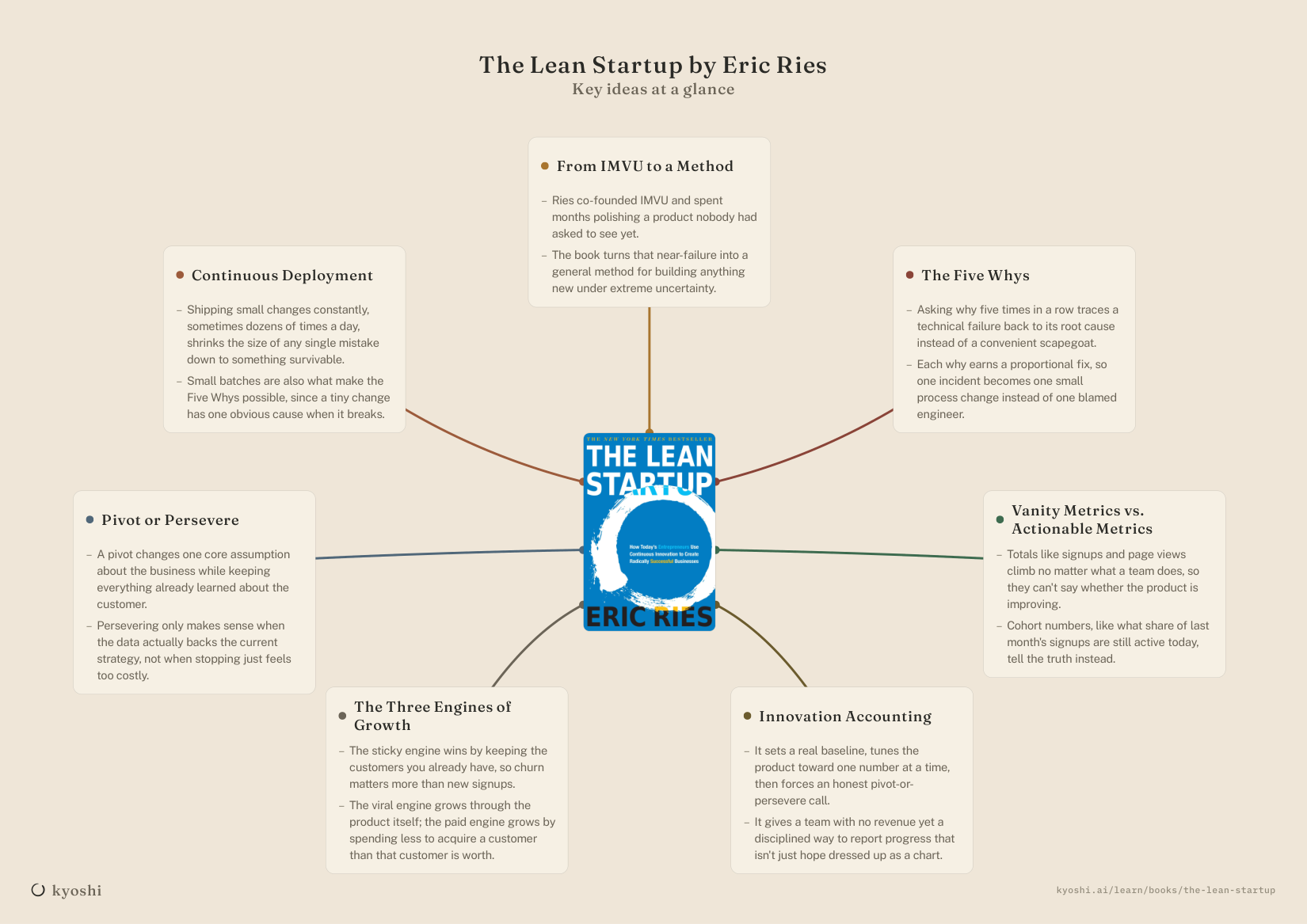
 Find this on the mind-map
Introduction
Eric Ries wrote this book out of his own failure. At his startup IMVU, he and his co-founders spent months in a windowless room building a 3D avatar chat product, writing detailed specs, hiring engineers, and polishing features before a single customer had asked for any of it. The product flopped. Ries's conclusion wasn't that the team worked too slowly or hired the wrong people. It was that they'd been extremely efficient at building something nobody wanted, and efficiency at the wrong thing is worse than doing nothing at all.
His fix borrows two ideas from places you wouldn't expect a startup book to look: lean manufacturing at Toyota, and Steve Blank's customer development process. The combination produces a simple reframe. A startup, or any new initiative inside an existing company, isn't a smaller version of a real business. It's an institution designed to create something new under conditions of extreme uncertainty, and its job is to find out whether a plan is true before the money or the runway runs out.
The book spends less time on the Build-Measure-Learn loop itself, which is covered elsewhere, and more time on the specific tools that make the loop honest: how to diagnose a failure without a witch hunt, how to tell a real number from a flattering one, how to grow a product once an idea is validated, and how to know when you're pivoting versus when you're just rationalizing a bad bet.
From IMVU to a Method
IMVU's early strategy looked disciplined on paper. The team researched competitors, wrote a business plan, and built a feature-complete product before launch, the way you'd build almost anything else worth doing well. Ries describes discovering, slowly and painfully, that none of the research had tested the one assumption that actually mattered: whether people wanted a 3D avatar chat client bundled with existing instant messengers at all. They'd built a very well-engineered answer to a question nobody asked.
The company survived by inverting the process. Instead of building the whole product and then testing it, IMVU shipped a stripped-down version in days, watched what actual users did with it, and let that behavior, not the founders' opinions, decide what got built next. Ries generalizes this into a claim that applies far outside startups: any team building something genuinely new is making guesses, and the guesses should be labeled as guesses and tested cheaply, not built out at full scale on faith.
A product team inside a large company runs into the same trap IMVU did when it spends two quarters building a "platform" before anyone outside the team has touched it. The platform might be excellent. It might also be solving a problem that doesn't exist, and nobody will know until the money is already spent.
The Five Whys
The Five Whys comes from Toyota's shop floor, and Ries adopts it as the debugging tool for a growing company's own mistakes. The method is almost absurdly simple: when something goes wrong, ask why it happened, then ask why that happened, and keep going five levels deep. A server outage traces back to a bug, which traces back to a missing test, which traces back to an engineer who didn't know the testing convention, which traces back to incomplete onboarding, which traces back to a hiring process that moved too fast to teach it properly.
The point of going five levels deep is that the first answer is almost always a person, and the fifth answer is almost always a process. Ries's rule is that the fix should be invested in proportion to the pain the mistake caused: a small bug gets a small fix, a major outage earns real time spent repairing the process that allowed it. Skip the exercise and a team re-blames the same category of mistake on a different person every few months, convinced each time that this one was an unlucky exception.
The habit only works if the room trusts that asking "why" won't turn into finding someone to fire. The first time a Five Whys session is used to build a case against an individual, nobody will answer honestly in the next one.
Vanity Metrics vs. Actionable Metrics
Vanity metrics are the ones that go up no matter what a team does: total registered users, cumulative downloads, total page views. They look great in a board deck because the line always slopes upward, and that's exactly the problem. A number that improves regardless of whether the product is actually getting better can't tell a team anything useful, and a team that optimizes for it is optimizing for a chart, not a business.
Actionable metrics are tied to a specific, repeatable action and broken out by cohort: what percentage of people who signed up in March are still active sixty days later, compared to the cohort that signed up in April after a product change. If the April number is better, the change worked. If it's the same, the change didn't matter no matter how good it felt to ship.
Ries's test for any metric a team wants to report is whether it's actionable, accessible, and auditable: does it show a clear cause and effect, can everyone see it in a format they understand, and is it credible enough that people trust it instead of ignoring it the first time it says something they didn't want to hear.
Innovation Accounting
Traditional accounting assumes you already know your business model and just need to track performance against it. Innovation accounting is for the period before that's true. It runs in three steps: establish a real baseline using an early, imperfect version of the product and honest actionable metrics, tune the engine by running experiments that try to move that baseline number, and then make the pivot-or-persevere decision once the tuning has run its course.
This matters most to the people a team reports to. Without innovation accounting, a founder or a department head defending a new initiative only has a story to tell, and stories are persuasive regardless of whether they're true. With it, the initiative has a number that was predicted in advance and either moved or didn't, which turns a status update from a performance into an actual report.
A team that skips this step tends to report "we shipped the feature" as if shipping were the goal. Innovation accounting insists the goal was always the number the feature was supposed to move, and shipping is just the method.
The Three Engines of Growth
Ries names three engines that sustain a company once the core product works, and argues that most companies should pick one to focus on rather than chasing all three loosely at once. The sticky engine grows by retaining customers: a company using it should watch new customer acquisition less than it watches churn, because keeping the customers already won matters more than adding new ones who'll leave at the same rate.
The viral engine grows because the product itself spreads from user to user as a side effect of normal use, not because of a referral bonus bolted on top. Its health depends on the viral coefficient, meaning how many new users each existing user brings in; above one, the product grows on its own, below one, it needs another source of fuel. The paid engine grows the oldest-fashioned way: a company spends money to acquire a customer and that customer is worth more over their lifetime than the acquisition cost, and the whole engine lives or dies on that one gap holding up.
A team that mixes all three measurement systems at once usually ends up unable to explain why growth sped up or slowed down last month, because three different mechanisms are moving the same top-line number for three different reasons. Picking one engine and measuring it honestly is what makes growth explainable instead of mysterious.
Pivot or Persevere
A pivot, in Ries's specific sense, is not giving up. It's a structured course correction that changes one fundamental assumption about the business while keeping everything the team already validated about the customer, the problem, or the channel. He catalogs several types: a zoom-in pivot narrows a whole product down to one feature that turned out to be the thing people actually wanted; a customer segment pivot keeps the product the same but targets a different buyer who values it more; a platform pivot turns a single application into a platform other products build on, or the reverse.
The decision to pivot or persevere is supposed to happen on a schedule, not only in a crisis. Ries recommends a regular pivot-or-persevere meeting where the team looks honestly at whether the metrics moved the way the hypothesis predicted. If they did, persevere. If they consistently didn't, across more than one honest attempt to fix it, pivot.
The hardest part isn't deciding to pivot once the data says so. It's resisting the pull to persevere anyway because the team has already invested a year of identity into the current direction. A pivot done on schedule, backed by a number that was agreed on in advance, is a decision. A pivot done only after months of denial is usually a layoff.
Continuous Deployment
IMVU shipped code to production as often as fifty times a day by the time Ries left, which sounds reckless until you see the logic. Small, frequent deployments mean any single change is small enough that if something breaks, the cause is obvious: it was almost certainly the last thing that shipped. Large, infrequent releases bundle hundreds of changes together, so when something breaks, nobody can say which of them caused it.
This connects directly back to the Five Whys. A root-cause investigation is only fast when the batch of changes under suspicion is small. Continuous deployment isn't just an engineering preference for shipping fast; it's what makes the whole diagnostic apparatus of the book actually usable in practice.
Teams that ship quarterly tend to treat every release as a high-stakes event, which makes them conservative about what goes into it and slow to learn whether any individual change actually helped. Teams that ship daily or hourly treat each release as one more small experiment, which is the entire point.
Putting It Together
Every piece connects back to one discipline: tell the difference between activity and learning, and refuse to let a good story substitute for an honest number. The Five Whys keeps mistakes from being blamed on people instead of processes. Actionable metrics and innovation accounting keep a team from mistaking a rising vanity chart for real progress. The growth engines explain why a number is moving instead of leaving it a mystery. Pivot-or-persevere turns a gut decision into a scheduled one backed by data. Continuous deployment makes all of the above fast enough to matter before the runway runs out.
Why It Matters for Leaders
Most managers already believe in moving fast. What this book actually demands is harder: moving fast in a way that produces proof instead of just output. A team can ship constantly and still be building the wrong thing efficiently, which is exactly the trap Ries fell into at IMVU before he had a method for catching it.
The practical shift is to require a number before funding a bet, not after. Before approving a new initiative, a manager using this book's logic asks what metric will move if the idea is right, what number would prove it's wrong, and how soon the team can know. That single habit turns every roadmap item from an act of faith into a testable claim, and it removes the awkward political problem of killing a project: if the hypothesis was written down and the number didn't move, ending it is a result, not a verdict on the people who tried.
It also changes how a manager runs a postmortem. Instead of asking who's responsible when something breaks, the Five Whys asks what sequence of small gaps let it happen, and fixes the gap closest to the root rather than the person closest to the mistake. That's a harder discipline to hold onto under pressure, because blaming a person is faster and feels more satisfying in the moment than fixing a process.
Picture Ingrid, a product director at a mid-size company, reviewing a proposal from her team to spend the next two quarters building a new onboarding flow because "users are confused." Instead of approving the full build, she asks the team to name the actionable metric it's supposed to move, settles on seven-day activation rate by new-signup cohort, and asks for a version that ships in two weeks instead of two quarters. The stripped-down version moves the number by four points, not the twenty they'd hoped for. Ingrid doesn't call that a failure. She calls it a validated direction with a weak lever, pivots the team toward a different part of the flow, and tells her own boss exactly what was learned and what it cost to learn it, which is a much easier conversation than explaining a finished project that didn't help anyone.
Frameworks referenced from this book

What to do next
Reinforce your understanding of The Lean Startup
Books related to The Lean Startup

High Output Management
Andy Grove's field manual for management as a production problem. Your output is the output of the people you influence, which reframes nearly everything a manager does as a question of leverage, not effort.

Team of Teams
General Stanley McChrystal's account of rebuilding a special-operations task force to fight a decentralized enemy network, and the argument that efficient hierarchy, the thing most organizations are explicitly built for, is the wrong design for a fast, complex environment.

The 4 Disciplines of Execution
Chris McChesney, Sean Covey, and Jim Huling draw on FranklinCovey's work with thousands of teams to explain why good strategy so often dies in the daily grind of running the business, and lay out the specific discipline a leader needs to protect a new goal from that grind.

Traction: Get a Grip on Your Business
Gino Wickman's case that most founders don't have a strategy problem, they have an execution problem, and his Entrepreneurial Operating System for closing the gap between the vision in a leader's head and what actually happens on a Tuesday.
Skills related to The Lean Startup

Frameworks related to The Lean Startup

Agile Methodology
Short cycles beat long plans — build a slice, ship it, get real feedback, adjust, and repeat until it fits.

Dreamboxing
A model for turning vision into disciplined execution by cycling through three stages — Dream, Drive, Do — rather than favoring one.

Managerial Leverage
Andy Grove's idea that a manager's output is their team's output, and that every meeting, decision, or process you run has a leverage value somewhere between high and negative.

The 4 Disciplines of Execution
Four disciplines for hitting your important goals: narrow focus, act on lead measures, keep a visible scoreboard, run weekly accountability.

The Value Triangle
A modern replacement for the Iron Triangle — swap cost, time, scope for investment, frequency, and incremental value — levers, not constraints.