The Trusted Advisor
David H. Maister, Charles H. Green & Robert M. Galford
Maister, Green, and Galford's argument that being trusted is a learnable skill, not a personality trait, and that the biggest thing standing between most advisors and real trust is how much of the conversation is secretly still about them.
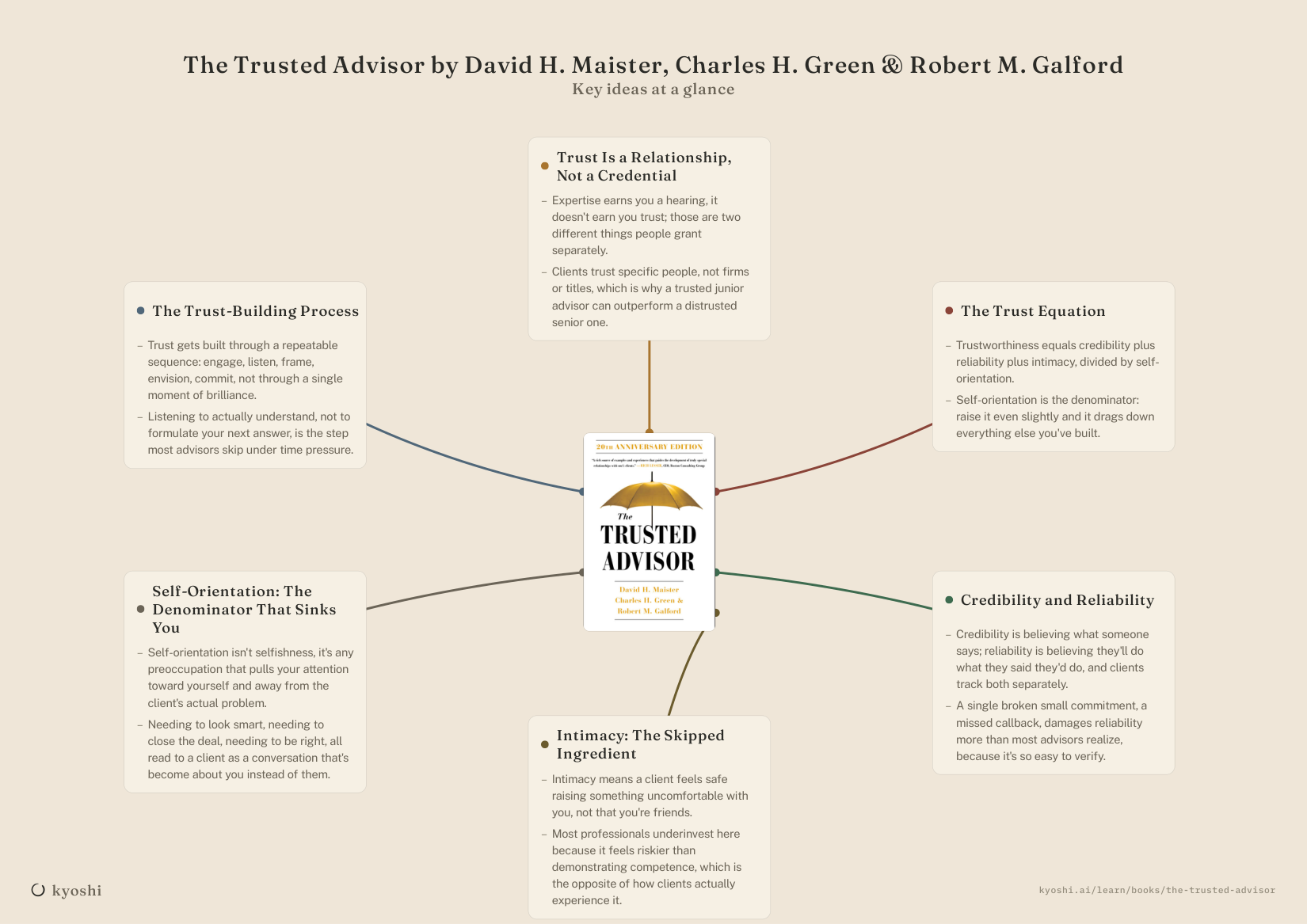
 Find this on the mind-map
Introduction
Maister, Green, and Galford start from an observation that should be obvious and mostly isn't: clients don't hire the smartest advisor available, they hire the one they trust most, and those are frequently not the same person. Technical competence gets you into the room. It doesn't determine whether the client tells you the real problem, takes your advice when it's inconvenient, or calls you again next time something goes wrong.
Their larger claim is that trustworthiness is not a fixed trait some people have and others lack. It's a skill built from specific, observable behaviors, which means it can be diagnosed when it's missing and deliberately strengthened when it's weak. The book is written for consultants and professional-services advisors, but its real subject is any relationship where one person is supposed to be helping another think through a hard problem, which covers most of what a manager or a coach actually does.
Trust Is a Relationship, Not a Credential
The authors open by separating two things people routinely confuse: being an expert and being trusted. Expertise is necessary to get a hearing, but it's a one-time entry ticket, not an ongoing source of trust. Clients don't re-evaluate your credentials every meeting. They evaluate, consciously or not, whether you're still behaving like someone who has their interests at heart.
This is also why trust is personal rather than institutional. A client doesn't trust a consulting firm, a law practice, or a company brand, they trust specific individuals inside it, and that trust doesn't automatically transfer when a new person from the same firm takes over the account. Maister, Green, and Galford point out that a junior advisor who has built real trust with a client will often get taken more seriously than a senior partner who's technically more credentialed but hasn't done the relationship work.
The practical implication is uncomfortable for anyone who assumes seniority or expertise does the work automatically. It doesn't. Trust has to be built person to person, and it has to be rebuilt every time the relationship changes hands.
The Trust Equation
The book's signature model is the trust equation, a way of making trustworthiness concrete instead of treating it as a vague quality some people have more of. The authors express it as trustworthiness equals credibility plus reliability plus intimacy, all divided by self-orientation. Credibility is about your words, whether people believe what you say is true and well-founded. Reliability is about your actions, whether people believe you'll actually do what you said you would. Intimacy is about emotional safety, whether someone feels secure raising something sensitive or uncomfortable with you. Self-orientation sits alone in the denominator, which is the equation's sharpest insight: it doesn't add to trust, it divides whatever trust the other three have built.
What makes the equation useful isn't the arithmetic, it's that it gives advisors a diagnostic instead of a single, blurry trust score. An advisor who's technically brilliant (high credibility) but misses deadlines (low reliability) is trusted less than their expertise alone would predict. An advisor who's reliable and credible but keeps the relationship entirely transactional (low intimacy) will never hear about the client's real, messier problem, only the sanitized version. And an advisor who's strong on all three but is visibly focused on winning the next contract (high self-orientation) will find that focus undercutting everything else, often without understanding why the client keeps hesitating.
Because self-orientation is a divisor, its effect isn't additive, it's corrosive across the whole relationship. A little bit of visible self-interest doesn't just subtract a little trust, it discounts the credibility, reliability, and intimacy you worked to build, all at once.
Credibility and Reliability
Credibility and reliability sound similar but fail in different ways, and the authors insist on keeping them separate. Credibility is earned through what you say: is it accurate, well-reasoned, and honest, including when the honest answer is one the client doesn't want to hear. Reliability is earned through what you do: does the thing you promised actually happen, on the timeline you said it would.
The authors note that reliability failures are often smaller and more frequent than credibility failures, and for that reason more damaging over time. A client may never catch a subtle analytical error, but they will absolutely notice a callback that didn't happen by the time you said it would, or a draft that showed up a day late without warning. Those small broken promises are easy for a client to verify and easy to remember, which is exactly why they erode trust faster than most advisors expect.
The fix the book proposes isn't dramatic, it's structural: make fewer promises, and keep every one of them, including the small ones that feel too minor to bother tracking. Reliability is built in exactly the moments that feel unimportant enough to skip.
Intimacy: The Skipped Ingredient
Of the four terms in the equation, intimacy is the one professionals most consistently underinvest in, and Maister, Green, and Galford spend real time on why. Intimacy in this context has nothing to do with friendship. It means a client believes they can bring you a problem that's embarrassing, political, or half-formed, and that you'll handle it with care rather than judgment or exposure.
Most advisors avoid building this deliberately because it feels riskier than demonstrating competence. Asking a client a genuinely personal question about what's actually worrying them feels like an overstep, while delivering another polished piece of analysis feels safe. The authors argue this instinct is backwards: competence is what gets you hired, but intimacy is what gets you told the truth, and advisors who skip it end up solving the problem the client described instead of the one that's actually hurting them.
The authors' practical advice is almost disarmingly simple: ask the uncomfortable question directly, and sit with the answer instead of rushing to solve it. A client who's never been asked "what's really worrying you about this" by an advisor will usually answer it, because almost nobody else has asked.
Self-Orientation: The Denominator That Sinks You
Self-orientation gets the most attention in the book because it's the hardest for advisors to see in themselves. It isn't the same as being selfish in an obvious way. It's any preoccupation, including well-intentioned ones, that pulls your attention toward your own performance, your own need to be seen as smart, your own eagerness to close the deal or be proven right, instead of toward the client's actual problem.
The authors point out that self-orientation often shows up disguised as diligence. An advisor who jumps in with the answer before the client finishes describing the problem looks eager and competent, but what the client experiences is someone who was more interested in demonstrating expertise than in actually understanding the situation. A salesperson anxious about hitting a quarterly number will, without saying a word about the quota, communicate that anxiety through small cues, which clients read instantly and trust less for having read.
The uncomfortable part of this section is that self-orientation is nearly invisible from the inside. Nobody consciously thinks "I'm about to prioritize looking smart over actually helping this person." It just happens, under pressure, in the form of interrupting, over-explaining, or steering the conversation toward the advisor's preferred solution a beat too early.
The Trust-Building Process
Having established what trust is made of, the authors turn to how it actually gets built in a real conversation, and they lay out a repeatable sequence: engage, listen, frame, envision, commit. Engage means establishing why this conversation matters to the other person specifically, not launching straight into content. Listen means genuinely taking in what's said, including what's implied underneath it, not just waiting for your turn to respond. Frame means playing back the problem in a way that shows you actually understood it, often surfacing something the client hadn't fully articulated themselves. Envision means painting a credible picture of what resolving the problem would look like. Commit means agreeing on a specific next step together.
The step advisors skip most often, according to the authors, is listening, specifically the kind of listening that happens before you've already decided what your answer is going to be. Most professionals listen just long enough to pattern-match the problem to a solution they already have ready, then stop actually taking in new information. The client experiences this as not being heard, even when the advisor's eventual advice turns out to be correct.
Trust, in this model, isn't built in a single dramatic moment of insight. It's built incrementally, through a series of ordinary conversations where the advisor consistently did the unglamorous parts, listening fully, following through on small commitments, asking the uncomfortable question, well.
Putting It Together
The whole argument collapses into one move: shift your attention, moment to moment, away from how you're coming across and toward what the other person actually needs. Credibility, reliability, and intimacy are all things you build by paying close, patient attention to someone else's problem. Self-orientation is what happens the instant your attention drifts back to yourself, and because it divides rather than merely subtracts, even a small amount undoes a disproportionate amount of the trust you worked to earn.
Why It Matters for Leaders
Managers and coaches are in the same position as the consultants this book was written for, people come to them with real problems and have to decide, often unconsciously, whether it's safe to be honest about what's actually going on. A manager who's technically sharp but whose team senses that every 1:1 is secretly about the manager's own standing with their boss will get the same polished, sanitized version of reality that a self-oriented consultant gets from a client. The team will bring problems once they're safe to report, not while they're still solvable.
The practical shift this book demands is noticing your own self-orientation in the moment, not after the fact. That means catching the impulse to jump in with a fix before someone finishes describing a problem, catching the internal pressure to look like you already knew the answer, and catching the moment a conversation turns, without anyone announcing it, into one about your own need to be useful rather than about what the other person needs. None of those impulses feel like selfishness from the inside. They feel like helpfulness, competence, or decisiveness, which is exactly why they're so easy to miss.
The second shift is treating reliability as seriously as the authors do, which is to say, more seriously than it feels like it deserves. Leaders often protect the big commitments and let the small ones slide, a callback a day late, a promised follow-up document that never arrives, assuming those don't register. They register. Each one is a small, easily verified data point a direct report uses to decide how much to actually trust the next big promise.
Picture a manager, Chidi, whose direct report mentions offhand in a 1:1 that a peer has been taking credit for her work in meetings Chidi doesn't attend. Chidi's first instinct is to immediately offer a fix, go talk to the peer, escalate it, solve it on the spot, because doing so would make him feel useful and in control. Instead, he remembers the trust equation and asks one more question before doing anything: "what would you want me to do here, and what would make this worse if I got it wrong." She tells him she doesn't want it escalated yet, she wants to try addressing it herself first and wants Chidi to simply know, in case it keeps happening. Chidi says that's exactly what he'll do, and then does nothing else, on purpose, until she asks. Two weeks later she comes back and tells him the full story, including a detail she'd left out the first time, because the first conversation proved he could be trusted with the smaller version.
What to do next
Reinforce your understanding of The Trusted Advisor
Books related to The Trusted Advisor

Crucial Conversations
A manager's guide to the book about the story you make up before you open your mouth. It's not really a book about talking, but about the half-second before you talk that decides whether the conversation goes well or badly.

Difficult Conversations
The Harvard Negotiation Project's case that every hard conversation you're avoiding is actually three conversations tangled together: a dispute over facts, a buried argument about feelings, and a quiet question about identity, and most people only ever engage the first one.

Games People Play
The psychiatrist who invented Transactional Analysis, explaining why so many conversations at work are really scripted performances with a hidden payoff. It's a guide to spotting the game before you're cast in a role you didn't agree to.

Getting to Yes
The original Harvard Negotiation Project playbook. Negotiate on interests and objective standards instead of trading positions back and forth, and you stop needing to choose between being "nice" and getting a good outcome.

Give and Take
Adam Grant's organizational-psychology case that how you handle reciprocity, giving, taking, or matching, predicts long-run success better than talent does, as long as you give the right way.

Good Leaders Ask Great Questions
John Maxwell's case that the single clearest sign a leader has stopped growing is that they've stopped asking real questions, and that the habit of asking, not the gift of answering, is what keeps a leader's judgment sharp over time.

How to Win Friends and Influence People
The original relationship-building classic, decades before "emotional intelligence" had a name. Carnegie's bet is that nearly every influence problem is actually an ego-management problem, yours and theirs.

Influence
A social psychologist's field guide to the handful of automatic triggers that make people say yes, written so you can recognize them when they're used on you, and use them honestly when you're the one asking.

Leadership is Language
David Marquet's argument, built from his time commanding a nuclear submarine, that the exact words a leader habitually uses either keep an organization stuck in command-and-control execution mode or genuinely open it up to better thinking. Most leaders have no idea which one their default language is doing.

Made to Stick
Why urban legends, conspiracy theories, and your most forgettable all-hands deck follow completely different rules, and the six ingredients Chip and Dan Heath found in every idea that actually sticks in people's heads, whether or not it deserves to.

Never Split the Difference
A former FBI lead hostage negotiator's case against "splitting the difference," negotiation isn't a logic problem you solve at the table, it's an emotional one you solve before you ever get there.

Quiet
Susan Cain's case against the modern workplace's "Extrovert Ideal": the unexamined assumption that the loudest, fastest-talking, most group-comfortable person in the room is automatically the most capable one, and what gets lost, specifically, when organizations build around that assumption.

Radical Candor
Kim Scott's case that most managers who avoid giving hard feedback think they're being kind, and are actually doing the least kind thing possible, because withheld feedback doesn't disappear, it just shows up later as a surprise.

Surrounded by Idiots
A blunt, color-coded field guide to why the person across the table from you seems to be speaking a different language, because, behaviorally, they basically are.

The 16 Undeniable Laws of Communication
John Maxwell's case that communication is not a personality trait some leaders are simply born with, it's sixteen learnable, named laws, grouped around who's speaking, what's said, how it's said, when it's said, and why it's said.

The 48 Laws of Power
Robert Greene's amoral compendium of how power actually moves through organizations and courts, stripped of any pretense that fairness or merit is what decides who wins. Useful as a decoder, dangerous as a playbook.

The 7 Habits of Highly Effective People
Stephen Covey's classic, read through a modern-manager lens. Many of the ideas taught today as "new" leadership frameworks were already captured here decades ago.
Skills related to The Trusted Advisor

Coaching
Helping people think, and take ownership of their own problems

Communication & Influence
Using narrative, story, and structure to inspire, align, and actually move people, not just inform them.
Frameworks related to The Trusted Advisor

Aristotle's Rhetoric
Aristotle's persuasion rests on three appeals — ethos (credibility), pathos (emotion), logos (logic) — use all three or your message won't land.

CLEAR Model
A five-stage coaching structure — Contract, Listen, Explore, Action, Review — that centers real listening and reflection before rushing to a plan.

Cleverness to Clarity
Drop corporate jargon for clear, direct language — three reasons (trust, speed, growth) and the 2N Formula for doing it.

FUEL Model
A four-stage coaching model — Frame, Understand, Explore, Lay out a plan — built for managers, ending in an actual plan.

STAR Technique
Turn an experience into evidence in four parts — Situation, Task, Action, Result — to advocate for your people, make the case.

T-GROW
A five-stage coaching structure — Topic, Goal, Reality, Options, Way Forward — that names what's actually worth discussing before it moves you from where you are to where you want to be.

The Four Leadership Support Roles
A 2x2 separating four modes for helping someone — coaching, mentoring, counseling, consulting — plus a test for picking the right one.

The Hemingway Iceberg Technique
A communication method from Hemingway's writing — say less, cut the padding, use specifics — letting what's unsaid carry the weight.

The Hero's Journey
Joseph Campbell's story arc — struggle, growth, return — turned into a structure for leadership storytelling people remember and act on.

The Influence Flywheel
A model for building influence without authority — five reinforcing spokes: Credibility, Connection, Clarity, Communication, Courage — building on each other.

The Pyramid Principle
Barbara Minto's McKinsey-born rule: lead with your conclusion, back it with 2 to 4 grouped arguments, support each with evidence.

The Thomas-Kilmann (TKI) Model
Five conflict styles, two dials — how hard you push, how much room you give — chosen on purpose, not by default.

The Three Stages of Communication
Leadership communication runs in three stages — Inform (facts), Inspire (emotion), Influence (action) — the one you're stuck in reveals the problem.