Blink
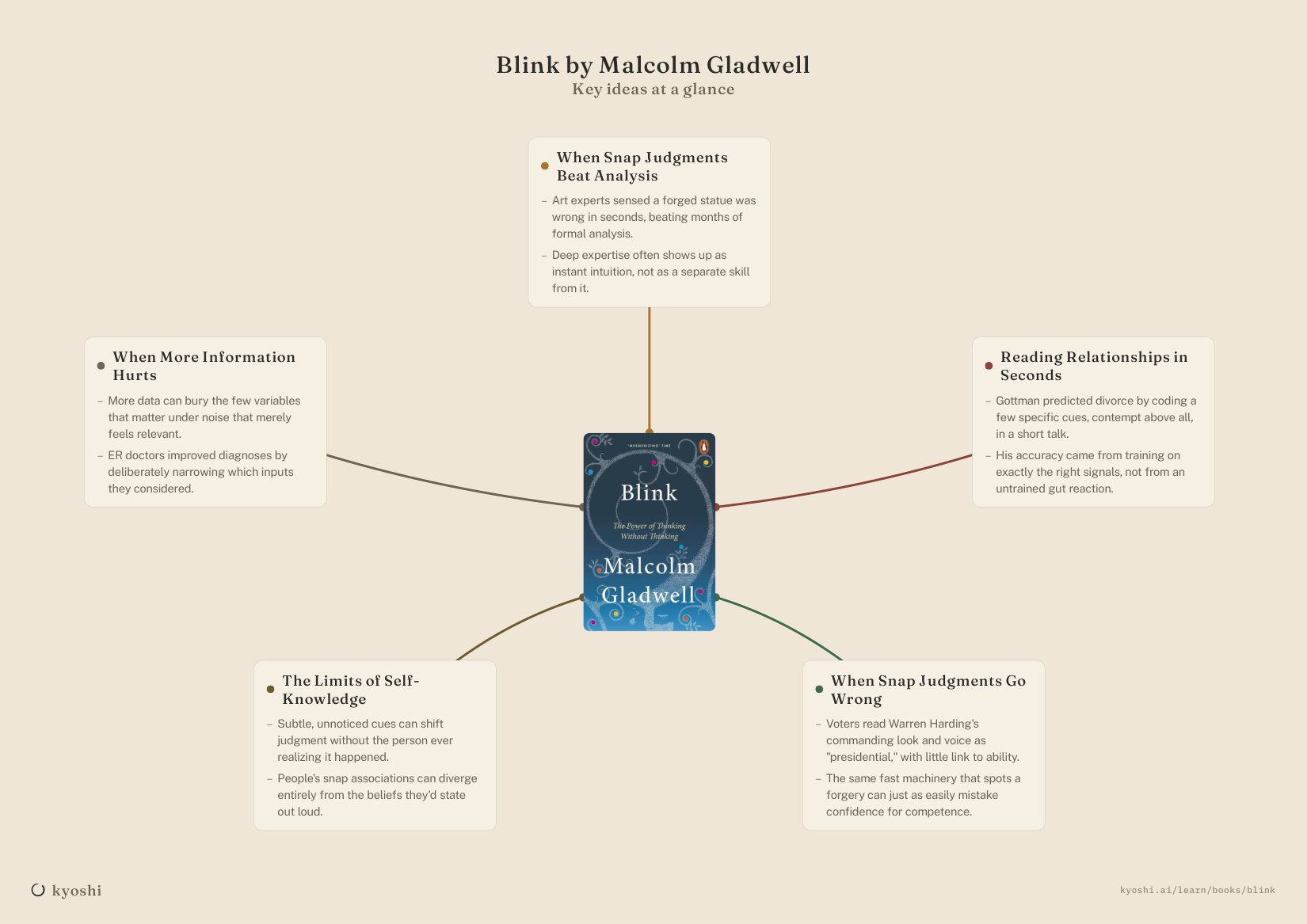
Malcolm Gladwell's dive into the two-second judgment: when snap decisions beat deliberate analysis, when they betray you without warning, and why you usually can't tell which is happening in the moment.
 Find this on the mind-map
Introduction
Gladwell's subject is "thin-slicing": the mind's ability to find patterns in situations based on very narrow windows of experience, often faster than conscious reasoning can even get started. The book's real tension isn't "trust your gut" versus "trust your analysis." It's that rapid cognition can be stunningly accurate or badly wrong, often using the exact same mechanism, and the book is an attempt to map when each happens.
When Snap Judgments Beat Analysis
Gladwell opens with art experts who, within seconds of seeing a statue now widely believed to be a forgery, felt something was off. That reaction, which they couldn't immediately justify, turned out to be more reliable than months of documentary and scientific analysis that had initially led the museum to authenticate the piece. The experts' trained unconscious had absorbed thousands of genuine pieces and recognized a mismatch their conscious reasoning hadn't caught up to yet. The lesson isn't that intuition beats expertise. It's that deep expertise often shows up as intuition, compressed into an instant.
Reading Relationships in Seconds
Psychologist John Gottman's research on marriage is Gladwell's clearest case for structured thin-slicing: by coding very specific emotional cues in a short conversation between partners, Gottman could predict with striking accuracy whether a couple would stay together. The key word is structured. Gottman wasn't guessing. He'd identified exactly which few signals mattered (contempt above all) and trained his pattern recognition on those, which is different from an untrained snap reaction to a stranger.
When Snap Judgments Go Wrong
Gladwell is equally interested in where thin-slicing fails, and the failures tend to share a cause: an unconscious bias doing the pattern-matching instead of real expertise. His account of the 1920 U.S. presidential election, which he calls the "Warren Harding error," argues that Harding's commanding appearance and voice led voters and party insiders to read "presidential" off physical presence alone, with little connection to his actual ability to govern. The same fast machinery that spots a forged statue can just as easily mistake confidence for competence.
Priming and the Limits of Self-Knowledge
Gladwell uses psychological priming research to make a related point: subtle, often unnoticed cues can shift behavior and judgment without the person being aware it happened, which means people are often poor narrators of their own decision-making. Implicit association research adds another layer. People can hold snap associations that don't match their stated, conscious beliefs at all, which complicates any simple story about "trusting your instincts," since the instinct itself may be running on information the person wouldn't endorse if asked directly.
Information Overload Can Hurt Snap Judgments
Gladwell argues that more information doesn't always make a snap judgment better. Sometimes it's actively worse, burying the few variables that actually matter under noise that feels relevant but isn't. The emergency room doctors who improved diagnostic accuracy by deliberately narrowing the inputs they considered are his case for this: expertise sometimes means knowing what to ignore, not what to add.
Putting It Together
The throughline isn't "trust your gut" or "distrust your gut." It's that rapid judgment is a real cognitive skill that can be trained, narrowed, and made more reliable (as with Gottman's structured observation or the art experts' years of exposure), or hijacked by bias and surface cues (as with Harding's appearance or unconscious priming). A manager reading Blink usefully isn't looking for permission to decide fast. They're looking for a way to tell, in a given moment, whether their fast reaction is trained pattern recognition or an untrained guess wearing its confidence.
Why It Matters for Leaders
Most managers think the risk of fast judgment is obvious: you'll decide too quickly and get it wrong. The real risk is subtler. You'll decide quickly, be right most of the time because you're experienced, and stop checking which kind of fast you're actually running on.
That difference matters because the two kinds of fast look identical from the inside. A trained read, built on hundreds of similar calls, feels exactly like a surface read built on confidence and polish. The only way to tell them apart is to ask what it's actually built on, not how certain it feels.
This shows up hardest in hiring and promotion. A candidate who presents well, speaks fluently, holds eye contact, sounds decisive, triggers the same fast "yes" in your head as a candidate whose actual track record you've seen play out for years. One of those reads is pattern recognition. The other is the Warren Harding error wearing a suit. If you can't point to the specific signals your gut is actually responding to, you don't yet know which one you're having.
The fix isn't to distrust every snap call. It's to build a short list, ahead of time, of the two or three things that actually predict success in a given decision, the way Gottman narrowed a marriage down to watching for contempt. Priya, a VP reviewing candidates for a senior role, used to trust whoever "felt like a strong leader" in the room. After a few bad hires who interviewed beautifully and then struggled on the job, she started writing down, before each interview, the two specific behaviors she was actually screening for. Her gut still fires fast. It's just firing on something real now, instead of on how the person carried themselves in the room.
What to do next
Reinforce your understanding of Blink
Books related to Blink

Clear Thinking
Shane Parrish's case that your biggest decisions aren't won by thinking harder in the moment. They're won or lost by the defaults you've already built long before the moment arrives.

Principles
Ray Dalio's attempt to turn decades of painful mistakes at Bridgewater into explicit, written rules, a bet that most bad decisions come from never writing down what you actually believe until you're forced to.

Same as Ever
Morgan Housel's case for studying what never changes about human behavior, risk, and decision-making, instead of exhausting yourself trying to predict what will, because the next crisis will look nothing like the last one, but it will be caused by the same handful of things that have always caused them.

Thinking, Fast and Slow
Daniel Kahneman's decades of research into the two systems running your mind, and why the fast, confident one is usually the one making your worst decisions, not your best ones.

Thinking in Bets
Former professional poker player Annie Duke's case that every decision is a bet made with incomplete information, and that judging decisions by their outcomes, the way almost everyone does, teaches exactly the wrong lessons.
Skills related to Blink

Frameworks related to Blink

Abilene Paradox
A team can agree to something nobody wants — not from pressure, but because everyone assumes they're the only doubter.

Cynefin Framework
Dave Snowden's model sorts problems into four domains — Clear, Complicated, Complex, Chaotic — by cause-effect clarity, then matches your response.
Occam's Razor
Among competing explanations, pick the one with fewest assumptions — in leadership, diagnose simply, build lean, and say what actually matters.

OODA Loop
John Boyd's four-stage decision cycle — Observe, Orient, Decide, Act — for fast, adaptive calls under pressure, run as a loop.

Probabilistic Thinking
Stop betting on one predicted future — assign real probabilities to outcomes, weigh them by impact, and let the math decide.
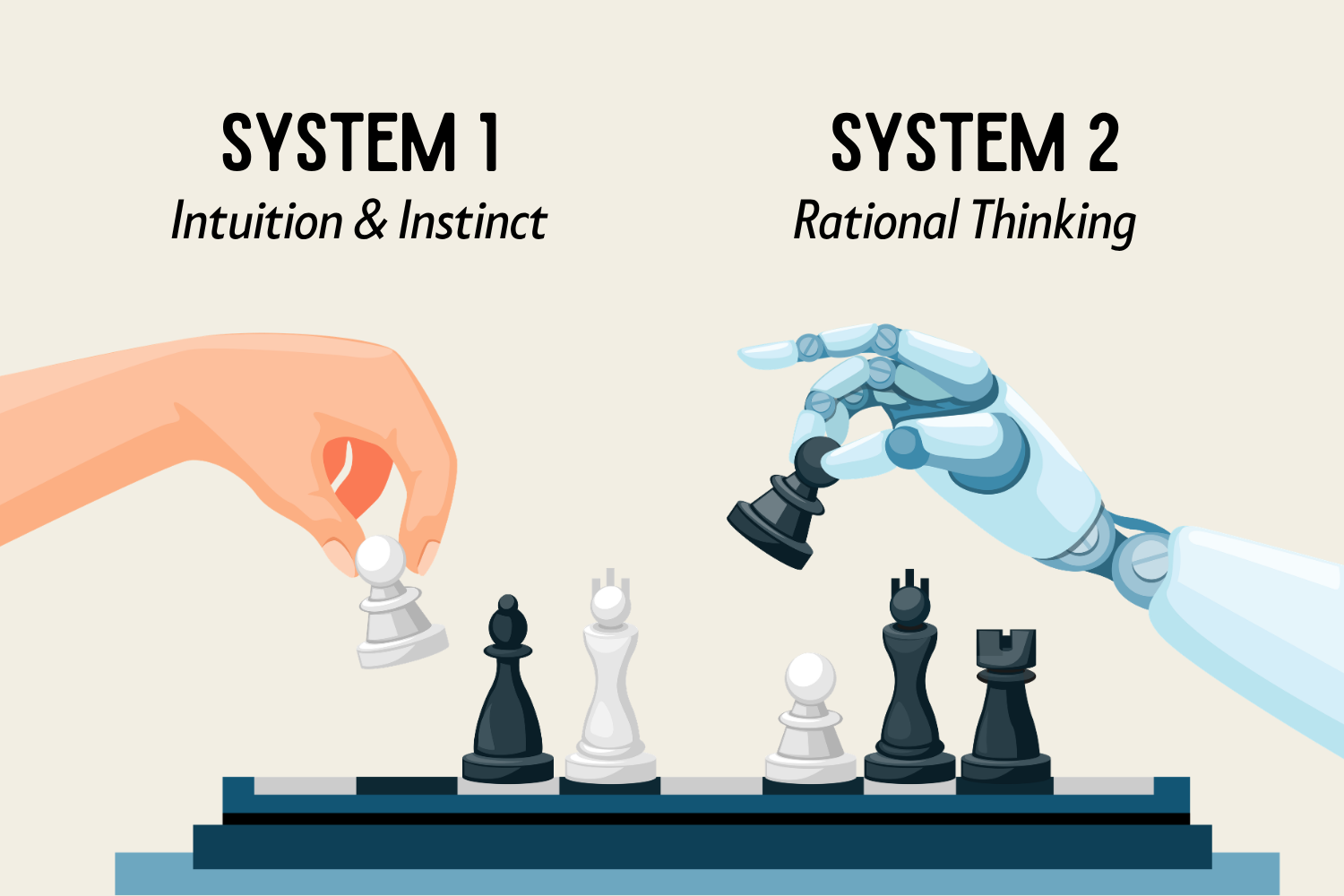
System 1 and System 2 Thinking
Your brain runs fast, gut-level System 1 and slow, deliberate System 2 — knowing which a moment needs is the skill.
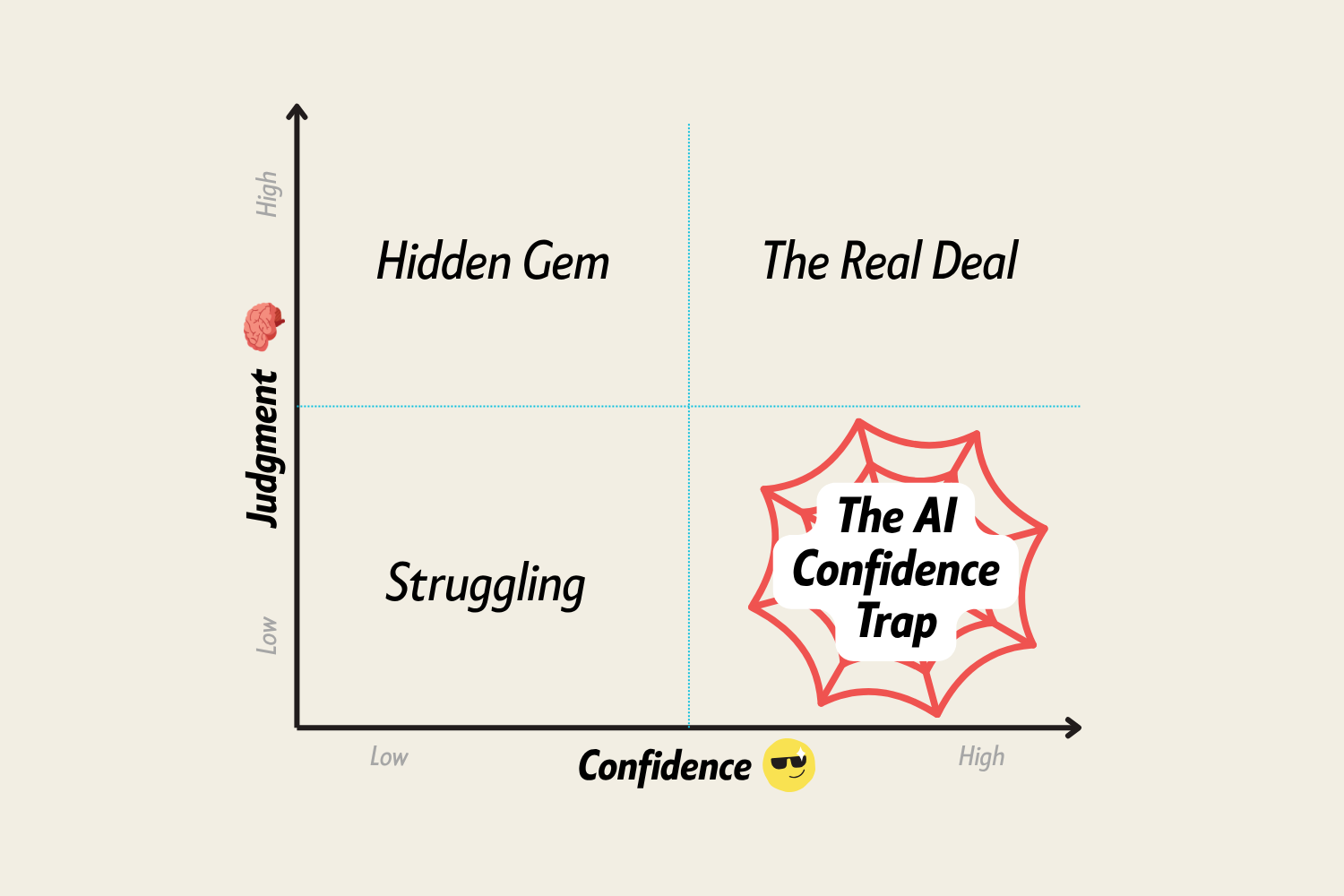
The AI Confidence Trap
AI-polished output can look like real competence when the thinking behind it isn't there — judge the reasoning, not the polish.