Clear Thinking
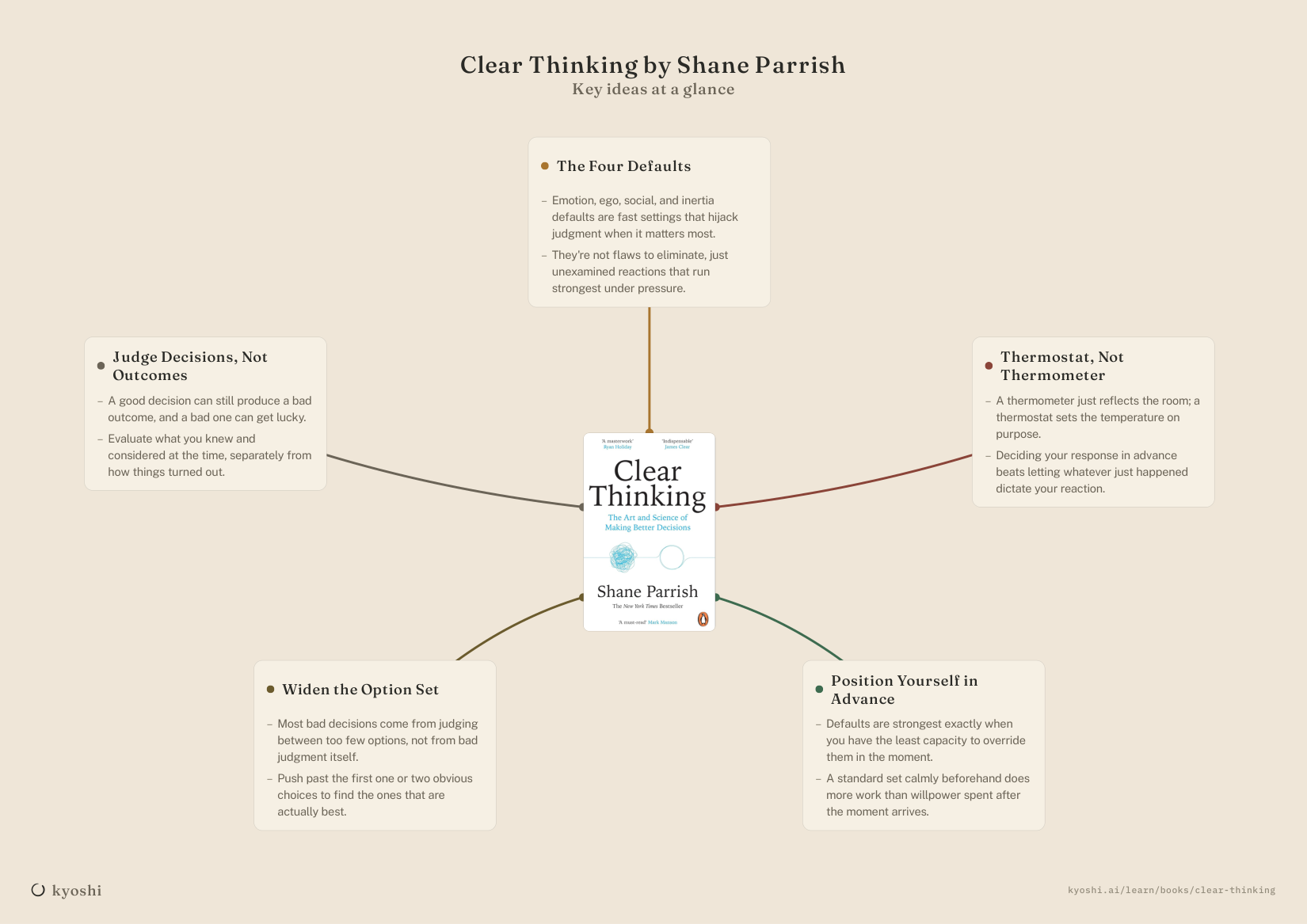
Shane Parrish's case that your biggest decisions aren't won by thinking harder in the moment. They're won or lost by the defaults you've already built long before the moment arrives.
 Find this on the mind-map
Introduction
Parrish's core claim is almost deflating at first: in the moments that matter most, most people aren't actually thinking at all. They're running on default behavior, automatic patterns that evolution and habit built for an earlier environment, and those defaults, left unmanaged, make the decision before any deliberate thought gets a vote. Clear thinking isn't about being smarter in the moment. It's about positioning yourself, in advance, so the moment doesn't ambush you.
The Four Defaults
Parrish names four automatic reactions that hijack good judgment: the emotion default (reacting to how you feel right now instead of what's actually true), the ego default (protecting your self-image instead of updating your view), the social default (going along with the group instead of thinking independently), and the inertia default (sticking with what's familiar instead of what's good). None of these are flaws to eliminate. They're fast, efficient settings that work most of the time. The problem is they run unexamined in exactly the moments that matter most: conflict, big decisions, pressure. Those are exactly the moments they're most likely to be wrong.
Thermostat, Not Thermometer
A thermometer just reflects the temperature of the room. A thermostat sets it. Most people, under pressure, behave like thermometers. Their mood and decisions are a direct readout of whatever just happened to them. Clear thinking means becoming a thermostat: deciding in advance what response you want to produce, regardless of what the room is doing to you in the moment. Manager A gets blindsided by a hostile email and fires back within the hour, matching its tone exactly; manager B gets the same email, waits, and responds from the standard they set for themselves rather than the one the email tried to set for them.
Position Yourself Before the Moment
Because defaults are strongest exactly when you have the least capacity to override them, the real leverage point is earlier: raising your personal standards, building habits, and designing your environment before the high-stakes moment ever shows up. A standard you set calmly in advance ("I don't make irreversible decisions angry") does far more work than willpower deployed in the heat of the moment, because by the time the moment arrives, willpower is usually already spent.
Widen the Option Set
Most bad decisions aren't really failures of judgment on a two-option choice. They're failures to generate a real third, fourth, or fifth option before judging between them. Parrish pushes toward deliberately asking "what else could I do here" past the first one or two obvious choices, because the default move is to evaluate whichever options show up first, not whichever options are actually best.
Judge Decisions, Not Outcomes
A good decision can produce a bad outcome, and a bad decision can get lucky. Parrish's standard is to evaluate the quality of the decision process at the time it was made: what you knew, what you considered, how you weighed it, separately from how it happened to turn out. Mixing the two teaches you the wrong lessons from both your wins and your losses.
Putting It Together
The Four Defaults explain why clear thinking fails in the moment. Becoming a thermostat and positioning yourself in advance are how you get ahead of them before they fire. Widening your options and judging decisions on process rather than outcome are what you do once you're actually at the decision point. That's what turns a default reaction into an actual choice.
Why It Matters for Leaders
Most leadership feedback about judgment arrives after the fact: you reacted badly, you should have handled that differently. Clear Thinking's real value is earlier than that. It gives you a way to name which default took over before you try to fix anything, instead of just resolving to "stay calmer next time" and hoping that works under pressure.
Here's the practical use: when a decision goes sideways, don't start by asking what you should have thought. Ask which default was running the show. Did you react to how you felt instead of what was true (emotion)? Were you protecting your own image instead of updating your view (ego)? Did you go along with the room instead of saying what you actually believed (social)? Did you stick with the familiar choice because it was familiar, not because it was good (inertia)? The diagnosis tells you what to actually fix. Telling an ego-driven manager to "slow down" misses the point; telling an inertia-driven one to "trust your gut" makes things worse.
The standards-in-advance idea matters most for the decisions you can see coming. If you know a tense 1:1 is on the calendar Thursday, or that a budget cut is going to land badly with your team, you already know roughly what kind of pressure you're about to be under. Decide now, calmly, what you're going to hold yourself to, not what outcome you want. "I won't make a staffing decision in the same meeting I hear the bad news" is a standard you can actually keep. "I'll handle this well" isn't, because by the time the moment arrives, you've already spent whatever willpower you had.
Picture a manager named Darius who gets a sharp message from a client an hour before a board update. His first draft of a reply matches the client's tone almost exactly: short, defensive, done in four minutes. He doesn't send it. He'd set a standard two months earlier, after a similar blowup: anything written in anger waits two hours before it goes out. He rereads it at the two-hour mark, rewrites it in five calmer sentences, and sends that instead. The client relationship survives. Nothing about Darius changed in that hour. The standard he'd already built did the work the moment couldn't.
What to do next
Reinforce your understanding of Clear Thinking
Books related to Clear Thinking

Blink
Malcolm Gladwell's dive into the two-second judgment: when snap decisions beat deliberate analysis, when they betray you without warning, and why you usually can't tell which is happening in the moment.

Principles
Ray Dalio's attempt to turn decades of painful mistakes at Bridgewater into explicit, written rules, a bet that most bad decisions come from never writing down what you actually believe until you're forced to.

Same as Ever
Morgan Housel's case for studying what never changes about human behavior, risk, and decision-making, instead of exhausting yourself trying to predict what will, because the next crisis will look nothing like the last one, but it will be caused by the same handful of things that have always caused them.

Thinking, Fast and Slow
Daniel Kahneman's decades of research into the two systems running your mind, and why the fast, confident one is usually the one making your worst decisions, not your best ones.

Thinking in Bets
Former professional poker player Annie Duke's case that every decision is a bet made with incomplete information, and that judging decisions by their outcomes, the way almost everyone does, teaches exactly the wrong lessons.
Skills related to Clear Thinking

Frameworks related to Clear Thinking

Abilene Paradox
A team can agree to something nobody wants — not from pressure, but because everyone assumes they're the only doubter.

Cynefin Framework
Dave Snowden's model sorts problems into four domains — Clear, Complicated, Complex, Chaotic — by cause-effect clarity, then matches your response.
Occam's Razor
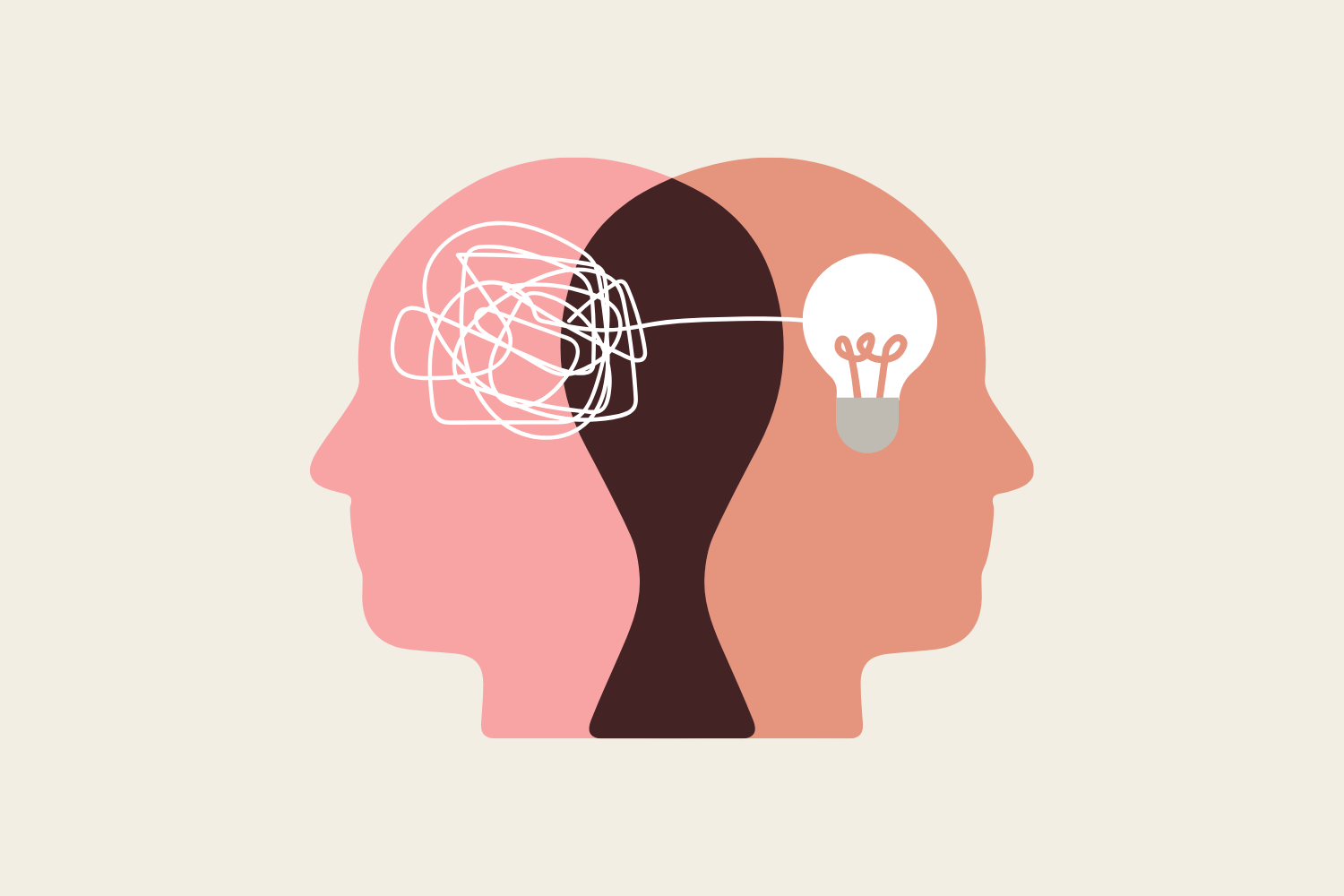
Among competing explanations, pick the one with fewest assumptions — in leadership, diagnose simply, build lean, and say what actually matters.

OODA Loop
John Boyd's four-stage decision cycle — Observe, Orient, Decide, Act — for fast, adaptive calls under pressure, run as a loop.

Probabilistic Thinking
Stop betting on one predicted future — assign real probabilities to outcomes, weigh them by impact, and let the math decide.
System 1 and System 2 Thinking
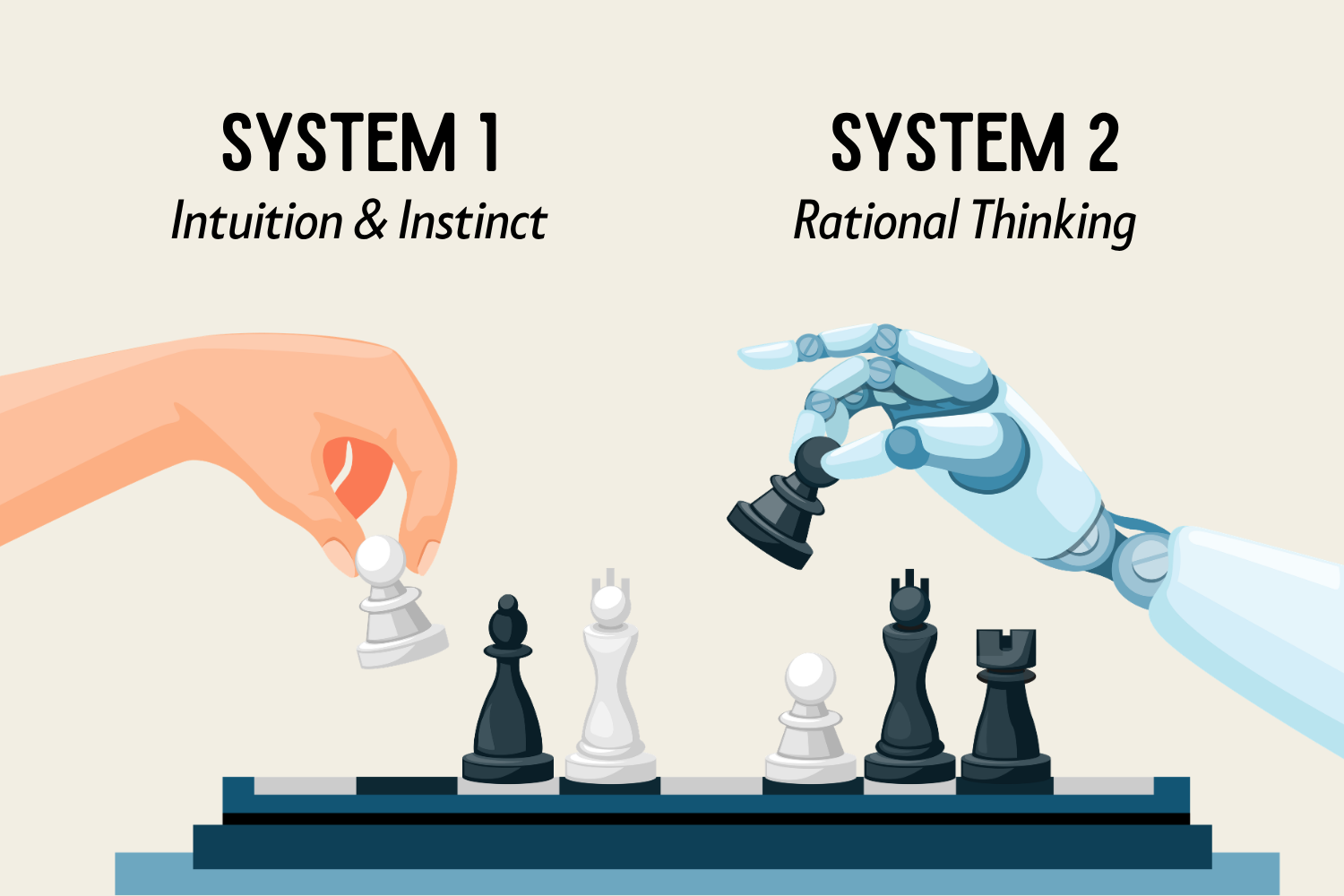
Your brain runs fast, gut-level System 1 and slow, deliberate System 2 — knowing which a moment needs is the skill.
The AI Confidence Trap
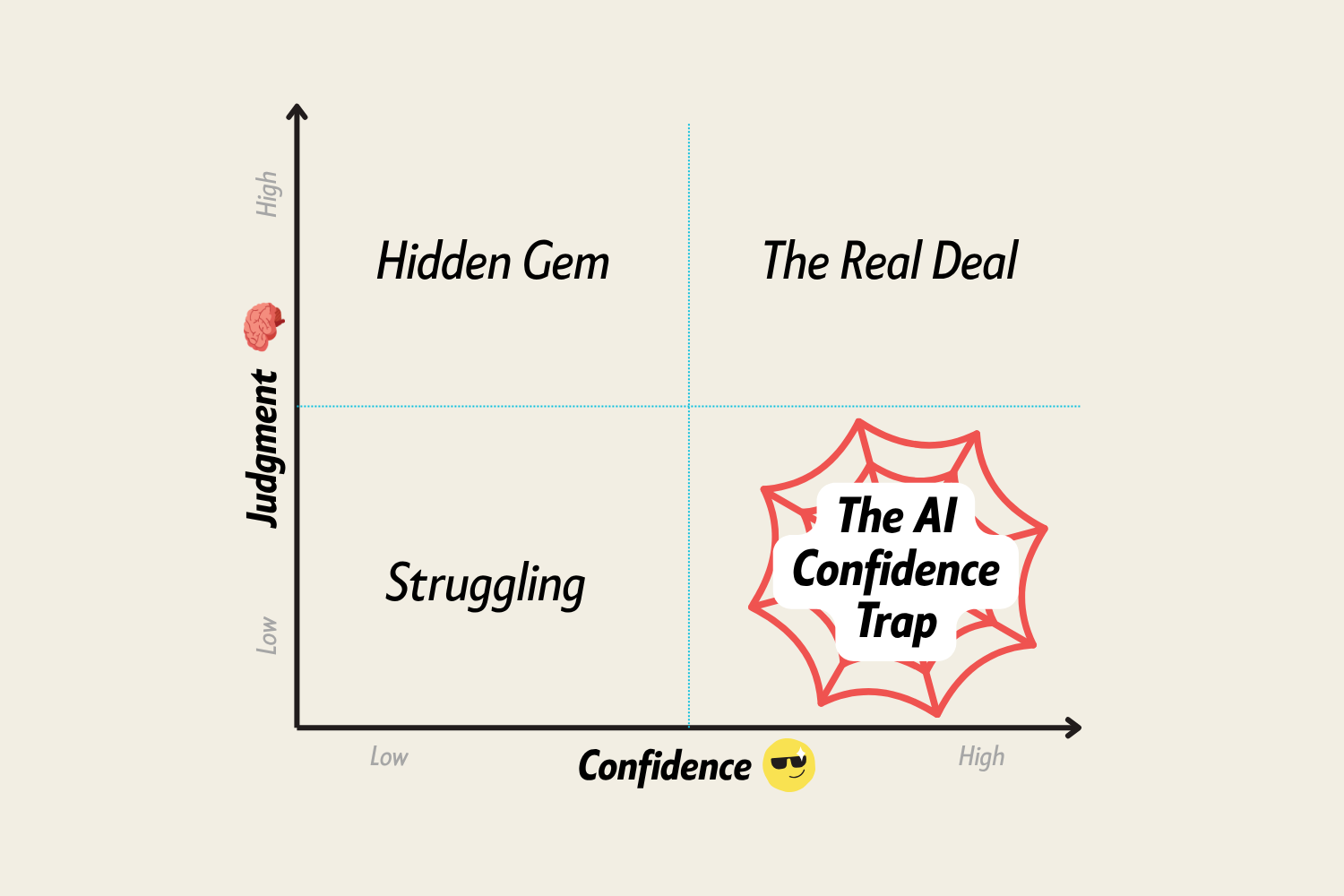
AI-polished output can look like real competence when the thinking behind it isn't there — judge the reasoning, not the polish.