Probabilistic Thinking
Stop betting on one predicted future — assign real probabilities to outcomes, weigh them by impact, and let the math decide.
 Find this on the mind-map
Introduction
The roots of this go back to the 17th century, when mathematicians Blaise Pascal and Pierre de Fermat worked out the foundations of probability theory while solving gambling problems. Jacob Bernoulli later extended that work into something more general: a way of reasoning about uncertainty using likelihoods instead of guesses. That same core idea — swap out one predicted outcome for a distribution of possible outcomes — is exactly what you need when a decision doesn't have a guaranteed answer.
How It Works
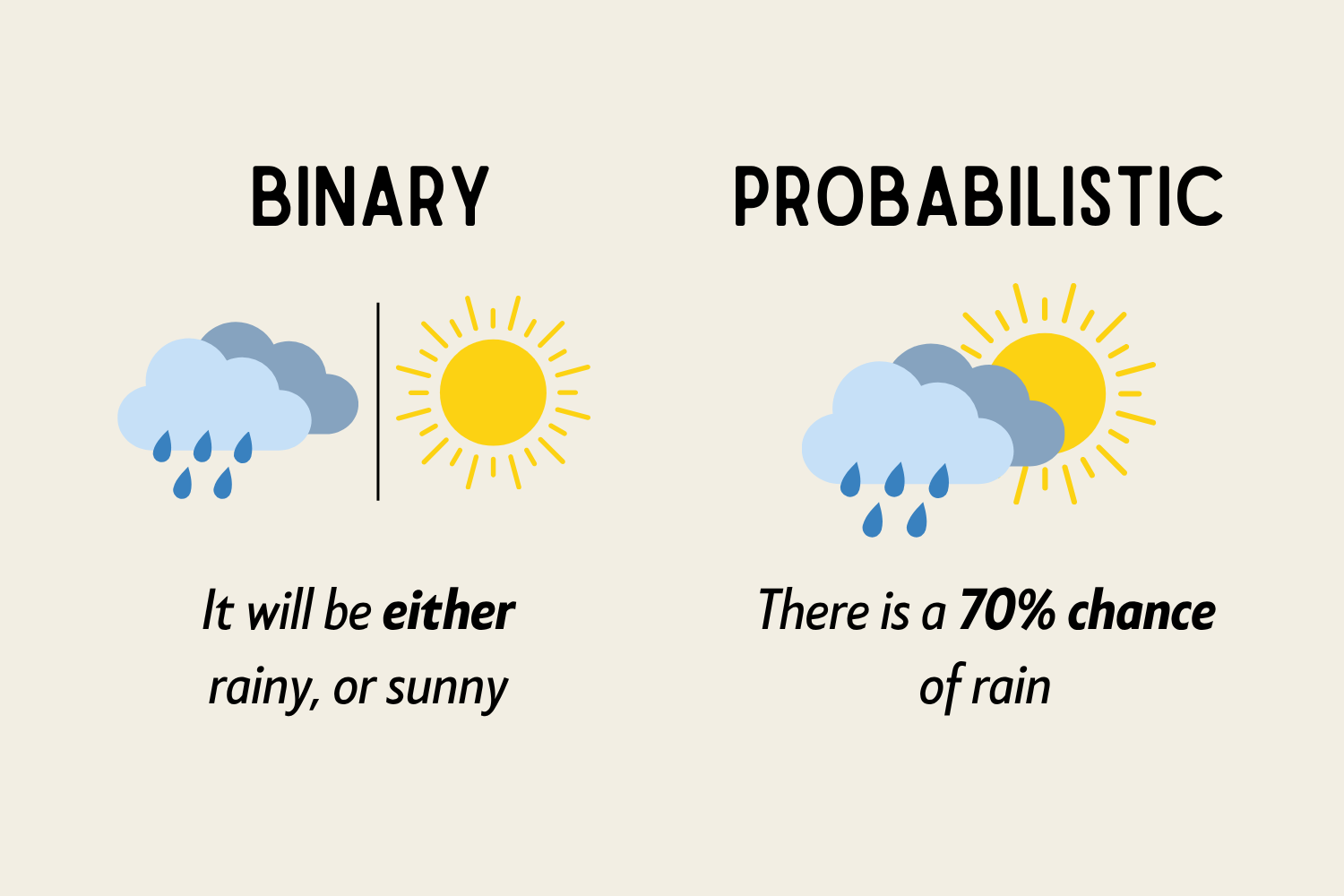
Here's the difference in a sentence. A deterministic thinker says: "Our product will succeed." A probabilistic thinker says: "There's a 70% chance of success, a 20% chance of moderate performance, and a 10% chance of failure."
You can run this in four steps.
| Step | What it involves |
|---|---|
| 1. Recognize uncertainty | Accept that no decision has a guaranteed outcome. Identify the range of possible results and what influences each one. |
| 2. Assign probabilities | Estimate the likelihood of success, moderate success, and failure using whatever data you actually have. |
| 3. Calculate expected value | Weigh the upside and downside by their probabilities. |
| 4. Update as data arrives | Revise your probabilities as customer feedback, market trends, and test results come in. This is Bayesian thinking. |
The expected value formula:
EV = (Probability of success × reward) + (Probability of moderate success × reward) + (Probability of failure × loss)
Here's a worked example. Say you're looking at a software launch where 50% of comparable products earn $5M, 30% earn $2M, and 20% lose $1M. EV = (0.50 × 5M) + (0.30 × 2M) + (0.20 × -1M) = $2.9M. Positive expected value — worth funding, even with a real chance of failure baked in.
The same arithmetic can flip a decision entirely once the downside changes. Take a leadership hire with a 60% chance of adding $500K, a 30% chance of adding $200K, and a 10% chance of costing $100K. That's an EV of $350K — a strong hire, on paper. Now make the role critical enough that a bad hire would cost $4M instead of $100K, and the EV drops to -$40K. Same candidate, same odds. The only thing that moved was the size of the downside — and that alone should change your decision.
Why It Matters for Leaders
Most people think in binary terms: this will work, or it won't. That framing hides two things you actually need to see — the real range of ways a decision can land, and how much of the outcome depends on the size of the downside rather than the odds of failure.
It also does something else useful: it separates the quality of a decision from the quality of its outcome. A sound decision can still fail through bad luck, and a careless one can still succeed through good luck. Judge your team purely on results and you'll train them to get lucky instead of getting rigorous.
The hiring example above shows the real payoff. Both versions of that decision look identical if you're thinking deterministically — same candidate, same track record. Only expected value exposes that one version is a good bet and the other isn't. Changing the probability or outcome inputs can flip the decision entirely, which means the numbers themselves deserve as much scrutiny as the arithmetic you do with them.
The same lens turns a vague worry into a number you can actually act on. Say you've got a single-supplier dependency: a 40% chance of no disruption, a 40% chance of $2M in delays, and a 20% chance of a $5M failure. That's an expected loss of $1.8M — which turns "we should probably diversify our suppliers" into an actual budget for doing something about it.
Poker players, hedge fund managers, and military strategists all think this way as a matter of routine, not because it hands them certainty — it doesn't — but because it hands them control over how a choice gets evaluated, and how fast their view updates once conditions change.
What to do next
Test your knowledge of Probabilistic Thinking
Practice Probabilistic Thinking
Apply Probabilistic Thinking to a real situation
Skills related to Probabilistic Thinking

Frameworks related to Probabilistic Thinking

Abilene Paradox
A team can agree to something nobody wants — not from pressure, but because everyone assumes they're the only doubter.

Cynefin Framework
Dave Snowden's model sorts problems into four domains — Clear, Complicated, Complex, Chaotic — by cause-effect clarity, then matches your response.
Occam's Razor
Among competing explanations, pick the one with fewest assumptions — in leadership, diagnose simply, build lean, and say what actually matters.

OODA Loop
John Boyd's four-stage decision cycle — Observe, Orient, Decide, Act — for fast, adaptive calls under pressure, run as a loop.
System 1 and System 2 Thinking
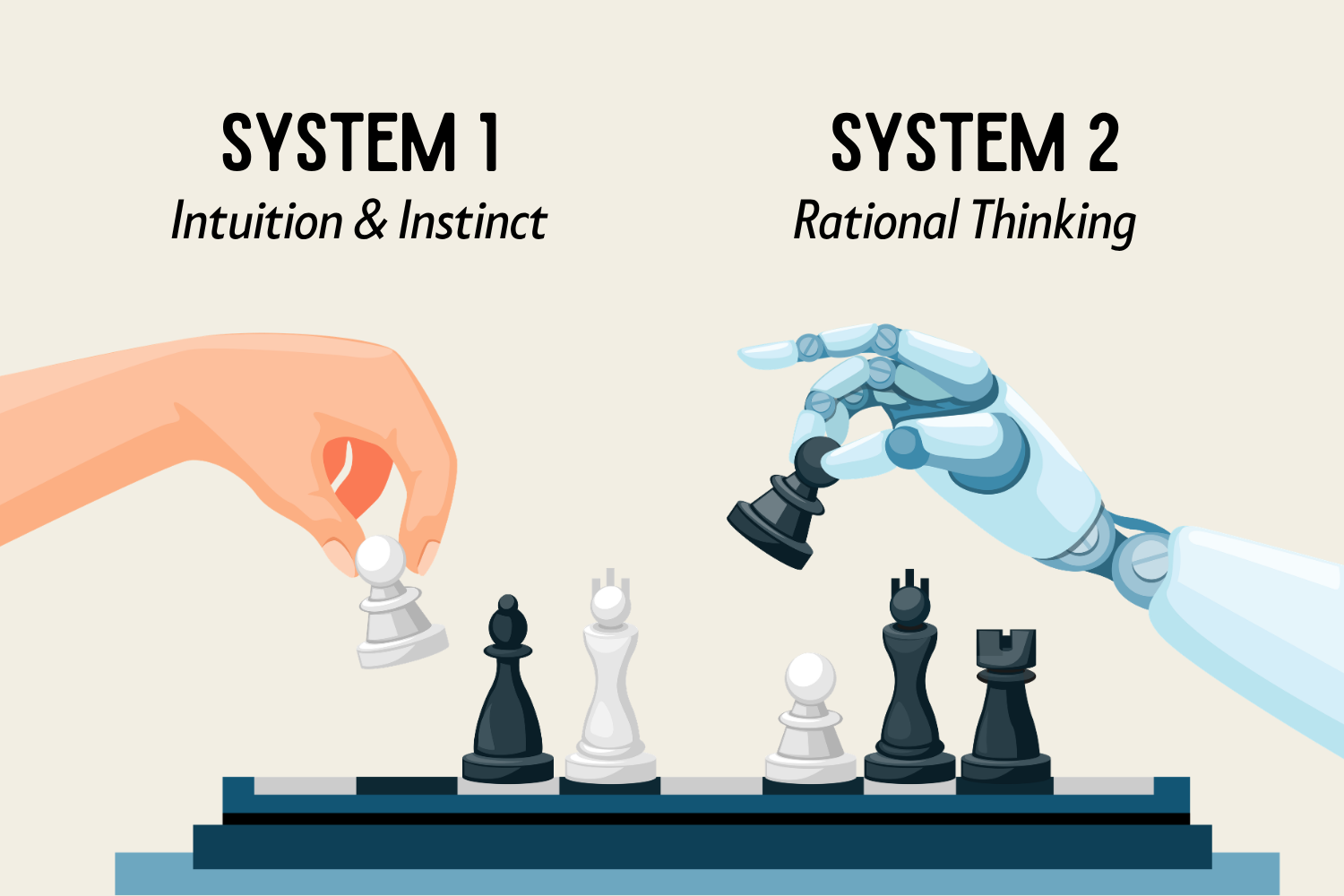
Your brain runs fast, gut-level System 1 and slow, deliberate System 2 — knowing which a moment needs is the skill.
The AI Confidence Trap
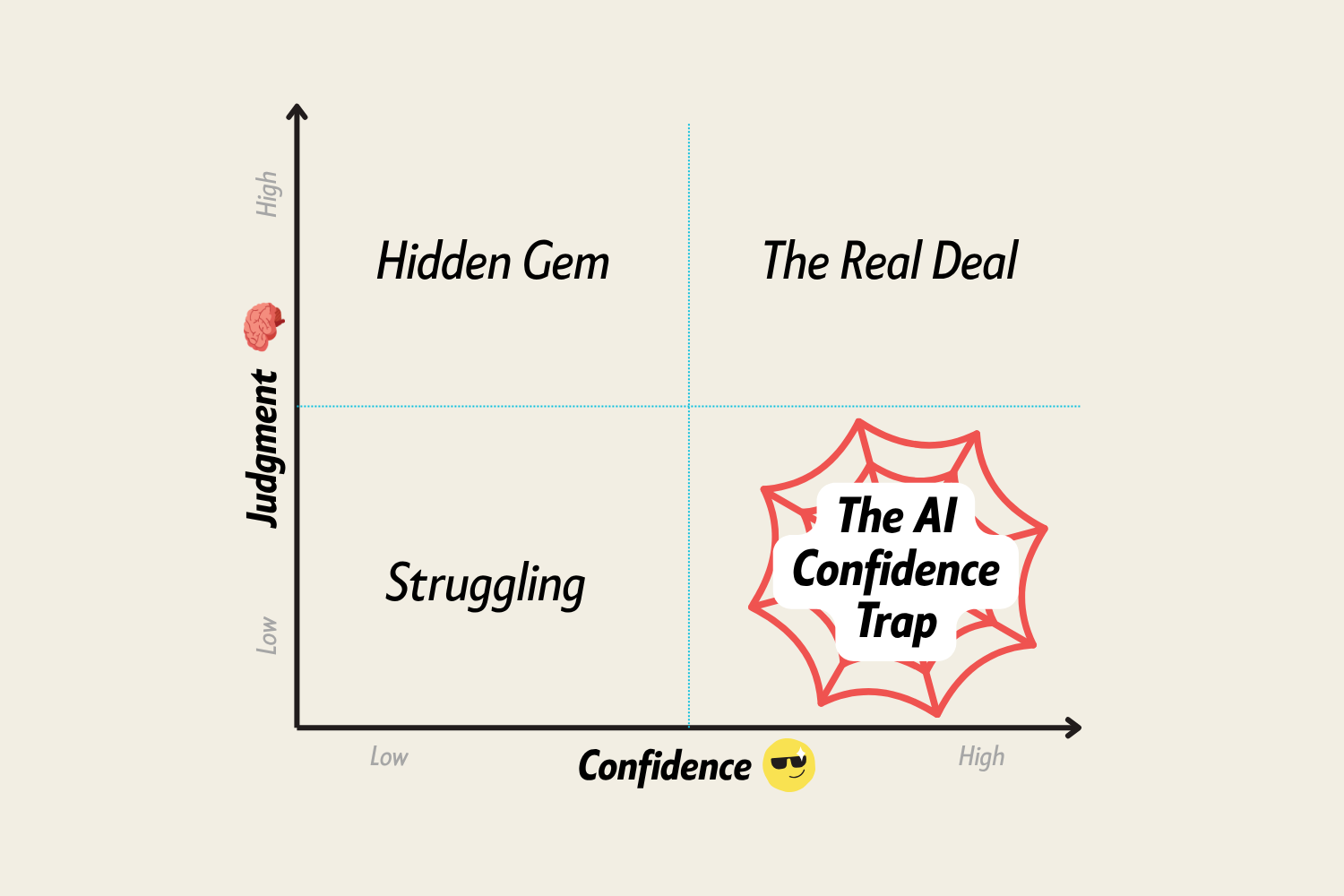
AI-polished output can look like real competence when the thinking behind it isn't there — judge the reasoning, not the polish.
Books related to Probabilistic Thinking

Blink
Malcolm Gladwell's dive into the two-second judgment: when snap decisions beat deliberate analysis, when they betray you without warning, and why you usually can't tell which is happening in the moment.

Clear Thinking
Shane Parrish's case that your biggest decisions aren't won by thinking harder in the moment. They're won or lost by the defaults you've already built long before the moment arrives.

Principles
Ray Dalio's attempt to turn decades of painful mistakes at Bridgewater into explicit, written rules, a bet that most bad decisions come from never writing down what you actually believe until you're forced to.

Same as Ever
Morgan Housel's case for studying what never changes about human behavior, risk, and decision-making, instead of exhausting yourself trying to predict what will, because the next crisis will look nothing like the last one, but it will be caused by the same handful of things that have always caused them.

Thinking, Fast and Slow
Daniel Kahneman's decades of research into the two systems running your mind, and why the fast, confident one is usually the one making your worst decisions, not your best ones.

Thinking in Bets
Former professional poker player Annie Duke's case that every decision is a bet made with incomplete information, and that judging decisions by their outcomes, the way almost everyone does, teaches exactly the wrong lessons.